How to Add Weight to a Pickleball Paddle: Placement Guide
If your paddle twists on blocks, feels late in kitchen hand battles, or makes you work too hard for depth, added weight can help. But the useful question is not simply should you add tungsten, lead tape, or pre-cut paddle weights. It is where to put the weight so it fixes the problem you actually have without creating a more expensive one somewhere else.
I love gear tweaks that show up on the court, not just on a scale. A few grams in the right place can make a paddle feel calmer, steadier, and easier to trust. Put those same grams in the wrong place and it can feel like you brought a frying pan to a hand fight.
Placement is the upgrade. Total weight matters, but where those grams sit determines whether you mostly change stability, swing weight, balance, or some combination of the three.
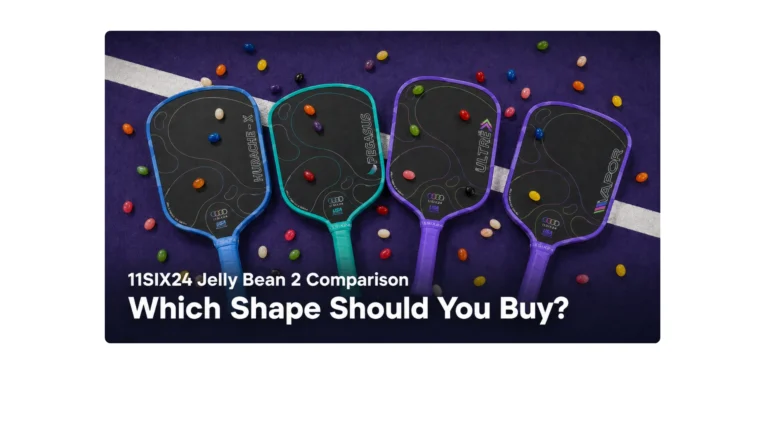
I learned that the expensive way on my Hurache-X Power 2 test paddle. Loading 12, 3, and 9 made the drives ridiculous, but I gave away more hand speed than the extra power was worth. Moving more of the added mass lower kept more of the solidity without charging the same hand-speed bill.
🎧 Prefer listening? Coach AJ walks through the main ideas from Coach Sid’s paddle-weight guide:
Where Should You Put Weight First?
If your paddle twists or feels punishing on off-center blocks, 3 and 9 o’clock is usually the cleanest first stability test. Start small, test the stock paddle first, and do not use that recommendation automatically when the paddle already feels stable, head heavy, or slow.
- Paddle twists or flutters? Test 3 and 9 o’clock.
- Stable but needs more plow-through or drive weight? Test a small amount at 10 and 2 o’clock.
- Want more stability with less swing-weight penalty? Test 4 and 8 or 5 and 7 o’clock.
- Need the largest change in head leverage? 12 o’clock does it, but it also sends the biggest hand-speed bill.
- Paddle already feels nose heavy? Look at handle or butt-cap weight before putting more mass near the top.
- Paddle already feels stable but sluggish? Do not add weight just because a chart says you can. Remove weight, move it lower, or leave the paddle stock.
Pickleball Paddle Weight Placement Chart
| If Your Paddle Feels Like This | First Placement to Test | Conservative First Test | What It Mainly Changes | Main Tradeoff |
|---|---|---|---|---|
| Twists on blocks, counters, or mishits | 3 and 9 o’clock | 1 to 2g per side | Twist resistance, off-center stability, effective sweet spot | Some added swing weight and total mass |
| Stable but lacks depth or plow-through | 10 and 2 o’clock | 1 to 2g per side | Swing weight, leverage, heavier contact | Slower reloads and hand speed |
| Needs more head leverage | 12 o’clock | 1 to 2g total | Largest swing-weight change per gram | Largest maneuverability penalty |
| Needs a calmer lower face without much tip drag | 4 and 8 or 5 and 7 | 1 to 2g per side | Lower-face stability with a smaller swing-weight increase | Less free leverage than upper weighting |
| Feels head heavy or stubborn | Handle or butt cap | Small measured amount | Balance and hand-side mass | Adds total weight without directly stabilizing the paddle face |
| Already stable but sluggish | Remove weight, move it lower, or leave stock | No automatic addition | Preserves hand speed and timing | You may give up some plow-through |
Those are starting tests, not recipes. A three-gram change on a light, low-swingweight widebody does not feel the same as three grams on an already head-heavy elongated power paddle.
Static Weight, Swing Weight, Twist Weight, and Balance Are Not the Same Thing
Once these four terms click, the clock-face stuff gets a lot less mysterious.
| Term | What It Tells You | Why Placement Matters |
|---|---|---|
| Static weight | How much the entire paddle weighs on a scale | Five grams is five grams no matter where you stick it |
| Swing weight | How resistant the paddle is to being accelerated and rotated through the swing | The farther weight sits from your hand, the larger its effect |
| Twist weight / twist resistance | How strongly the paddle resists rotating sideways on off-center contact | Weight spread toward the side edges helps more than weight near the centerline |
| Balance | Where the paddle’s mass feels concentrated between the handle and head | Handle weight and tip weight can produce very different feel at the same total weight |
This is why two paddles that both weigh 8.3 ounces can feel completely different.
Put several grams near the butt cap and most of that mass stays close to your hand. Put the same grams at 12 o’clock and you give those grams much more leverage against your wrist and arm.
Spread weight out toward 3 and 9 and you also make the paddle more resistant to sideways twisting when you miss the center.
The scale tells you how much weight you added. Placement tells you what you did with it.
Coach Sid’s Paddle Tuning Rule: Name the Miss Before You Add Weight
Most players do this backwards. They see someone on YouTube load the top corners, copy the setup, and then wonder why their hands feel late during firefights. That is not tuning. That is guessing with adhesive.
When I look at a paddle setup from a coaching view, I start with the miss:
- If the paddle twists: test more side-to-side stability.
- If clean drives require too much effort: test a little more plow-through, but only after contact and swing path look sound.
- If your hands are late: you may already have too much swing weight, too much total mass, or too much weight high on the frame.
- If resets pop up: the paddle may be unstable, too lively, poorly balanced—or the player may be arriving with a tight grip or poor contact.
- If the paddle already feels head heavy: more tip weight is usually the wrong first move.
Name the miss before you name the placement.
When Weight Is Not the Fix
Tape will not repair late preparation, poor footwork, a grip that is too tight, inconsistent contact, or attacking the wrong ball. If the paddle behaves during controlled drills but falls apart only when your feet stop moving, tune the player before you tune the paddle.
Some paddles also do not need help. If the stock setup already gives you stability, timing, comfort, and enough depth, the smartest adjustment may be leaving it alone. I tested the Joola Perseus Pro 4 16mm stock with only an overgrip because its starting balance already gave me the mix of power and manageability I wanted. Not every review ends with tape on the edge guard. Customization is a tool, not a requirement.
Where to Add Weight on a Pickleball Paddle
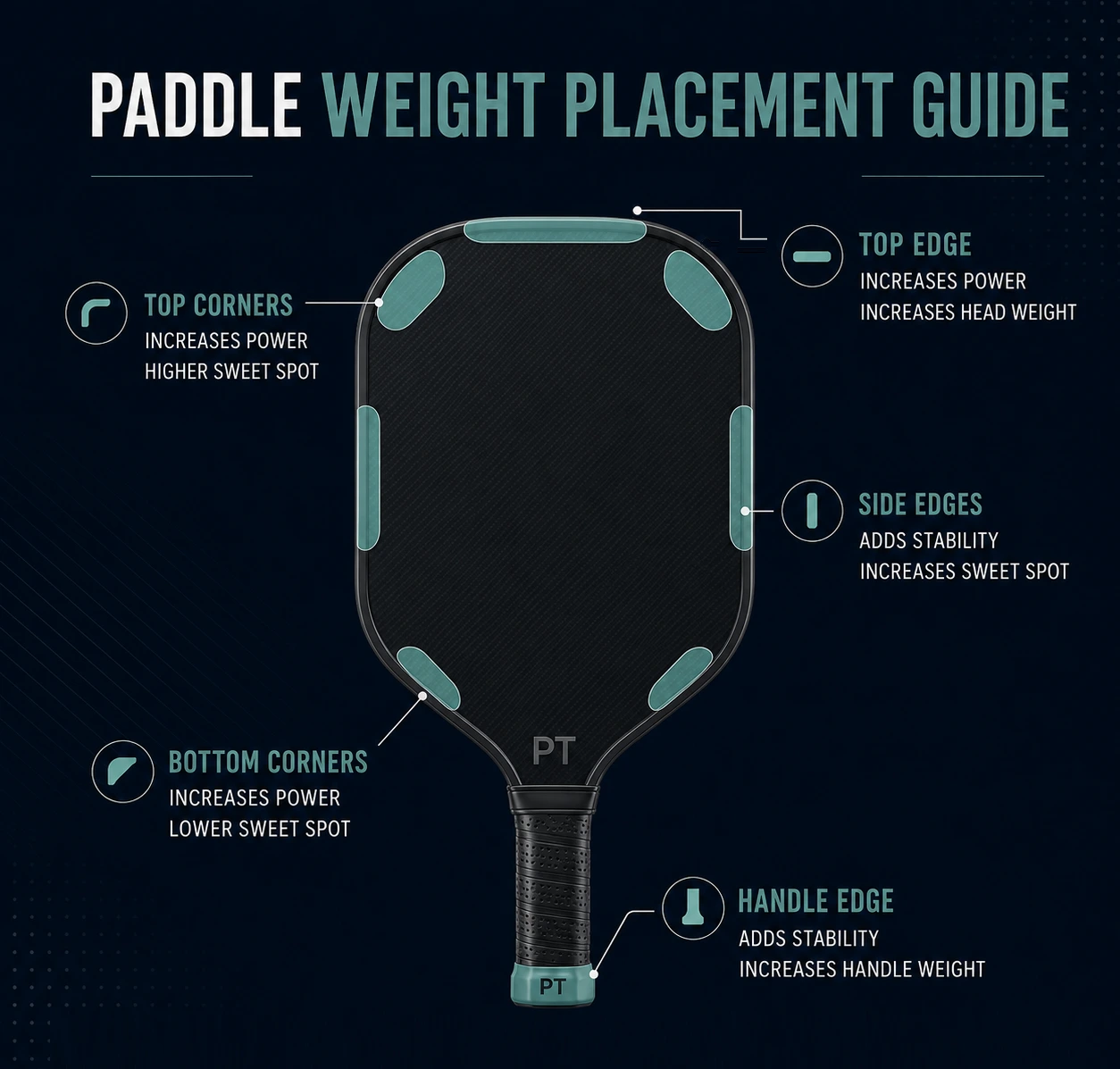
The clock-face method is the easiest way to describe placement. Picture the top of the paddle as 12 o’clock, the widest side edges around 3 and 9, and the lower corners or throat area around 4 and 8 or 5 and 7.
3 and 9 O’clock: Twist Resistance and a More Forgiving Face
Side weighting is mainly a stability move. Moving mass toward both side edges makes the paddle harder to rotate sideways when the ball strikes away from the centerline.
The first improvement often shows up on defense, not offense. Blocks feel cleaner, counters flutter less, and reaction volleys stop leaking wide as often. The paddle face has not physically grown, but the effective sweet spot can feel larger because off-center contact becomes less punishing.
If pace bullies your paddle or the face wants to twist sideways on imperfect contact, this is usually the first area I test. If the face stays square but the ball still pops up, check the blocking mechanics before blaming the paddle.
Best fit: blockers, counterpunchers, players whose face twists on mishits, and anyone who likes the paddle’s basic personality but wants fewer expensive misses.
I saw that on the Franklin C45: perimeter weight calmed harder off-center contact without taking away the paddle’s quick hands.
When I do not start at 3 and 9: if the paddle already blocks cleanly, counters on time, and rarely twists, more side stability may not be the missing piece. A player who needs more depth on clean drives may learn more from a small 10-and-2 test, while a fast-hands doubles player may be better served by lower-side weight or handle-side balance.
10 and 2 O’clock: Plow-Through With a Hand-Speed Bill
Weight at 10 and 2 sits farther from your hand than side weight placed lower on the frame. It therefore creates a larger swing-weight change and can also contribute some stability because the mass is still spread toward the corners.
When it works, you feel it in the ball: easier depth on drives, heavier counters, and more authority on putaways.
The bill arrives during fast exchanges. The same setup that makes the ball leave heavier can make the paddle reload later when speedups start flying.
Tip weight is like hot sauce. A little can wake things up. Too much ruins the meal.
Best fit: players who already trust the paddle’s stability and clearly need more leverage, depth, or finishing weight.
My Avoura Rhapsody 13 was the opposite kind of lesson. Tungsten at 10 and 2 added useful power and stability without costing the quick hands I liked about the paddle. Same placement idea, different starting paddle, very different bill.
12 O’clock: The Biggest Swing-Weight Change
Weight at 12 sits farthest from the hand along the length of the paddle. That makes it the most aggressive place to increase head leverage and swing weight with a small amount of mass.
It can help a paddle drive through the ball, but it can also make the head feel stubborn, delay reloads, and make kitchen defense more demanding.
I rarely make 12 o’clock the first test for recreational doubles players. If you already feel late during hand battles, top-edge weight usually makes the problem louder.
4 and 8 or 5 and 7: Stability With Less Tip Drag
This is one of my favorite areas for a player who wants a more solid paddle without turning it into a skillet.
You are still adding mass toward both sides of the paddle, but the weight sits closer to your hand than an upper-corner setup. That usually means a smaller swing-weight penalty while still helping calm lower-face contact.
It does not create the same obvious “wow” leverage as upper weighting. That is part of the appeal. For a reset-heavy doubles player, a paddle that becomes quieter and more predictable can be more useful than one that suddenly hits harder.
Best fit: kitchen-first doubles players, quick reloaders, reset-heavy players, and players who want stability without much additional tip leverage.
Handle or Butt-Cap Weight: Change the Balance
Handle weight is doing a different job entirely.
It still increases the paddle’s total mass, but because that mass sits close to your hand, it has a much smaller effect on swing weight than putting the same grams near the head. It can move the balance sensation closer to the hand and make a nose-heavy setup feel more planted or neutral.
What it does not do is provide the same direct face-stability benefit as putting mass along the side edges.
That distinction matters: a paddle can feel better balanced without actually becoming lighter or dramatically more resistant to twisting.
Read next: Butt Cap Weight: Understanding Handle-Side Balancing and What It Actually Changes
Every placement has a bill attached to it. The best setup improves the shot you care about without quietly stealing from the shots you need under pressure.
How Much Weight Should You Add to a Pickleball Paddle?
Start smaller than your gear brain wants to.
I prefer a conservative first test of roughly 2 to 4 grams total on paddles that already have some mass or swing weight. On lighter or clearly unstable paddles, 4 to 6 grams total may still be a reasonable early test.
The important part is not treating either range as a prescription. Starting paddle weight, balance, shape, swing weight, player strength, timing, and sensitivity all change how noticeable those grams become.
| Total Added Weight | What You May Notice | How I Treat It |
|---|---|---|
| 1 to 2 grams total | Small change, especially high on the frame | Useful for sensitive players or high-swingweight paddles |
| 2 to 4 grams total | Noticeable change in balance, stability, or leverage | Conservative first test for many paddles |
| 4 to 6 grams total | Clear change in paddle personality | Reasonable when the stock paddle is light or clearly unstable |
| 6 to 10 grams total | Large change in timing and balance | Test deliberately and watch counters, resets, fatigue, and comfort |
| More than 10 grams | You are substantially rebuilding the setup | Only go here when you know what each placement is solving |
Change one variable at a time. Adjust the amount or adjust the placement. Do not change both during the same test if you want to know what actually helped.
If your forearm gets tired sooner, your hands feel late, or your resets start popping up like microwave popcorn, back off and retest.
Good setups usually whisper before they shout. You feel a little more trust, a cleaner block, or a little more weight through the ball. If the first thing you notice is how dramatically different the paddle feels, there is a decent chance you overcooked it.
Starting Setups I’d Actually Test
- Conservative stability test: 1 to 2 grams per side at 3 and 9.
- More aggressive stability test: 2 to 3 grams per side at 3 and 9 on a light, clearly unstable paddle.
- Power/leverage test: 1 to 2 grams per side at 10 and 2 when the paddle is already stable.
- Low-drag stability test: 1 to 2 grams per side at 4 and 8 or 5 and 7.
- Tip test: about 1 to 2 grams total at 12 before making a bigger commitment.
- Balanced setup: side weight plus a small measured amount in the handle when the face needs stability but the completed setup feels nose heavy.
Test the Stock Paddle Before You Tune It
Do not start with tape. Start with evidence.
I compare the stock paddle against one change at a time using blocks, counters, drives, resets, and a hands drill. I am not looking for the setup that feels most dramatic. I am looking for the setup that improves one weakness without creating another.
That is the same court-first principle behind the PickleTip paddle testing method: measurements help explain the paddle, but pressure decides whether the change is useful.
| Test | What to Record | What the Result May Suggest |
|---|---|---|
| 10 blocks against pace | Twists, flutter, pop-ups, clean contacts | Repeated sideways twisting may justify a side-weight test |
| 10 counters | Late contacts, wide misses, clean contact | Late hands may mean the paddle already swings heavy or the added weight sits too high |
| 10 drives | Depth, effort, launch, control | Clean but weak drives may benefit from leverage; long misses probably do not |
| 10 resets | How many sit down versus pop up | Unstable lower-face contact may respond to lower-side weight, but grip pressure and technique still matter |
| One hands-battle drill | Early, neutral, or late | If you already feel late, do not start by loading the top |
| One full game or session | Pressure timing, fatigue, confidence | A setup has to survive real points, not just cooperative drilling |
Paddle Tuning Test Log
| Setup | Total Paddle Weight | Placement | Blocks | Counters | Drives | Resets | Keep, Move, or Remove? |
|---|---|---|---|---|---|---|---|
| Stock baseline | _____ | None | _____ | _____ | _____ | _____ | _____ |
| Test 1 | _____ | _____ | _____ | _____ | _____ | _____ | _____ |
| Test 2 | _____ | _____ | _____ | _____ | _____ | _____ | _____ |
Your first complete test:
- Weigh the stock paddle and write down the setup.
- Run the same block, counter, drive, reset, and hands tests.
- Name the weakness you are trying to fix.
- Add the smallest placement change that logically targets that weakness.
- Repeat the same tests and play a full session without moving the weight.
- Keep the setup only if the targeted shot improves while timing, resets, counters, comfort, and fatigue remain acceptable.
Do not judge the setup after one good drive or one ugly mishit. One good drive can make a bad setup feel smart.
A setup that wins the warmup but loses the firefight is not your setup.
I have removed or moved weight after a setup made one shot look better but hurt the rest of the point. On my Hurache-X Power 2 test paddle, weight at 12, 3, and 9 made drives explode through the court, but the hand-speed loss was more expensive than the extra power was worth. I eventually preferred 3 grams at each of 12, 5, and 7 because moving more of the added mass lower kept more of the solidity without charging the same hand-speed bill.
That is why the test log has a remove option. Tuning is not successful just because the tape stayed on.
How to Add Tungsten Tape, Lead Tape, or Paddle Weights
Sticking the weight on is easy. Getting the same amount in the same place on both sides is where people get sloppy.
Measure in grams. Do not assume an inch of one product weighs the same as an inch of another. Width, thickness, adhesive, backing material, and density vary.
- Weigh the paddle first. Record stock weight and balance point if you track it.
- Choose the one placement you already decided to test. Do not change multiple things at once.
- Weigh each strip or pre-cut piece.
- Mirror side placements carefully. Match grams and position left to right.
- Clean and dry the edge guard before applying adhesive.
- Press the material down securely.
- Protect loose edges where necessary. Remember protective edge tape adds mass too.
- Reweigh the finished paddle.
- Test it before changing anything else.
Is Added Paddle Weight Legal?
Yes—USA Pickleball currently permits properly installed aftermarket paddle weights and weight systems on approved paddles for sanctioned play, as long as the modified paddle still complies with the rest of the equipment rules. USA Pickleball’s March 3, 2026 referee notice treats properly installed aftermarket weights as equivalent to weighted tape.
Rules can change, so before a sanctioned event I would still verify the current USA Pickleball aftermarket paddle-weight notice and Equipment Standards Manual.
And do not use weighting as an excuse to alter the texture or playing characteristics of the paddle face.
Does Paddle Shape Change Where You Should Add Weight?
Absolutely. The same three grams can feel harmless on one paddle and miserable on another because the starting shape, balance, face width, swing weight, and stability are different.
| Paddle Shape | Common Starting Trait | First Question to Ask | Be Careful With |
|---|---|---|---|
| Widebody | More width and often stronger side-to-side forgiveness | Does it actually twist, or does it only need more leverage? | Adding unnecessary side mass to an already-stable paddle |
| Hybrid | Compromise of reach, maneuverability, and stability | Which part of that balance is actually missing? | Overloading one trait and losing the all-court feel |
| Elongated | More reach and leverage, often with less lateral margin | Does it need stability without more tip drag? | Automatically loading 10-and-2 or 12 on an already head-heavy build |
Widebody Paddles
Widebody paddles often begin with more lateral forgiveness simply because more paddle exists around the centerline. That does not guarantee every widebody has high twist resistance, but it means I do not automatically assume 3 and 9 is necessary.
If it genuinely twists, test the sides. If it already blocks cleanly but lacks carry, a small 10-and-2 test may teach you more.
Hybrid Paddles
Hybrid paddles usually live between widebody forgiveness and elongated leverage. That makes them flexible to tune, but also easy to ruin if you chase one trait too aggressively.
If the face twists, test the sides. If it is already stable and you mainly want a calmer lower face without giving away quick hands, move the experiment lower.
Elongated Paddles
Elongated paddles give you reach and leverage, but many also begin with more head-side leverage and a smaller margin toward the side edges.
If an elongated paddle twists, 3 and 9 or slightly lower side placement makes sense before blindly loading the tip. If the nose already feels stubborn, handle-side balancing may be the more useful conversation.
Shape rule: do not tune the category. Tune the individual paddle in your hand.
What Happened When I Tested These Paddle Weight Setups
| Paddle Test | What I Started With | What Changed | What It Taught Me |
|---|---|---|---|
| 11SIX24 Hurache-X Power 2 16mm | My elongated test paddle weighed 7.9 ounces stock and felt quick, light, hollow, and not planted enough once points got messy. | A heavier 12, 3, and 9 setup produced cannon-like drives but cost more hand speed than I wanted. I preferred 3 grams at each of 12, 5, and 7, bringing my sample to about 8.3 ounces while keeping more kitchen maneuverability. | The most powerful setup was not the best setup. Moving more mass lower kept solidity without charging the same hand-speed bill. |
| Avoura Rhapsody 13 | The short, quick widebody already had the hand speed I wanted, but after a few hours I wanted a little more substance high on the face. | I added tungsten at 10 and 2. Serves and drives gained power, blocks and counters felt more stable, and the paddle stayed maneuverable at the kitchen. | Upper-corner weight can work when the stock paddle has enough hand-speed margin to pay the bill. |
| Franklin C45 | The C45 already felt unusually quick in hand, but harder off-center contact could use more perimeter stability. | Added edge weight broadened the effective sweet spot and made the paddle more stable against pace while preserving its excellent hand speed. | Perimeter weight does not automatically make a quick paddle slow. Starting swing feel matters. |
| Six Zero Coral Pro shapes | I tested Hybrid, Widebody, and Elongated versions in drills, recreational games, and competitive play. | The Widebody protected imperfect contact best, the Hybrid gave me the most complete balance, and the Elongated added reach and leverage with less margin near the sides. | Shape changes the problem you begin with before a single gram is added. |
Those are not universal recipes. They are test records, and the fact that they produced different answers is the point. The Hurache-X punished me for getting greedy with high weight. The Rhapsody had enough speed to accept 10-and-2 without losing its hands. The C45 took perimeter weight and stayed quick. The Coral Pro shapes started with different problems before I added anything at all. Factory variation means your copy can still begin at a different static weight or balance, and your timing may make the same setup feel completely different.
I did not measure before-and-after swing weight and twist weight on every one of these builds, and I am not going to reverse-engineer numbers I never recorded. If I measured it, I’ll give you the number. If I only felt it on court, I’m going to tell you that too.
High-Swingweight Paddles Need a Different Starting Point
A high-swingweight power paddle is not starting from the same place as a quick neutral all-court paddle.
You can improve twist resistance and still make the overall setup worse if the paddle crosses your personal hand-speed limit.
That is why I look smaller and lower first on paddles that already feel substantial. If the face needs calmness, a modest lower-side test may make more sense than loading 10 and 2 or 12.
A powerful paddle usually does not need help becoming more powerful. It may need help becoming playable under pressure.
If added weight creates or worsens forearm, elbow, wrist, or shoulder discomfort, remove it rather than trying to “get used to” the setup. For the broader equipment and technique discussion, use the pickleball elbow guide.
The heavier the paddle already swings, the smaller and more deliberate the first weight test should be.
The right setup should improve your game and survive your body. If it only does one of those, it is not right yet.
Should You Copy a Pro’s Paddle Weight Setup?
Usually, no.
A pro’s setup is built around that player’s paddle, hands, timing, strokes, and job on court—not yours.
Even two paddles with the same static weight can move differently when their balance and swing weight are different.
A setup that helps a pro hit heavier counters may simply make you late.
Borrow the idea. Do not borrow the grams until you understand the problem those grams were solving.
Can Adding Weight Increase Spin?
Not directly.
Spin depends on the paddle-ball interaction, including surface friction, swing path, paddle speed, and clean contact. Adding mass does not create a grittier surface.
Weight can indirectly make spin easier to repeat when instability is ruining contact. If the paddle twists on an off-center topspin drive, better stability may help the face arrive more consistently.
The tape is not creating the spin. It is helping the player stop fighting the paddle.
For the actual surface side of that equation, see how pickleball paddle grit, friction, and spin interact.
Can Added Weight Make the Sweet Spot Feel Bigger?
Yes, but it does not physically enlarge the face. When side weight improves twist resistance, blocks can leave cleaner, counters can flutter less, and imperfect contact can feel less punishing. That is the “bigger sweet spot” players are feeling.
If the paddle face is already staying square, more weight is not going to rescue late feet, poor timing, excessive grip pressure, or bad shot selection.
Five Weighting Mistakes That Make a Paddle Worse
- Too much too fast: you jump to a dramatic setup and immediately lose timing or hand speed.
- Uneven placement: the left and right sides do not match.
- Solving the wrong problem: you add leverage when the real issue is instability—or add stability when the real issue is the player.
- Copying another player: you borrow the setup without borrowing the paddle, swing, timing, body, or reason behind it.
- Ignoring the bill: one shot improves while counters, resets, fatigue, or comfort quietly get worse.
A bad setup can trick you twice. One shot feels better, so you keep it. Three other shots quietly get worse.
Tungsten Tape, Lead Tape, or Pre-Cut Weights?
For tuning purposes, the paddle responds to the mass and placement, not the marketing name on the strip.
Compare products by actual grams per strip or grams per inch because width, thickness, adhesive, backing material, and density vary.
| Option | Main Advantage | Main Tradeoff | Best Use |
|---|---|---|---|
| Tungsten tape / lead-free weight | No lead handling and easy experimentation | Can cost more and density varies | My default starting recommendation |
| Lead tape | Dense, common, compact | Lead exposure and disposal require more care | Experienced tuners who deliberately choose it and handle it responsibly |
| Pre-cut paddle weights | Known pieces such as 1g, 2g, or 3g | Less flexible for unusual amounts | Easy repeatable testing |
| Edge-guard/protective tape | Secures and protects the finished setup | Adds weight of its own | Finishing a tested setup |
For most players starting from scratch, I would use tungsten or another clearly labeled lead-free weight first. It keeps the tuning experiment focused on paddle performance instead of adding unnecessary material-handling concerns.
A Cheap Testing Material: Ultra-Thin Magnetic Tape
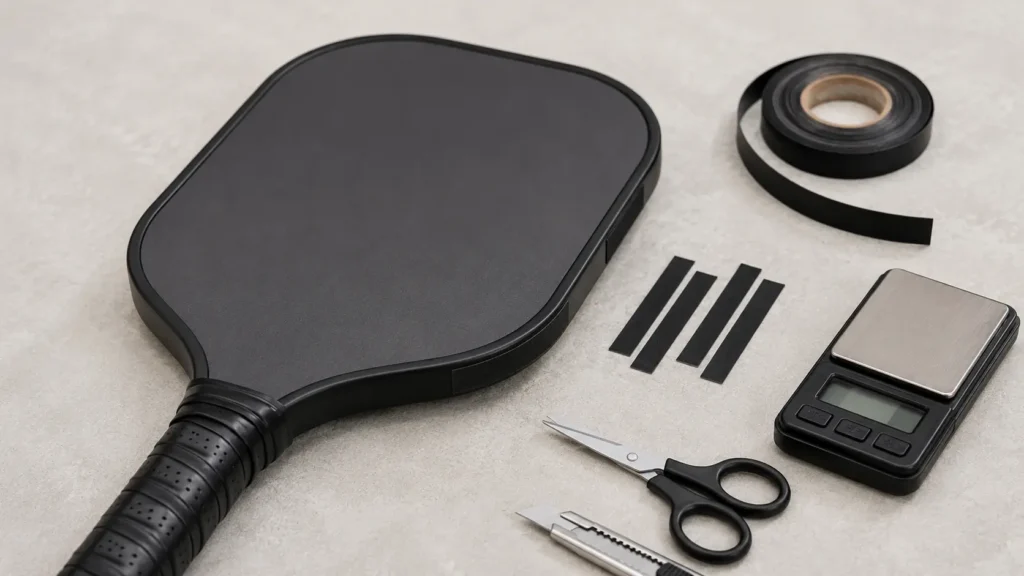
I have also experimented with ultra-thin magnetic tape as a cheap, easy-to-cut material for temporary placement tests before committing to a denser finished setup.
The magnetism is irrelevant once it is stuck to the paddle. I use it because it is inexpensive and easy to move. The version I have used is 12 mil ultra-thin magnetic tape, 0.6 inches wide by 60 feet long.
It is less dense than typical tungsten or lead products, so you may need a longer strip to reach the same number of grams. That makes it more useful as a cheap experiment than as the most compact permanent build.
Whatever material you test, the paddle only knows mass and placement. Weigh the strip and record where you put it.
Lead Tape Safety
Lead adds a material-handling issue that tungsten and other lead-free weights do not. If you choose lead tape, avoid touching your face or handling food while working with it, keep scraps contained and away from children and pets, and clean your hands and work area afterward. Those are the same basic hygiene steps recommended in current EPA lead-exposure guidance and CDC/NIOSH lead guidance.
Do not sand, grind, burn, or otherwise turn the tape into lead dust or fumes. If you use it, keep the finished strip covered beneath protective edge tape where practical so you are not repeatedly handling exposed edges.
If you do not specifically need lead, I think the easier answer is simpler: use a lead-free weighting product.
Paddle Weight FAQs
If the paddle twists or feels punishing on off-center blocks, a conservative first stability test is usually 1 to 2 grams per side at 3 and 9 o’clock. Skip that default when the paddle already feels stable, sluggish, head heavy, or slow in your hands.
Start smaller than you think. Two to four grams total is a conservative first experiment for many paddles, while a light or clearly unstable paddle may justify four to six grams. Starting paddle weight, balance, swing weight, shape, and player timing matter more than a universal number.
Added weight changes total mass, but placement determines the main effect. Side weight can improve twist resistance, upper weight increases swing weight and leverage, and handle-side weight changes balance with a smaller swing-weight effect.
Not directly. Weight does not make the paddle face grittier. It may help some players repeat spin-producing contact when added stability reduces paddle twisting on off-center hits.
You probably added too much, or put it too high, if your hands become late, counters slow down, resets get worse, fatigue rises, or discomfort appears. Remove some weight or move it lower and repeat the same test.
Yes. USA Pickleball currently permits properly installed aftermarket paddle weights and weight systems on approved paddles for sanctioned play, as long as the modified paddle still complies with the rest of the equipment rules. Verify the current Equipment Standards Manual and referee notices before competing.
When the paddle is already stable, test a small amount at 10 and 2 o’clock for more swing weight and plow-through. Weight at 12 o’clock produces an even larger swing-weight change per gram but also carries a larger maneuverability penalty.
If the goal is to make off-center contact less punishing, 3 and 9 o’clock is usually the first placement to test. Side weight can improve twist resistance so the effective sweet spot feels larger, although it does not physically enlarge the paddle face.
Handle-side weight mainly changes total mass and balance while adding less swing weight than the same mass near the paddle head. It can make a nose-heavy setup feel more hand-balanced, but it does not provide the same face-stability benefit as side weighting.
The Setup Is Right When the Paddle Stops Surprising You
Most players think paddle weighting is about hitting harder.
I usually notice the useful change first in the quieter shots: a block that stops twisting, a counter that leaves cleanly, or a reset that does not punish me as badly when contact wanders low.
The setup earns its way onto the paddle when the shot you targeted gets better without stealing your counters, resets, timing, comfort, or confidence.
A paddle should help you feel early, steady, and dangerous—not late, jumpy, and confused.
Placement is the upgrade. The setup is finished when the paddle stops surprising you.
Looking for a new paddle before modifying one? Browse the PickleTip paddle reviews.