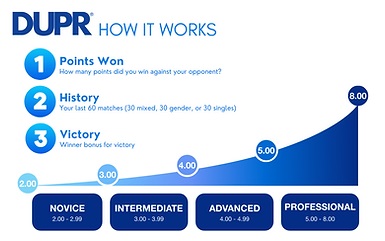

Pickleball Ratings Explained: Levels, Systems, and What the Numbers Mean
Pickleball ratings estimate the competitive level a player’s results repeatedly support. They help clubs, leagues, and tournaments create fairer games, but the number is only useful when you understand what it measures, and what it leaves out.
A player can look comfortable at 4.0 in one setting and struggle badly at the same label somewhere else. That does not always mean someone misrepresented their level. Skill descriptions, dynamic ratings, event brackets, local competition, and actual match performance are related, but they are not identical.
Coach Sid’s quick answer:
A skill level describes what your game can generally do. A dynamic rating estimates what your recorded results support. A ranking shows where you finished inside a particular event, league, or tour. Those ideas overlap, but they are not interchangeable.
🎧 Listen to Coach AJ, one of PickleTip’s coaches, break down how pickleball ratings work:
Ratings vs. Skill Levels vs. Rankings
Players constantly mash these terms together. That is how someone ends up saying, “I am ranked 4.0,” when they really mean they play at a 4.0 skill level or carry a rating near 4.0.
| Term | What it tells you | Main evidence | Main limitation |
|---|---|---|---|
| Skill level | What abilities broadly match levels such as 3.0, 3.5, or 4.0 | Shot execution, consistency, strategy, and self- or coach-assessment | A player may check boxes in drills that do not survive real matches |
| Dynamic rating | What a result-based system estimates about your competitive strength | Eligible match scores, opponent strength, and the provider’s current algorithm | Its usefulness depends on the amount, recency, and quality of the data |
| Ranking | Where a player or team stands inside a defined competition | Event finish, league standings, or tour points | Placement does not automatically describe ability across all players |
A single player can carry all three at once. They might play at a 4.0 skill level, hold a 3.92 doubles rating, and finish sixth in a regional tournament. None of those numbers cancels the others. They answer different questions.
In my own coaching sessions, I have watched players check nearly every 4.0 skill-chart box in drills, then lose that structure once returns shorten and transition pressure begins.
USA Pickleball describes skill levels through knowledge and proficiencies rather than match-result algorithms. Dynamic systems such as DUPR and UTR-P use recorded results, but they do not calculate ratings the same way. Do not translate one provider’s number directly into another provider’s scale.
For a deeper breakdown of beginner, intermediate, and advanced development, see our guide to pickleball levels. To estimate your own level, use our self-rating guide. For the system-specific version, start with our complete DUPR pickleball rating guide.
How Pickleball Ratings Work
A result-based rating does not grade the prettiest ball you hit all afternoon. It estimates the competitive level your recorded performance supports across eligible matches.
- A match is recorded. The provider decides whether the result is eligible and how it should be treated.
- The performance is compared with the players involved. The system evaluates what the result suggests relative to the competition.
- The rating updates as new evidence arrives. Fresh ratings may move more because the system has less history. More useful results generally make the estimate steadier.
The exact formula belongs to the provider. Some systems consider score, opponent strength, match type, recency, or the amount of match history, but they do not all use those inputs in the same way. That is why broad rating logic belongs here while provider-specific calculations belong in their own guides.
For DUPR basics (including what the number means, how to get rated, and why it moves) read our DUPR guide. For a closer look at expected score, margin, and reliability, continue to how the DUPR algorithm works.
You may beat a stronger team on Saturday, lose badly on Tuesday, and still be roughly the same player. Your actual level starts showing itself across the run of matches. Human ego loves the outlier. Rating systems care more about the pattern.
Coach’s note:
Ratings live closer to what survives under pressure than what looks clean in a practice line. A player can look sharp during warmups and still leak points once the score gets uncomfortable.
Reviewed August 2026: This guide explains the broad logic behind pickleball ratings. Each provider controls its own formula, eligible results, update schedule, and reliability language, so system-specific details can change.
DUPR, UTR-P, and Skill Charts Do Different Jobs
- USA Pickleball skill levels: Descriptive levels from 1.0 through 5.5+ based on knowledge, shot proficiency, consistency, court awareness, and strategy. They are not produced by a match-result algorithm.
- DUPR: A dynamic system with separate singles and doubles ratings based on eligible match results. Use the DUPR guide for the current scale, profile features, and update logic.
- UTR-P: A separate result-based system with its own scales, verification rules, and reliability process. Its number should not be treated as a direct conversion of DUPR or a descriptive USA Pickleball skill level.
Those scales are not conversion charts. A “4.0 player” on a descriptive skill chart is not automatically a 4.000 in every dynamic system. One describes a range of abilities. The others calculate numbers from their own data and rules.
Pickleball Skill Level Chart (1.0 to 5.5+)
This compact chart helps explain the broad skill labels used around pickleball. It is not a conversion table for DUPR or UTR-P, and it is not a complete player-development roadmap.
📥 Download the PickleTip Pickleball Skill Level Chart (PDF)
- 1.0–2.0: new to the game and learning rules, scoring, positioning, and basic contact.
- 2.5: can sustain short rallies and is beginning to understand positioning, but direction and consistency remain limited.
- 3.0: gets more serves, returns, dinks, and volleys into play, but consistency becomes unreliable under pressure.
- 3.5: shows improved court awareness, rally construction, and shot selection.
- 4.0: plays a more complete and adaptable soft-and-hard game.
- 4.5: shows consistent control, defense, counters, and tactical adjustment.
- 5.0–5.5+: executes advanced shots and strategies consistently against high-level competition.
For the complete level-by-level progression (including what tends to separate 3.0, 3.5, 4.0, and advanced players) continue to our pickleball levels guide.
How Do You Get a Pickleball Rating?
- Choose a responsible starting level. Use a skill chart, coach assessment, or organizer guidance before enough recorded results exist.
- Create a profile with the rating provider used by your club, league, or tournament. Different providers use different scales and rules.
- Play eligible matches. Tournament, league, club, and reported recreational results may be treated differently depending on the provider.
- Check the result details. Make sure names, partners, opponents, and scores are correct before treating the number as meaningful.
- Keep playing. A first rating is a starting estimate, not a permanent verdict.
If you do not yet have enough recorded matches, use our self-rating guide to choose a responsible starting level without turning this broad ratings overview into a full self-assessment test.
Coach’s note:
Early ratings surprise people because the sample is thin. Before declaring a system brilliant or broken, check how much useful evidence it has to work with.
Where Ratings Help, and What the Number Misses
Ratings reduce blind guessing. They help create closer games, cleaner brackets, and a more honest starting point for competition.
- Ratings help when enough recent and representative match data exists.
- Ratings miss context such as partner fit, matchup differences, local player-pool strength, and the specific role each doubles partner played.
- Ratings become misleading when players treat one number as a complete description of their game or personal worth.
The healthiest way to use a rating is as a working estimate. Let it help you find competition and expose weaknesses. For the deeper discussion of local rating bubbles, inactivity, manipulation, connectivity, and statistical confidence, read where DUPR ratings can fall short.
Rating Myths That Get Players in Trouble
Myth:
One win against a stronger player proves your level.
Reality:
One result can be an outlier. Repeated competitive performance is more revealing.
Myth:
Power determines rating level.
Reality:
Consistency, positioning, patience, and decision-making keep deciding points after raw pace stops surprising people.
Myth:
A club 4.0 is identical everywhere.
Reality:
Local pools, event strength, partner combinations, and styles vary.
Myth:
Every rating system uses the same scale.
Reality:
Each provider controls its own scale, eligible results, update rules, and reliability language.
How Should You Use Your Rating to Improve?
Use the rating as feedback, not as the training target. Look for the weaknesses that keep showing up against appropriate competition, then use PickleTip’s pickleball strategy lessons, focused drills, and player-development guides to work on the problem itself. For a structured level-by-level development path, continue to pickleball levels.
Should You Move Up, Stay Put, or Find Stronger Competition?
- Move up when you are consistently winning and your game still holds together when the pace rises.
- Stay at your level when the matches are competitive but the same weaknesses keep deciding points against you.
- Seek stronger games when your current group flatters your weaknesses and you need better opponents to reveal what is missing.
The goal is not to protect your ego, and it is not to get buried for the sake of saying you played up. The right challenge stretches your game. The wrong challenge just buries it.
Before entering an event, read our guide to preparing for a pickleball tournament. For the larger bracket question, see why skill ratings and tournament brackets should stay separate.
Frequently Asked Questions
A pickleball rating is a number produced by a rating provider to estimate competitive playing strength from eligible match results. It is different from a descriptive skill level and from a ranking inside a particular event or tour.
The exact formula depends on the provider. Result-based systems generally evaluate recorded performance relative to the players involved and update the rating as more eligible results are added.
A rating estimates competitive playing strength from match evidence. A ranking shows where a player or team stands inside a defined event, league, or tour.
Some major rating providers calculate separate singles and doubles ratings because the formats demand different movement, coverage, and tactical skills. Check the rules of the provider used by your club or event.
There is no universal number because providers use different systems. A rating generally becomes more useful when it is supported by enough recent, accurate, and representative results.
A good rating is one that places you in competitive games that challenge your current level without consistently overwhelming you or flattering your weaknesses.
Coach Sid’s Bottom Line
Your level is not the best pickleball you can briefly produce. It is the game that keeps showing up when pace, pressure, and repeated competition test it.
Use the rating to find honest games. Use the supporting guides to understand the system, assess your level, and decide what to train next.