

What Is DUPR in Pickleball? Rating Meaning, Scale and How It Works
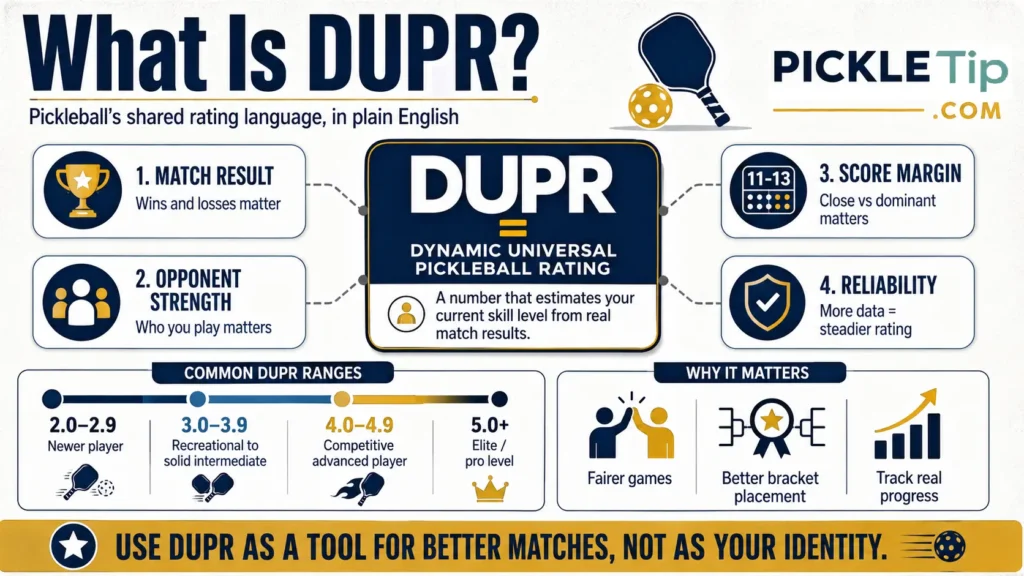
What is DUPR in pickleball? DUPR stands for Dynamic Universal Pickleball Rating. It is a match-based system that estimates competitive playing strength on a scale from 2.000 to 8.000. New players begin as NR, or Not Rated, and receive separate singles and doubles ratings after verified results are added.
PickleTip’s quick answer: DUPR is a placement tool. It can help players find fairer games, join appropriate sessions, and enter suitable events. It is not a complete scouting report, a permanent identity, or a substitute for watching how someone actually plays.
The number makes more sense once you separate the rating itself from the evidence supporting it.
🎧 Prefer listening? Hear a 5-minute introduction to DUPR pickleball ratings narrated by Coach AJ. Coach Sid adds the practical court perspective:
Source note: This guide was reviewed on August 4, 2026, against DUPR’s official How It Works page, Reliability guidance, and enhanced-profile documentation. Current scale, Reliability, and profile-feature details come from DUPR; PickleTip’s range descriptions and practical court guidance are identified as interpretation.
What Does DUPR Stand For?
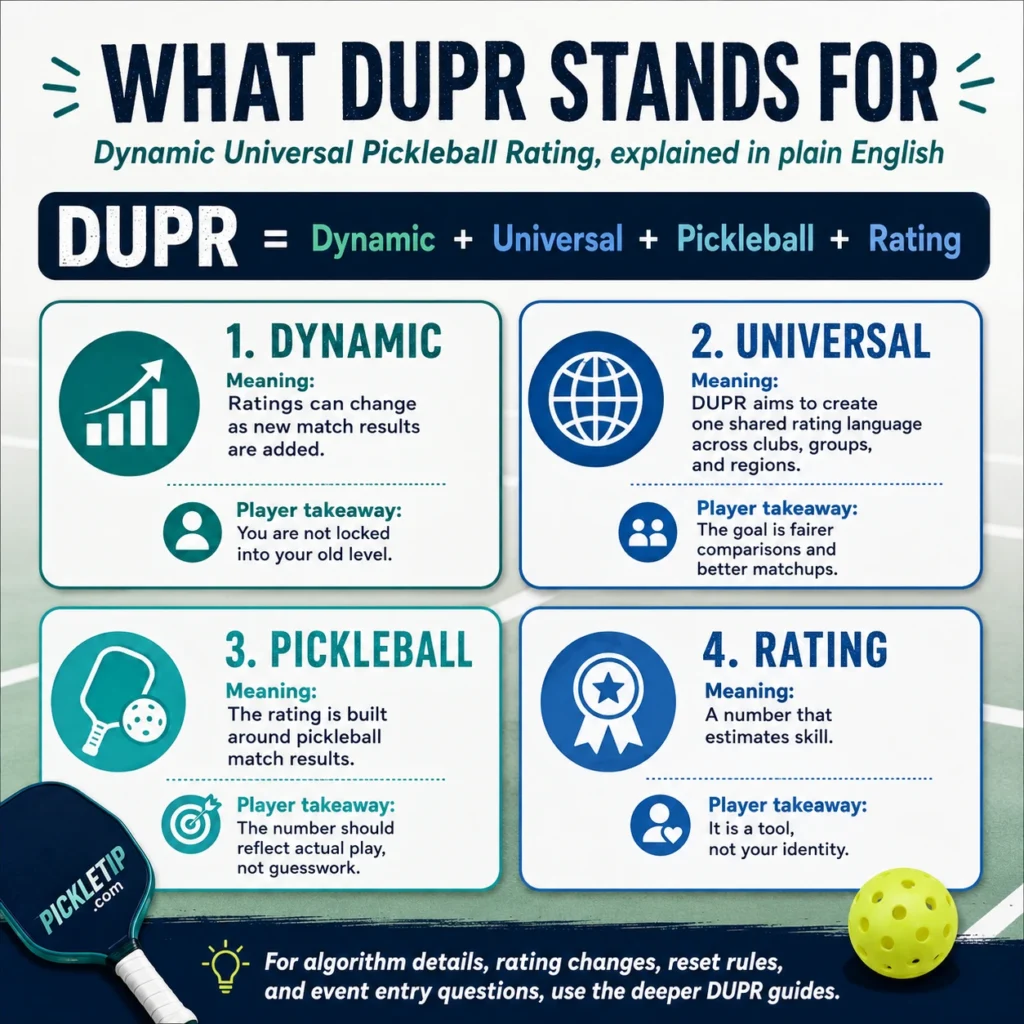
DUPR stands for Dynamic Universal Pickleball Rating. The name describes the system’s intended job:
The Full Name in Plain English
- Dynamic: the rating can change when new match evidence is added.
- Universal: DUPR aims to give players one shared rating language across clubs, regions, ages, genders, and playing groups.
- Pickleball: the number comes from results in this sport, not general athletic ability.
- Rating: the number estimates competitive strength. It is not a ranking, identity, or guarantee.
What DUPR Actually Measures
DUPR estimates competitive pickleball strength from recorded match results. It gives players, clubs, leagues, and event organizers a shared number for comparing competitive level.
The number does not tell you how a player wins points. It cannot fully describe playing style, partner chemistry, best shots, weak patterns, decision-making, movement, composure, or one specific matchup.
I can look noticeably stronger or weaker depending on the partnership. One partner may simplify the middle and protect a weakness; another may create hesitation or repeatedly expose the same pattern.
Coach Sid’s translation: DUPR can help get four players onto the right court. It cannot tell you exactly what will happen once the ball is served.
A DUPR rating and a complete skill-level description are not the same thing. I can put two 3.3 players on the same court and see two completely different problems. One may control the kitchen but struggle when pushed through transition. The other may drive and counter well but give away points through impatient decisions.
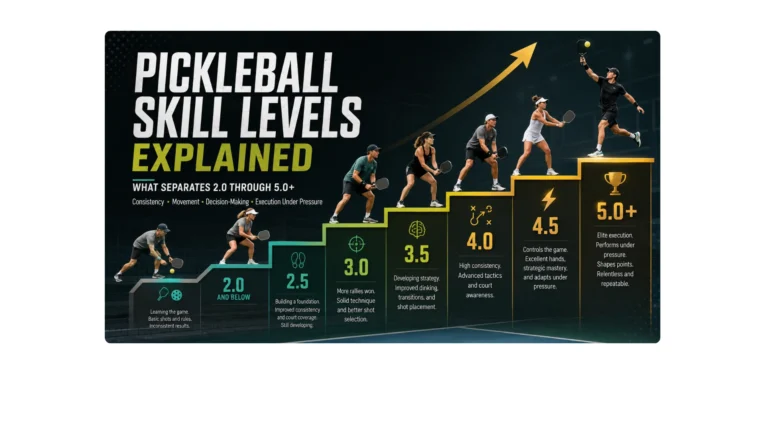
DUPR tells me they belong near each other. It does not tell me why either player wins or loses. For observable court development, see what different pickleball skill levels look like from 2.0 through 5.0+.
What Players Use DUPR For
The decimal is only useful if it helps create better games.
A better game does not mean every player looks equally skilled or wins points the same way. It means neither team begins with an obvious structural advantage and both sides have a realistic path to winning.
| Who uses it | What DUPR can help with |
|---|---|
| Players | Finding more competitive games, tracking recorded results, and choosing appropriate events |
| Clubs and leagues | Grouping players into closer sessions, ladders, round robins, and programs |
| Tournament organizers | Applying published entry rules, seeding fields, and reducing obvious mismatches |
| The wider sport | Using one shared numerical language across different communities |
In the DUPR sessions I run at Adventure Quest, the rating does its most important work before the game: it helps me build a court that should be competitive. Once the ball is served, I learn more from who handles pressure, who changes tactics after a bad start, who communicates, and which partnerships actually work. Those observations help shape the next session instead of letting the decimal make every placement decision.
Trouble usually starts when a placement tool becomes a status symbol or a permanent label. That separate issue is explored in why players and clubs can lose trust in DUPR.
DUPR Rating Scale: What the Numbers Mean
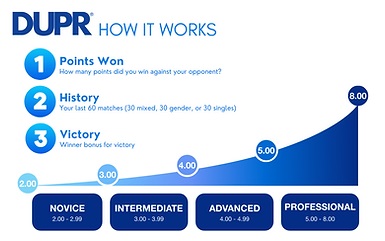
All new players begin as NR, or Not Rated. After verified match evidence enters the system, DUPR ratings run from 2.000 to 8.000. Singles and doubles are tracked separately.
DUPR supplies the numerical scale. The descriptions below are PickleTip’s broad playing context, not official DUPR skill definitions.
Players sometimes search for a DUPR score or DUPR score meaning, but DUPR’s official term is rating. The number represents an estimate of competitive strength, not a point total from one game.
| DUPR range | PickleTip’s broad playing context |
|---|---|
| NR | Not Rated; the player does not yet have an established numerical rating in that format |
| 2.000–2.999 | Newer or developing competitive profile |
| 3.000–3.499 | Recreational competitive range |
| 3.500–3.999 | Established intermediate competition |
| 4.000–4.499 | Strong club and tournament competition |
| 4.500–4.999 | High-level competitive play |
| 5.000+ | Elite amateur and professional-level territory, with the scale extending to 8.000 |
A 3.8 does not have one required forehand, one required serve, or one required style. The rating estimates where the player fits based on match evidence; it does not prescribe what the player must look like on court.
How DUPR Ratings Work in Plain English
DUPR does not look only at whether you won or lost. It compares the score your team produced with what the matchup was expected to produce.
- The matchup creates an expectation. The players’ existing ratings help establish what score the system expects.
- The actual score creates the performance signal. Scoring more or fewer points than expected can affect how the result is interpreted.
- The match enters a larger history. Match type, recency, and the amount of existing evidence help determine how much the result matters.
That is why a win does not always produce the jump a player expected—and why two partners may not move by the same amount. For the full calculation, including expected score, match weighting, recency, volume, Forecast, and Impact, read how the DUPR algorithm calculates rating movement.
Important distinction: Rating movement and rating quality are different questions. The algorithm determines how results affect the number. Reliability helps show how established and current that number is.
What Is DUPR Half Life?
Players still use the phrase DUPR Half Life when asking how older matches lose influence. DUPR’s current public explanation uses the broader term match recency: newer results generally have more influence than older results.
The terminology has changed, but the central idea has not. A current rating should respond more to the player you are showing now than to results from several seasons ago.
How Do You Get a DUPR Rating?
To get a DUPR rating, you need recorded match results connected to your DUPR profile.
- Create a DUPR account. New profiles begin as NR.
- Play a match that can be recorded. Results may come from clubs, leagues, tournaments, organized sessions, or properly submitted recreational play.
- Make sure the result reaches the correct profile. A match cannot inform your rating if it is missing, attached to the wrong player, or never validated when validation is required.
- Keep adding representative results. A first rating can appear early, but recent matches against varied players create a more useful profile.
Creating a standard DUPR account is free. Clubs, leagues, tournaments, special sessions, or optional products may charge their own fees.
Before enough match evidence exists, a player may still need a practical estimate for open play or a local program. For that separate process, use the PickleTip RATE Method to estimate your pickleball level.
At one local DUPR Day, the final numbers were useful, but the clearest differences appeared in who adjusted after a poor start, who stayed composed in close games, and who could perform with different partners. Read what that DUPR Day revealed about composure, adjustment, and match pressure.
DUPR Rating vs. Reliability Score
The Rating and Reliability Score answer two different questions:
| DUPR Rating | Reliability Score | |
|---|---|---|
| What it measures | Estimated competitive strength | How established and current the estimate is |
| Range | 2.000–8.000 | 1–100% |
| Main question | Where does this player currently fit? | How firmly should we trust that placement? |
| Built from | Recorded match performance | Volume, recency, player variety, match context, and supporting evidence |
| Useful threshold | Depends on the playing environment | DUPR describes 60% or higher as reliable |
Reliability does not tell you how good the player is. It tells you how firmly the current rating stands.
A high rating with low Reliability may rest on limited or older evidence. A lower rating with strong Reliability may be a firmer estimate of current competitive level.
How Many Matches Do You Need for an Accurate DUPR Rating?
There is no single match count that guarantees an accurate DUPR rating. A first rating can form early, but recent results against varied and connected opponents provide stronger evidence than the same number of matches inside one closed group.
I have seen local groups in the New Orleans area become internally consistent without being externally calibrated. The players may sort correctly relative to one another while the entire pool still sits too high or too low against outside competition. The practical goal is not merely more matches. It is more representative evidence.
Better question: Is this rating supported by enough recent, varied competition to describe the player outside one narrow setting?
The Main Ratings and Tools on a DUPR Profile
The core profile numbers are the singles rating, doubles rating, and Reliability Score. DUPR’s enhanced profile adds subscores and tools that provide more context but serve different purposes.
| Profile item | What it means |
|---|---|
| Singles Rating | Your official rating from recorded singles results |
| Doubles Rating | Your official rating from recorded doubles results |
| Reliability Score | How established and current the singles or doubles rating is |
| Mixed and age-based ratings | Subscores that add context for qualifying mixed or age-division results |
| Career High | A profile marker showing the player’s highest qualifying DUPR |
| Forecast and Impact | Optional tools that show matchup expectations and possible rating movement; they are simulations, not guarantees |
Your official singles or doubles DUPR remains the primary rating for that format. Subscores and profile tools add context; they do not automatically replace the official number.
For an event, the organizer’s published rule controls. Do not assume the most specialized number automatically determines eligibility. Check the exact rating, date, cap, and Reliability requirement named in the rules. The complete decision guide is which DUPR profile number counts for an event.
What to Understand Before You Use DUPR
Before treating the decimal as a firm placement, check the evidence behind it and the rules of the setting where it will be used.
- Check Reliability. A precise-looking decimal can still rest on limited or older evidence.
- Look for representative results. Recent matches against varied, connected competition usually tell you more than repeated results inside one isolated group.
- Read event rules carefully. The organizer decides which rating, subscore, date, cap, or Reliability requirement applies.
- Test the placement on court. Look at the score, the pressure points, and whether the same mismatch repeats across games or different partners. One bad game is not the same as a consistent competitive gap.
Your Next DUPR Question
The next guide depends on what you are trying to figure out:
| Your question | Read this next |
|---|---|
| Why did my rating move that way? | How the DUPR algorithm calculates rating movement |
| Does this number reflect my current game? | Why a DUPR rating may not reflect current playing ability |
| Which profile number controls event entry? | Which DUPR rating counts for events |
| Why do players or clubs lose trust in the system? | Why players and clubs can lose trust in DUPR |
Related guides include whether DUPR should reward performance differently, how the first DUPR Reset worked in 2026, and how DUPR fits among pickleball ratings, levels, rankings, and brackets.
For login help, player search, account support, or your DUPR ID, use the official DUPR website or app.
Frequently Asked Questions About DUPR
DUPR is the Dynamic Universal Pickleball Rating, a match-based system that estimates competitive playing strength. New players start as NR, and numerical ratings run from 2.000 to 8.000.
New players begin as NR, or Not Rated. Once rated, the DUPR scale runs from 2.000 to 8.000, with separate official ratings for singles and doubles.
Create a DUPR account, play matches that can be recorded, make sure the results reach the correct profile, and continue adding recent representative results. A first rating can appear early, but more useful evidence makes the profile more dependable.
The DUPR Rating estimates competitive strength on a 2.000 to 8.000 scale. Reliability is a 1 to 100 percent supporting measure showing how established and current that estimate is. Reliability does not measure skill.
Yes. Singles and doubles have separate official DUPR ratings because results from the two formats are tracked independently.
DUPR says ratings update automatically after a result is shared and processed. The time required for a match to appear can depend on the submission method, validation, event system, or processing conditions.
A good DUPR rating depends on your goals and playing environment. Ratings from about 3.0 to 4.0 cover much of recreational and club competition, while 4.5 and above generally represents strong competitive play. The quality of the evidence supporting the number matters too.
Creating a standard DUPR account is free. Clubs, leagues, tournaments, special sessions, or optional products may charge separate fees.
The Rule Worth Remembering
DUPR gives pickleball players a shared way to estimate competitive strength.
Use DUPR to place the player. Use the full game to understand the player.




Great article, but I have to say, it’s frustrating how often DUPR changes its algorithm. Just when I think I’ve got a handle on how it works, they go and tweak something. The new features like the genie tool are helpful, but I wish they would just pick a system and stick with it. It’s hard to keep up with all the changes and understand how they affect my rating.
DUPR is currently not accurate.
It is producing many obvious significant errors.
It can impact playing and coaching careers.
Can DUPR be fixed?
DUPR is trash. There are great losses and bad wins. DUPR doesn’t really tell you much accurately at all especially when considering doubles play. Shame this is what people are hanging their hats on.
I think that recently DUPR has been much better. The new reliability thing is nice. They have fixed a lot of things, and my rating looks much more accurate.