Pickleball Serving Rules (2026): What Counts as a Legal Serve?
A legal pickleball serve is not just “underhand.” Under the 2026 USA Pickleball rules, legality depends on how you release the ball, where your feet are when you strike it, whether you use a volley serve or drop serve, what happens at contact, and where the serve lands.
The fastest way to settle a serve argument is to identify the serve type first. A volley serve and a drop serve do not use the same contact rules.
2026 Legal Serve Snapshot
- Volley serve: hit the ball before it bounces and follow the volley-serve requirements.
- Drop serve: release the ball, let it bounce, then hit it under the drop-serve requirements.
- Both: use a legal release, legal foot position, and land the serve diagonally in the correct service court beyond the Non-Volley Zone.
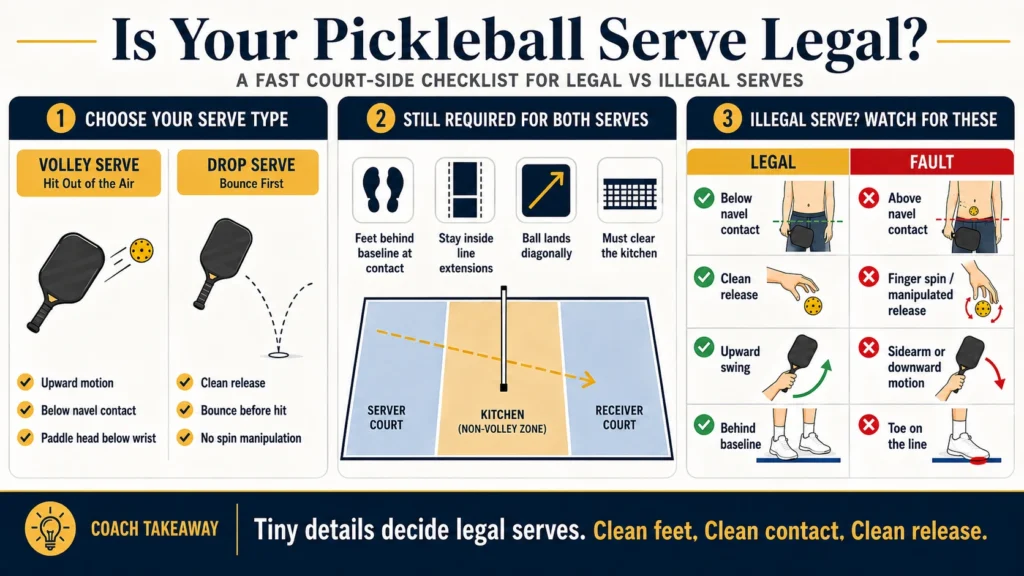
- Volley serve only: paddle moving in a clear upward arc, paddle head clearly not above the wrist joint, and ball clearly no higher than the waist at contact.
- Drop serve only: release from a natural unaided height, do not propel the ball, and let it bounce before contact.
- No intentional pre-serve spin: some natural rotation is expected, but do not manipulate the ball to add spin before paddle contact. Spin created by the paddle at contact is legal.
- Net-touch serve: clipping the net does not automatically create a replay; if the serve otherwise lands legally, the ball remains live.
Coach Sid legality test: Release. Feet. Contact. Landing. Check those four things in that order. For contact, first identify whether you are judging a volley serve or a drop serve.
Need scoring, kitchen rules, faults, and the rest of the game? Use the complete pickleball rules guide. Here, we are staying with the serve.
🎧 Prefer listening? AJ Parfait explains the legal-serve framework in this short audio summary.
What Makes a Pickleball Serve Legal?
A legal serve has four checkpoints:
- Legal release: the ball is released in a way allowed by the serving rules.
- Legal feet: your feet satisfy the service-position requirements when you contact the ball.
- Legal contact: identify whether it is a volley serve or drop serve, then apply the rules for that serve type.
- Legal landing: the ball lands in the correct diagonal service court beyond the Non-Volley Zone.
Players usually look at the swing first. That is how a lot of serve arguments start. A smooth underhand-looking motion can still produce an illegal serve if the release, feet, contact, or landing is wrong.
Volley Serve vs. Drop Serve: The Rules Are Different
This is the distinction I want players to make before arguing about whether somebody’s motion was legal.
| Legality Check | Volley Serve | Drop Serve |
|---|---|---|
| Ball bounces before contact | No | Yes |
| Clear upward paddle arc | Required | Not required |
| Paddle-head / wrist restriction | Required | Not required |
| Ball no higher than waist at contact | Required | Not required |
| Natural unaided release height | Not the drop-serve test | Required |
| No propelling ball on release | Not the volley-serve test | Required |
| Legal feet | Required | Required |
| Correct diagonal landing | Required | Required |
The practical lesson: do not apply the three volley-contact tests to a legal drop serve. That is one of the easiest ways to create a rule argument that never needed to happen.
2026 Volley Serve Rules
A volley serve is struck before the ball bounces. Rule 7.C uses three specific motion/contact requirements.
- Upward arc: the paddle must be moving in a clear upward arc when it contacts the ball.
- Paddle head: the highest point of the paddle head must clearly not be above the highest part of the server’s wrist joint at contact.
- Ball height: the ball must be clearly no higher than the server’s waist when the paddle contacts it.
Important 2026 Wording
The rule says waist, not navel. You will still hear players use the belly button as a shortcut, and older explanations often equated the two. I would not use “navel height” as the actual 2026 rule standard.
The 2026 rules also allow the volley serve to be made with either a forehand or backhand motion. A backhand serve is not illegal just because it looks unusual; it still has to satisfy the same volley-serve requirements.
2026 Drop Serve Rules
A drop serve works differently. Under Rule 7.D, the server releases the ball, lets it bounce on the playing surface, and strikes it after the bounce.
- Natural unaided height: release the ball from a natural height rather than artificially creating extra release height.
- Do not propel it: do not push, throw, toss, or otherwise propel the ball in any direction or manner to create the drop.
- Let it bounce: the ball must contact the playing surface before you strike it.
- Multiple bounces are allowed: there is no limit on the number of bounces before contact.
- Bounce location is not restricted: the ball does not have to bounce in one special spot before you hit the serve.
- Volley-serve contact tests do not apply: the upward-arc, paddle-head/wrist, and waist-height requirements are not the drop-serve contact test.
- Forehand or backhand is allowed: either motion is permitted after the legal release and bounce.
A Serve Can Be Illegal Before You Swing
Serve legality does not begin at paddle contact. Rule 7.B governs the release for both serve types.
- The ball is released from one hand or from the paddle.
- The release must be visible to the receiver.
- The server may not deliberately manipulate the ball to add pre-serve spin.
- Some natural rotation is expected during a normal release; a rotating ball is not automatically an illegal spin serve.
- The ball may roll off the paddle face by gravity, and spin created when the paddle strikes the ball is legal.
Easy distinction: the rule does not ban a spinning serve. It bans deliberately adding manipulation or spin during the release. Paddle-generated spin at contact is allowed.
If you want to use legal paddle-generated sidespin on purpose, see Pickleball Slice Serve.
Pickleball Serve Foot Faults
Foot legality is judged when the server strikes the ball. I treat that moment like a snapshot.
- Do not touch the baseline with your feet at contact.
- Stay inside the imaginary extensions of the sideline and centerline.
- At least one foot must be on the playing surface or ground in the legal serving area when the ball is struck.
- After legal contact, your momentum may carry you forward across the baseline.
Coach Sid cue: the baseline is a contact snapshot. What matters is where your feet are when paddle meets ball, not where you finish the motion.
Where Must a Legal Serve Land?
Once the ball leaves the paddle, the next question is simple: where did it land?
- The serve travels diagonally crosscourt.
- It must land inside the opponent’s correct diagonal service court.
- It must clear the Non-Volley Zone.
- A serve touching the Non-Volley Zone line is short and a fault.
Other boundary lines of the correct service court are treated according to the normal line rules. The important special case is the kitchen line: it is part of the Non-Volley Zone, so it is not a legal serve landing.
Can a Pickleball Serve Hit the Net?
Yes. A serve that touches the net is not automatically replayed.
If the ball clips the net and still lands legally in the correct diagonal service court beyond the Non-Volley Zone, play continues. If it lands short, in the wrong service court, or otherwise out, it is a fault.
Net-touch test: don’t ask, “Did it touch the net?” Ask, “Where did it land?”
Common Illegal Pickleball Serves
| Problem | Why It Is Illegal |
|---|---|
| Flat or downward volley-serve motion | Paddle is not moving in the required clear upward arc at contact. |
| Volley serve contacted clearly above waist | Ball-height requirement is violated. |
| Paddle head clearly above wrist joint | Volley-serve paddle-position requirement is violated. |
| Baseline foot fault | Server touches the baseline at contact. |
| Foot outside an imaginary extension | Server is outside the legal serving area at contact. |
| Propelled drop | Drop-serve ball was pushed, thrown, or otherwise propelled instead of legally released. |
| Drop serve hit before bounce | A drop serve must bounce before paddle contact. |
| Intentional spin added before contact | Server manipulated the release to impart prohibited pre-serve spin. |
| Kitchen-line landing | The NVZ line is part of the NVZ and is short on a serve. |
| Wrong diagonal service court | The serve did not land in the correct service court. |
Why “Clearly” Matters in the 2026 Volley-Serve Rules
The 2026 volley-serve language repeatedly uses the word clearly: clear upward arc, paddle head clearly not above the wrist, and ball clearly no higher than the waist. USA Pickleball’s 2026 Rulebook Change Document says adding “clearly” was intended to make the volley-serve requirements stronger and more enforceable.
That word matters on a real court. Nobody standing across the net can measure a one-inch difference in contact height or paddle position. Borderline is not the same thing as clearly illegal.
Coach Sid Court-Side Test
I’ve watched hundreds of rec players lose points on serves they thought were legal. Contact height is one of the first places I look when the motion is actually over the line. But “I think that was a little high” is different from a ball that was clearly above the waist.
When somebody tells me a serve “looked illegal,” I don’t start by debating style. I go back to the same four checks: Was the release legal? Were the feet legal? Which serve type was it, and was the contact legal for that serve? Where did the ball land?
A weird-looking serve is not automatically an illegal serve. “I’ve never seen anyone serve like that” is not a rule.
What If the Serve Is Questionable Instead of Clearly Illegal?
In officiated play, Rule 20.E.2 gives the referee a replay tool when the referee is not certain that one or more service requirements were met. That replay must be called before the return of serve. The release rules also give the receiver specific replay rights for a release that was not visible or for suspected manipulation or spin, again before the return.
Practical point: a questionable serve and a clearly illegal serve are not the same thing. The rulebook gives officials a way to handle uncertainty; it does not turn “that looked funny” into a rule.
Legal Doesn’t Mean Good
A legal serve can still be a bad serve. A technically strange-looking serve can still be legal.
- For how to build the motion, use Pickleball Serve Technique.
- For where to aim and what you want the returner to do, use Where to Serve in Pickleball.
- For a beginner learning path, use Pickleball Serves for Beginners.
- If the argument is really about 0-0-2, Server 1/Server 2, or whose serve it is, use Pickleball Scoring.
Pickleball Serving Rules FAQ
Not every legal serve uses the same contact test. A volley serve must satisfy the requirements for a clear upward paddle arc, paddle-head position, and ball height at contact. A drop serve is hit after a legal release and bounce, and those three volley-contact restrictions do not apply to the strike.
Yes. The 2026 rules allow either a forehand or backhand motion for a volley serve and for a drop serve. The rest of the requirements for the chosen serve type still apply.
For a volley serve, the general release rules do not prohibit an upward toss as long as the release is otherwise legal, visible, and not manipulated to add spin. A drop serve is different: its release cannot be propelled in any direction or manner and must come from a natural unaided height.
No. Some natural rotation is expected during a release. The prohibited action is deliberately manipulating the ball to add spin before paddle contact. Spin created by the paddle at contact is legal.
Yes. There is no restriction on the number of bounces before the server strikes the ball and no restriction on where those pre-serve bounces occur on the playing surface. The release still has to be legal and unpropelled.
In officiated play, Rule 20.E.2 allows the referee to call a replay when the referee is not certain that one or more service requirements were met. The replay must be called before the return of serve. A questionable serve is not automatically treated the same as a clear violation.
For sanctioned competition, use the current USA Pickleball Official Rulebook as the final authority.
Rules-status review: Rechecked August 19, 2026 against the current 2026 USA Pickleball Official Rulebook and current USA Pickleball rule-change records.