How We Test Pickleball Paddles: The PickleTip Method
Page updated: August 2026
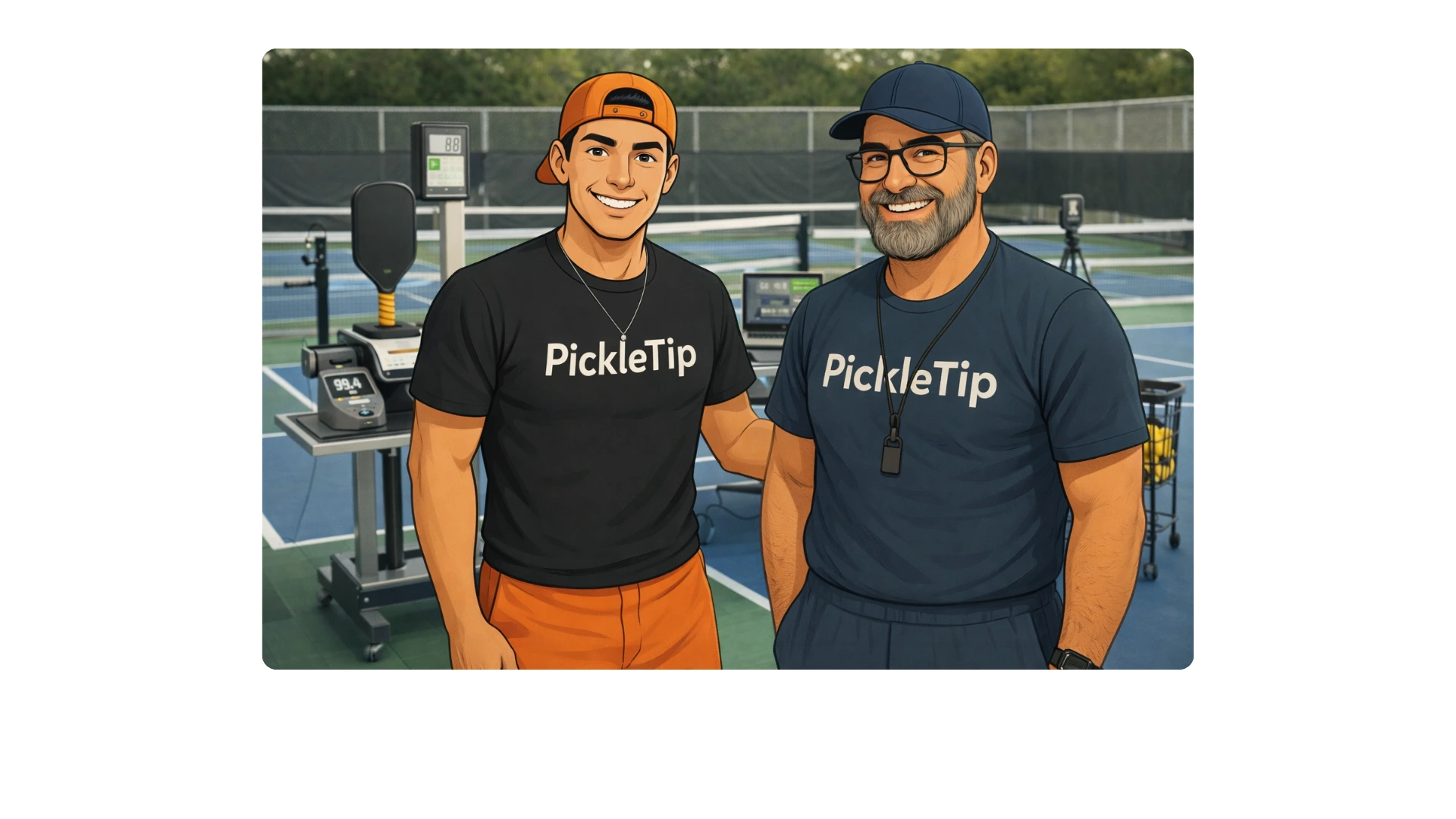
I’m Coach Sid, co-founder of PickleTip, a registered DUPR Coach, and director of the New Orleans Pickleball Club. I test paddles the same way I watch players leak points in clinics, DUPR sessions, drilling, and doubles play: late, jammed, rushed, off-center, and sometimes a little irritated that the next ball is coming straight at the body again. PickleTip testing is court-first and measurement-informed. We create repeatable pressure situations first, then use specifications and measurements to help explain why the paddle behaved the way it did. About Coach Sid
PickleTip’s testing philosophy: Don’t choose a paddle on your prettiest swing. Pay attention to the late block, rushed reset, cramped counter, and off-center ball. Those are the shots that tell me whether a paddle actually fits your game.
How Does PickleTip Test Pickleball Paddles?
PickleTip uses a court-first paddle testing method built around mistake coverage. I think about that method through six things that keep showing up in real reviews: Pressure, Access, Discipline, Durability, Load, and Errors. Together, that is the PickleTip PADDLE Method. Instead of judging a paddle only by peak power, fresh-paddle spin, or clean-contact feel, we recreate common pressure situations and track what the paddle keeps doing when execution is less than perfect.
- P — Pressure: What happens when the ball gets fast, late, jammed, rushed, or off-center?
- A — Access: How easily can the player reach usable spin, power, touch, and control without needing a perfect full swing?
- D — Discipline: Does the paddle stay predictable when face angle, timing, or contact point slips a little?
- D — Durability: Does the paddle or surface change with break-in, wear, contamination, or repeated use?
- L — Load: What does the paddle demand from the player in hand speed, swing effort, recovery, and fatigue over time?
- E — Errors: What repeatable miss keeps showing up when execution breaks down?
PADDLE is not a six-part scorecard, and I do not expect one paddle to “win” every letter. It is a way to keep the review honest about tradeoffs. A paddle can give you easy access to power and spin, for example, while asking more from your hands or punishing a particular late-contact miss.
The central idea underneath all six letters is still Mistake Coverage: what does the paddle still give you when the swing is not ideal?
That idea came from watching the same thing happen over and over with real players. Warmup swings can make almost any decent paddle look good. The useful differences start showing up when feet are late, the contact point moves, a reset gets rushed, or somebody attacks the body before the hands are ready. Those are the balls that donate points, so those are the balls I want a paddle review to explain.
Important: I’m not trying to turn the court into a laboratory. PickleTip court testing does not replace certification testing, destructive analysis, or controlled engineering work. My job here is different: make the same ugly real-player situations happen often enough to see whether the paddle keeps reacting the same way.
The PickleTip PADDLE Method at a Glance
| What We Test | Pressure Situation | What Failure Looks Like | What It Helps Reveal |
|---|---|---|---|
| Jam stability | Late body-ball contact | Launch, spray, sit-up | Face stability and mistake coverage |
| Transition control | Fast feeds followed by a reset | Floaters or late counters | Pace absorption and recovery |
| Face discipline | Rushed block with little swing | Unwanted pop or depth | Launch predictability |
| Soft catch | Hot ball at the body | Pop-up instead of neutral ball | Touch and pace management |
| Hands battles | Fast kitchen exchanges | Slow reload or directional leak | Hand speed and stability |
| Off-center survival | Edge, low-face, or imperfect contact | Twist, weak reply, sit-up | Forgiveness and usable hitting area |
| Spin access | Compact rolls, drops, and drives | Ball stops shaping when swing shrinks | Accessible spin under pressure |
| Power window | Compact versus full swings | Sails, spray, or unpredictable jump | How much usable pace you can access |
PADDLE gives me the questions. The eight court tests later on are how I try to answer them. The tests overlap by design: one jammed block can tell me about pressure, discipline, and the kind of error a paddle creates all at once. Real points do not separate themselves into neat categories. The rest of this page shows what I actually watch for, how those situations are recreated, and where a useful court observation stops being something I can honestly claim as a measurement.
What Keeps a Paddle Review Honest
- Built from coaching and live play: The method comes from clinics, DUPR sessions, drilling, community play, and doubles environments where I watch real players win points, donate points, and make the same mistakes more than once.
- Built around real player errors: We intentionally test the contact players wish they could avoid, not only the swings they would put on a highlight reel.
- Repeatable pressure checks: The same core situations show up from review to review, which makes it easier to tell the difference between a paddle tendency and one great or terrible point.
- You can check the work: In the FLiK F3 review, slightly imperfect balls repeatedly stayed more playable. In the Engage X2 review, late counters and edge stability exposed a very different cost.
- Measurements have a defined role: Numbers provide context and help explain tendencies; they do not automatically decide the verdict.
- We try to catch our own bias: covered branding, random swaps, repeated drills, outside feedback when useful, and the same court standards whether or not a brand pays a commission.
If you want the broader equipment picture behind construction, materials, surfaces, and setup, use the Equipment Education hub. Here, I’m sticking to how we actually test paddles and how I decide what the court is telling me.
What We Observe, Measure, and Interpret
One of the easiest ways to make paddle testing sound smarter than it is is to blur three different things together: what happened, what we measured, and what I think explains it. I try hard to keep those separate.
Observed Court Behavior
These are the things I can actually watch happen: blocks launching long, resets floating, counters arriving late, off-center contact twisting the face, compact rolls losing shape, or a paddle that felt wonderful twenty minutes ago starting to feel slow once the hands and forearm are tired.
Measured Values
When a review includes measured values, we identify them as measurements from our test unit. Depending on the review, those may include characteristics such as weight, balance, swing weight, twist weight, dimensions, or other useful specifications.
Factory tolerances matter. A measurement from one paddle should not be presented as a guarantee that every retail unit will be identical.
Interpretation
This is where coaching and testing meet. A higher stability measurement may help explain why a paddle stays quieter on off-center contact. A higher swing weight may help explain why it feels composed through the ball but starts charging you for that stability during repeated hands battles.
PickleTip rule: Measurements are translators, not judges.
The Paddle Traits We Keep Coming Back To
- Power window: The range in which you can add pace while keeping launch and direction predictable enough for your game. This is one part of Access: usable performance, not just peak output.
- Twist weight: When measured, a useful stability indicator related to how strongly a paddle resists rotating around its long axis on off-center contact.
- Perceived hold or dwell: The on-court sensation that the ball stays connected to the face longer or shorter. Unless instrumented dwell time is actually measured, we describe this as perceived feel rather than pretending the sensation is a laboratory measurement.
- Spin access: How readily a player can create useful ball shape on rolls, drops, drives, and other compact swings, not merely the maximum spin available on a perfect full-speed stroke. It belongs under the same Access question.
- Miss profile: The repeatable way a paddle tends to give away points when execution slips.
- Fatigue tax: The performance cost that appears as hands, forearms, reaction timing, or swing timing begin to fade.
What Actually Decides the Verdict
Pressure decides the verdict. Measurements help explain it. The PADDLE Method keeps the rest of the questions in view so one big strength does not hide an expensive tradeoff.
- Mistakes matter more than highlight shots. Late contact, cramped counters, rushed resets, and off-center balls tell me more about paddle fit than warmup winners do.
- Usable windows matter more than peak numbers. I care about the range of pace, launch, spin, and control a player can actually manage, not merely the biggest number a paddle can produce.
- Every paddle has a miss profile. Two paddles can both feel impressive while failing in completely different ways. The important question is which failure your game can afford.
- The verdict can change with time. Fatigue, adaptation, break-in, surface wear, and repeated use can expose things the first ten minutes cannot.
- Fit is personal. The characteristic that saves one player can punish another. A review should identify that tradeoff instead of pretending every player needs the same paddle.
Who Tests PickleTip Paddles?
Coach Sid leads PickleTip paddle testing and writes the final verdicts. My job is to connect what the paddle does to the mistakes and pressure situations I see players deal with on court: contact points moving, hands arriving late, rushed resets, and the small timing leaks that start donating points. About Coach Sid
Coach AJ, an IPTPA Level 2 instructor and competitive player, contributes higher-level feedback when relevant, particularly around control under pace, spin access, hand speed, and fast kitchen exchanges. About Coach AJ
Another tester is most useful when they disagree with me. If the same problem keeps showing up in different hands, I trust it a lot more. Different skill levels and playing styles can also expose failure points that one player simply may not create.
Why We Test Beyond the Warmup
Most of the useful stuff shows up after the warmup. We test on court, where feet get stuck, contact points move, score pressure changes decisions, and somebody eventually fires a ball at your hip before you are ready.
- Structured drill blocks: repeated feeds let us compare similar contact situations.
- Transition work: fast feeds, resets, counters, and movement expose launch and stability problems.
- Hands exchanges: quick kitchen play reveals reload speed, maneuverability, face stability, and fatigue.
- Clinics and community play: real players produce the imperfect contacts that sterile warmups often hide.
- Live games: decision-making, score pressure, movement, and fatigue show whether drill impressions survive actual play.
We do not pretend every review receives exactly the same number of hours or the same number of testers. When testing duration or long-term use materially affects a conclusion, the individual review should make that context clear.
How We Reduce Paddle-Testing Bias
A paddle can feel better simply because you expect it to. Brand reputation, price, graphics, early excitement, and one ridiculous winner can make you fall in love before the paddle has actually earned it.
- Covered branding when useful: hiding obvious logos can reduce reputation bias.
- Random mid-session swaps: changing paddles without building an entire narrative around the next one reduces honeymoon effects.
- Same-drill comparisons: resets, blocks, counters, and rolls are easier to compare when the task stays similar.
- Repeated pressure: one great shot does not outweigh a pattern of poor outcomes.
- Multi-player feedback when useful: another tester can challenge whether the result follows the paddle or only one player.
- Separate first impression from final verdict: an exciting first ten minutes is evidence, not a conclusion.
The 8 PickleTip Paddle Tests
These tests are designed to expose Mistake Coverage and answer the PADDLE questions under pressure. I am not trying to manufacture cartoonishly bad contact. I am recreating the ordinary ugly balls that doubles pressure produces whether we like it or not.
1. The Jam Check
Situation: A speed-up arrives at the hip, chest, or backhand side before you can create a comfortable swing.
A partner feeds or speeds balls into the body. We watch whether emergency blocks stay low and neutral or turn into launches, sit-ups, and directional spray. This is one of my favorite tests because a paddle can feel wonderfully controlled on cooperative dinks and then completely change personality when the ball gets behind the hands.
What it reveals: face stability, launch predictability, and how much the paddle helps when contact is cramped.
2. The Transition Ladder
Situation: You absorb pace, reset, and then have to recover quickly enough for the next ball.
We use fast body feeds followed by a reset and an immediate counter opportunity. We watch whether resets stay neutral and whether the paddle lets the player recover in time for the next contact.
What it reveals: pace absorption, reset predictability, transition control, and recovery cost.
3. Face Discipline Check
Situation: A rushed block arrives with almost no time to swing.
We compare controlled blocks against intentionally late or slightly open-face contact to see how sharply the paddle punishes imperfect face discipline. Some paddles give you a little grace here. Others turn a face that is barely open into a ball your opponent gets to tattoo.
What it reveals: launch sensitivity and the cost of small face-angle mistakes.
4. Soft Catch Test
Situation: A hot ball reaches the body and you need to absorb rather than punch.
We compare quiet catches with firmer defensive contact and watch how easily pace can be neutralized without leaving an attackable ball.
What it reveals: touch, pace absorption, and how forgiving the response is when the hands are not perfectly soft.
5. Hands Battles and Reload
Situation: Several fast contacts arrive in succession at the kitchen line.
We pay attention not only to the first counter but also to whether the paddle gets back into position for the next one. The first counter can flatter a paddle. The third fast contact is often where hand speed, balance, and fatigue start telling the truth.
What it reveals: maneuverability, reload speed, face stability, and fatigue cost.
6. Off-Center Survival
Situation: Contact drifts toward the edge, low face, or another less-efficient part of the hitting surface.
We watch whether the face twists, pace disappears, direction changes, or the ball sits up enough to become attackable.
What it reveals: forgiveness, stability, and how much of the paddle face is practically usable under pressure.
7. Spin Access
Situation: You need useful ball shape without a huge swing.
We use compact roll dinks, topspin drops, controlled drives, and other shorter swings. The question is not only how much spin the paddle can produce at maximum effort, but how easily useful spin appears when time and swing length shrink.
What it reveals: accessible spin and whether the surface still helps create shape during realistic compact contact.
8. Power Window and Response Curve
Situation: You move from compact acceleration to a fuller swing and need the response to remain predictable.
We compare shorter swings with fuller swings and watch how quickly pace arrives, how launch changes, and where additional effort stops producing controllable results.
What it reveals: usable power, response curve, launch predictability, and how wide the paddle’s controllable power window feels for the player.
The PickleTip Miss Profile
The best paddle is not necessarily the one with the biggest strength. It may be the one whose common miss you can afford.
A miss profile is the repeatable way a paddle tends to turn imperfect execution into a lost-quality ball.
- Floater: the ball rises and hangs instead of staying neutral.
- Sail: unexpected depth sends the ball longer than intended.
- Sit-up: the ball stays in but lands high enough to invite an attack.
- Short-ball miss: an attacking ball loses enough pace or depth to become harmless.
- Spray: direction leaks left or right as timing deteriorates.
A player who naturally opens the face when rushed may hate a paddle whose dominant miss is a sail. Another player may gladly accept that tradeoff for easier power. That is why our reviews describe the miss instead of hiding everything inside one generic “control” score.
You can see this in actual PickleTip reviews. With the FLiK F3 family, I kept coming back to the same note: slightly imperfect blocks, resets, and rushed contacts stayed more playable than I expected. The Engage X2 exposed a different tradeoff: its drive-friendly, head-forward feel could be useful, but late counters and edge-heavy resets were more expensive. Neither observation fits neatly inside one generic “control” number. That difference is exactly what a miss profile is supposed to capture.
The Fatigue Tax
A paddle can become a different decision after an hour of play.
More mass or higher swing resistance can improve composure through contact, but it can also make repeated counters and quick recovery more demanding. That tradeoff becomes more obvious when the forearm and hands are no longer fresh.
We call that cost the Fatigue Tax: how much of the paddle’s performance advantage you have to keep paying for as a session continues.
This shows up in real reviews too. In my Thrive Smoke review, the dense, stable feel was a strength, but the higher swing weight also made quick exchanges more demanding. That is the kind of tradeoff I want the review to surface: the same characteristic can help you on one ball and collect rent on the next three.
This is a performance observation, not a medical diagnosis. Players with wrist, elbow, shoulder, or other physical concerns should make equipment decisions with their own health context in mind.
How We Handle Durability, Break-In, and Surface Wear
Durability matters because three different things can make a paddle seem as though it has changed:
- Actual wear or durability change: the paddle or surface no longer behaves the way it did earlier.
- Break-in: the construction settles and the response changes over time.
- Player adaptation: you learn the paddle’s timing, launch, contact point, and response curve.
Dirt adds another complication because a contaminated face can temporarily reduce surface interaction and make wear look worse than it is.
When spin or surface performance appears to change, we first try to recreate the same shots under similar conditions and clean the face appropriately before deciding that the surface itself has worn out. For the complete maintenance process, see How to Clean a Pickleball Paddle.
Long-term surface durability is its own subject. Our ongoing analysis of newer durable-grit technologies lives in Pickleball Paddle Grit Durability.
Testing limitation: Real-court observation can identify changes in performance over time, but it is not the same thing as controlled laboratory abrasion testing, surface microscopy, destructive analysis, or a large multi-unit durability study. For the lab-side distinction, see How Pickleball Paddles Are Tested: USAP vs. UPA-A.
Factory Tolerances and Sample Limits
No honest paddle review should imply that one retail sample represents every paddle leaving the factory.
Weight distribution, total weight, surface texture, assembly, and other manufacturing variables can differ within normal production tolerances. When we publish a measurement, it belongs to the unit we tested unless we explicitly say that multiple units were measured.
That matters when comparing reviews. If two paddles of the same model do not feel identical, player imagination is not the only possible explanation.
How Weighting Fits Into Our Testing
We normally want to understand a paddle in stock form before tuning it.
Adding mass can change stability, balance, maneuverability, swing timing, and the paddle’s miss profile. That means an aggressively modified paddle is no longer telling us exactly how the stock product behaves.
When we tune, we prefer small, symmetrical changes followed by additional court testing. A paddle that already feels demanding or head-heavy may not benefit from simply adding more mass.
For the complete tuning method (including where weight changes stability, balance, and hand speed) see How to Add Weight to a Pickleball Paddle.
How Approval Status Fits Into Testing
Performance and legality are separate questions.
A paddle can test extremely well and still be the wrong choice for a player who needs a particular tournament approval. Approval status can also change independently of how a paddle performs on court.
That is why PickleTip keeps equipment-approval verification separate from review verdicts. If USA Pickleball approval matters for your event, check the exact model in our maintained USA Pickleball Approved Paddles reference and confirm it against the official USA Pickleball equipment list before competing. If you want to understand what certification testing actually measures, see USAP vs. UPA-A paddle testing.
Affiliate Links, Updates, and Changed Verdicts
Affiliate links never buy a verdict.
PickleTip may earn money when readers purchase through some links, but a commission does not determine whether a paddle is recommended, criticized, or ruled a poor fit for a particular player.
I’m not looking for reasons to trash a paddle. I’m trying to figure out who will love it, who will fight it, and why.
If later evidence materially changes a review (such as a specification change, approval change, durability problem, production variation, or longer-term play result) we update the relevant page and explain the new context when it affects the conclusion.
What Court Testing Can’t Tell Us
There are things I can learn on a court and things I simply cannot prove there. Pretending otherwise would make the review sound more scientific, not more useful.
- One test paddle cannot establish the full manufacturing range of an entire model.
- On-court feel cannot substitute for an instrumented measurement when a precise physical value is required.
- Short-term testing cannot prove long-term durability.
- One player’s perfect fit is not automatically another player’s perfect fit.
- Different balls, temperatures, court conditions, grips, added weight, and player fatigue can influence what happens during play.
I cannot remove every variable from pickleball. I can make the expensive ones easier to see before you buy the wrong paddle.
Questions About the PickleTip Testing Method
PickleTip testing is court-first and measurement-informed. We use repeatable pressure situations to establish how a paddle behaves, then use measurements and specifications to help explain those tendencies.
PADDLE stands for Pressure, Access, Discipline, Durability, Load, and Errors. It is the six-question framework PickleTip uses to organize court observations, while Mistake Coverage remains the central idea underneath the method.
Mistake coverage is how well a paddle protects the quality of your shot when timing, contact, positioning, or swing length is less than ideal. We test late blocks, rushed resets, compact counters, and off-center contact to expose it.
A paddle miss profile is the repeatable way imperfect execution tends to lose shot quality with that paddle, such as floaters, sails, sit-ups, short balls, or directional spray.
No. Specifications and measured values provide context and help explain tendencies, but on-court behavior under repeatable pressure situations drives the verdict.
Unless an instrumented dwell measurement is specifically reported, we describe the on-court sensation as perceived hold, dwell, or response rather than treating feel as a laboratory measurement.
No. Factory tolerances and unit-to-unit variation can affect weight, balance, surface texture, and feel. Measurements on PickleTip refer to the unit tested unless we explicitly report a multi-unit sample.
Track the mistakes that cost you usable balls. Count rushed resets that float, emergency blocks that launch, off-center contacts that twist, and counters that arrive late. Your repeatable misses usually tell you more about fit than the winner you are still thinking about three points later.
Try the PickleTip Method on Your Own Paddle
You do not need a new paddle to learn something from this method. In fact, the paddle already in your bag is a good place to start because you already know what “normal” feels like.
Take the paddle you already own and run two simple tests during your next sessions. You do not need a scorecard. Just notice which problems start talking back.
- Jam Check: Have a partner attack the hip and body. Track how many emergency blocks stay neutral versus launch or sit up.
- Transition Ladder: Take two fast feeds followed by a reset. Track how many rushed resets stay low enough to prevent the next attack.
Do it while fresh and again later in the session. You are not looking for one perfect number. You are looking for a pattern.
The PickleTip question: When your execution slips, what kind of mistake does this paddle help you survive, and what kind does it make more expensive?
Use the Method on Real Paddles
Once you understand the method, “control,” “power,” and “forgiveness” stop being floating adjectives. You can trace them back to the situations where the paddle either helped or got expensive.
- FLiK F3 Review — A clear example of Mistake Coverage: slightly imperfect balls staying more playable across three shapes.
- Engage X2 Review — A useful counterexample showing how late counters and edge stability can become part of a paddle’s Miss Profile.
- Paddle Reviews — See how individual paddles behave under the testing principles described here.
- Equipment Education — Understand the construction and performance concepts behind what we feel on court.
- Paddle Grit Durability — Follow the separate question of how newer paddle surfaces hold their performance over time.
- Adding Weight to a Pickleball Paddle — Learn how tuning can alter balance, stability, hand speed, and mistake profile.
- USA Pickleball Approved Paddles — Verify current exact-model approval separately from performance.
Comment question: When you test a paddle, which mistake tells you the most about whether it fits your game: a floaty reset, a launchy block, an off-center twist, or a late counter?