
Why the Thrive Ignite Is One of the Most Interesting Foam Paddle Releases Right Now
Here is the problem with a lot of foam paddles right now: they know how to impress you before they know how to behave. They feel explosive in the easy parts. Then the point gets ugly, the kitchen gets crowded, your hands get rushed, and suddenly that extra pop starts feeling more like a prank than a weapon. That is why the Thrive Ignite has my attention. On paper, it looks less like a cheap adrenaline hit and more like Thrive may be trying to make foam power feel usable.
Update July 2026: The Thrive Ignite is now available for purchase. This article was originally published before release and remains a first-look design analysis based on production specifications and design direction, not a finished match-play review. I will update it with court impressions, durability notes, and foam paddle comparisons after extended testing.
Why players care: Coach Sid translation: plenty of foam paddles feel electric when you are fresh and swinging free. The real test starts when the kitchen turns into a bar fight, your reset has to land soft, and the paddle still needs to behave.
Why This Release Still Matters
Let me say it the Coach Sid way: foam has gotten very good at making a first impression and very weird at surviving real point construction. A paddle can feel spicy in warmups, then turn into a liability the second the exchange gets crowded and your hands are trying to land a soft ball with bad intentions flying at your chest. That is why the Thrive Ignite is interesting. On paper, it does not look like a simple loud-pop stunt. It looks like Thrive may be trying to build a foam paddle that can still act civilized when the match stops being pretty.
What makes this release worth watching:
- Not the lazy template: Thrive opened with a hybrid Gen 4 foam shape instead of blindly chasing the usual elongated power lane
- The interesting signal: The spec sheet suggests a tuned build with multiple design levers, not just a foam badge slapped onto a hot face
- The player problem it may solve: More offense without that jumpy, overcaffeinated feeling that can wreck resets and counters
- The part nobody should fake: It still has to prove all of that under pressure, in hands battles, and over real match play
That is the whole point of this preview. The design signals are promising, but promising and proven are not the same thing. This article is about why the Ignite has my attention now, not about pretending the final verdict is already in.
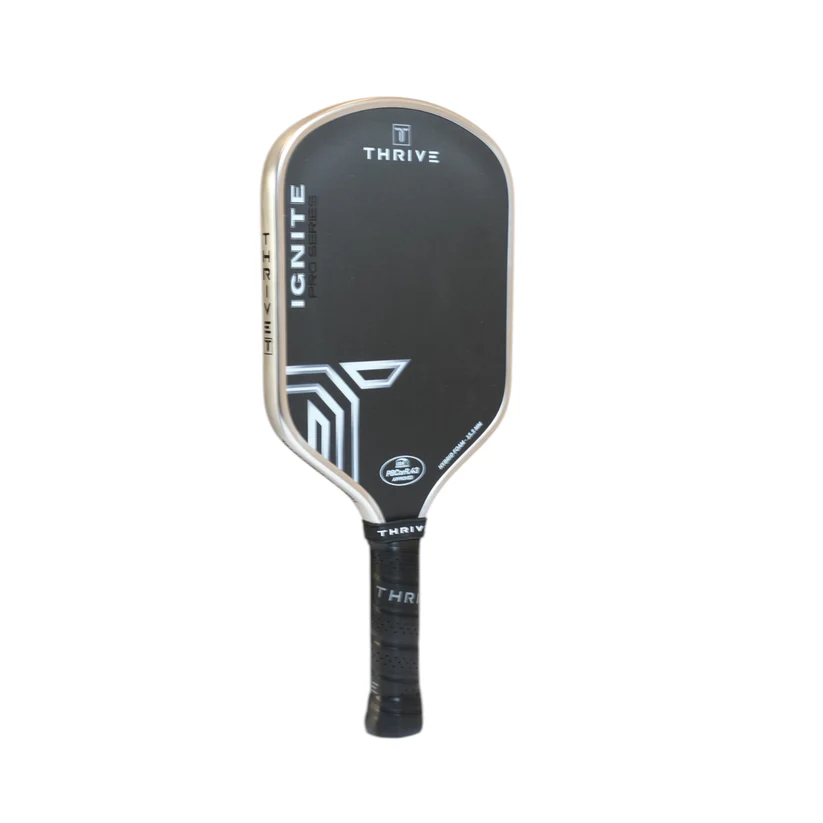
Confirmed Launch Specs
| Shape | Hybrid |
| Release year | 2026 |
| Current status | Available |
| Paddle length | About 16.25 to 16.3 inches |
| Paddle width | About 7.5 to 7.75 inches |
| Core thickness | 15.5mm |
| Core construction | EPP foam core with TPE foam ring |
| Face build | 4 layers total: 3 T700 carbon fiber layers and 1 fiberglass layer |
| Surface | Peel ply with added Clear Fusion grit layer |
| Handle length | About 5.375 to 5.5 inches |
| Grip circumference | 4.125 inches |
| Weight | About 7.95 to 8.05 ounces |
| Swing weight | Roughly 111 to 114 |
| Twist weight | About 6.4 to 6.6 |
| Approval | USA Pickleball approved |
| Additional certification | PbCor43 certified |
| Manufacturing process | Thermoformed |
| Color options | Chrome and Chrome Cherry |
| Warranty | 12 month limited warranty |
| Included extras | Custom weight card, paddle cover, clear edge guard tape, woven key chain, and lead weights |
| Price | $219.99 |
Source: Manufacturer launch specifications and publicly available release information available at the time of writing. These are confirmed launch specs, not full independent match-play validation.
Availability: Check current pricing and availability
Important: These specs are confirmed. Their match-play value is still unproven.
The Real Tension With Foam Paddles
Foam paddles are not new anymore, but players are still trying to figure out which ones stay trustworthy when the game gets fast, messy, and unforgiving. Easy power already got the market’s attention. What still feels unsettled is which builds stay playable once dinks, resets, and hand battles stop feeling clean.
This is the fight happening inside the whole foam category right now. Players want free offense, but they do not want a paddle that starts freelancing the moment the exchange gets ugly. They want put-away juice without losing touch, shape, and nerve. That is the tension the Thrive Ignite appears to be stepping into, and it is why this launch matters beyond one brand or one spec table.
What caught my attention was not just that Thrive chose a hybrid shape. It was choosing one on its first foam release. A lot of brands introduce power by chasing reach and leverage because that is easier to market. Thrive appears to be aiming at balance first. Whether that actually works is still unknown, but it is a different design philosophy than the usual “make it longer, make it hotter, let the player figure it out” approach.
Instead of chasing a louder version of what already exists, the Ignite appears to be chasing a more usable version of it.
- a three-foam architecture built around an EPP foam core, a TPE foam ring, and added foam support in the lower corners
- internal weighting to help stability and sweet spot behavior
- a hybrid shape instead of forcing this into an elongated-only lane
- a durability-minded grit approach instead of relying on raw texture alone
It is also entering the market at a premium price point, which raises the stakes. If a paddle is going to live around the $220 range, players are not looking for flash. They want a real reason to believe it solves something the rest of the category has not solved cleanly yet.
This is the core signal inside the release: not “how explosive can we make it?” but “can we make foam power feel more playable over the full shape of a match?”
What Those Specs Might Mean
Based on the build alone, a few possibilities stand out. These are design-based inferences, not finished performance conclusions.
Design Signals
- Multi-foam structure: likely aimed at smoother energy transfer instead of a one-note foam response
- Fiberglass support layer: may help soften the feel compared with a stiffer all-carbon style build
- Hybrid shape: suggests a balance-first design, not a max-reach elongated power play
- Internal weighting: appears intended to improve stability and sweet spot behavior
- Average swing weight with moderate twist weight: suggests Thrive may be trying to keep the paddle maneuverable without giving up too much stability
- Slightly higher balance profile on paper: hints that the paddle may carry a little more forward presence than some hybrids while still staying out of full elongated territory
Those signals do not all point to the same outcome. They stack into a pretty specific possibility: a paddle that still carries offense, but does not behave like it is trying to detonate every neutral ball.
- More controlled power: the multi-foam layout and fiberglass support layer could soften the experience compared with more abrupt foam power paddles
- Less always-on pop: this may reward committed swings more than frantic hand battles
- Better stability for a foam build: internal weighting could help reduce some of the dead-zone or uneven-response issues players worry about
- Longer spin life: the Clear Fusion grit concept suggests Thrive is trying to improve durability, not just launch-day texture
The real question is not whether the Ignite can create offense. It is whether Thrive found a way to make foam offense feel playable when the hands speed up, the contact gets ugly, and the match stops being comfortable.
Typically, foam paddles lean toward one of two flavors: stiff and hollow, or powerful and a little chaotic. If the Ignite lands in a denser, more connected lane with better control, that would make it more than just another foam release.
That feel lane is a big part of why this launch stands out. Early signals point less toward the classic stiff and hollow foam response and more toward something denser, calmer, and easier to use. For players who have been foam-curious but did not love the idea of a paddle feeling too hot or too hollow, that distinction matters.
The Clear Fusion grit story also deserves attention. A lot of launch copy talks about spin, but not every brand makes durability part of that same conversation. Thrive is clearly trying to position this surface as more than a fresh-texture headline by tying spin potential to longer-term surface life, which is exactly the kind of claim worth watching in a premium release.
How It Looks Different from a Typical Foam Paddle
| Typical Foam Paddle Concern | What the Ignite Appears to Be Chasing |
|---|---|
| Too much instant pop | More controllable activation |
| Hollow or disconnected feedback | Denser, calmer response |
| Uneven sweet spot behavior | More stability through internal weighting |
| Launch-day spin, short-term grit | A durability-minded surface story |
| Elongated-only power personality | Hybrid-shape playability |
Who This Release May Interest
Players Likely to Watch This Closely
- players curious about foam paddles but cautious about control issues
- players who feel current power paddles get too reactive in soft exchanges
- players who want offense without living on the edge of every reset and dink
- hybrid-shape players looking for a foam option that is not trying to drag them into elongated territory
- players who like modern power but still want a paddle that feels playable for full-match use
- players tired of needing to tinker with weight just to make a paddle settle down
Players Who May Want to Wait for Court Testing
- players who want max pop above everything else
- players who love ultra-reactive counter behavior
- players who prefer a pure elongated power shape
- players who want a finished verdict before spending premium money
- players who only care about immediate put-away violence and not broader manageability
This is not the part where I tell you to buy it. It is the part where I tell you who may want to keep this release on the radar as more testing comes in.
If you have ever liked the idea of a power paddle but hated feeling like you had to manipulate your swing, baby your resets, or bolt extra weight onto the frame just to trust it, this is exactly the kind of release worth tracking.
It is also interesting for players coming from elongated paddles who have been thinking about a move toward hybrid for faster hands, cleaner hand battles, and a little less work at the kitchen line. Since this release opened in a hybrid shape, that alone may put it on the radar for players who want modern power without committing to a full elongated profile.
On the other hand, if your favorite thing in the world is instant pop, fast counters, and a paddle that feels like it is always trying to speed the game up, this may or may not be your lane. That is the kind of question full play testing should answer more clearly.
What We Still Do Not Know Yet
This is the trust section, because this is where a lot of early-release articles start floating off into la la land. I am not doing that here. A paddle does not earn trust because a launch sounds clever. It earns trust when the ball gets heavy, your feet get late, and the thing still helps instead of betraying you.
There are still real questions that matter:
- Does the activated-power idea actually stay controllable under pressure?
- How forgiving is the sweet spot compared with other foam builds?
- Does a denser response reduce put-away power in fast exchanges?
- How well does the grit hold up over real use, not just early impressions?
- Does the balance point affect hand speed enough to matter at the kitchen line?
- Will this feel connected and stable over time, or just promising out of the wrapper?
Those answers will decide whether the Ignite is simply an interesting launch or a release that earns real staying power in the foam conversation this year.
Why This Release Belongs on the Radar
Coach Sid’s read: The most interesting thing about the Thrive Ignite is not that it might hit hard. A lot of paddles can do that. The interesting thing is whether Thrive has finally built a foam paddle that still acts like your teammate once the point gets hectic.
Related Reading
- Best foam-core pickleball paddles.
- USA Pickleball and PBCoR approval standards
- Best control paddles
- Best power paddles
What Comes Next
If you already know this is your kind of experiment, you can check current pricing and availability here. If you have been burned by hot paddles before, I would wait for the full review. That is not fence sitting. That is discipline.
The full review is where the Thrive Ignite either earns a spot in the serious foam conversation or gets sent back to the lab in my head. That next step has to answer the stuff that actually matters: pressure handling, forgiveness, feel quality, spin retention, matchup value against other foam power paddles, and whether this on-paper idea of controlled offense still holds together when the match gets mean.
- placement inside the broader best paddles conversation
- a full Thrive Ignite review once deeper testing is complete
- comparisons against other foam power paddles and hybrid power options
Questions Players Will Probably Ask
No. This is a first-look design analysis now that the Thrive Ignite is available. The paddle still needs extended court testing before I treat it like a finished performance review.
Because the Ignite appears to be targeting a harder problem than raw pop: keeping offense usable when resets, counters, and touch shots start deciding points.
The early difference is not just that it uses foam. It appears to be built around a multi-foam concept, internal weighting, hybrid geometry, and a more stability-minded design direction.
It may be especially interesting to players who want modern offense but do not want to live with a paddle that feels too hot, twitchy, or exhausting in soft hands and pressure exchanges.
Not on paper. The launch profile looks more like controlled offense than all-out chaos, which is exactly why competitive players may care.
The real unanswered questions are whether the Ignite stays stable under pressure, forgives enough across the face, keeps its grit, moves fast enough at the kitchen, and still feels connected deep into real match play.
Final Take: Intriguing Is Easy. Trust Is Hard.
The Thrive Ignite looks more interesting than a standard foam launch because it does not appear built to win the simple loudest-pop contest. It appears built to test whether this category can deliver offense in a form players actually trust over time.
If Thrive pulled that off, the Ignite could become one of the more thoughtful foam releases of the year. If not, it will join the long list of paddles that sounded right on paper but never earned lasting trust once real match play exposed the gaps.
That is why this preview matters now. Not because the verdict is already in, but because this is exactly the kind of release that could either earn real trust or expose the same old foam problems all over again.