How to Improve at Pickleball With Purposeful Practice
Playing more pickleball can make you more experienced without necessarily making you much better. You may recognize more situations, feel more comfortable on court, and learn how your regular opponents play. But if the same third-shot miss, transition error, short return, or rushed speedup keeps appearing, extra games alone may only give the mistake more repetitions.
A useful improvement cycle usually begins with a narrower question:
What is the biggest repeatable limitation in my game, and what kind of practice would actually change it?
Quick answer
To improve at pickleball, stop collecting random tips and give one repeatable problem a complete improvement cycle. Find it in real matches. Trace it to the cause. Practice it in an environment where it can actually change. Then put it back into live play and measure the behavior, not just whether you won the game.
You do not need to rebuild every part of your game. You need to decide what deserves your attention now, how to train it, and whether the change survives a real point.
GROW starts once you have something specific worth fixing. If you are still deciding what success should mean this season or how you will recognize progress, start with the SCORE framework for pickleball goals and progress. If the bigger question is which part of your game deserves attention, the PickleTip Skill Hierarchy can help you choose a priority. Once you have that priority, GROW turns it into practice: gather evidence, identify the cause, train the right thing, then see whether the correction survives real play.
You Do Not Need Six Things to Work On
Most players do not lack improvement ideas. They have too many of them.
One video says to add topspin. Another says to soften your grip. A stronger player tells you to drive the third shot. A coach notices your feet are still moving at contact. You miss a backhand on game point and decide the backhand is the problem. By the end of the week, you have six priorities and no real plan.
Improvement becomes more manageable when you separate three questions:
- What repeatedly breaks down?
- Why is it breaking down?
- What environment gives me the repetitions needed to change it?
The first question identifies the symptom. The second finds the cause. The third selects the training method.
PickleTip principle
Do not choose a drill because it looks useful. Choose it because it addresses a problem that repeatedly appears in your matches.
Why More Games May Repeat the Same Mistake
Games are excellent for decision-making, adaptation, anticipation, partner coordination, and pressure. They are often inefficient for rebuilding a specific movement because the needed situation may appear only a few times.
Suppose your third-shot drop is inconsistent. In three recreational games, you might receive:
- a handful of returns deep enough to require a true third-shot decision;
- different speeds, spins, and locations;
- interruptions between attempts;
- pressure to avoid the developing shot after a miss;
- no reliable feedback about whether the mistake came from balance, contact, trajectory, target, or decision-making.
That environment is valuable once the skill exists. It is not always the best place to build it.
At the opposite extreme, a cooperative drill can provide dozens of repetitions but remove the uncertainty that makes the skill difficult in a game. This is why a player may look good during drilling and abandon the correction as soon as the score begins.
The solution is not choosing games or drills. It is using each environment for the job it does best.
What motor-learning research adds
A 2024 systematic review and meta-analysis of contextual interference and transfer found an overall transfer advantage for more random practice, but the effect was smaller and not statistically significant in applied settings. A companion meta-analysis on retention also found a benefit from higher contextual interference overall. I take that as support for a progression, not a slogan: use predictable repetitions when a correction is fragile, then add enough variability and uncertainty to find out whether the skill can survive changing conditions.
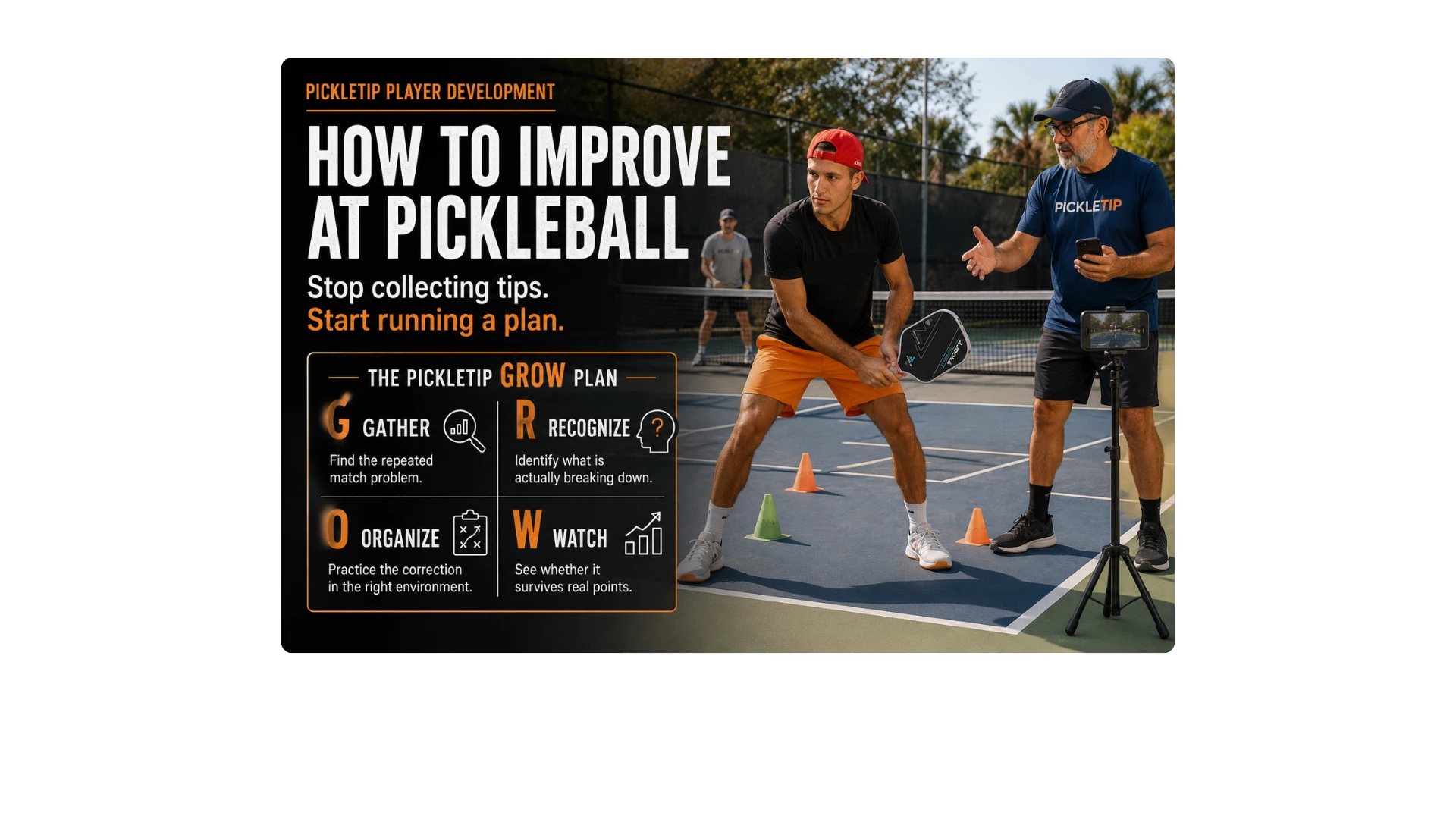
The PickleTip GROW Plan
I use four steps to keep improvement from turning into a pile of unrelated tips. Coach AJ and I developed this plan after years of drilling, playing, and film study. The PickleTip GROW Plan moves from the first match observation to the moment the correction has to survive a real point:
The GROW Plan
- G — Gather evidence: Find the repeatable match problem instead of reacting to one memorable miss.
- R — Recognize the real limitation: Figure out what is actually causing the result.
- O — Organize purposeful practice: Match the practice environment, target, and feedback to the problem.
- W — Watch the change in real points: Test the correction under uncertainty and decide whether to repeat, revise, drill, or move on.
Those four steps are enough to run the cycle. If you get stuck on the diagnosis or the practice itself, that is when the other tools become useful.
GROW becomes useful once you have played enough real points to notice that something keeps happening. From there, the job is figuring out what is causing it and what kind of practice could actually change it.
A GROW cycle in one example
A transition reset keeps popping up. Gather shows the miss happens repeatedly while the player is moving forward. Recognize traces the problem to balance rather than soft hands. Organize uses predictable transition feeds to build the stop before contact, then adds changing feeds. Watch tracks whether that stop survives real points before judging every reset by whether the ball landed perfectly.
Which GROW step are you stuck on?
| What keeps happening | Start here |
|---|---|
| You do not know what to practice. | Gather: Look for one repeated match situation. |
| You keep choosing corrections that do not help. | Recognize: Trace the rally to the earliest controllable breakdown. |
| You understand the problem, but practice is not changing it. | Organize: Change the repetitions, feedback, variation, or pressure. |
| It works in practice but disappears during games. | Watch: Test it through intentional play and scored uncertainty. |
G: Gather Evidence From Real Matches
The loudest error is not always the most important one. A missed putaway may be memorable, but the point may have become difficult because of a short return three shots earlier. A player may blame a backhand dink while the real issue is late preparation or reaching instead of moving the feet.
Gather evidence from several sources:
- Match notes: Write down repeated situations immediately after playing.
- Recorded matches: Use the PickleTip FILM method for pickleball video analysis.
- Partner observations: Ask what repeatedly places the team under pressure.
- Coach feedback: Use an experienced outside view when the cause is unclear.
- Simple tracking: Count a small number of relevant events rather than every statistic available.
If you need a structured way to review a completed match, use the REVIEW framework for post-match review. If you have several possible weaknesses and are still deciding which recurring leak deserves attention, use the LEAK framework. If REVIEW or LEAK already showed you what keeps going wrong, that becomes the starting point for GROW.
Look for patterns that appear across several games:
- returns landing short;
- third shots being contacted while off balance;
- transition balls attacked from below net height;
- players arriving at the kitchen without completing a pickleball split-step;
- dinks being contacted late or too close to the body;
- partners separating when one player is pulled wide;
- shot selection changing when the score becomes tight.
You do not need a professional analytics system. You need enough evidence to distinguish a pattern from normal variation.
When I review a match, I do not stop the video at the miss and stare only at the paddle. I rewind the rally far enough to see when the player first lost balance, position, time, or a clear decision. The problem worth fixing often begins before the ball everyone remembers.
I learned the same lesson years ago while watching players at City Park. I was sidelined with a sore Achilles and spent the morning observing instead of playing. Jenn kept trying to hit transition balls while she was still moving. She did not realize that was the pattern. I pointed it out and remembered the Red Light Green Light drill AJ had taught me. She took the idea into her next match and played better. What mattered was not that I had found a clever drill. The useful sequence was observe the repeated breakdown first, identify the movement problem, then choose a drill that matches it.
Better evidence
“I missed three drops today” is weak evidence. “On five deep returns, I attempted the drop while drifting backward and contacted four below my preferred contact point” gives you something trainable.
R: Recognize What Is Actually Breaking Down
The same visible error can come from different causes. A third-shot drop that lands in the net may involve mechanics, movement, recognition, target selection, pressure, or fatigue. Choosing the wrong cause leads to the wrong practice.
Coach Sid’s diagnostic rule
Do not automatically coach the last thing that went wrong. Trace the rally backward until you find the earliest problem the player could actually control. That is usually a better place to start the correction.
| Type of limitation | What it looks like | Example |
|---|---|---|
| Technical | The movement, paddle path, contact, or control is unreliable even in a predictable drill. | You cannot consistently produce a soft drop from a comfortable feed. |
| Recognition | You can execute the skill, but you recognize the right ball or situation too late. | You attack balls below net height because you read them as attackable too late. |
| Tactical | The shot is executable, but the option or target does not fit the situation. | You drive a difficult return at two established opponents when a drop offers more margin. |
| Positional | Your location, balance, spacing, or recovery makes the next shot unnecessarily difficult. | You crowd the kitchen line, get jammed, and blame the volley. |
| Partnership | Team movement, responsibility, communication, or target selection creates the breakdown. | Both players cover the sideline while the middle opens. |
| Mental | The behavior changes under pressure, after mistakes, or when the score becomes important. | You stop using the developing drop after one miss and revert to a low-percentage drive. |
| Physical | Mobility, balance, strength, endurance, discomfort, or recovery limits execution. | Your preparation becomes late near the end of longer games because your legs are fatigued. |
More than one limitation may contribute, but choose the one that appears earliest in the breakdown and offers the clearest correction.
Sometimes two causes are close enough that I test one correction first and watch whether the pattern changes. Diagnosis is not always clean on the first pass.
Partnership problems are especially easy to mislabel. If both players reach for the same middle ball, the answer may not be “communicate more.” The earlier problem may be that neither player knows who owns the ball when one partner is pulled wide. That needs a shared rule and repeated team movement, not louder last-second yelling.
O: Organize Practice Around the Problem
Then practice it somewhere the problem can actually change. Some corrections need clean, predictable repetitions. Others need changing balls, decisions, movement, or a score attached.
| Problem | Best starting method | Purpose |
|---|---|---|
| Movement or contact is unreliable | Controlled drill | Build the basic technique with predictable repetitions. |
| Placement lacks control | Target-zone practice | Connect technique to a useful court outcome. |
| The player reads the ball too slowly | Variable feeds | Make the player read the ball before choosing the shot. |
| Shot selection is poor | Scenario practice | Repeat the same situation and test which choice gives the best margin. |
| The skill disappears under pressure | Constraint game or intentional play | Test the correction with scoring and uncertainty. |
| The cause remains unclear | Video review or coaching | Improve the diagnosis before adding repetitions. |
| Physical capacity limits the skill | Appropriate off-court work | Work on the physical limitation safely instead of piling more repetitions onto it. |
Use the pickleball drills guide after you know which movement or decision needs repetitions. Use the pickleball practice guide when you are ready to organize those repetitions into a session.
W: Watch for the Change in Real Points
A drill result matters only if it changes what happens during points. Once the movement or decision becomes reasonably reliable, test it in a game through intentional pickleball.
Watch for four levels of transfer:
- Recognition: Did you notice the situation?
- Decision: Did you choose the intended behavior?
- Execution: Did you perform it with adequate balance, technique, and margin?
- Effect: Did it create the court outcome you were trying to produce?
Do not skip directly to the result. A correct decision can produce a miss. An incorrect decision can produce a winner. Improvement becomes clearer when you evaluate the process in order.
Pressure exposes a different kind of failure. A player may use the developing drop comfortably in a drill, then drive three difficult returns in a row once the score reaches 7–7 because one earlier drop clipped the tape. The mechanical skill did not disappear. The decision changed when the miss started to feel expensive.
When drills stop helping
A drill has done its job when the correction is reliable enough to become uncertain again. That means removing the guarantee that you know which ball or situation is coming next. Add changing feeds, decisions, movement, scoring, and live opponents. If the skill only works when you know exactly what is coming, it is not ready yet.
How to Use Target Zones: A Cone Is Not the Goal
Target zones make practice more specific, but a cone is not the real objective. The zone should represent an outcome you need during a rally.
Target-zone rule
The cone is not the goal. Choose the rally outcome first, then place the target where the ball must land to create it. A useful target teaches depth, time, movement, pressure, or recovery, not just accuracy.
| Skill | Useful target zone | Purpose of the target |
|---|---|---|
| Serve | A large deep zone rather than the final inches of the baseline. | Push the returner back while preserving enough margin to keep the serve reliable. |
| Return | Deep middle or a deep lane chosen for the opponent. | Create time to reach the kitchen and reduce the serving team’s easy angles. |
| Third-shot drop | A playable kitchen zone with safe net clearance. | Make the next contact difficult enough to earn forward movement. |
| Dink | A zone that moves an opponent or protects your partner. | Create pressure without using unnecessary risk. |
| Reset | A soft landing area that prevents an aggressive volley. | Neutralize pressure and earn time to regain position. |
| Volley | A deep middle or controlled space away from an opponent’s strongest counter. | Maintain advantage while keeping the next ball predictable. |
A target can also be too precise. If you are rebuilding contact or balance, demanding that every ball hit a tiny cone may encourage guiding the ball, changing the swing, or judging good attempts as failures.
Begin with a large meaningful zone. Reduce it only when control improves without damaging the movement.
Give the Weakness a Job You Can Measure
Vague goals describe a topic. Useful goals describe a behavior.
This is narrower than the season-level goal setting in SCORE. You are not redefining what success means. You are giving one improvement cycle a behavior you can actually observe so you can tell whether the correction is working.
| Vague goal | Specific improvement goal |
|---|---|
| Improve my serve. | Use the same routine and land at least seven of ten practice serves in a large deep target zone without increasing effort. |
| Get better at drops. | Establish balance before contact and send the drop high enough over the net to land in a playable kitchen zone. |
| Improve my footwork. | Complete a split-step before the opponent contacts every ball while I move through transition. |
| Make fewer errors. | On balls contacted below net height, choose a neutral reset instead of an attack. |
| Communicate more. | Call middle balls early enough for both partners to continue moving without hesitation. |
| Be mentally tougher. | Use the same between-point routine after an error and begin the next point with the planned serve or return target. |
A good goal should answer:
- What situation triggers the behavior?
- What exactly should change?
- What outcome should the change create?
- How will I observe or count it?
Use this sentence:
Improvement goal template
When __________________ happens, I will __________________ so that __________________. I will track __________________.
One-cycle worksheet
- Repeated situation: What keeps showing up in matches?
- Earliest controllable breakdown: Where does the point first become harder than it needs to be?
- Limitation type: Technical, recognition, tactical, positional, partnership, mental, or physical?
- Practice environment: Controlled drill, target work, variable feeds, scenario play, constraint game, video, coaching, or off-court work?
- Behavior to track: What should you notice, choose, or do differently?
- Transfer test: What would the correction look like during a real point?
- Next decision: Repeat, revise, return to drilling, get feedback, or move on?
Work in Short Cycles, Not Endless Projects
You do not need a rigid multi-month training calendar. Start with a short cycle long enough to collect repetitions and evidence but short enough to revise when the diagnosis is wrong.
If a calendar helps you stay organized, set a short review date. The number of useful practice and live-play opportunities matters more than choosing a supposedly ideal number of days.
A cycle does not need equal time in every kind of practice. A technical correction may need several controlled sessions before you add variation. A tactical mistake may need almost no mechanical work at all, you may move quickly from recognizing the situation into scenario play and live points.
Set a review point, then ask whether the behavior is improving. If it is stable in predictable practice, add variation. If it survives variation, test it in real points. If it falls apart, go back a step instead of pretending the cycle is finished.
The Reset Was the Miss. The Footwork Was the Problem.
Earlier I used the transition reset as a quick GROW example. Here is what that diagnosis actually looks like when you trace the point backward.
One of the easiest coaching mistakes is fixing the final visible error. A transition reset pops up, so the immediate advice becomes “soften your hands” or “open the paddle less.” Sometimes that is the correction. Sometimes the hands are only trying to rescue a body that never stopped moving.
Here is a common sequence to look for on video:
- The player hits a playable third-shot drop.
- The player runs forward without reading the opponent’s contact.
- The opponent volleys toward the player’s feet.
- The player reaches the ball while the body is still drifting.
- The paddle face changes as the player tries to regain balance.
- The reset pops up.
At full speed, the paddle face looks guilty. When you trace the point backward, the earlier and more useful problem is the incomplete stop.
The earliest controllable breakdown
Do not automatically fix the last thing that went wrong. Trace the rally backward and find the earliest breakdown you could control. The miss may happen at the paddle, but the useful correction may begin with the return, the feet, the spacing, or the decision made two shots earlier.
A better practice plan would be:
- build the stop before the feeder’s contact with predictable transition feeds;
- add variable feeds only after the player can establish balance;
- track whether the stop happened before tracking whether every reset landed perfectly;
- add scoring or a constraint game once the movement survives changing balls;
- test the behavior in live points through intentional pickleball.
The player may still miss a good reset. That does not erase the correction. First check recognition, decision, execution, and effect in that order. Movement and balance belong inside execution.
That is why you trace the point backward. Otherwise, you can spend an hour drilling the last thing that went wrong instead of the first thing that made the rally difficult.
How Much Should You Track?
Tracking can clarify improvement or become a second hobby that distracts from it. Use the smallest measurement that answers the current question.
Useful measures include:
- how often the relevant situation appeared;
- how often you recognized it;
- how often you attempted the intended behavior;
- how often the execution met a basic standard;
- whether the intended tactical outcome occurred;
- whether the old habit returned under score pressure.
Examples:
- Return depth: Seven of ten returns land in the selected deep zone, and you begin moving forward immediately after contact.
- Transition movement: You complete the stop before the opponent’s contact on six of eight relevant balls.
- Shot selection: You neutralize seven of nine balls contacted below net height rather than attacking them.
- Partner movement: Both players shift together on most wide balls instead of leaving the middle unprotected.
Winning percentage, rally length, and total errors may be interesting, but they can be influenced by opponent level, partner combinations, and match style. For one specific correction, the process measures usually tell you more.
When GROW Is Not the Right Tool Yet
GROW works best when you have a repeatable, observable problem that can move through an improvement cycle. Sometimes the problem is still too fuzzy for GROW.
| What is actually unclear | Use this first |
|---|---|
| You do not know what success should mean this season or how progress should be measured. | SCORE — define the destination and scorecard. |
| You finished a match and need to reconstruct what repeatedly happened. | REVIEW — run the post-match review. |
| You have several weaknesses and do not know which one is costing the most. | LEAK — identify the priority worth attacking. |
| Your established game has fallen below its normal baseline across multiple sessions. | TRACE — diagnose a sustained slump. |
If the visible error keeps changing and you need a deeper diagnosis, use the ERROR framework for recurring mistake patterns. If the skill exists but breaks down when pace, placement, pressure, or conditions change, use the RANGE/FLOOR framework for consistency.
If pain, mobility, or another physical limitation is preventing the correction, address that appropriately before increasing training volume.
Complete beginners may also need basic instruction before self-diagnosis becomes useful. And sometimes you simply do not have enough court evidence yet to separate a real pattern from one strange day. In those cases, more observation, video, or qualified coaching is more useful than forcing GROW to produce an answer.
If the same breakdown remains difficult to explain, a pickleball coach can help when you cannot distinguish cause from symptom, need immediate movement feedback, or keep repeating a drill without meaningful change.
Can You Improve at Pickleball on Your Own?
Yes, to a point. You can gather match evidence, keep notes, record video, use targets, and build some controlled repetitions without constant private lessons. The limitation is feedback: it is easy to repeat the wrong correction when you cannot see the real cause.
Solo work is strongest when the task does not require an opponent read, partner movement, live spacing, or score pressure. Use the pickleball practice guide for a full practice-session structure and the specialist practice pages for specific solo work. Here, the question is simpler: does the environment you chose give the current problem the feedback and uncertainty it needs?
How Often Should You Practice to Improve?
There is no universal number of sessions. Age, health, training history, recovery, court access, goals, and the difficulty of the correction all matter.
For the current correction, the better question is whether you are getting enough useful repetitions to change the behavior, enough variation to test it, and enough live points to see whether it transfers. One focused session can be more useful than several hours of unstructured play.
For a full practice-session structure, use the pickleball practice guide. For this cycle, you only need enough useful practice exposure to make the next evidence-based decision.
Recovery matters
Persistent pain, unusual fatigue, reduced coordination, or declining performance are not signals to add more repetitions. Adjust the workload and seek appropriate medical or training guidance when needed.
Common Pickleball Improvement Mistakes
Mistake
Choosing the most recent miss as the next training priority.
Better approach
Look for a pattern across several games and trace the rally to the earliest controllable breakdown.
Mistake
Practicing several unrelated skills in the same improvement cycle.
Better approach
Choose one limiting priority or one tightly connected pattern so feedback remains clear.
Mistake
Measuring only whether the ball landed in or whether the game was won.
Better approach
Evaluate recognition, decision, execution, and effect in that order. Movement and balance belong inside execution.
Mistake
Keeping a correction in controlled drills after it has become comfortable.
Better approach
Add variable feeds, scenarios, scoring, and intentional live play so the skill learns to survive uncertainty.
Frequently Asked Questions About Improving at Pickleball
There is no universally fastest method for every player. A practical improvement cycle is to identify one repeatable match limitation, trace it to the earliest controllable cause, choose the practice environment that matches that cause, and test the correction in live play.
Use controlled drills when movement or contact is unreliable. Add variable practice when you need to recognize changing balls. Use games, scored constraints, and intentional play when the skill exists but needs to survive uncertainty, partner interaction, and pressure. Most improvement plans need more than one environment.
Review several matches and look for the earliest repeatable breakdown you can control. Classify it as technical, recognition-based, tactical, positional, partnership-related, mental, or physical. Then choose the drill, scenario, target, live-play goal, video review, coaching, or off-court work that fits the actual problem.
Yes. You can improve independently with match video, notes, targets, and controlled practice, especially when the task does not require opponent reads or partner movement. Live spacing, decisions, and score pressure still require practice with other players, and outside feedback helps when the diagnosis is unclear.
There is no universal number of sessions. Practice often enough to give one current priority useful repetitions, variation, and live transfer opportunities while preserving recovery and movement quality. One focused session can be more useful than several hours of unstructured play.
Stop Collecting Tips and Start Running a Plan
Improving at pickleball is not about mastering every available shot at the same time. It is about finding the limitation that currently affects the most points, choosing the kind of practice that can change it, and watching whether the correction survives real play.
Gather evidence. Recognize the real limitation. Organize practice around it. Watch for the change in real points.
Then make the next decision from evidence instead of frustration.
Start here
After your next session, write down one repeated situation, not ten mistakes. Identify the earliest part you could control, classify the limitation, and choose one practice method for the next cycle. Now your next court session has a job.