
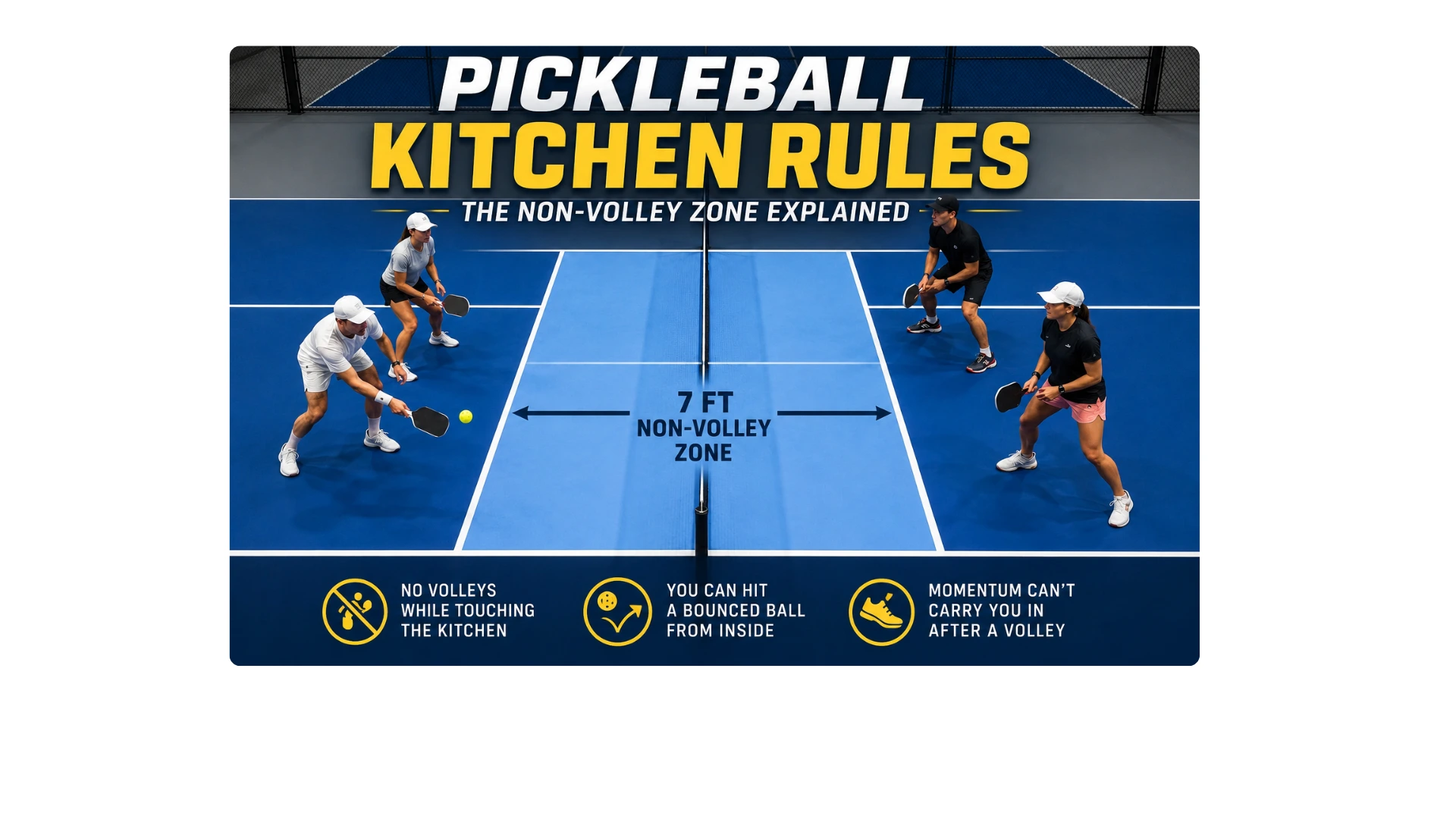
Pickleball Kitchen Rules: What You Can and Can’t Do in the NVZ
The pickleball kitchen rule is really a volley rule. The kitchen, officially called the Non-Volley Zone (NVZ), is the 7-foot area on each side of the net. You may enter it, stand in it, and hit a ball from it after the ball bounces. What you cannot do is volley while touching the NVZ or its line—or let momentum from your volley carry you into it afterward.
Kitchen Rule in One Sentence
You can be in the kitchen whenever you want until you volley. If you hit the ball out of the air while touching the NVZ, touch the kitchen line, or your volley momentum carries you into the NVZ, it is a fault.
🎧 Prefer listening? Coach AJ from PickleTip breaks down the pickleball kitchen rule in plain English:
Pickleball Kitchen Rules: Quick Answers
| Kitchen Question | Answer |
|---|---|
| Can you stand in the kitchen? | Yes. Being in the kitchen is legal by itself. |
| Can you step into the kitchen? | Yes. There is no rule requiring you to stay out of it. |
| Can you hit a bounced ball from the kitchen? | Yes. Once the ball bounces, you may play it from inside the NVZ. |
| Can you volley while standing in the kitchen? | No. Volleying while touching the NVZ is a fault. |
| Does the kitchen line count as the kitchen? | Yes. The NVZ line is part of the non-volley zone. |
| Can a serve touch the kitchen line? | No. A serve touching the NVZ line is short and a fault. |
| Can a return or rally ball land in the kitchen? | Yes. The special line restriction applies to the serve, not ordinary rally balls. |
| Can momentum carry you into the kitchen after a volley? | No. If the contact results from your volley momentum, it is a fault. |
| Can your paddle be above the kitchen during a volley? | Yes. The NVZ restriction concerns contact with the court surface, not the air above it. |
What Is the Kitchen in Pickleball?
The kitchen is the common nickname for the Non-Volley Zone. Each player’s NVZ extends 7 feet from the net and from sideline to sideline.
On a standard 20-foot-wide pickleball court, that makes each side’s non-volley zone 20 feet wide by 7 feet deep.
Most importantly, the non-volley-zone line is part of the NVZ. A toe touching the line is not “almost out.” For purposes of the volley rule, it is touching the kitchen.
| NVZ Measurement | Rule |
|---|---|
| Depth | 7 feet from the net on each side |
| Width | Sideline to sideline |
| Width on a standard court | 20 feet |
| NVZ line | Part of the non-volley zone |
| Common nickname | Kitchen |
If you’re wondering where the nickname came from rather than what is legal there, that is a different question. Read why pickleball calls the NVZ the kitchen.
Can You Go in the Kitchen in Pickleball?
Yes. You can enter the kitchen at any time.
That surprises newer players because “stay out of the kitchen” gets repeated so often that it starts sounding like an actual rule. It isn’t.
You can:
- walk through the kitchen;
- stand in the kitchen while a rally is happening;
- step into the kitchen before the ball bounces;
- hit a ball after it bounces in the kitchen;
- remain in the kitchen after hitting that bounced ball.
The restriction appears when you want to hit the ball before it bounces.
Coach Sid Note
“Stay out of the kitchen” is one of the worst shortcuts we teach beginners. It teaches players to treat the paint like out-of-bounds when the real restriction is the volley. The better cue is: “Bounce? Go get it. Volley? Check your feet.”
I know because I learned it that way too. On my third day playing pickleball, I wrote that one of the rules I was still trying to remember was “staying out of the kitchen when I slammed a ball.” Looking back, that was the exact beginner mental model I now try to undo. I was thinking of the kitchen as a place to avoid instead of asking the better question: did the ball bounce, and where are my feet if I volley?
What Counts as a Volley?
A volley is hitting the ball out of the air before it bounces.
If the ball bounces first, the shot is not a volley, so the basic non-volley-zone prohibition does not prevent you from playing that ball while standing in the kitchen. The separate two-bounce rule controls when volleys first become available after the serve.
That’s the distinction that settles most kitchen arguments:
The kitchen doesn’t prohibit shots from the kitchen. It prohibits volleys while you are in contact with the kitchen.
The Kitchen Is the Ground, Not the Air Above It
Here’s where the word “kitchen” trips people up again.
The non-volley zone is a court area. The NVZ rule does not create an invisible vertical wall rising seven feet from the net.
You can lean over the kitchen and volley with your paddle above the NVZ. Just keep yourself—and anything connected to you—from touching the zone during the volley action.
That doesn’t give you unlimited permission to reach across the net itself. Crossing the plane of the net is governed by separate rules. The unusual exception for a ball that bounces on your side and then returns across the net is covered in our reach-over-the-net rule guide.
The Kitchen Line Is Part of the Kitchen
If your shoe touches the non-volley-zone line while you volley, you are touching the NVZ.
There is no safe strip on the line because “most of my foot was outside.”
The same line also matters on a serve. A normal rally ball that lands on a court line is generally in, but the non-volley-zone line is an exception on the serve: a serve touching that line is short and a fault.
| Ball or Player Contact | Result |
|---|---|
| Your toe touches the NVZ line while volleying | Fault |
| A serve touches the NVZ line | Fault |
| A return of serve lands on the NVZ line | Legal |
| A dink lands on the NVZ line | Legal |
| A drop lands on the NVZ line | Legal |
How the Momentum Rule Actually Works
The most painful kitchen faults happen when the volley itself was legal.
You are outside the kitchen. You punch a clean volley. The ball is a winner.
Then your body keeps going.
I’ve watched hundreds of players teetering on the brink of falling into the kitchen after lunging for a high flick volley near the line. I especially enjoy watching Coach AJ there because he always seems to know exactly where his feet are.
If momentum from that volley causes you to contact the non-volley zone, the volley becomes a fault.
And the ball becoming dead does not rescue you. If your volley momentum is still carrying you and you subsequently touch the NVZ, the kitchen fault can occur after the ball has already become dead.
The ball can be finished before your volley is finished. Your body still has to complete the volley action without momentum carrying you into the NVZ.
Can you ever enter the kitchen after a volley?
Yes. This is where the word momentum matters.
Hitting a volley does not put the kitchen off-limits for the rest of the point. Once your volley momentum is over, you can step into the kitchen. The rule follows the momentum, not the fact that you hit a volley earlier.
So don’t teach this as:
“You can never step into the kitchen after a volley.”
Teach it as:
“Your volley momentum cannot take you into the kitchen.”
My Coaching Cue
After a volley near the line, think anchor. Hit the ball, control your balance, and make sure you own your feet before moving forward. A winner does not buy you immunity from momentum.
What If Your Paddle, Hat, Clothing, or Partner Touches the Kitchen?
The NVZ rule is not limited to the bottom of your shoes.
It is not just your shoes. Your paddle, clothing, hat, or anything else you are wearing or carrying can cause the fault if your volley action brings it into contact with the NVZ. USA Pickleball’s official rules summary specifically says momentum cannot carry you—or anything you are wearing or carrying—into the non-volley zone.
Can your partner stand in the kitchen while you volley?
Yes. Your partner can legally stand in the kitchen while you volley from outside it.
The fault happens if your volley action creates prohibited NVZ contact—for example, your momentum carries you into that partner while they are touching the kitchen.
So this is legal:
- Your partner is standing in the kitchen.
- You are legally outside the kitchen.
- You volley without contacting your partner or otherwise creating an NVZ fault.
If You Step In, Get Both Feet Back Out Before You Volley
Suppose you step into the kitchen to play a dink after the bounce.
The next ball pops up.
You cannot jump from inside the kitchen and volley while airborne simply because you plan to land outside.
You must first re-establish both feet on the playing surface completely outside the NVZ before volleying.
| Starting Position | What Happens Next? | Legal? |
|---|---|---|
| Standing inside NVZ | Ball bounces and you hit it | Yes |
| Standing inside NVZ | You jump out and volley before both feet re-establish outside | No |
| Standing inside NVZ | You step out, establish both feet outside, then volley | Yes |
| Standing outside NVZ | You jump, volley, and land outside NVZ | Yes, assuming no other fault |
| Standing outside NVZ | You volley and momentum carries you onto the line | No |
Can a Serve Land in the Kitchen?
No. The serve must clear the non-volley zone and its line and land in the correct diagonal service court. If you want the rest of the service requirements, see the full pickleball serving rules.
A serve that touches the NVZ line is short.
After the serve, though, the kitchen does not prohibit the ball from bouncing there.
- A serve landing in the kitchen: fault.
- A return landing in the kitchen: legal.
- A dink landing in the kitchen: legal.
- A drop landing in the kitchen: legal.
- Any ordinary rally ball bouncing in the kitchen: legal.
The kitchen restricts where the serve may land and where a player may be touching while volleying. It does not make the NVZ an out-of-bounds area during the rally.
Kitchen Calls You’ll Actually See on Court
The basics are in the quick-answer table above. These are the calls that usually make everyone stop, point at the line, and start reconstructing what happened.
| Edge Case | Call | Why |
|---|---|---|
| You volley outside the NVZ, then your momentum carries you in | Fault | Your volley action is not finished until your momentum is under control. |
| You volley with your paddle above the NVZ while established outside it | Legal | The kitchen is court surface, not forbidden airspace. |
| You were in the NVZ, step fully out with both feet, then volley | Legal | You re-established both feet outside before the volley. |
| You jump from inside the NVZ and volley before both feet re-establish outside | Fault | Landing outside afterward does not fix where you started the volley action. |
| Your partner stands in the NVZ while you volley from outside it | Legal | Your partner’s location alone does not create your fault. |
| Your volley momentum carries you into a partner who is touching the NVZ | Fault | Your volley action caused contact with something already touching the zone. |
What About an Erne?
An Erne can look like somebody is breaking the kitchen rule because the player is airborne near the NVZ and attacking a ball close to the net.
The important NVZ question remains the same: where was the player established, and did the volley action create prohibited contact with the non-volley zone?
If you want to learn how to actually hit an Erne, I break that down in the Erne guide. For kitchen purposes, the question is simpler: did the player establish legally and avoid prohibited NVZ contact during the volley action?
Who Calls a Kitchen Fault?
In recreational play, calling your own obvious kitchen fault is the cleanest way to handle it. If your toe was on the line when you volleyed, you do not need a jury.
In non-officiated competition and officiated matches, fault-calling authority depends on the applicable USA Pickleball rules and whether a referee is present. For sanctioned play, use the current official rulebook rather than relying on a club’s house habit.
You can review the current USA Pickleball Official Rulebook. For the rest of the game—serving, scoring, the two-bounce rule, line calls, and common faults—use my pickleball rules guide for beginners.
Did the Pickleball Kitchen Rules Change in 2026?
The core kitchen rules covered here did not get a new on-court meaning in 2026. USA Pickleball substantially reorganized the rulebook, so old rule numbers can now point you to the wrong place even when the underlying concept is still familiar.
One kitchen-related example is the definition of the act of volleying. In 2025, that language appeared as Rule 9.B.1. In the 2026 rulebook, USA Pickleball moved it into the definitions section: the act starts when you hit the ball out of the air and ends when your follow-through movement or momentum stops. The practical rule did not change; its location did.
For us on court, the important parts have not changed:
- Do not volley while touching the NVZ or its line.
- Do not allow volley momentum to carry you—or anything you are wearing or carrying—into the NVZ.
- Re-establish both feet outside the NVZ after being inside before you volley.
- Remember that entering or standing in the kitchen is legal when you are not volleying.
If you are comparing this article with an older video or rule citation, use the current USA Pickleball Official Rulebook and the 2026 Rulebook Change Document rather than assuming the old rule number still matches.
Rules-status review: Rechecked August 19, 2026 against USA Pickleball’s current Official Rulebook, Rules Summary, and 2026 Rulebook Change Document.
The Five Kitchen Rules I Want Players to Remember
- You are allowed in the kitchen. Being there is not the fault.
- You cannot volley while touching the kitchen or kitchen line.
- If you were in the kitchen, get both feet re-established outside before volleying.
- Your volley momentum cannot carry you into the kitchen—even after the ball becomes dead.
- The kitchen is court surface, not forbidden airspace. Reaching above it is not itself an NVZ fault.
That’s the version I teach because players can actually use it while a rally is moving. You don’t need thirteen kitchen sayings rattling around in your head. You need to know whether the ball bounced, where your feet are, and whether your volley momentum is under control.
Bounce? Go get it. Volley? Check your feet. After the volley? Own your balance.




Very helpful guide.
“The airborne volley launch”.
We are probably not the first group of players to disagree with your conclusion about the plane of the kitchen. Unless we are lacking a total comprehension of your meaning, the plane of the kitchen is violated with many volleys where one’s body parts are across the kitchen plane but not touching the kitchen ground. Please correct your article or explain how one can hit an ERNIE. Thanks,
Thanks for catching that Paul. This was an older article that I misinterpreted the rules at the time, and have now fixed the verbiage.
You have the rule wrong.
You can go into the kitchen anytime. You just can’t volley while in there.
That is a very insightful observation, and thank you for bringing it up! You are absolutely right: a player can step into the Non-Volley Zone (NVZ) at any time during a rally. There is no rule against standing or walking in the kitchen.
My original article emphasized the rule that catches most people out, which is why I focused so heavily on it: the fault is only triggered when a player is touching the NVZ (or the line) during the act of volleying.
I’ve clarified the opening sections of the article to make this distinction much more obvious.
Your comment helped me make the guide much clearer for everyone, separating the simple act of movement from the rule about hitting the ball!
Thanks again for the sharp eye! Happy dinking!