Dinking in Pickleball: What It Is, Why It Works, and How to Build a Better Soft Game
Coach Sid Says
If you are confused about dinking in pickleball, welcome to the kitchen line, my friend. Good intentions get cross-examined up there.
Most players hear the word dink and think, “Oh, that just means hit it soft.” Calling that “just hitting it soft” is like calling gumbo soup. Technically, maybe. Spiritually, absolutely not.
A useful dink does more than land in the kitchen. It stays below a comfortable attack, protects your position, and gives the other team a small problem to solve. A bad dink can land in the kitchen and still get treated like a free appetizer.
Start here to understand what the dink is supposed to accomplish and which part of your soft game is actually leaking. When the motion itself needs work, use How to Dink in Pickleball. When the ball already behaves and you want to create pressure on purpose, move into the pickleball dinking game.
Quick Answer
A dink in pickleball is a controlled soft shot, usually hit from near the kitchen line, that lands in the opponent’s non-volley zone and stays low enough to limit an aggressive downward attack. Good dinking is not merely keeping the ball soft. It is controlling the ball well enough to change the opponent’s contact or improve your next one.
Who This Helps
Maybe your dinks float. Maybe they die in the net. Maybe they land in the kitchen but never make anybody uncomfortable. Or maybe you stay patient for four or five shots, then attack a ball that never deserved it.
Those misses are not all the same problem. Some come from the stroke. Some come from your feet. Others come from choosing the wrong ball at the wrong time. Let’s figure out which one keeps showing up in your game.
Find the Dinking Lesson You Need
- What Is Dinking in Pickleball?
- What Makes a Good Dink?
- Why Dinking Works at the Kitchen Line
- Safe Dink vs. Useful Dink
- The Main Types of Pickleball Dinks
- Where Should You Aim a Dink?
- When Does a Dink Become Attackable?
- When Should You Not Dink?
- What Keeps Going Wrong With Your Dinks?
- The PickleTip Dinking Learning Path
- Dinking in Pickleball FAQ
What Is Dinking in Pickleball?
Dinking in pickleball means using a soft, controlled shot to place the ball in the opponent’s kitchen while keeping it below a comfortable attacking height. The shot is usually played after both teams have reached the non-volley line, where a low ball can force the opponent to hit upward instead of swinging down.
A dink is different from a drop shot mainly because of where you hit it and what problem you are solving. A pickleball drop shot is commonly played from farther back in the court to help your team move toward the kitchen. A dink is normally played once you are already near the kitchen line and are trying to control a neutral exchange or make the opponent hit upward.
The official rules define and govern the non-volley zone, commonly called the kitchen, but they do not define a separate shot called a dink. Players use dink for the low, controlled ball that bounces in that area.
You can hit a soft ball into the kitchen from the transition zone, but I would usually call that a drop or a reset because you are solving a different problem: neutralizing pressure and earning your way forward. The kitchen-line dink begins once you are in position to control a neutral exchange.
Most dink rallies happen with all four players near the kitchen. Nobody wants to be the first person to float a meatball. The ball is not being crushed. It is being guided, lifted, pushed, rolled, redirected, or neutralized into a location that makes the next contact awkward.
Soft does not mean passive. A good dink can make a player bend, reach, shuffle, hesitate, contact the ball below the net, or wonder whether attacking it would be brave or foolish.
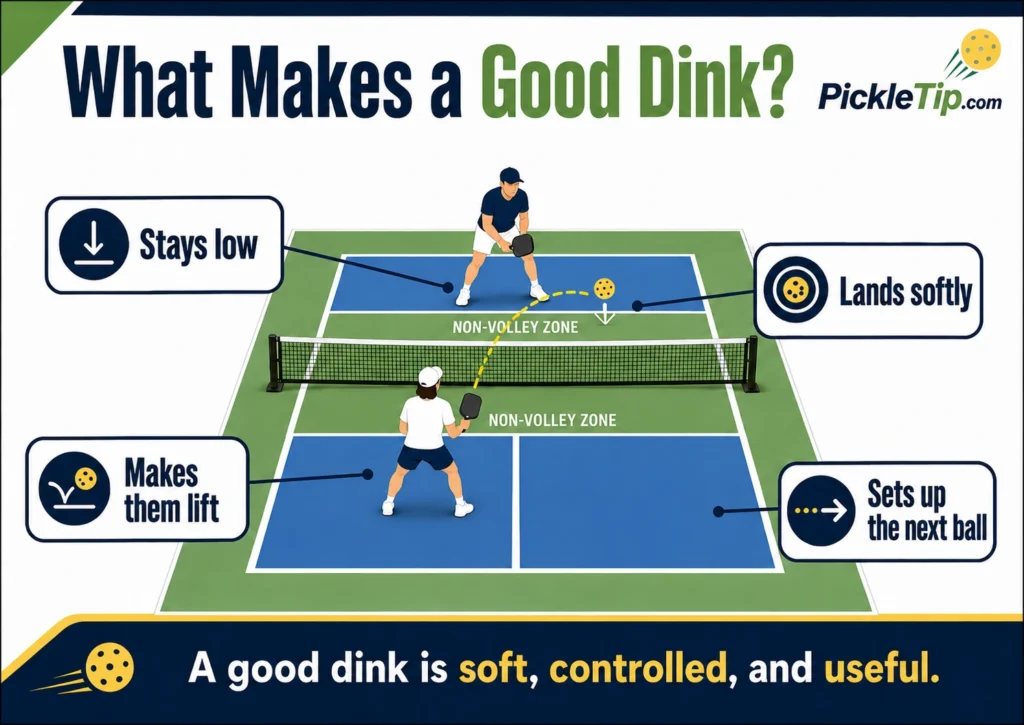
Coach Sid court note: When I watch newer players dink, I can usually tell within two balls whether they are trying to place the ball or simply survive the rally. The survival version often comes from feet that stop moving while the paddle face tries to rescue the ball at the last second. Survival dinking keeps the point breathing. Purposeful dinking makes the other team start doing math with their feet.
What Makes a Good Dink?
Coach Sid’s Four Jobs of a Useful Dink
A good dink does not need to skim the tape or paint a sideline. It needs enough margin to clear the net, a shape that brings the ball down, and a landing spot that does not give the opponent an easy downward swing.
1. It stays below comfortable attack height
The ball crosses and descends without sitting comfortably above net height. If it floats into the opponent’s strike zone, it is not doing dink work anymore. It is making a donation.
2. It lands with a reason
A safe target, a pressure target, and a recovery target are not always the same. Landing in the kitchen is only the first requirement.
3. It protects your structure
You should finish balanced enough to recover, protect the middle, and help your partner handle the next ball.
4. It improves the next ball
The best dinks make the next shot easier for you, harder for the opponent, or both. One dink may not win the rally, but it can shape what happens next.
If the ball lands in but leaves you falling sideways or gives the opponent a comfortable contact, it completed only part of the job.
When your dink motion itself is inconsistent, stay in the mechanical lane. Use the complete How to Dink guide to work through grip pressure, paddle path, contact, footwork, and trajectory before asking the ball to solve advanced kitchen problems.
Why Dinking Works at the Kitchen Line
Dinking matters because the kitchen line changes the geometry of the point. From farther back, players have more time and can use larger swings. At the non-volley line, the ball reaches you quickly, your feet are close to the kitchen, and anything left high can be attacked before you have time to apologize to your partner.
- It prevents easy attacks. A low dink makes the opponent contact the ball below or near net height instead of swinging comfortably downward.
- It helps you hold the kitchen line. A controlled next ball lets you stay balanced instead of backing away and surrendering court position.
- It changes pace. Dinking can neutralize opponents who want every exchange to become a hands battle.
- It exposes movement and balance. Repeated low contacts reveal who reaches, stands tall, loses patience, or struggles on one side.
- It creates attackable balls. You are waiting for a ball you can attack from balance—not trying to set a rally-length record.
This is why dinking is not the boring toll road before the fun part. It is how you keep possession of the kitchen line while waiting for the attack to belong to you.
One useful beginner lesson: dinking to the middle can be a smart neutral choice because the center of the net is lower, the target reduces extreme angles, and the ball can force the other team to communicate about who takes it. Middle is not automatically best. A predictable middle ball can become comfortable, but it gives developing players a bigger target with fewer ways to miss.
Safe Dink vs. Useful Dink
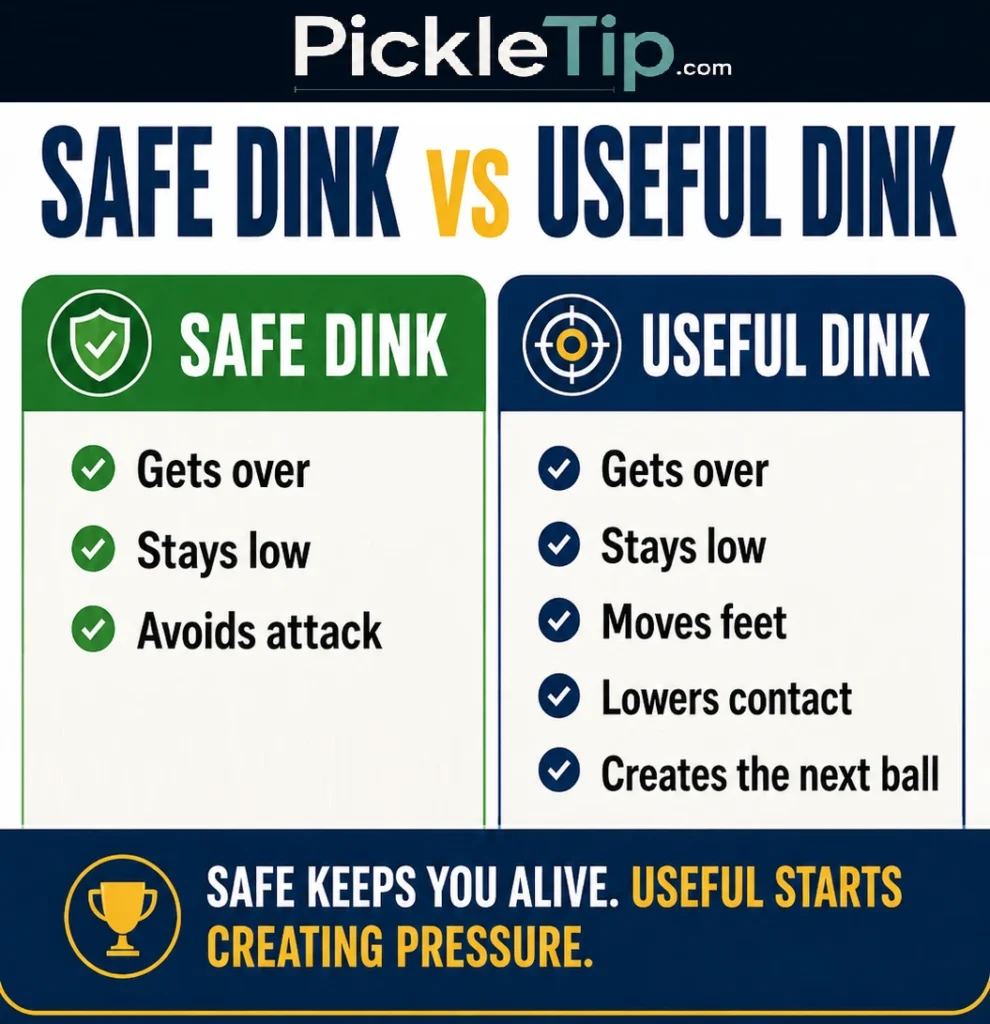
A safe dink gets the ball over without giving up an obvious attack. That is a necessary skill. It is also only the beginning.
A useful dink stays safe while creating a small problem:
- a lower contact point
- a late step
- an uncomfortable reach
- confusion between partners
- a predictable next shot
- a ball that sits up on the next exchange
Some players use dead dink as an informal name for the harmless version: the ball is in, but it has no real purpose and gives the opponent a comfortable contact. The problem is not that every neutral ball must create offense. Sometimes neutral is exactly what you need. The problem is sending the same comfortable ball over and over while expecting pressure to appear by itself.
Control → Placement → Pressure
Beginner dinking is about control. Can you keep the ball low without panicking?
Intermediate dinking is about placement. Can you send the same soft ball to a location that changes the opponent’s contact?
Advanced dinking is about pressure and decisions. Can you shape the next ball and recognize when the attack has actually been earned?
Once your basic dink is consistent, the dinking game is where you learn to use targets, patterns, pace, spin, posture, and partner positioning to turn safe contact into pressure.
The Main Types of Pickleball Dinks
You do not need twenty dink names rattling around in your head during a point. The names only matter when they help you recognize what job the shot is doing.
| Dink Type | Primary Job | Where to Learn More |
|---|---|---|
| Basic dink | Builds dependable soft contact, height control, and placement from the kitchen line. | How to Dink in Pickleball |
| Push dink | Guides the ball forward with controlled directional pressure instead of merely lifting it over. | How to Dink in Pickleball |
| Neutralizing dink | Uses a soft, conservative target to recover from a stretched or off-balance position at the kitchen line. | How to Dink in Pickleball |
| Cross-court dink | Uses the longer diagonal court and lower center of the net while creating wider movement. | Defending the Cross-Court Dink |
| Backhand dink | Handles balls on the backhand side with a stable paddle and controlled contact. | Backhand Dink |
| Stretch backhand dink | Neutralizes wide balls that pull the player outside a normal contact window. | Backhand Dinks on the Stretch |
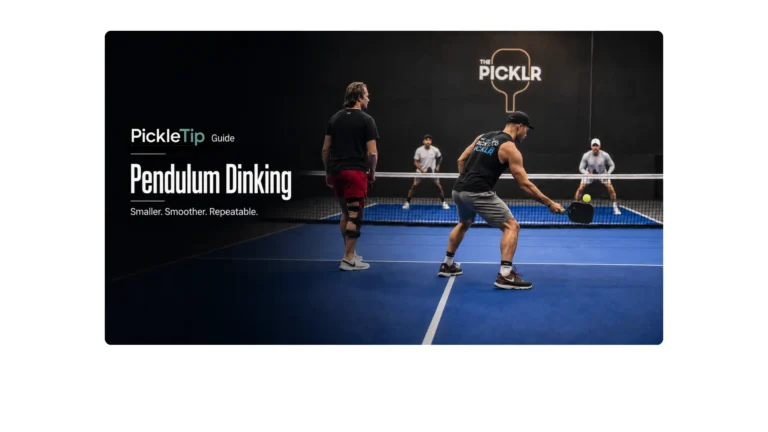
| Pendulum dink | Uses a shoulder-driven arc and quiet wrist to make the soft stroke easier to repeat. | Pendulum Dinking |
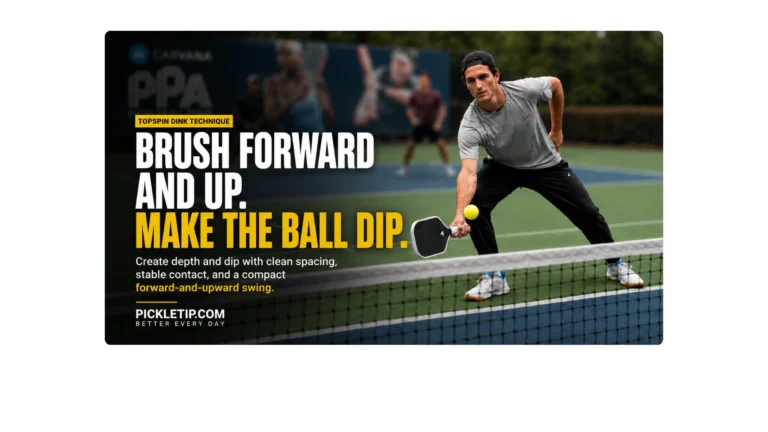
| Topspin dink | Uses brushing contact to create dip, bounce, and controlled forward pressure. | Topspin Dinks |
| Purposeful dink | Uses target, depth, pace, or spin to influence the opponent’s next shot. | Pickleball Dinking Game |
Call it whatever you want during a game. The simple checklist is better: low ball, useful target, balanced finish, ready for the next shot.
Where Should You Aim a Dink?
Common dink targets include the middle, the opponent’s feet, the outside foot, the front half of the kitchen for neutralization, and deeper kitchen space when you are balanced enough to apply pressure. Choose the target according to your position and the next ball you want, not because somebody told you one spot always wins.
| Target | Why Players Use It | Main Risk |
|---|---|---|
| Middle | Gives you a larger target, crosses a lower section of net, limits some angles, and can force partner communication. | A predictable middle ball can become comfortable if you never change the pattern. |
| Opponent’s feet | Encourages a lower contact and may force the player to lift or move backward. | A ball pushed too deep or high can become attackable. |
| Outside foot | Tests balance and lateral movement without requiring an extreme sideline angle. | Poor recovery can leave your own middle exposed. |
| Front half of the kitchen | Helps neutralize the rally when you are stretched, late, low, or off balance. | A short ball with too much bounce may let the opponent step forward comfortably. |
| Back half of the kitchen | Changes depth and can make opponents contact the ball near their feet or while retreating. | Depth without enough dip can feed an attack. |
| Sharp cross-court angle | Moves the opponent wider and opens court geometry. | It can expose an ATP lane, invite an Erne, or pull you outside your own recovery position. |
A simple target rule: when you are balanced, you can ask a harder question with depth, angle, spin, or the outside foot. When you are stretched, late, jammed, or below the ball, neutralize first and recover your position.
The outside foot is not a magic target. If reaching for it pulls you off balance, exposes your middle, or makes you contact the ball late, you created a problem for yourself first. A short neutralizing dink from bad balance can be the smarter shot; a deeper pressure dink belongs to the ball you can control.
Once you can control these targets, the Pickleball Dinking Game guide shows you how to combine them into patterns against real opponents.
When Does a Dink Become Attackable?
A dink becomes attackable when its height, location, your balance, and the opponents’ position allow you to accelerate without giving away more than you gain. Ball height matters, but height alone does not make the decision.
- The ball sits high enough for forward acceleration instead of an upward rescue swing.
- Your feet are under you and the contact is in front of your body.
- Your partner is prepared for the counterattack.
- The opponent is late, leaning, recovering, or holding the paddle in a vulnerable position.
- The ball is close enough to your body that you can control the direction.
Reset, Dink, or Attack?
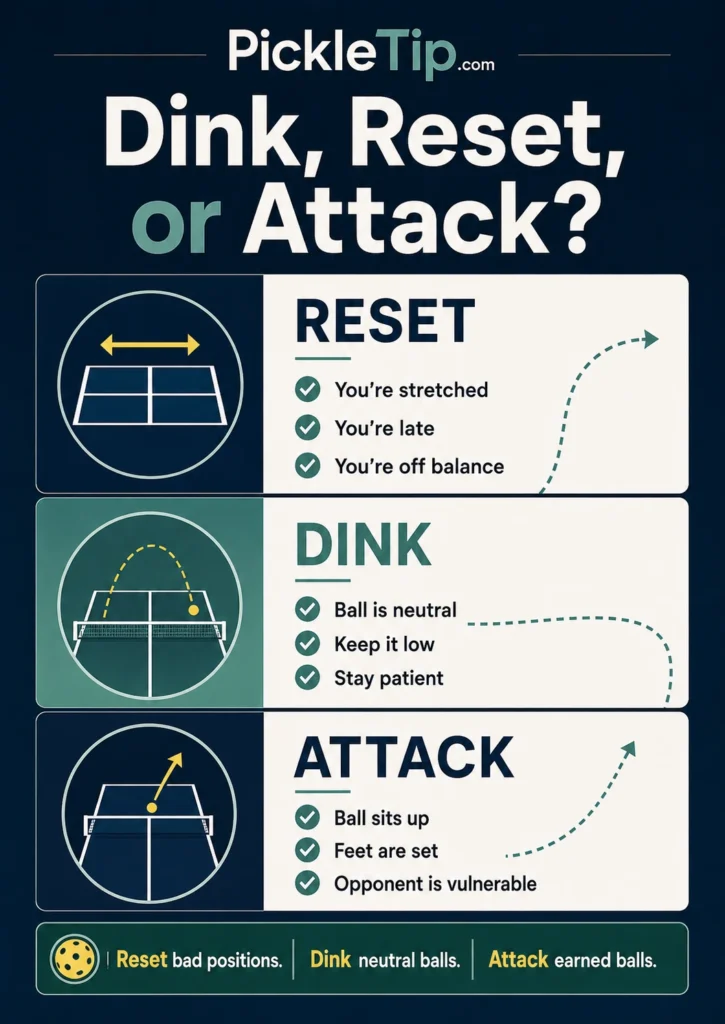
A reset gets you out of trouble. A dink manages a neutral exchange. An attack uses an advantage. The contact may be soft in the first two situations, but the job changes according to the ball, your balance, and where all four players are standing.
Your partner belongs in that decision. If you speed up while your partner is still upright, pulled wide, or holding the paddle low, you may be volunteering both of you for a hands battle only one person knew was starting. Before speeding up, notice whether your partner has recovered to the line, squared the shoulders, and brought the paddle back in front.
Reset, Dink, or Attack? Red, Yellow, and Green Lights
Red light: you are reaching, late, jammed, below the ball, or off balance. Keep it low, reset the exchange, and recover.
Yellow light: the ball is somewhat high, but your contact, partner readiness, or opponent position is unclear. Add controlled pressure or choose another dink instead of forcing the attack.
Green light: the ball sits up, your feet are balanced, your paddle is in front, your partner is ready, and the opponent is late or compromised.
Do not attack because the rally bored you. Boredom is not a tactical signal. It is just your paddle looking for snacks.
When Should You Not Dink?
The ball does not care that you planned to dink. Its height, your feet, your partner, and the other team may give you a better choice.
| Situation | Better Choice | Why |
|---|---|---|
| The ball sits high and you are balanced. | Attack or apply controlled pressure. | A passive dink may waste the opening your earlier shots created. |
| You are stretched, jammed, or reaching low. | Reset or neutralize. | Survive the bad position before trying to create offense. |
| The opponent is leaning or late. | Place the ball where recovery is difficult. | A purposeful soft ball may be better than an impatient speed-up. |
| You are bored in a neutral rally. | Stay patient or change the target. | Boredom does not make a poor ball attackable. |
The best soft game is not soft all the time. It is controlled until control earns something better.
What Keeps Going Wrong With Your Dinks?
When the same miss keeps showing up, do not collect another random dinking tip. Find the leak first. The ball usually tells you whether the problem is your contact, feet, paddle face, patience, or decision.
| What Keeps Happening | Likely Problem | Best Next Lesson |
|---|---|---|
| Your dink floats high or changes direction unexpectedly. | Grip tension, late paddle-face change, wrist movement, poor spacing, or contact behind the body. | How to Dink in Pickleball |
| Your wrist keeps flicking and the stroke has too many moving parts. | The paddle needs a simpler repeatable motion. | Pendulum Dinking |
| Your backhand dink pops up. | The elbow, wrist, posture, contact point, or footwork loses stability. | Backhand Dink |
| Wide backhand balls pull you off balance. | The ball has moved outside your normal contact window and your recovery pattern is late. | Backhand Dinks on the Stretch |
| Cross-court dinks drag you wide or expose the sideline. | Your slide, pivot, contact choice, or recovery position needs work. | Defending the Cross-Court Dink |
| Your basic dink is consistent, but opponents remain comfortable. | The shot lacks purposeful placement, depth variation, rhythm change, or tactical intent. | Pickleball Dinking Game |
| You want more dip and forward pressure without simply hitting harder. | You are ready to learn controlled brushing contact. | Topspin Dinks |
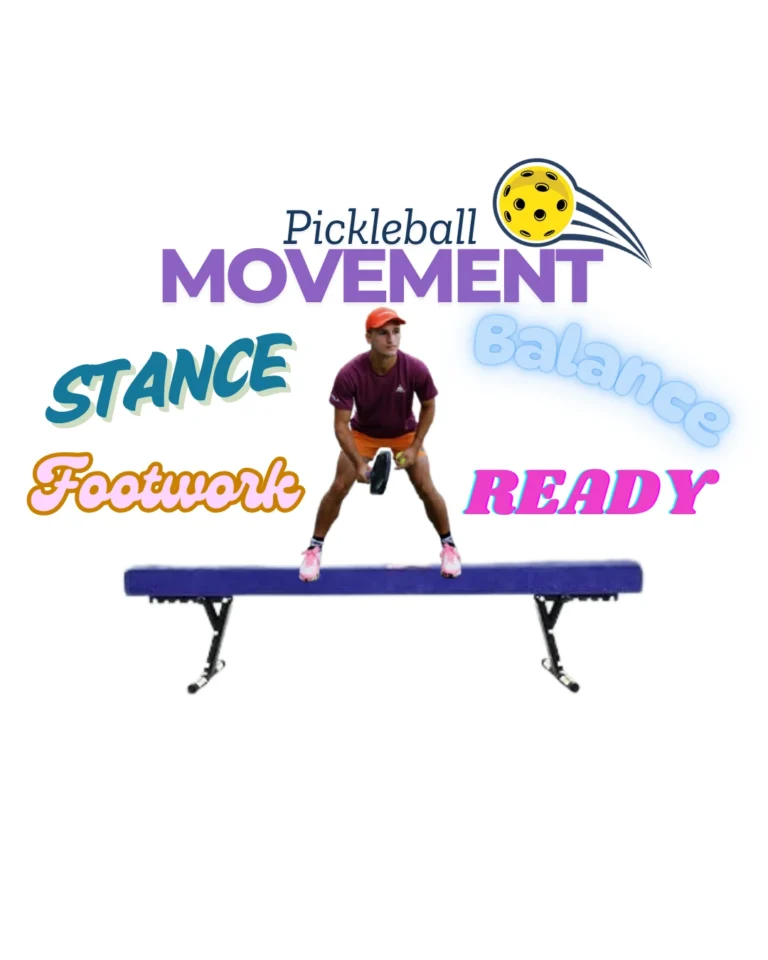
The leak I see over and over: players make two or three decent dinks, then the hand gets impatient before the feet are ready. The grip tightens, the wrist joins the meeting, and the next ball floats high enough to need its own warning label. Before rebuilding the swing, check whether the player stopped moving, crowded the bounce, or contacted the ball beside the body. Many pop-ups are not failures of knowledge. They are failures of balance, spacing, or patience. I see this most often when a player reaches for the bounce instead of moving around it. Once we get the feet closer and move contact back in front, the same paddle motion suddenly stops sending the ball shoulder-high.
The PickleTip Dinking Learning Path
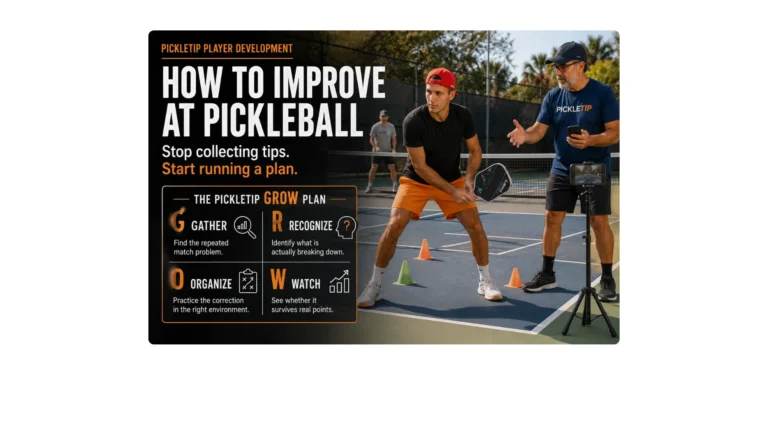
Stop collecting tips like loose pickleballs in the trunk. Start with the first part of your dinking game that is still breaking down, then follow the lesson that solves that problem.
| Stage | Your Question | Best Guide |
|---|---|---|
| 1. Understand | What is a dink, why does it work, and what should it accomplish? | You are on the right page. |
| 2. Build the motion | How should I use my grip, feet, paddle face, contact point, and swing path? | How to Dink in Pickleball |
| 3. Simplify the stroke | How can I reduce wrist and elbow errors? | Pendulum Dinking |
| 4. Fix a specific wing | Why does my backhand dink keep popping up? | Backhand Dink |
| 5. Handle wide pressure | What do I do when a dink pulls me outside my normal contact window? | Backhand Dinks on the Stretch and Cross-Court Dink Defense |
| 6. Add spin | How do I create controlled dip and forward pressure? | Topspin Dinks |
| 7. Build strategy | How do I use patterns, targets, rhythm, posture, and attack timing to win the kitchen exchange? | Pickleball Dinking Game |
Bottom Line
A good dink is soft, but it is not harmless. It keeps the opponent from attacking comfortably, protects your kitchen position, and helps shape a better next ball. Learn the concept here, build the stroke in the How to Dink guide, then move into the Dinking Game when you are ready to create pressure on purpose.
A dink rally is a conversation disguised as a tiny yellow ball being nudged over a net. One ball asks whether the opponent can get low. The next asks whether they can move their feet. The next asks whether they can stay patient. Eventually, one ball sits up like a biscuit on a plate.
That is when the dink has finished talking.
Dinking in Pickleball FAQ
Dinking in pickleball is the soft-game skill of hitting a controlled shot from near the kitchen line that lands in the opponent’s non-volley zone and stays low enough to limit an aggressive downward attack.
Dinking helps players hold the kitchen line, prevent easy attacks, change pace, test an opponent’s balance, and create a higher ball that can be attacked from a stable position.
Start with a light grip, stable paddle face, balanced feet, contact in front of your body, and enough net clearance for the ball to descend into the kitchen. Build control first, then placement, then pressure and decision-making.
Useful dink targets include the middle, the opponent’s feet, the outside foot, the front half of the kitchen when neutralizing, and deeper kitchen space when you are balanced enough to apply pressure.
Dinks commonly pop up because of excessive grip tension, wrist movement, a late-opening paddle face, contact behind the body, poor spacing, tall posture, or feet that stopped moving.
Yes. Beginners should learn dinking early because it develops touch, balance, paddle control, kitchen-line positioning, and patience. It should be learned alongside serving, returning, movement, and court positioning.
Attack when the ball sits high enough, your feet are balanced, the contact is in front, your partner is ready, and the opponent is late, leaning, or out of position. Height alone does not make every dink attackable.
A dink is usually played from near the kitchen line to manage a neutral exchange or prevent an attack. A drop shot is commonly hit from farther back in the court to land in the kitchen and help the hitting team move forward.
A reset neutralizes pressure when you are stretched, late, or off balance. A dink usually manages a neutral exchange from near the kitchen line. Both may be soft, but they solve different problems.
You can hit a soft ball into the kitchen from the transition zone, but that shot is usually better described as a drop or reset because its job is to neutralize pressure and help you move forward.
Some players use “dead dink” as an informal name for a safe but harmless ball that lands in the kitchen without changing the opponent’s contact, balance, movement, or likely next ball. Neutral dinks are sometimes necessary, but repeated comfortable balls create little pressure.
Dink to the middle when you want a larger target, fewer extreme angles, or partner confusion. Use cross-court when your balance and recovery allow you to use the longer diagonal and move the opponent wider. Neither target is automatically best.