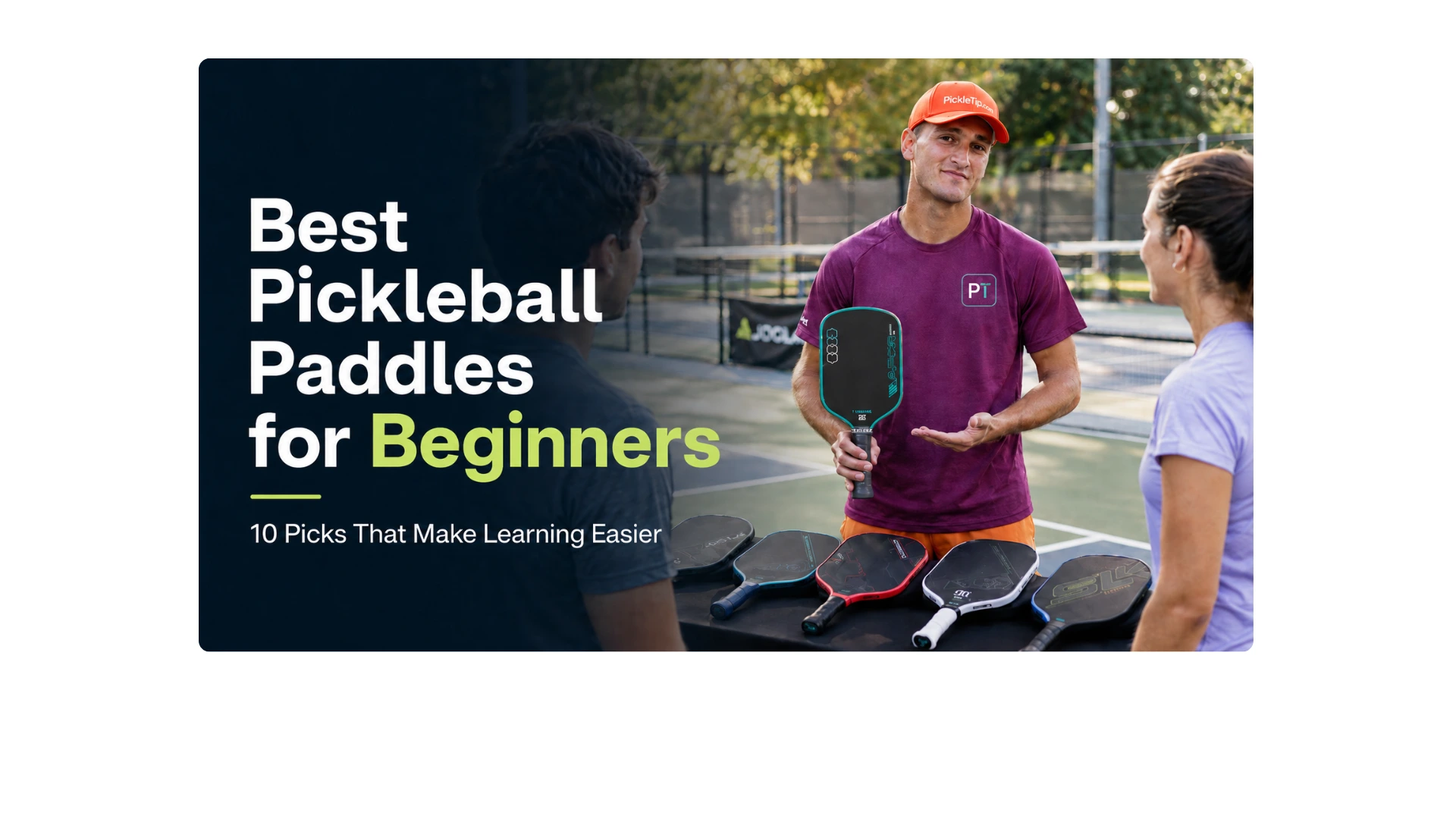
Best Pickleball Paddles for Beginners: 10 Picks That Make Learning Easier
The 11SIX24 Vapor Jelly Bean is the best first pickleball paddle for most beginners. Its forgiving hybrid shape gives a new player control, useful spin, manageable handling, and enough room to learn the complete game. Choose the wider 11SIX24 Pegasus Jelly Bean when maximum forgiveness matters more than quicker handling. The Vatic Pro PRISM Flash 16mm remains the safest proven value, while the Six Zero Coral Hybrid is the better fit for an athletic beginner or experienced racket-sport player who is likely to improve quickly.
Updated August 14, 2026: I reshuffled these picks around the problems I see beginners actually trying to solve: off-center contact, lack of pace, slow preparation, unpredictable depth, and learning to shape the ball. The Holbrook Mav Pro 2 and Redeemed Genesis remain worthwhile options when their specific strengths match what a new player needs.
Not sure whether you need a wider face, faster hands, more control, or more power? Start with how to choose a pickleball paddle. Shopping mainly by price? Use the best budget pickleball paddles guide.
PickleTip may earn a commission from qualifying purchases made through some links in this guide, at no extra cost to you. Recommendations are based on beginner fit, not commission.
Jump to: beginner picks • why I skip many starter paddles • what makes a paddle easier to learn with • full recommendations • what matters when comparing paddles • starter set or one paddle? • how much to spend • mistakes to avoid • when to upgrade • FAQ
Best Pickleball Paddles for Beginners at a Glance
| Beginner Need | Best Pick | Why It Fits | Main Tradeoff |
|---|---|---|---|
| Best First Paddle for Most Beginners | 11SIX24 Vapor Jelly Bean | Forgiving hybrid shape, manageable handling, useful spin, and a neutral path into the full game | The wider Pegasus protects off-center contact better |
| Most Forgiving Beginner Paddle | 11SIX24 Pegasus Jelly Bean | Wide shape and large usable sweet spot give beginners more help when contact drifts | Not as quick or streamlined as the Vapor |
| Best Proven Value | Vatic Pro PRISM Flash 16mm | Predictable control, useful forgiveness, and an established beginner-to-intermediate track record | Players who need easy power must create more pace themselves |
| Best Beginner-to-Intermediate Paddle for Fast Improvement | Six Zero Coral Hybrid | Forgiving enough to learn with and capable enough for a coordinated player to avoid an early upgrade | More performance-oriented than a casual beginner may need |
| Best for Learning Spin | Honolulu J2NF | Strong spin potential for topspin serves, shaped returns, and roll volleys | Spin still requires sound contact and swing mechanics |
| Best for Beginners Who Need Pace | Honolulu J6CR | Provides more usable offense for a player who struggles to create depth | Requires more discipline on blocks, resets, and short swings |
| Best for a Calmer Response | FLiK F3 | Predictable touch for learning drops, resets, placement, and depth | Provides less free offense than the power-oriented choices |
| Best for Quick Handling | Holbrook Fuze | Fast preparation and easier reloads during volleys and kitchen exchanges | Speed alone does not provide maximum stability or forgiveness |
| Best Balanced Alternative | Holbrook Mav Pro 2 | Forgiving contact, manageable handling, and a balanced response across the game | Newer options now have clearer category advantages |
| Best Comfort-First Recreational Option | Redeemed Genesis | Comfortable grip, balanced feel, and a dependable response that beginners trusted in class | Lower long-term performance ceiling than the leading recommendations |
Before tournament play: Approval status can change. Verify the exact model against the equipment requirements used by your event rather than assuming another thickness, generation, or similarly named version has the same status. For the full approval and legality process, see Pickleball Paddle Rules, Testing, Approval & Legality.
Why I Do Not Recommend the Usual Starter Paddles
A good entry-level pickleball paddle should be beginner-friendly without being disposable. Many beginner-paddle lists repeat the same easy-to-find products: wooden starter sets, older Onix models, or entry-level JOOLA paddles sold by major retailers. Those paddles may be convenient, but being available everywhere does not automatically make a paddle easier to learn with.
Some inexpensive paddles are perfectly fine for a family trying pickleball in the driveway. The problem begins when a player expects to take lessons, join open play, or keep playing. Weak edge support, inconsistent contact, limited spin capability, uncomfortable grips, and dead or unpredictable sweet spots can make normal beginner mistakes feel even more confusing.
My test is simple: would I hand this paddle to a new player in a lesson and trust it not to make the learning process harder? I would rather recommend a forgiving modern paddle that can survive the beginner stage than a disposable starter paddle someone replaces as soon as they learn to reset, block, or shape the ball.
A beginner does not need an advanced power paddle. A beginner needs equipment that makes good contact easier to recognize and bad contact easier to diagnose.
What Makes a Paddle Easier to Learn With?
I judge a beginner paddle by the mistakes new players actually make: late preparation, off-center contact, uncertain face angle, oversized swings, tight grips, and trouble controlling depth. I am combining what I felt testing these paddles with what I see newer players struggle with in lessons and the feedback beginners gave while using them. The best choices are not simply the cheapest paddles or the newest technology. They are the paddles most likely to make those early mistakes easier to understand and correct.
- Forgiveness: Off-center contact should remain playable instead of twisting badly or launching unpredictably.
- Predictable launch: The paddle should not create surprise pop that teaches a beginner to guide or decelerate the swing.
- Large usable sweet spot: A new player needs enough effective hitting area to receive useful feedback while spacing and contact improve.
- Manageable swing demand: The paddle should move, stop, block, and reload comfortably for a full session. Static weight alone does not tell you that.
- Grip comfort: The handle should feel secure without making the player squeeze it like the paddle owes them money.
- Useful stability: Very light should not mean flimsy. Blocks and volleys still need enough face stability to teach clean contact.
- Modern spin capability: A beginner does not need the highest spin number on a spreadsheet, but the surface should allow the player to learn topspin, shaped serves, and controlled rolls.
- Controlled core response: A 16mm core is usually a safe starting point because it commonly provides a more forgiving and predictable response. It is a guideline, not a law.
- Reasonable price: A first paddle should offer real performance without asking a new player to pay premium money for traits they cannot yet evaluate.
- Durability: The paddle should remain useful long enough for the player to learn instead of becoming another piece of equipment they have to replace before their game develops.
- Room to develop: A good first paddle should still make sense after the player learns drops, resets, blocks, counters, serves, returns, and basic spin.
Coach Sid’s beginner rule: Your first paddle should make your misses easier to understand. Look for a forgiving face, predictable depth, enough stability to keep mishits playable, and a swing feel you can manage for a full session. If the paddle makes every mistake feel random, it is making the learning process harder.
My Beginner Paddle Rankings
The rankings are based on beginner fit, not one universal performance scale. The best choice depends on whether the player needs forgiveness, predictable control, easier pace, quick handling, or more room to improve. If you are stuck among the top four, the decision is mostly this: Vapor for balance, Pegasus for contact margin, PRISM Flash for proven control value, and Coral for a coordinated player who is likely to want more paddle six months from now.
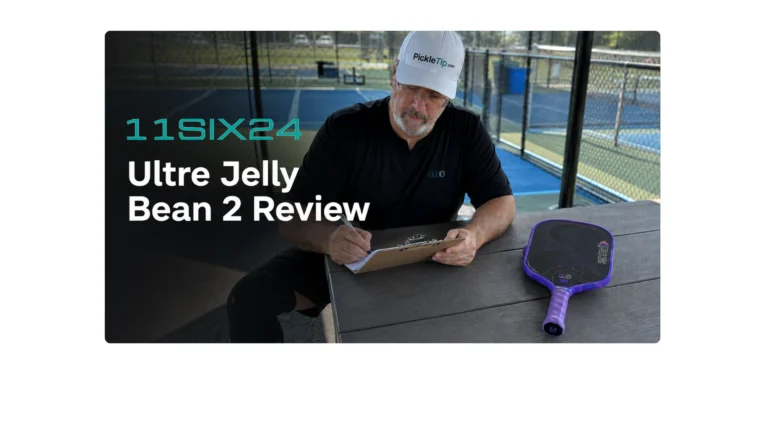
1. 11SIX24 Vapor Jelly Bean — Best First Paddle for Most Beginners
Why it is the best first paddle for most beginners: The Vapor Jelly Bean is the most sensible starting point for the average beginner without a strong tennis, racquetball, table-tennis, or other racket-sport background. Its forgiving hybrid shape offers a practical balance of control, spin, handling, and usable sweet-spot size without pushing the player toward an extreme shape or response.
I prefer the Vapor when a beginner wants one answer and does not yet know which playing style will emerge. It can support the complete doubles game while the player learns whether control, offense, spin, reach, or hand speed will eventually matter most.
I already knew what I liked about the Vapor shape before putting it at the top of this list. In other 11SIX24 Vapor builds I tested, clean hands battles were where the shape made the most sense to me: counters and short-takeback volleys came around quickly when the ball stayed in front. That shape history is part of why I like the Vapor here. The Jelly Bean pairs the quicker hybrid geometry with a calmer response than the hotter Vapor builds I have tested.
- Choose it when: You want one balanced first paddle for learning the complete doubles game.
- Choose it when: Quicker handling matters, but you still need a forgiving face and controlled response.
- Choose something else when: Maximum protection on off-center contact matters more than hybrid-shape versatility.
Shop the 11SIX24 Vapor Jelly Bean
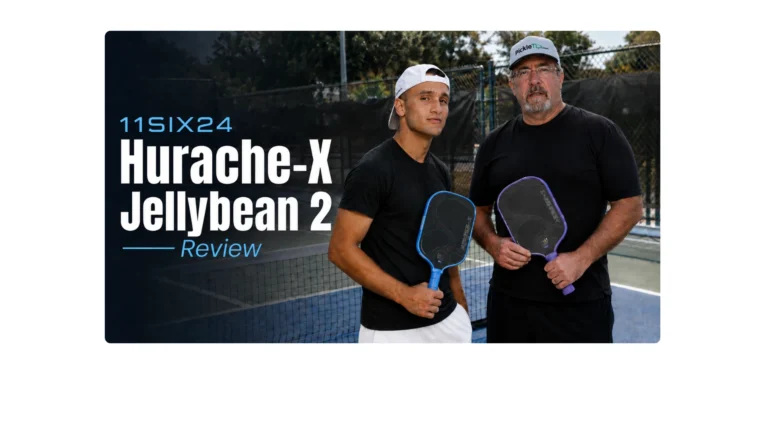
2. 11SIX24 Pegasus Jelly Bean — Most Forgiving Beginner Paddle
Why it wins for forgiveness: The Pegasus Jelly Bean is the best choice when a beginner’s contact still wanders around the face. Its wider shape provides a larger usable hitting area and more forgiveness while spacing, footwork, and paddle preparation are still developing.
Pick the Pegasus when reducing the punishment for imperfect contact matters more than having the quickest or most streamlined shape. Compared with the Vapor, this is the choice when protecting contact that drifts toward the outside of the face matters more than quicker preparation.
I have more exact-model history with the Pegasus. In my earlier testing, the large sweet spot kept off-center hits controlled, and the paddle stayed quick enough for blocks and counters. Players who used it also trusted it on resets and in the soft game. That is the practical split for me: Vapor when quicker preparation matters more, Pegasus when I want the bigger face to protect the slightly late or slightly off-center contact beginners produce all the time.
- Choose it when: You want the most forgiving shape in the main recommendations.
- Choose it when: Outer-face contact, stability, and a large usable sweet spot are your biggest concerns.
- Choose something else when: You strongly prefer quicker preparation, more reach, or a more streamlined hybrid feel.
Shop the 11SIX24 Pegasus Jelly Bean
3. Vatic Pro PRISM Flash 16mm — Best Proven Beginner Value
The Vatic Pro PRISM Flash 16mm remains one of the safest established recommendations for a new player. Its controlled response helps beginners work on placement, drops, resets, and directional control without constantly wondering when the ball will jump off the face.
What stood out to me was how complete it felt for the price. I trusted it during long dink exchanges and third-shot drops, and it still offered useful spin and enough offense to grow with. The one drawback was a slightly inconsistent sweet spot.
- Choose it when: You value consistency, control, and a proven value record.
- Choose it when: You want a paddle that encourages a full controlled swing instead of fear that the ball will fly.
- Choose something else when: You need the paddle to generate most of your pace or prefer a lively, pop-forward response.
Read the Vatic Pro PRISM Flash review
4. Six Zero Coral Hybrid — Best for a Fast-Improving Beginner
The Six Zero Coral Hybrid is the better fit for an athletic beginner, tennis convert, or coordinated racket-sport player who is likely to improve quickly. A player who already understands acceleration, contact in front, topspin, hand-eye coordination, or compact volley mechanics may not need the most sheltered beginner setup.
What stood out was that its extra offense did not feel chaotic. I could swing firmly and still trust the depth, which is why I think of it as power with a leash. The Coral gives a fast-improving player more room to grow without jumping directly to an unforgiving power paddle.
- Choose it when: You already bring useful racket-sport mechanics or expect to progress quickly.
- Choose it when: You want more offense without buying an extreme power paddle.
- Choose something else when: You primarily need maximum forgiveness, a calmer launch, or the easiest possible first experience.
Read the Six Zero Coral Hybrid review
5. Honolulu J2NF — Best for Learning Spin
The Honolulu J2NF makes the most sense for a beginner who wants to start learning topspin serves, shaped returns, and roll volleys early. It produced exceptional spin during my testing, but the more useful beginner trait was that the spin came with consistent depth and a forgiving sweet spot.
Do not buy it because a spin number looks exciting. Spin cannot rescue late contact, a loose swing path, or a paddle face pointed in the wrong direction. Choose it because developing shape on the ball is a real goal and you are willing to learn the mechanics.
6. Honolulu J6CR — Best for Beginners Who Need Pace
The Honolulu J6CR is the power choice for a newer player who struggles to create depth or offensive pace. I only recommend it to beginners whose real problem is producing enough pace, because power is not automatically an advantage during the beginner stage.
What surprised me was how quickly it moved for an elongated power paddle, and the sweet spot felt larger than the shape suggested. The tradeoff is timing: compact counters and punch shots became much more predictable only after I stopped getting early and learned its response.
Choose the J6CR when lack of pace is the actual problem. If blocks, resets, counters, and short swings are already the shots getting away from you, extra offense is probably the wrong fix. Do not choose it only because power felt fun during a short demo.
7. FLiK F3 — Best for a Calmer Response
The FLiK F3 is the control-specific choice for a player who wants a calm response while learning drops, dinks, resets, blocks, placement, and repeatable depth.
The note I kept writing during testing was, “That ball should have been worse.” The F3 did not fix bad swings, but it kept more rushed blocks, slightly off-center resets, and awkward defensive balls playable. It belongs here for the beginner who can clearly say, “I do not need more pace. I need the ball to behave.” If generating pace is already the problem, this is not the paddle I would reach for first.
8. Holbrook Fuze — Best for Quick Handling
The Holbrook Fuze is the speed choice for beginners who value quick paddle preparation, fast reloads, and easier handling during volleys and kitchen exchanges. It can help a newer player feel less late when the ball speeds up.
Do not confuse quick with automatically forgiving. The lightest or fastest-feeling paddle is not always the easiest to control if the face becomes unstable on contact. Choose the Fuze when slower or head-heavier paddles make you feel late, not simply because a low weight sounds beginner-friendly.
9. Holbrook Mav Pro 2 — Best Balanced Alternative
The Holbrook Mav Pro 2 gives a new player a larger sweet spot, manageable handling, and a balanced response across dinks, drives, volleys, and blocks. Choose it when you already own it, have tested it, or simply find its grip and balance more comfortable than the higher-ranked options. A paddle that is helping you learn does not need to be replaced simply because another model ranks higher.
Beginner feedback: Newer players using the Mav Pro 2 appeared to gain better control over their shots. I did not track whether the biggest change was depth, direction, fewer pop-ups, or cleaner contact, so I would not make the claim more specific than that.
Read the Holbrook Mav Pro 2 review
10. Redeemed Genesis — Best Comfort-First Recreational Option
The Redeemed Genesis stays on this list because several participants in a beginner class preferred it. They found it reliable and comfortable, which matters more to me here than trying to make the paddle sound more advanced than it is.
Its lower ranking reflects a lower long-term performance ceiling, not a failure as a beginner paddle. For a recreational player still learning basic contact and swing paths, immediate comfort and trust can matter more than specialized technology.
Coaching note: That beginner-class preference is the strongest reason I keep the Genesis here. I would rather use the feedback I actually saw than invent a more technical reason for ranking it.
Read the Redeemed Genesis review
What Matters Most Once You Start Comparing Paddles
Forgiveness Should Make Mistakes Easier to Read
A forgiving paddle should keep more off-center contact playable without turning every mishit into another mystery. Width helps, but so do stability, sweet-spot behavior, and a predictable launch. New players are still learning face angle and swing length, so enough power is useful; surprise pop usually is not.
Judge Handling After a Full Session, Not Three Swings
Do not shop by static weight alone. A light paddle can still feel slow when the balance is head-heavy, and an extremely light paddle can feel unstable. The better test is whether you can swing, stop, block, and reload it comfortably after the excitement of the first ten minutes wears off.
Grip fit belongs in the same decision. Players with smaller hands may prefer a smaller grip circumference because it can feel easier to control and may reduce the urge to squeeze. Hand size, comfort, grip pressure, wrist freedom, balance, and swing demand matter more than gender labels. If a paddle causes recurring arm, wrist, elbow, or shoulder pain, a paddle guide cannot diagnose the reason; recurring pain deserves qualified medical advice.
Buy Enough Paddle to Grow Into
The cheapest temporary paddle can cost more when it needs to be replaced immediately. A good first paddle should still make sense when simply getting the ball over the net is no longer the whole assignment. You do not need premium technology on day one, but you should have enough forgiveness, control, spin capability, and stability to learn what your game actually needs next.
Should a Beginner Buy a Pickleball Starter Set or One Better Paddle?
Buy a starter set when several people need basic equipment for casual play. Buy one better paddle when one person expects to take lessons, join open play, or keep playing after the first weekend.
| Choose a Starter Set When… | Choose One Better Paddle When… |
|---|---|
| Two or more people need basic equipment immediately | You expect to play regularly rather than only try the sport once |
| The goal is casual family, driveway, or vacation play | You are joining open play, lessons, leagues, or clinics |
| The total package price matters more than individual paddle performance | You care about comfort, forgiveness, and room to improve |
| You understand that the included paddles may be temporary | You would rather avoid replacing a weak starter paddle within a few weeks |
How Much Should a Beginner Spend on a Pickleball Paddle?
A beginner should spend enough to get a comfortable, durable, forgiving paddle, but not premium money for technology the player cannot yet evaluate. Prices change, so think in buying lanes rather than pretending one exact number stays correct forever.
- Very low-cost paddles: Fine for trying the sport once, but often inconsistent, uncomfortable, or quickly outgrown.
- Affordable individual paddles: Usually the best starting lane for someone who plans to play regularly.
- Mid-priced paddles: Worth considering when the extra cost clearly buys better forgiveness, comfort, durability, stability, or room to develop.
- Premium paddles: Rarely necessary for a first purchase unless the player has borrowed or demoed enough paddles to explain what the extra money fixes.
For current recommendations organized by price ceiling, use the best budget pickleball paddles guide.
Common Beginner Paddle-Buying Mistakes
- Buying the cheapest paddle without checking comfort or stability. That was my first mistake. A poor paddle can make normal beginner contact feel even more inconsistent.
- Buying maximum power because it feels exciting during warmup. Extra rebound often makes blocks, counters, and short swings harder to control.
- Choosing by static weight alone. Balance and swing demand determine whether the paddle actually feels quick or tiring.
- Assuming every beginner needs an ultra-light paddle. Too little stability can make mishits and blocks harder to manage.
- Choosing by gender instead of fit. Hand size, grip circumference, comfort, strength, balance, and playing style matter more.
- Buying a tiny or demanding sweet spot. A first paddle should protect imperfect contact while technique develops.
- Paying for a specialized shape too soon. Elongated, power-first, and extreme-spin builds may solve problems a beginner does not yet have.
- Ignoring durability or whether the paddle is legal where you plan to compete. Consider whether the paddle will remain useful after regular use, and if tournament play matters to you, verify the exact model before buying.
When Should a Beginner Upgrade a Pickleball Paddle?
Do not upgrade because another paddle is newer. Upgrade when you can name the shot your current paddle is holding back, and the tradeoff you are willing to accept to fix it.
- Your current paddle consistently twists or loses too much depth on normal off-center contact.
- The grip, balance, or swing demand causes recurring discomfort or fatigue.
- You now create enough pace that you need more control and launch predictability.
- You have developed reliable touch but need more usable offense.
- Your playing style now clearly favors a longer handle, different shape, faster hands, more stability, or another specific trait.
- The surface, edge, handle, or internal response has degraded.
- You borrowed or demoed another paddle and can explain exactly which shots improved and which tradeoff you accepted.
Upgrade test: “I want something better” is not yet a buying reason. “My compact blocks die short and this more stable paddle gives me repeatable depth” is.
Still Not Sure Which Paddle Fits You?
- How to Choose a Pickleball Paddle — match paddle traits to the misses and shots in your game.
- Best Budget Pickleball Paddles — current picks organized around price and value.
- Best Control Pickleball Paddles — deeper recommendations when predictable touch, resets, blocks, and calmer response are the main buying need.
- Best Spin Pickleball Paddles — deeper recommendations when spin production is a primary buying goal rather than one beginner-learning trait.
- Beginner Pickleball Gear — equipment beyond the paddle.
- Best Pickleball Paddles for Tennis Players — longer handles, two-handed backhands, reach, and tennis-transition fit.
- Best Pickleball Paddles — the current overall rankings once beginner-specific fit is no longer the main constraint.
- PickleTip Paddle Reviews — individual model testing and full play profiles.
Beginner Paddle FAQ
The 11SIX24 Vapor Jelly Bean is the best first paddle for most beginners because its forgiving hybrid shape provides manageable handling, control, useful spin, and room to learn the complete game. Choose the wider 11SIX24 Pegasus Jelly Bean when maximum forgiveness matters more than quicker handling. The Vatic Pro PRISM Flash 16mm remains the safest proven value.
Look for a forgiving face, predictable depth, enough stability to keep mishits playable, a comfortable grip, and a swing feel you can manage for a full session. A 16mm control or mild all-court paddle is usually a safe starting point, but thickness alone does not determine fit.
A widebody paddle can help beginners because the larger face usually provides more usable hitting area and forgiveness. The tradeoff is that some wide paddles may feel less quick or streamlined than a hybrid shape. Choose width when off-center contact is the bigger problem and quicker handling when preparation is the bigger problem.
There is no single ideal ounce range for every beginner. Static weight, balance, swing demand, stability, grip comfort, and fatigue all matter. Choose a paddle you can swing, stop, block, and reload comfortably for a full session without feeling unstable.
No. Beginners need a comfortable and predictable paddle, not the newest premium construction. Spending more is worthwhile only when it clearly improves forgiveness, stability, comfort, durability, spin capability, or room to develop.
A starter set makes sense when several people need inexpensive equipment for casual play. One better individual paddle usually makes more sense for a person who expects to play regularly, take lessons, or join open play.
No. A lighter paddle may feel quicker, but an extremely light or poorly balanced paddle can twist more and feel unstable. The goal is manageable swing demand with enough stability to keep imperfect contact playable.
Choose the grip circumference that feels comfortable without requiring a tight squeeze. Players with smaller hands often prefer a smaller grip, but hand size, comfort, wrist freedom, and grip pressure matter more than gender labels.
Usually not as a default. An elongated paddle may add reach or handle length, but it can also reduce face width, forgiveness, or hand speed. Choose one when the player has a specific reason, such as a two-handed backhand or a strong preference developed through testing.
Approval matters if you plan to use the paddle in tournament play. Verify the exact model against the equipment requirements used by your event because approval status can change and similarly named versions may not share the same status.
Upgrade when you can identify a specific limitation, such as poor stability, uncomfortable swing demand, insufficient control, limited offense, the wrong handle or shape, or physical deterioration. Do not upgrade only because a newer paddle is popular.
Your First Paddle Should Remove Doubt
If you are still deciding, go back to the problem you are trying to solve, not the paddle with the longest feature list. The right first paddle should make the game easier to read while you are still figuring out what kind of player you are becoming.
Coach Sid note: Your first paddle should help you recognize good contact. It should not make you spend your first month wondering whether every miss was you or the paddle.