
Pickleball Defense: Read Pressure and Choose a Response
Good pickleball defense is not about desperately getting one more ball back. It starts with recognizing that the other team has the better ball. From there, your job is to survive the attack, take away some of their advantage and get balanced enough to make a better decision on the next one.
I did not understand that when I started playing. I did not know that being even two feet out of position could turn an ordinary ball into a rushed swing or a panic block. The ball had not suddenly become faster. I had taken away my own time.
When you are under pressure, your job changes. You are usually not trying to hit a winner. You are trying to make the next ball less attackable.

What Is Pickleball Defense?
Pickleball defense begins when the opponent has the advantage. Your job is to survive the immediate attack, make the next attack less comfortable and recover enough balance or court position to regain choices.
That may require a block, reset, counter, controlled retreat, defensive return or decision to let an out ball go. The correct response depends on the incoming ball, your balance, your contact point and how much time you actually have.
The mistake I see most often is a player trying to attack while still defending. They are stretched, late or contacting the ball below the net, but they swing as though they have an offensive ball. That usually gives the opponent another easy attack.
Good defenders do not begin with “Should I block or counter?” They begin with “How much trouble am I actually in?”
Recognize Your Defensive State
Before choosing the shot, identify the rally state: neutral, under pressure or emergency defense. You can go from scrambling to neutral in two balls and give the advantage right back on the third. Defense is a condition, not a permanent role.
Neutral
You are balanced, you have time and neither team has a clear attacking advantage. You may be able to apply pressure, but the rally is not demanding an emergency response.
Under Pressure
Your opponent has an attackable ball or is sending pace at your body, feet or outside edge. You can still reach the ball with reasonable control, but your response should reduce the opponent’s advantage instead of creating a bigger swing.
Emergency Defense
You are late, stretched, moving quickly or contacting from a poor position. The goal is survival. Height, margin and recovery time matter more than disguise or a perfect target.
| Rally state | Your immediate job |
|---|---|
| Neutral | Decide whether the rally has earned an attack |
| Under pressure | Make the opponent’s next attack less comfortable |
| Emergency defense | Keep the ball alive with enough margin to recover |
In reset drills, I kept seeing players recognize the need to reset one ball too late. Their feet were still moving, contact had drifted away from the body and only then did they decide to soften the shot. The problem showed up before the paddle touched the ball.
Picture an opponent attacking at your feet. Your first contact is a stretched block that simply stays alive: emergency defense. The next attack reaches you with a little more time, but you are still under pressure. Then you place a low ball into the kitchen and force the opponent to hit up. Now the rally may be neutral. If the next ball sits up while you are balanced, you may finally have permission to counter.
One good block does not automatically erase the pressure. Reassess after every contact.
Four Questions Before You Defend the Ball
1. Is the Ball Going In?
The best defense against an out ball is to let it go.
At Elmwood, I spend a lot of lesson time on rushed speedups struck from below net height. They feel dangerous before their flight has had time to reveal itself. As players improve at reading height, paddle path and trajectory, they stop rewarding opponents for simply hitting harder.
That does not mean abandoning every difficult ball. A wide, low or fast ball may still land in. The lesson is not “never chase.” It is “do not turn an opponent’s mistake into your mistake.”
2. Am I Balanced?
Balance changes what the ball allows you to do.
- If you are stable and contacting in front, you may have several options.
- If you are reaching or leaning, choose more margin and less ambition.
- If you are running, regain enough control of your body and paddle before trying to change the rally.
Players see a high ball and think offense. If you are falling backward to reach it, your body is still playing defense.
3. Where Will I Contact the Ball?
A ball contacted comfortably in front gives you more control than one that jams your shoulder, drops at your feet or pulls you outside your base.
Contact below the net usually requires lift and respect for the net. Contact above the net may open more offensive options, but only when your balance and spacing support them.
4. Which Response Reduces the Pressure?
You do not always end an attack with one spectacular defensive ball. Sometimes the win is turning an overhead into a shoulder-high volley, then turning that volley into a ball the opponent must contact below the net.
Block when you need compact control. Reset when you need to remove pace and make the opponent hit up. Counter when your balance, preparation and contact point give you control—not simply because the ball arrived fast.
| Situation | Likely priority | Where to learn more |
|---|---|---|
| Fast ball into your body | Use a compact block or controlled redirection | Pickleball blocking technique |
| Low contact while balanced | Soften or reset the ball so opponents must hit up | Resetting in pickleball |
| Attack you can read while balanced | Consider a controlled counter instead of automatically absorbing pace | Backhand counter guide |
| Repeated drives and speedups | Use an opponent-specific plan for handling power | Countering bangers |
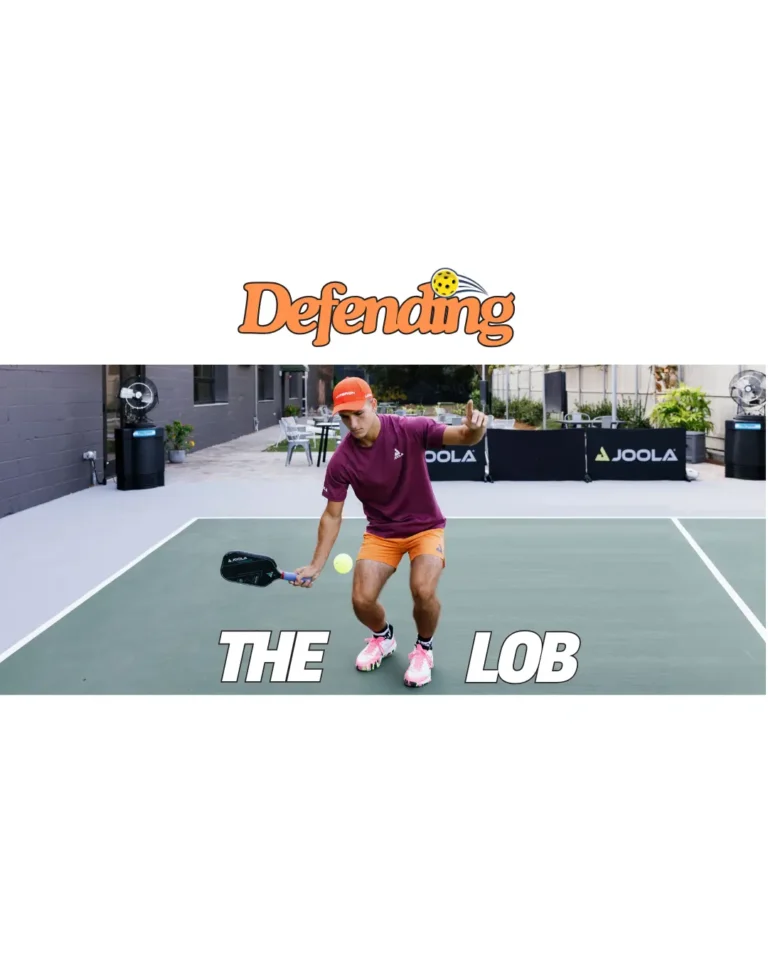
| Lob over your team | Communicate, move safely and decide who will play the ball | Defending the lob |
| Opponent has an overhead | Protect yourself, create time and choose a high-margin target | Smash defense |
The same incoming ball may require a different response when you are moving, jammed, protecting a partner or reaching outside your base.
Defense Changes With Your Court Position
At the Baseline
From the baseline, you usually have more reaction time but more court to cover. A deeper ball with useful margin can buy time to recover and make the opponents contact farther from the net.
Hitting harder does not automatically get you out of trouble. When you are late or moving, extra pace may just reach two balanced opponents sooner.
In the Transition Zone
The transition zone is the area between the baseline and the non-volley zone. It is not the same thing as “the middle” between doubles partners.
Players are vulnerable there because they are often moving when the opponent contacts the ball. If you cannot continue forward safely, control the next ball and earn the next step instead of charging through the shot.
If you keep moving through contact, work on when to move, stop and advance in the transition-zone guide. If your movement is stable but the ball still rebounds too high, work on the contact itself in the pickleball reset guide.
At the Kitchen Line
At the kitchen, the ball reaches you quickly. Preparation has to happen before the opponent makes contact.
- Stay balanced instead of standing upright or leaning into the kitchen.
- Keep the paddle available in front of your body.
- Avoid an unnecessary backswing against incoming pace.
- Choose a response that matches your balance, contact point and available time.
- Recover the paddle and your balance immediately after contact.
Your pickleball ready position supports those responses, but there is no single paddle angle or grip that solves every defensive ball.
In Doubles, Protect the Seam Between Partners
In doubles, “the middle” usually means the seam or space between partners—not the transition zone. Opponents attack that seam because uncertainty can be as valuable as open court.
“Forehand takes the middle” can be a useful starting agreement, but reach, balance, handedness and movement can change who should play a particular ball. Stay connected closely enough that the seam does not become the opponent’s easiest target.
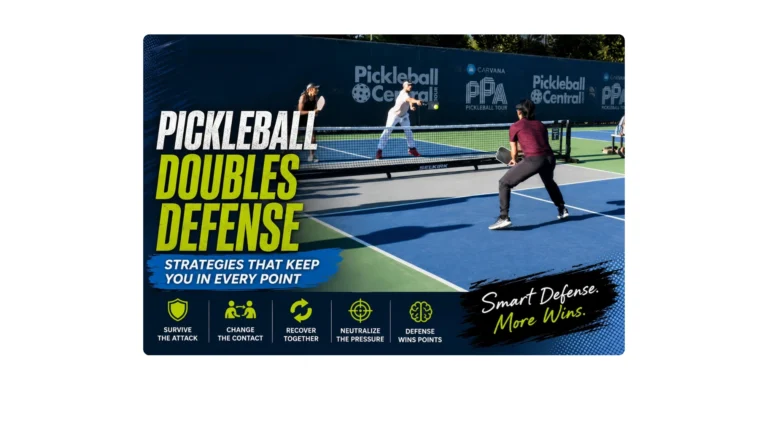
If opponents keep splitting your team or trapping one partner deeper than the other, work through Pickleball Doubles Defense Strategies.
When Should You Back Up on Defense?
Backing away from the kitchen is not automatically right or wrong. The useful question is whether creating space improves your chance of handling the next attack.
I sometimes teach a small space-making step when the opponent has obvious leverage and the defender can move before contact while staying balanced. That is different from drifting backward through every speedup. The step should create time, not leave you moving when the ball arrives.
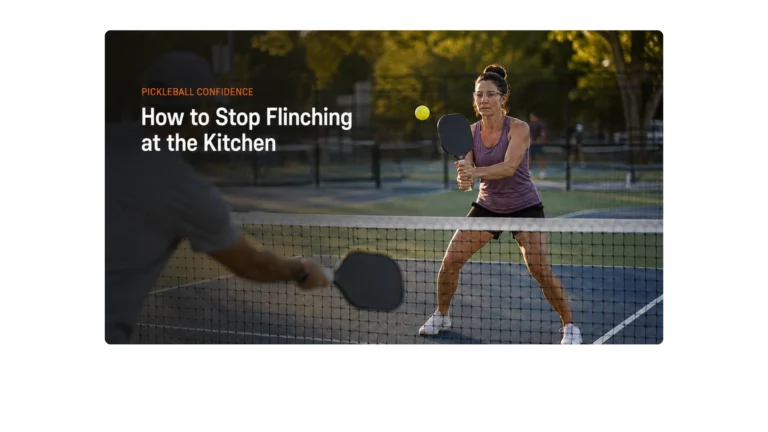
Backing up also gives away court position and can expose your feet. Create space for a reason, then recover it when the pressure is neutralized. If fear or flinching makes you abandon the line before an attack develops, work through the kitchen confidence guide instead of treating automatic retreat as strategy.
In doubles, one player retreating while the other remains tight to the kitchen can open a large gap. The doubles-defense guide explains how partners recover to compatible depths.
Read the Attack Instead of Guessing
Read the hitter, but do not finish the story before the ball leaves the paddle.
Look for information that limits what the opponent can comfortably do:
- Ball height: A ball below the net normally offers fewer downward attacking options than an elevated ball.
- Opponent balance: A balanced player usually has more choices than someone reaching or falling away.
- Contact point: Contact in front may allow more direction and acceleration. Late contact can reduce those options.
- Paddle preparation: Swing size and paddle path may hint at pace or direction.
- Available court: Your position and your partner’s position help determine which targets look attractive.
Reads are probabilities, not promises. Good opponents disguise attacks, and sometimes the correct preparation still loses to a better shot. Use the clues to cover the most likely threat while remaining able to react to the ball that is actually hit.
Neutralize Before You Counterattack
“The best defense is a good offense” has talked a lot of players into attacking one ball too early.
A counter can be the right response when your position supports it. It is a much worse bargain when you are jammed, reaching or lifting a ball from below the net.
Defense is not surrender. It is buying enough control to recognize the first ball you can safely pressure again.
Recover After the Defensive Shot
Making the ball is only part of the job. Players often admire the save, remain stretched or leave the paddle where the last swing finished.
After contact:
- Regain your balance.
- Recover the paddle to a useful ready position.
- Reconnect with your partner in doubles.
- Identify whether the opponents can attack again.
- Recover court position only as quickly as the next ball allows.
Do not rush forward simply because your last shot landed in the kitchen. If the reset sits high, the opponents may still be attacking. Make them prove that the pressure is gone.
Common Pickleball Defense Mistakes
- Trying to win while stretched: Speed or angle is added from a position that cannot support it.
- Swinging at incoming pace: A large swing makes timing, recovery and paddle-face control harder.
- Backing up automatically: Court position is surrendered without gaining useful reaction time.
- Moving through contact: The player charges through transition or reaches without organizing the base.
- Guessing too early: The player commits before enough information is available.
- Using one response for every attack: Blocking every ball is no better than countering every ball.
- Failing to recover: The first defensive ball survives, but the paddle, feet or partner connection are not ready for the next one.
- Playing a clear out ball: The defender bails the opponent out by volleying an attack that would have missed.
Which Defensive Skill Is Breaking Down?
Identify the pressure first. Then work on the specific shot or team problem that keeps breaking down.
- Pace takes away your control: Start with compact blocks. If flinching takes away the decision before the ball arrives, use the kitchen confidence guide.
- You struggle while moving through midcourt: Use the transition-zone guide for movement and stopping decisions, the reset guide for the contact itself and pickleball positioning if you are repeatedly reaching, crowded or late.
- The ball gets over or above you: Use the separate guides for defending lobs and surviving overhead attacks.
- Your team separates under pressure: Work on partner coverage, compatible depth and coordinated recovery in Pickleball Doubles Defense Strategies.
Pickleball Defense Frequently Asked Questions
What is the most important principle of pickleball defense?
Recognize whether you are neutral, under pressure or in emergency defense before choosing the shot. Reaching the ball does not mean you are in position to attack it.
Should I block, reset or counter a fast ball?
Block when you need compact control. Reset when you need to remove pace and make the opponent hit up. Consider a counter when you are balanced, prepared and contacting in front. The speed of the incoming ball does not make that decision by itself.
Should I back away from the kitchen when opponents attack?
Sometimes. A controlled step can create reaction time against an obvious attack, but automatic retreat gives away court position and can expose your feet. Create space for a specific reason.
How do doubles partners protect the middle?
Partners protect the seam by staying connected, adjusting with the ball and agreeing on responsibilities for shots between them. “Forehand takes the middle” is a starting agreement, not a substitute for reading balance, reach, movement and handedness.
What is the best grip for pickleball defense?
No single grip is best for every defensive ball. A relatively neutral grip can make forehand and backhand responses easier to access, but the intended response and incoming contact still matter. If grip pressure or paddle angle is causing popups, work through the blocking guide.
What should a beginner learn first about pickleball defense?
Start by staying balanced, using a compact response against pace and recognizing balls you should let travel out. A beginner does not need six defensive shots immediately. One controllable response and better recovery will keep more rallies alive.
How can I practice better defensive decisions?
Use feeds that vary in height, speed and location instead of repeating one predictable ball. After each response, identify your rally state, where you contacted the ball and whether your shot made the next attack easier or harder. The pickleball drills guide includes progressions that turn those reads into practice.
Stay Alive Long Enough to Get a Better Ball
Great defenders are not simply faster or more athletic. They recognize pressure sooner, respect the quality of the ball they received and choose a response their position can support.
Let out balls go. Use compact responses against pace. Create space only when it helps. Make the next attack less comfortable, then recover your balance, paddle and court position.
Defense is not just getting one attack back. It is making the opponent keep attacking until the advantage disappears, and noticing when the rally finally gives you permission to hit back.