Pickleball Paddle Dwell Time: What It Means and Why It Matters
Some paddles feel like the ball touches the face and leaves before you’ve finished thinking about the shot.
Others feel different.
You catch a low reset, a roll volley, or a dipping third, and for just an instant it feels like the ball stays with the paddle.
Players call that hold. Pocketing. Connection. Sometimes they say the paddle feels soft or plush.
The technical idea underneath all of those descriptions is dwell time.
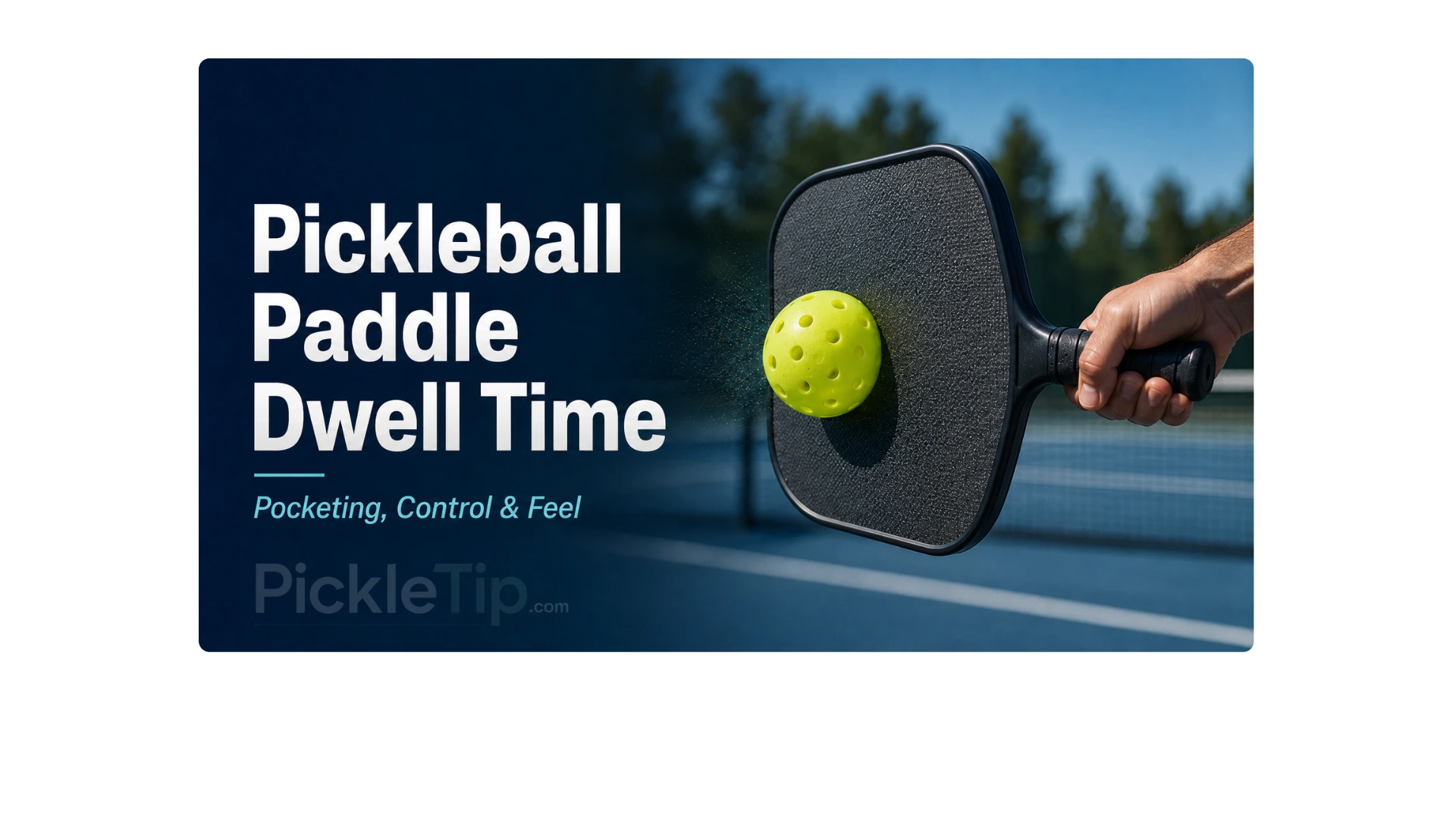
Pickleball paddle dwell time is the brief amount of time the ball remains in contact with the paddle face during impact. The contact itself happens extremely quickly, but differences in how the ball, face, and core deform and rebound can change how that impact feels and how much control you have over the ball’s launch and shape.
The practical version I use on court is simpler:
Dwell time is how long the paddle seems willing to work with the ball before sending it back.
That does not mean the ball is literally sitting on your paddle long enough for you to make a decision. Everything is happening far too quickly for that.
But some paddles give you a noticeably more connected impact than others.
And once you learn to feel that difference, a lot of paddle-review language starts making more sense.
What Does Dwell Time Mean in Pickleball?
When a pickleball hits your paddle, the collision is not perfectly rigid.
The ball deforms.
The paddle face can flex.
The core compresses and recovers.
Then the ball leaves.
Dwell time describes the contact interval between the beginning of that collision and the moment the ball separates from the paddle.
Players usually do not measure that interval themselves. What we feel instead are the effects of the entire contact event.
Players use words like plush, soft, connected, crisp, firm, and poppy to describe what they feel. Those words overlap, but they are not perfect synonyms.
A paddle can feel soft without having the longest actual contact time. A paddle can have noticeable pocketing and still produce plenty of pace.
Dwell time is about the contact event. Pocketing is mostly how that contact feels to the player.
Is Ball Pocketing the Same Thing as Dwell Time?
Not exactly, although players often use the terms as if they are.
Ball pocketing is the sensation that the ball sinks into, settles into, or stays connected to the paddle face before leaving.
Dwell time is the underlying contact-duration concept.
Pocketing is what you feel.
Think of it this way:
| Term | What It Means |
|---|---|
| Dwell time | How long the ball and paddle remain in contact during impact |
| Ball pocketing | The player’s sensation that the ball is being held or cradled by the paddle |
| Soft / plush feel | A sensory description of impact comfort and response |
| Crisp / immediate feel | A sensory description of a quicker, firmer response |
The mistake is assuming those four things always move together.
They often do.
They don’t always.
A muted paddle may sound and feel soft without giving you extraordinary pocketing. Another paddle may give you obvious ball hold but still return plenty of pace once the face unloads.
That’s why I don’t like reducing paddle feel to one adjective.
The Paddle That Made Dwell Time Obvious to Me
The Rizen Ascent is one of the clearest examples I’ve tested.
Its face wasn’t the roughest paddle surface in my bag. In fact, when I compared it with some of the more aggressive grit-focused faces, there wasn’t anything about the thumb test that screamed, this thing should shape the ball better.
Then I played with it.
On dinks, low resets, drops, rolls, and drives, the ball felt connected to the face instead of immediately jumping away from it.
That mattered most when the point got uncomfortable.
A low reset that I might normally just try to survive felt like something I could guide. On a roll, I had confidence getting underneath and around the ball. On a drive, I could swing with shape without feeling like the launch window disappeared the second I contacted it.
That’s what I mean when I talk about usable dwell.
Usable dwell is enough connected contact to help me control, shape, or redirect the ball without making the paddle feel late when I need it to release.
It isn’t about chasing the paddle that feels mushiest or trying to find the paddle that supposedly holds the ball the longest.
I want enough connection to guide a reset, shape a roll, or trust the depth of a drive, and I still want the paddle to get out of the way when the point speeds up.
What Actually Creates Dwell Time?
This is where paddle marketing can get messy.
There is no single “dwell time material.”
Dwell isn’t created by one layer or material. It comes from everything the ball is hitting and everything behind the face reacting together.
Core Compression
A paddle core is not a concrete wall.
Depending on its material, density, cell structure, thickness, construction, and state of break-in, it can compress differently when the ball arrives.
A core that gives more at impact can contribute to the softer, more pocketed contact players often describe as extra dwell.
But that does not mean softer is automatically better.
Too little rebound can make a paddle feel dead. Too much deformation or an unpredictable response can make launch difficult to trust.
What I care about is controlled compression.
The paddle should give a little without turning every contact into a guessing game.
Face Flex
The paddle face can also deform during impact.
A face that flexes more can contribute to that feeling of the ball sitting on the paddle instead of instantly rebounding. A stiffer face often gives me a quicker, more immediate response.
I treat that as a tendency, not a shortcut for ranking paddles from a material label.
The face is attached to a core, perimeter structure, edge system, throat, and handle. Change the rest of the paddle and the same face material can behave very differently.
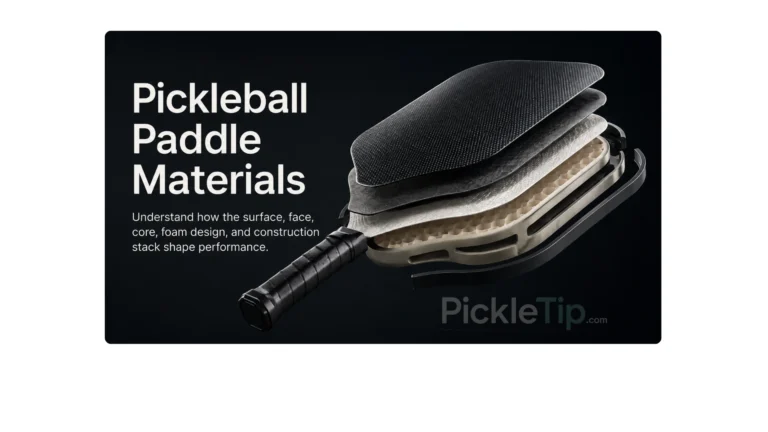
Face material matters too, but carbon, Kevlar, fiberglass, and other material labels do not tell you dwell time by themselves. If you are comparing those materials rather than the contact window they help create, use my pickleball paddle materials guide.
Core Thickness
Thicker paddles are often associated with more control and a softer response, which is why players naturally connect 16 mm paddles with more dwell.
That reputation didn’t come from nowhere. A thicker core gives the paddle more depth through which the impact can be managed. But thickness alone does not tell me how the paddle will release the ball.
I would never reduce it to:
16 mm = long dwell
14 mm = short dwell
Two paddles from my own testing make the point. The 14 mm CRBN 3 TruFoam Genesis gave me a soft-yet-crisp short-game feel and a surprisingly large sweet spot for a thin build. The 16 mm JOOLA Perseus Pro 4, despite being thicker, still gave me a quick, lively pop and a crisp response on blocks, volleys, and counters.
I’m not claiming the 14 mm Genesis has more measurable dwell than the 16 mm Perseus. I didn’t instrument the contact time on either paddle. The useful point is simpler: 14 mm did not automatically feel hard and immediate, and 16 mm did not automatically feel slow and plush.
Thickness is one ingredient.
It is not a dwell-time score.
Foam and Honeycomb Construction
Modern foam paddles have pushed the word “dwell” much further into paddle conversations, and some foam formulations do produce a dense, cushioned, connected response that feels very different from a stiff, immediate honeycomb power paddle.
But “foam” is not one material or one feel. Some foam paddles are plush, some are explosive, and some honeycomb paddles pocket the ball beautifully.
The useful question is not simply “Is it foam?” It is “What does this particular construction do when the ball hits it?”
If you are comparing the construction types themselves or deciding which models fit you, my foam core pickleball paddle guide covers that separate buying question.
Does More Dwell Time Give You More Control?
It can.
I notice the benefit most on shots where launch precision matters more than raw speed:
- dinks,
- third-shot drops,
- resets,
- blocks,
- roll volleys,
- controlled counters,
- and shaped drives.
When the ball feels connected for that extra beat, it can be easier to manage how much pace you return and where the ball leaves the face.
But I want to be careful with the phrase “more dwell equals more control.”
Control isn’t something the paddle installs for you.
Your hand pressure, face angle, contact point, swing path, preparation, and timing still matter.
A paddle with more usable dwell can make a controlled stroke easier to execute.
It cannot turn bad preparation into good touch.
Dwell gives you a bigger conversation with the ball. You still have to say the right thing.
Does Dwell Time Increase Spin?
The Rizen Ascent is one reason I stopped using face roughness as a shortcut for how easy a paddle would be to shape. It did not win the thumb test, but I kept getting easy shape on drops, rolls, and topspin drives because the contact felt connected.
That does not mean dwell creates spin by itself. Dwell and grit describe different parts of contact. Dwell is about how long the ball and paddle remain connected. Surface friction is about how strongly the face resists the ball sliding across it. Your stroke still has to provide the motion.
Useful dwell can give a good spin-producing stroke more opportunity to shape the ball, but it is not an RPM button. If you want the surface side of that equation, read my guide to pickleball paddle grit, where I separate texture, friction, and spin.
Long Dwell vs Quick Release: Which Feels Better?
Neither one is automatically better.
They solve different problems.
| More Dwell / Pocketing | More Immediate / Shorter-Dwell Feel |
|---|---|
| Ball feels more connected | Ball feels quicker off the face |
| Often easier to manage pace | Often easier to create immediate rebound |
| Can help drops and resets | Can help counters and fast exchanges |
| Often described as plush or soft | Often described as crisp or firm |
| Can make shaping feel natural | Can reward compact punch-style contact |
| May require a fuller stroke for offense | May require softer hands for control |
This is why two good players can hit the same paddle and disagree completely.
One player says:
I love how long the ball stays on this thing.
The next player says:
I hate it. I feel like I have to wait for the ball.
They’re not necessarily experiencing two different paddles.
They may simply prefer two different contact windows.
Can a Paddle Have High Dwell Time and Still Have Power?
Absolutely. Dwell and power are not opposite ends of one slider.
A paddle can compress, feel connected at contact, and still send the ball back in a hurry. I’ve stopped treating plush contact and outgoing speed as opposites.
The 11SIX24 Alpha Pro Power is a good example from my own testing. It gave me more dwell and forgiveness than the original Power Series without losing the pop I wanted to attack. That is the kind of mismatch players sometimes call sneaky power: calm contact, but a faster outgoing ball than the feel suggests.
So soft feel does not predict power. A paddle can hold the ball nicely and still send it back in a hurry.
Can You Feel Dwell Time?
You can usually feel differences between paddles.
But that does not mean your hand is measuring dwell time.
Unless I have instrumented contact-time data, I won’t claim one paddle literally keeps the ball on the face a certain number of milliseconds longer than another. What I can compare on court is how connected, controllable, and predictable that impact feels during the same shots.
There is also useful collision research that helps explain why paddle-ball contact is more complicated than one variable like dwell. In a 2026 Physics Education paper, physicist Rod Cross measured pickleball paddle-ball collisions and showed that outgoing ball speed changes with incoming ball speed, paddle speed, and impact location. If anything, that makes me even less interested in pretending one word (dwell) explains the whole collision. Read the published study.
What you’re perceiving is a bundle of signals:
- vibration,
- sound,
- core compression,
- face flex,
- rebound,
- ball deformation,
- launch,
- and how long the impact feels connected.
So when I talk about dwell in a paddle review, I’m describing what I feel on court, not pretending my hand is a stopwatch.
My test is practical.
Can I feel the ball well enough to change what I do with it?
Can I take pace off a reset?
Can I roll a low ball without feeling like it escaped early?
Can I shape a drive and still predict the depth?
That’s the dwell I care about.
Does Dwell Time Change After a Paddle Breaks In?
It can feel like it does.
Paddles can change as cores, foam structures, face systems, and surrounding materials settle through use.
Sometimes a paddle that feels firm out of the box becomes more connected after several sessions.
Players might describe the change as more pocketing, a softer face, a larger-feeling sweet spot, or simply less harshness.
A change in feel does not prove that measurable contact time increased. Several parts of the paddle can change how impact feels as the paddle settles in.
If I notice a meaningful break-in change, I care about the on-court result first:
Does the launch become easier to predict?
Do resets improve?
Does the paddle start holding the ball better?
Does power suddenly increase?
“Broken in” only matters if the paddle actually plays differently.
Is More Dwell Time Better?
No. I would choose dwell by looking at your misses, not by chasing the paddle that claims the most of it.
If your resets keep floating, incoming pace feels hard to absorb, or the ball seems to escape before you can shape it, a more connected paddle may help.
If your game depends on fast counters, compact speed-ups, and immediate response, an extremely plush paddle may feel late compared with the contact window your hands are used to.
Think about dwell in terms of your misses.
You may prefer more dwell if:
- your resets routinely float high,
- the ball feels like it shoots off your paddle,
- you struggle to take pace off incoming speed,
- you like shaping drops and rolls,
- you prefer a connected or plush feel.
You may prefer a more immediate response if:
- you already have very soft hands,
- you want faster counters,
- you like punch volleys,
- you create offense with short swings,
- you dislike a deep pocketing sensation.
The question isn’t:
Which paddle has the most dwell?
It’s:
How much usable dwell helps you play your shots better?
How I Test for Usable Dwell
I don’t try to rank paddles by squeezing the face or bouncing a ball on them in the living room.
I take them to the court.
The shots I pay the most attention to are:
Low Reset
Can I absorb pace and guide the ball into the kitchen, or does it jump away before I feel connected?
Third-Shot Drop
Can I swing through the ball confidently and still keep the launch window predictable?
Roll Volley
Does the paddle let me stay connected long enough to create shape without overworking my hand?
Controlled Drive
Can I accelerate and bend the ball while still trusting depth?
Counter
Does the paddle release quickly enough when I don’t want extra hold?
That last one matters.
Dwell isn’t automatically a bonus on every shot.
The paddle has to let go of the ball in a way that fits your timing too.
Those are the shots that tell me the most about usable dwell. For the broader process I use to judge power, spin, stability, forgiveness, control, and player fit, see how I test pickleball paddles.
Dwell Time Is Contact, Pocketing Is the Feeling
If you remember only one thing, make it this:
Dwell time is the contact. Pocketing is what that contact feels like.
The mistake is trying to turn dwell into a specification you can shop by. Thickness, foam, softness, grit, and power can all affect what you feel, but none of them tells you by itself whether a paddle will give you the contact window you want.
That is why I care more about usable dwell than maximum dwell. Can I guide the reset? Shape the roll? Trust the drive? And when somebody speeds the ball up at me, does the paddle still release quickly enough to fit my timing?
Dwell gives you a bigger conversation with the ball. You still have to say the right thing.
For me, the best dwell isn’t the paddle that feels like it holds the ball forever.
It’s the one that gives me just enough connection to do something useful with it before the ball leaves.