Six Zero Coral Pro Review: 13.5 Hours of Court Testing
The original Six Zero Coral was easy to get along with. It gave me control, a forgiving face and enough offense to finish a ball without making every block feel like a small gambling problem.
The Six Zero Coral Pro does not tear up that formula. The face has more bite, the ball kept moving aggressively throughout my testing, and I got a little more help when I decided to attack.
I played the Hybrid, Widebody and Elongated versions, and none felt like Six Zero had started over. This is still a Coral. The personality stayed put; the face got meaner.
🎧 Prefer listening? Coach AJ breaks down the differences between the new SixZero Coral Pro shapes:
Quick Verdict
The Coral Pro adds easy, high-level spin and a modest bump in offense without losing the control that made the original Coral so comfortable. I kept reaching for the Hybrid. The Widebody forgave the most mistakes, while the Elongated gave me the most reach and leverage.
Coral Pro at a Glance
- Plays like: A spin-heavy all-court paddle that still behaves itself in the soft game
- Best quality: High-level spin without needing an exaggerated swing
- Power: More offensive than the original Coral, but still not a pure power paddle
- Control: Predictable on drops and resets once I adjusted to the extra surface bite
- Surface: Aggressive Double Diamond Tough texture that remained consistent during my testing
- Best overall shape: Hybrid
- Most forgiving shape: Widebody
- Best reach and leverage: Elongated
- Price: $220 before any eligible discount
- Approval: UPA-A approved; not listed by USA Pickleball when checked August 25, 2026
How I Played With the Coral Pro
I do not use speed guns, spin-measuring devices or ball cannons for these conclusions. I played all three shapes across nine 90-minute sessions, about 13.5 hours total, using drills, recreational games and competitive play. I watched for the same strengths and mistakes to keep showing up. That is the same real-court approach explained in how PickleTip tests pickleball paddles.
Test Focus
- Topspin and slice serves
- Third-shot drives and controlled drive-drops
- Roll volleys and counters
- Dinks, drops and resets
- Hand speed during kitchen exchanges
- Stability on off-center contact
- Sweet-spot forgiveness
- Surface consistency as the paddles accumulated play
- Differences between the Coral Pro and original Coral
I paid attention to what the ball actually did, whether I could repeat the shot and how opponents reacted when the spin changed the bounce or pulled them off their spot. I was not trying to reward the prettiest swing of the day. I wanted to know what happened on rushed blocks, short rolls, defensive resets and contact that wandered away from the middle. Paddle samples, playing styles and conditions vary, but the same shape-specific patterns kept returning.
Questions I Wanted the Court to Answer
- Does the new face create useful spin on short swings, or only when I have time for a full cut?
- Does the added offense make drops, resets or blocks jumpier than the original Coral?
- Do the Hybrid, Widebody and Elongated shapes actually play differently enough to matter?
- Does the aggressive surface keep its bite as the paddles accumulate play?
What I Liked and What Gave Me Pause
| Pros | Cons |
|---|---|
| Elite spin across all three shapes | Not listed by USA Pickleball when checked August 25, 2026 |
| Surface remained consistent during testing | Costs $20 more than the original Coral |
| More offensive than the original Coral | Elongated shape is less forgiving near the edges |
| Balanced power and pop | Extra surface bite can make lazy drops and dinks move more than expected until you adjust |
| Predictable control during soft play | Current Coral owners may not need to upgrade if they are satisfied with their spin |
| Three genuinely distinct shape choices | Players who need maximum raw power should look elsewhere |
What Changed From the Original Coral?
Put the Pro beside the original Coral and most of the family resemblance is still there. Six Zero retained the same general platform, three shape options and Tectonic Core with ProPulsion Foam.
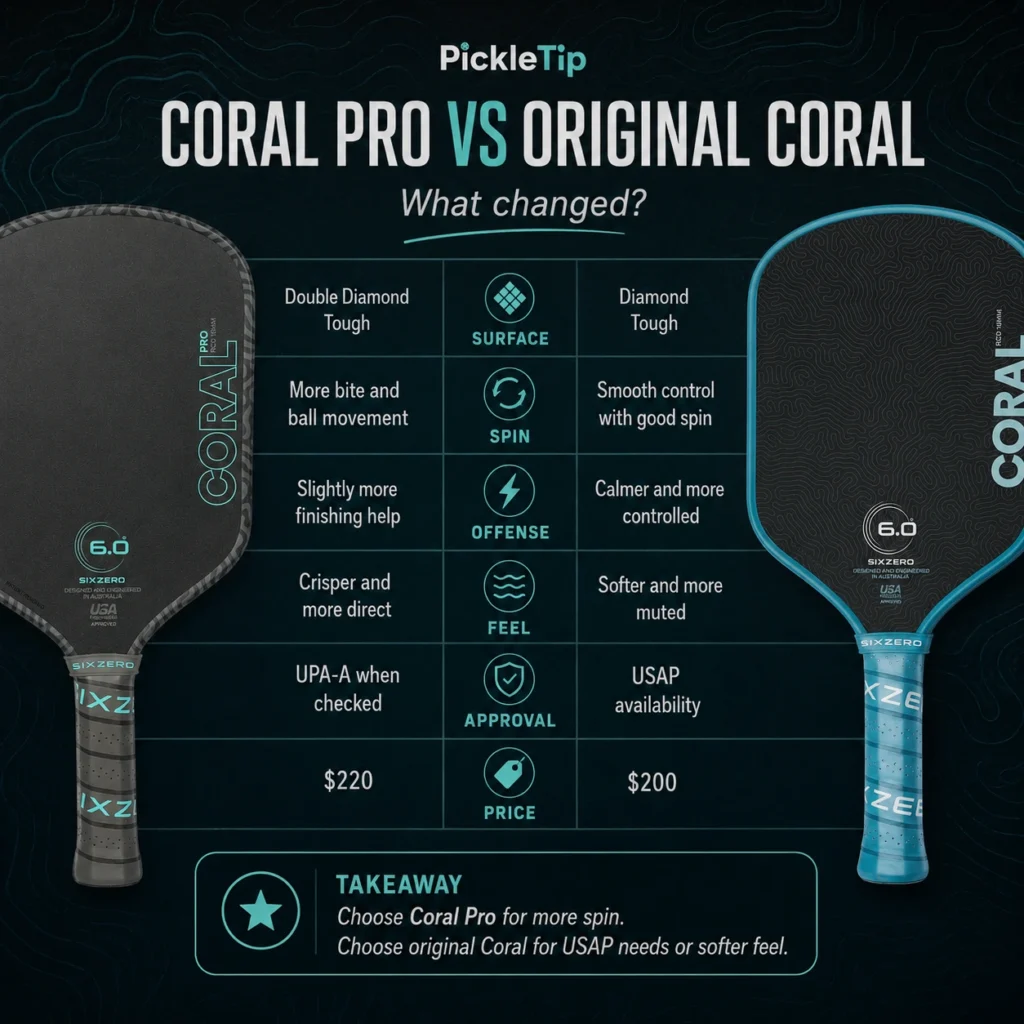
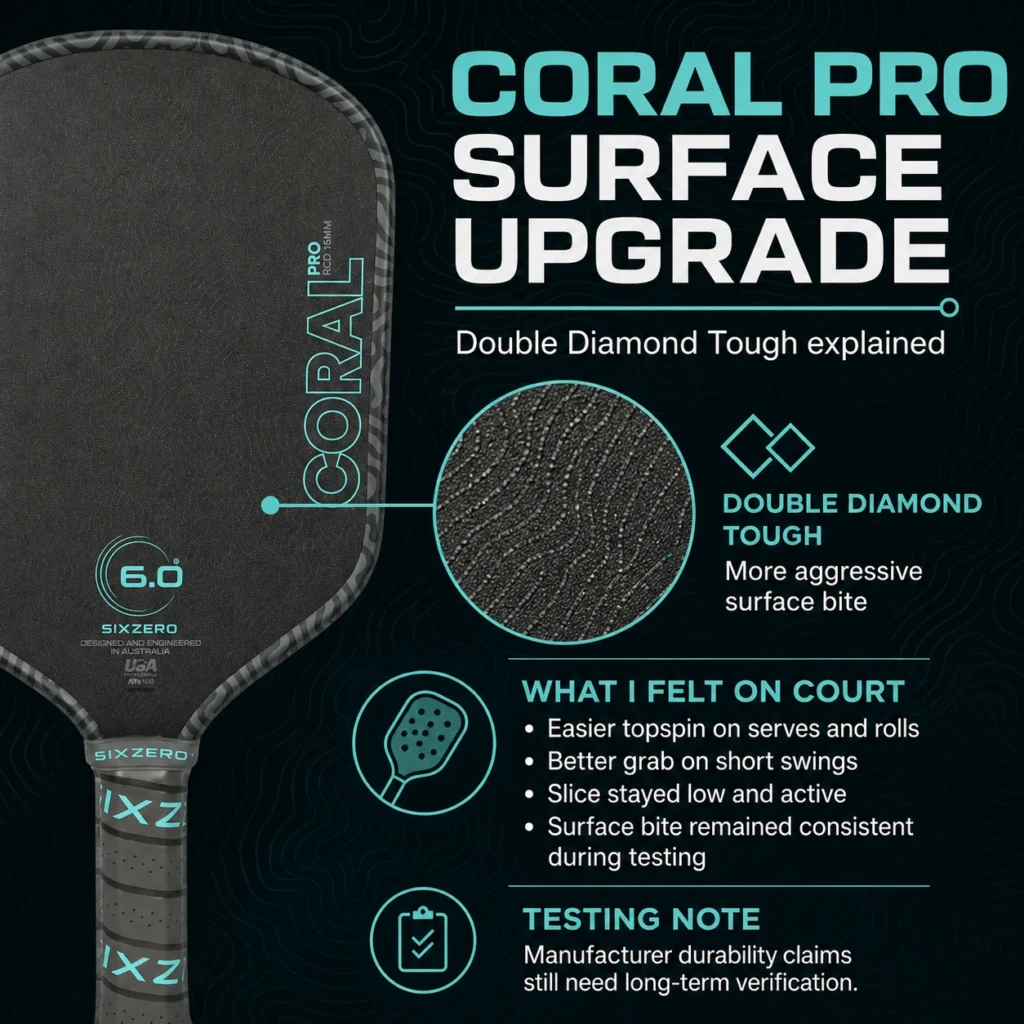
Most of what separates the Pro from the original Coral is on the face: the Double Diamond Tough raw carbon fiber surface. It looks rougher, feels rougher and, more importantly, puts more movement on the ball.
Main Changes I Felt
- More spin: The ball is easier to shape on serves, rolls, drives, dinks and drops.
- More offense: Drives and putaways carry slightly more pace and pressure.
- More persistent surface performance: The face continued producing strong bite throughout my testing without an obvious decline.
The paddle underneath still behaves like a Coral. The Pro did not suddenly become a demanding power paddle; it just gave me more shape and a little more pressure without making the soft game nervous.
How the Coral Pro Plays
Spin
The spin showed up immediately.
I did not have to exaggerate my swing to make the ball move. Topspin serves dipped sooner, roll volleys dropped more sharply and topspin dinks pulled opponents farther off their spot.
The biggest difference appeared on shots with almost no runway. On rolls, flicks, dipping counters and shaped dinks, the face grabbed the ball before I had time for anything resembling a full swing. That is useful spin, not spin that only appears when I have three seconds to wind up.
Slice responded just as well. Returns stayed lower, defensive slices carried more action and I could move the ball away from an opponent without carving at it like I was trying to open a coconut.
This is not one of those paddles that feels like sandpaper in your hand and then forgets all about spin once a ball shows up.
Power
The Coral Pro has more usable offense than the original, but nobody will mistake it for a pure power paddle.
Drives leave the face with enough pace to pressure defenders, and putaways require less effort than they did with the standard Coral. The additional spin also makes that offense more useful because I can swing aggressively while still bringing the ball down inside the baseline.
The harder I swung, the more pace I got. I never found a hidden trapdoor where an ordinary block suddenly launched chest-high, which is still my least favorite surprise in a foam paddle.
Pop and Hand Battles
There is enough pop to survive a hands battle, but not so much that every soft touch needs adult supervision.
Punch volleys carry respectable pace, and counters can be redirected without requiring a large swing. The Widebody is particularly effective in fast exchanges because it combines quick handling with the most stable face of the three shapes.
Short swings worked well. In fast exchanges, I did not have to manufacture pace, but I could still keep the ball from climbing when I punched or redirected it.
Control, Drops and Resets
The extra offense did not wreck the soft game.
The ball stays on the face long enough to shape drops and resets, and the response is predictable when contact is clean. I could take pace off hard drives without feeling as though the paddle wanted to launch every ball upward.
The surface made a few early soft shots move more than I expected. A lazy drop or dink can pick up spin you did not consciously order. Once my hands caught up, that extra grab became useful. I could pull a dink wider, roll one down sooner or add shape without taking a bigger swing.
Feel
The Coral Pro feels slightly crisper and more direct than the original Coral. It still has the connected, cushioned response expected from the Coral platform, but it does not feel quite as soft or muted.
There is some cushion, but I would not call it pillowy. I could feel when I missed the middle without the paddle barking at my hand.
Forgiveness and Sweet Spot
The three shapes were much farther apart on forgiveness than they were on spin.
The Widebody is the easiest to trust on imperfect contact. The Hybrid offers a strong middle ground, while the Elongated requires cleaner contact closer to the center of the face.
None felt unusually difficult for its shape, but the Elongated made edge contact easier to diagnose. When I missed toward the sideline, the face moved enough to let me know about it.
Surface Durability
According to Six Zero’s Coral Pro product page, Double Diamond Tough contains twice the diamond infusion of the original surface, is 2.5 times rougher and offers up to eight times the texture durability of traditional raw carbon fiber.
Testing Note
I cannot verify those exact numbers without laboratory wear testing. I can say that the face stayed aggressive and the spin did not noticeably fade during my time with the paddles.
I did not experience the quick drop in ball bite that sometimes appears as a traditional peel-ply surface begins wearing smooth. Serves continued dipping, rolls continued grabbing, and slice remained easy to produce.
I need more months with the paddles before I call the durability question settled. So far, the surface has held its bite better than I normally expect from a conventional raw carbon fiber face.
That distinction matters. I can report that the face stayed aggressive during my testing. I cannot turn a manufacturer durability claim into a long-term finding before the paddle has earned it.
Hybrid vs Widebody vs Elongated
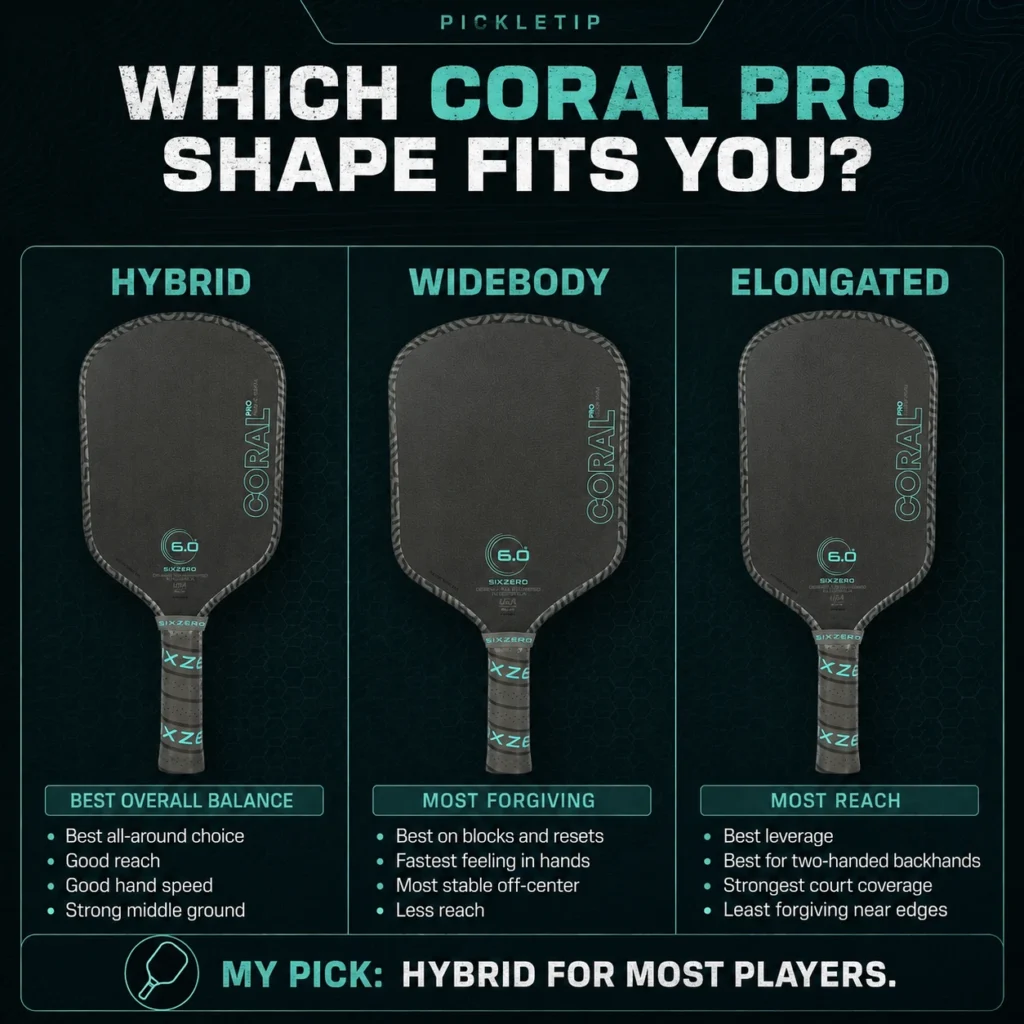
All three versions share the same basic Coral Pro personality. Shape changes the size of the safety net. The Hybrid spreads its strengths most evenly, the Widebody protects imperfect contact and the Elongated rewards cleaner contact with more reach and leverage.
Which One Would I Buy?
The Hybrid. It gave me enough reach to matter without charging as much for mishits as the Elongated. If defense, late blocks and forgiveness are your bigger problems, I would go Widebody instead.
Hybrid: Best Overall Balance
The Hybrid is my favorite of the three and the one I would hand to most players first. It provides enough length for reach and two-handed backhands while retaining better stability and forgiveness than the Elongated.
- Best for: All-court players seeking the most balanced Coral Pro
- Main strength: Complete combination of reach, stability and maneuverability
- Main limitation: Less forgiving than the Widebody and less reach than the Elongated
Widebody: Most Forgiving
The Widebody required the least negotiation. Its wider hitting area provides the most confidence during resets, blocks and defensive exchanges.
- Best for: Players prioritizing forgiveness, defense and fast hands
- Main strength: Stability and a generous usable hitting area
- Main limitation: Less reach and baseline leverage
Elongated: Most Reach
The Elongated gave me the most reach and leverage, exactly as it should. The bill arrives on off-center contact.
- Best for: Players prioritizing reach, leverage and two-handed backhands
- Main strength: Extended court coverage and offensive reach
- Main limitation: Least forgiving of the three shapes
Six Zero Coral Pro Specifications
| Specification | Hybrid | Widebody | Elongated |
|---|---|---|---|
| Approval body | UPA-A | UPA-A | UPA-A |
| Face material | Double Diamond Tough raw carbon fiber | Double Diamond Tough raw carbon fiber | Double Diamond Tough raw carbon fiber |
| Core | Tectonic Core with ProPulsion Foam | Tectonic Core with ProPulsion Foam | Tectonic Core with ProPulsion Foam |
| Core thickness | 16mm | 16mm | 16mm |
| Average weight | 8.0-8.3 oz | 8.0-8.3 oz | 8.0-8.3 oz |
| Length | 16.3″ | 16″ | 16.5″ |
| Width | 7.5″-7.7″ | 7.8″-8″ | 7.3″-7.5″ |
| Handle length | 5.5″ | 5.5″ | 5.75″ |
| Grip circumference | 4.125″ | 4.125″ | 4.125″ |
| Published swing weight | 114 | 110 | 117 |
| Published twist weight | 6.7 | 7.1 | 5.9 |
| Published PBCoR | Not listed | 0.42 | 0.42 |
These figures are Six Zero’s published specifications. Actual paddle weight and measured characteristics can vary between individual production samples.
The numbers line up pretty well with what happened in my hands. The Widebody carries the lowest listed swing weight and highest twist weight of the three, which fits its quicker, steadier behavior. The Elongated has the highest listed swing weight and lowest twist weight, matching the extra leverage and smaller margin I felt near the edge. The Hybrid sits between them, which is exactly where it played.
Six Zero Coral Pro vs Original Coral
| Category | Coral Pro | Original Coral |
|---|---|---|
| Core platform | Tectonic Core with ProPulsion Foam | Tectonic Core with ProPulsion Foam |
| Surface | Double Diamond Tough | Diamond Tough |
| Spin | Elite | Good to very good |
| Offense | Slightly stronger | Balanced and controlled |
| Feel | Slightly crisper and more direct | Softer and denser |
| Surface consistency | Strong during my testing | Good, but less aggressive |
| Approval | UPA-A | USAP availability |
| Regular price | $220 | $200 |
Most of the upgrade is right there on the face. The rougher surface gives me more spin and lets me attack with a little more confidence, but the paddle underneath still behaves like a Coral.
The Pro spins more, hits a little harder and feels slightly crisper. The original still makes sense for players who prefer its softer feel, need USAP approval or simply do not need more spin than they already have.
If the original Coral is the calmest choice, the Coral Pro is the same idea with a sharper pencil. It lets me draw more shape on the ball, especially when the swing is short, but it does not cross into the jumpy behavior that defines hotter foam power paddles.
If you are coming from a Double Black Diamond, the family progression is pretty easy to understand. In my original Coral review, the Coral had more pop, more dwell and a crisper feel than the DBD, while the DBD stayed tamer and better suited to players who still fight long balls. The Coral Pro moves another step toward offense, mostly through the extra spin and surface bite, but it still does not behave like a high-risk power paddle. I would stay with the DBD if control is the whole point. I would choose the Coral Pro when I want that familiar Six Zero balance with more shape and finishing help.
Is the Coral Pro Worth the Upgrade?
If I were buying new and UPA-A approval worked where I compete, I would spend the extra $20 on the Coral Pro. The surface gives me noticeably more spin and a little more freedom to attack.
Upgrade Decision
- Upgrade if: You want more spin, frequently shape shots and value the stronger bite of the Double Diamond Tough surface.
- Keep the original if: Its current spin is sufficient, you prefer the softer feel or you require USAP approval.
The upgrade is real, but plenty of Coral owners can keep their $220. You will notice it most if spin is already doing real work for you: pulling returns wide, dipping drives, changing the bounce on a dink or getting a roll down at somebody’s feet.
UPA-A Approval Is the Main Catch
When I checked the UPA-A approved paddle registry on August 25, 2026, all three Coral Pro shapes appeared:
- Coral Pro RCD-E 16MM: Elongated
- Coral Pro RCD 16MM: Hybrid
- Coral Pro RCD-W 16MM: Widebody
I did not find the Coral Pro on the USA Pickleball approved paddle list during that same check. Do not assume you can bring it to every tournament. A UPA-A listing does not make it legal in leagues or events that require USA Pickleball approval. For the larger distinction between the two systems, see PickleTip’s USAP versus UPA-A approval guide.
Check Before You Compete
Verify the equipment rules for your specific tournament, league or club before purchasing the Coral Pro for competition. If an event requires a paddle from the USAP approved list, the Coral Pro may not be eligible.
Who I Would Hand the Coral Pro To
- All-court players who use spin to create openings
- Players who rely on topspin serves, rolls and dipping drives
- Players who want more offense without giving up predictable control
- Current Coral users who want a stronger-biting surface
- Players who want a choice among Hybrid, Widebody and Elongated shapes
- Competitors whose events accept UPA-A approved paddles
In doubles, the Hybrid and Widebody make the easiest cases because both stay manageable in quick kitchen exchanges. The Widebody adds the most protection when a speedup catches me late. The Hybrid gives up a little of that protection for more useful reach and baseline leverage.
For singles or a two-handed backhand, the Elongated becomes more interesting. Its extra length helped when I was stretched and gave me more leverage from the baseline, but it also demanded cleaner contact. I would not choose it merely because elongated paddles look more aggressive.
Who Can Save the Money?
- Players who require USAP approval
- Players seeking the hardest-hitting power paddle available
- Current Coral owners who are satisfied with their existing spin
- Players who prefer a very soft, muted paddle response
- Players who do not use spin enough to benefit from the surface upgrade
Six Zero Coral Pro Price and Availability
The Six Zero Coral Pro was listed at $220 when I checked and comes in Hybrid, Widebody and Elongated shapes. Six Zero includes a custom neoprene cover. Price, availability and discount eligibility can move around.
Disclosure: This article contains an affiliate link. If you make a purchase through that link, PickleTip may earn a commission at no additional cost to you. Affiliate relationships do not determine review conclusions or ratings.
Sources
- Six Zero Coral Pro Product Page
- UPA-A Approved Paddle Registry
- USA Pickleball Approved Paddle List
- Six Zero Coral Product Page
Product specifications, price and approval status were checked August 25, 2026. Approval lists and retail details can change.
Frequently Asked Questions
No. It has enough offense to finish points, but spin and controlled all-court play remain its strengths.
Yes. I saw more ball movement on serves, rolls, drives, dinks and slices. The difference was most useful on short swings, where the face still grabbed the ball without much runway.
I prefer the Hybrid because it gives me useful reach without sacrificing too much stability, forgiveness or hand speed. The Widebody forgives more. The Elongated reaches farther.
The Hybrid is the best all-around doubles choice. Pick the Widebody instead if blocks, resets, hand speed and forgiveness matter more to you than extra reach.
The Elongated offers the most reach, baseline leverage and handle length, but it is also the least forgiving near the edges. The Hybrid is the safer choice if you want room for two hands without giving up as much stability.
The face stayed aggressive and the spin did not noticeably fade during my testing. Six Zero’s long-term durability numbers remain manufacturer claims, so I need more time before treating that question as settled.
For a new buyer who values spin and can use a UPA-A paddle, yes. Current Coral owners who already have enough spin may have little reason to spend another $220.
It was not listed on the USA Pickleball approved paddle list when I checked August 25, 2026. All three shapes were listed by UPA-A. Check the requirements of your tournament or league before competing with it.
The regular price is $220 before any eligible discount, and a custom neoprene cover is included.
For the Coral Pro, Coach Sid played all three shapes across nine 90-minute sessions, about 13.5 hours total, using drills, recreational games and competitive points. The test focused on repeatable patterns in ball movement, control, power, forgiveness and handling rather than laboratory instruments.
Coach Sid’s Final Verdict
The Coral Pro works because Six Zero did not try to turn the Coral into something it was never meant to be.
It is still a balanced, approachable all-court paddle. The difference is that the face now gives me useful spin even when the swing is short, while the soft game stays predictable once I account for the extra bite.
I would still choose the Hybrid because it asked me to compromise the least. The Widebody is the better answer when forgiveness comes first, and the Elongated makes sense when reach and leverage are worth paying for with a smaller margin near the edge.
The paddle itself is not the problem. The approval label may be. Players who need USAP eligibility should stay with the original Coral or choose another approved option.
If UPA-A approval works where you play, the Coral Pro makes a strong case for itself. It delivers serious spin without the occasional launch-code nonsense that comes with some hotter foam paddles.
Among control-oriented paddles for doubles, the Coral Pro belongs on the more offensive, spin-driven side of the conversation. Among pure power paddles, it is still the calmer and more predictable choice. It lives between those two groups, and the Hybrid handles that middle ground best.