Best Pickleball Paddle for 3.5 Players? Rating Is Not the Answer
Yesterday a video showed up in my feed naming the top five pickleball paddles for 3.5 players.
I actually stopped scrolling.
Really?
The five best paddles for 3.5 players?
How in the hell do you determine that?
I watch a ridiculous number of paddle reviews. Part of that is because I’m addicted to pickleball. Part of it is because I find the differences between reviewers almost as interesting as the paddles themselves.
One reviewer calls a paddle incredibly controllable.
Another says it’s too hot.
One says the sweet spot is enormous.
Another complains about mishits.
One says it’s the perfect paddle for an intermediate player.
Someone else can’t wait to get it out of his bag.
Some of that is simply because people are different. Some reviewers are influenced by the brands they have historically loved. Some have relationships with manufacturers. Affiliate commissions can certainly complicate things.
But let’s give every reviewer the benefit of the doubt.
Assume everybody is being completely sincere.
I still don’t understand how anybody can confidently name the five best paddles for a 3.5 pickleball player.
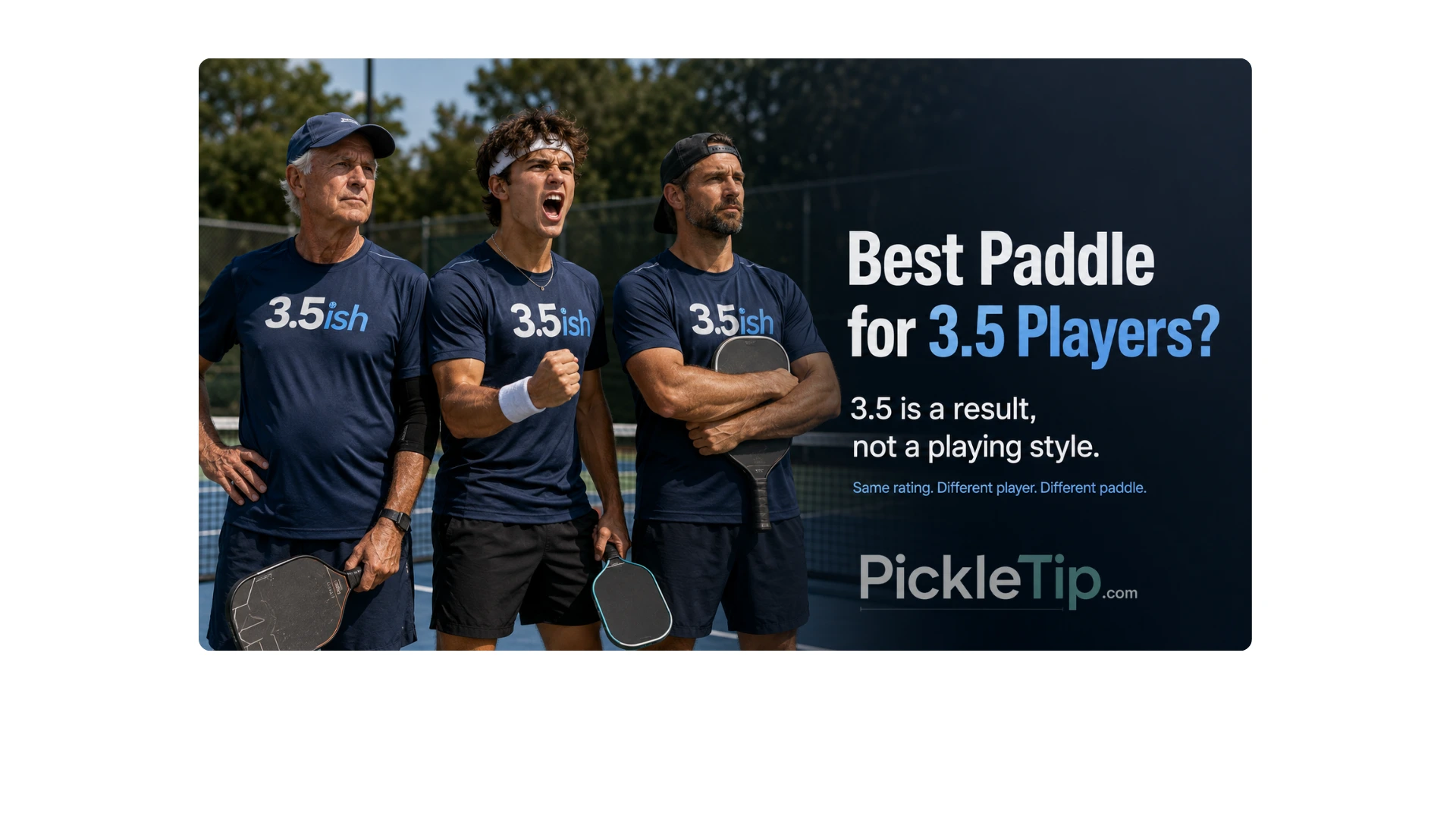
Because 3.5 is a result, not a playing style.
And paddles don’t care what number is next to your name.
A 3.5 rating can tell me roughly how well you compete. It cannot tell me how you produce those results. Paddle fit depends much more on how you play, where you struggle and what your current equipment is doing than on the number next to your name.
What Does a 3.5 Rating Actually Tell You?
A pickleball rating can be useful. It gives us a rough idea of where somebody currently competes.
What it does not tell us is how that player got there.
It doesn’t tell us whether the player generates tremendous power or almost none.
It doesn’t tell us whether the player wins with hand speed, placement, patience, defense, spin, athleticism, anticipation or consistency.
It doesn’t tell us why the player loses points.
And those things matter a whole lot more when choosing a paddle.
By the time players reach 3.5, they usually have enough ability to win points in recognizable ways. The problem is that they don’t all win them the same way.
One player may develop great hands before great movement. Another may bring years of tennis into pickleball and never struggle to generate pace. Another may build an entire game around resets, placement and patience. They can arrive at roughly the same competitive level through completely different routes.
That is what makes 3.5 such a messy equipment category. It is less a single type of player than a meeting point for players whose games may have almost nothing in common.
Think about three completely different players.
All three have the exact same 3.5 rating.
Player One: The 70-Year-Old Surgeon
Imagine a 70-year-old player with limited mobility.
He isn’t chasing every lob down.
He’s not covering half the court for his partner.
He’s certainly not winning because he’s the fastest athlete in the building.
But hit a ball anywhere close to him and he’s a surgeon.
His hands are fantastic. He absorbs pace, blocks hard drives into open spaces and sees angles before everyone else does.
His placement is ridiculous.
His rating might be held back primarily because there are balls he physically cannot reach anymore.
Now tell me what paddle a “3.5 player” needs.
More power?
Maybe.
More control?
Maybe.
Faster hands?
Possibly.
A bigger sweet spot?
That might matter a lot.
You cannot answer the question from 3.5.
You need to know the player.
Player Two: The 19-Year-Old Wrecking Ball
Now take a 19-year-old athlete.
Same rating.
3.5.
This kid can fly.
He gets to everything.
He generates enormous paddle-head speed and hits drives loaded with topspin.
When he catches one correctly, opponents at his level sometimes can’t handle the pace.
His problem isn’t producing offense.
His problem might be that he tries to produce offense from everywhere.
He attacks balls that should be reset.
He drives balls that should be dropped.
He occasionally sends a speedup into the back fence because every ball looks attackable.
Would you give him the same paddle as the 70-year-old player?
Maybe the worst thing you could give this kid is more effortless power.
His best paddle might actually take something away.
That’s something we don’t talk about enough.
The right paddle doesn’t always amplify your strength. Sometimes it puts guardrails around it.
Player Three: The Wall
Now imagine a 35-year-old 3.5.
Completely different game again.
He rarely speeds the ball up.
He blocks hard drives.
He resets from transition.
He drops third shots.
He gets to the kitchen and patiently moves the ball around.
His favorite strategy is basically:
“You hit one more ball.”
And then another.
And another.
He sets his partner up, waits for opponents to get impatient and collects points from their mistakes.
Maybe his biggest weakness is that he doesn’t create enough offense himself.
Maybe his control is already excellent.
Maybe what helps him isn’t additional softness at all.
Same rating.
Different player.
Different problem.
Potentially a completely different paddle.
Yet all three get placed into the same bucket:
3.5 player.
That’s the problem.
Now hand all three of them the same supposedly safe “all-around paddle for 3.5 players.” One might find it wonderfully forgiving. Another might think it is uncontrollably hot. The third might find it unnecessarily sluggish.
The paddle did not change.
The player did.
I’ve watched a real version of this happen during a clinic where we were comparing foam-core paddles. Most of the players were in the 3.5 to 4.0 range. Three different players fell in love with three different paddles during the first few minutes. Warmup dinks looked clean. Everybody seemed happy.
Then we turned the speed up.
Now we were seeing floating resets, players getting jammed in hand battles and counters sailing long. The setup stayed mostly the same: same court, same partner feed, same body-block and counter pace. The pressure showed us where each player and paddle combination started breaking down.
That told me more about which paddle fit each player than knowing they were all somewhere around 3.5 to 4.0 ever could.
Rating Is a Filter, Not a Prescription
A rating tells us roughly where the player competes. Paddle fit depends on what produced that result: hand speed, mobility, power, touch, spin, consistency, anticipation, shot selection, defense, previous racquet-sport experience, physical limitations or some strange combination of all of them.
A 3.5 who has elite hands but poor mobility is not the same player as a 3.5 with elite athleticism and terrible shot selection.
A 3.5 former tennis player who can crush a forehand but struggles at the kitchen isn’t the same player as somebody who learned pickleball from day one and wins almost entirely through patience and touch.
A pickleball rating measures competitive performance. It does not diagnose paddle fit.
That doesn’t mean rating is useless when choosing a paddle.
A brand-new player generally doesn’t need an extremely demanding paddle that punishes every slightly imperfect contact. If you’re still at that stage, I break down what actually helps in my guide to the best pickleball paddles for beginners.
An experienced player may be capable of taking advantage of characteristics that a newer player doesn’t have the technique to use consistently.
And this isn’t a criticism of DUPR or any other rating system. A rating system isn’t supposed to diagnose your equipment. Its job is to estimate competitive ability.
So I am not saying:
Your skill level has absolutely nothing to do with paddle selection.
I’m saying something more specific.
Rating is a filter, not a prescription.
It can help narrow what might be sensible.
It cannot tell you what paddle you should buy.
“Intermediate” Isn’t a Playing Style Either
This isn’t only a 3.5 problem.
We do the same thing with words like beginner, intermediate, advanced, 4.0 and 4.5.
You’ll see paddles marketed as:
Best paddle for intermediate players.
Okay.
Which intermediate player?
The former Division I tennis player who’s been playing pickleball for four months and still drives every third shot?
The 60-year-old who has been playing for five years and wins almost entirely with placement?
The defensive player with incredible resets?
The banger trying to learn patience?
Those labels can still be useful for describing development. My pickleball skill levels guide explains what beginner, intermediate, 3.5, 4.0 and other levels generally look like on court.
But “intermediate” still tells me very little about which paddle any one of those players should use.
The Better Question Is: What Is Costing You Points?
Now ask me what keeps costing you points, and I can actually start helping.
Instead of asking:
What is the best paddle for a 3.5 player?
Ask:
What is keeping this particular 3.5 player from becoming better?
Maybe the player struggles with:
- balls sailing long
- unstable blocks against pace
- slow hands during firefights
- short serves and returns
- inconsistent resets
- weak putaways
- mishits outside the center of the face
- difficulty generating topspin
- trouble creating depth without overswinging
Those are actual problems.
Those problems give us something to evaluate.
A rating doesn’t.
What I Want to Know Before I Recommend a Paddle
Knowing that somebody is a 3.5 is useful.
But it’s nowhere near enough.
I’d much rather know:
- How do you win points?
- How do you lose them?
- What shots repeatedly break down?
- Do you naturally create power or fight for it?
- Do you prefer attacking or extending rallies?
- Are your hands fast enough for the paddle you’re currently using?
- Do you frequently miss the center of the face?
- What happens when somebody drives the ball directly at you?
- What happens when you’re under pressure in transition?
- What do you wish your current paddle did better?
Before I recommend a paddle, I’d rather know how you win points, how you lose them and what repeatedly breaks down under pressure. Tell me those things and we’re talking about paddle fit.
Tell me you’re a 3.5?
I know you’re a 3.5.
That’s about it.
If you want a more complete process for sorting through those questions, that’s exactly what I cover in my guide on how to choose a pickleball paddle that fits your game.
The decision should begin with your game, not your DUPR.
Why Honest Paddle Reviewers Can Disagree
This also explains something that fascinates me about paddle reviews.
I can watch two experienced reviewers test the exact same paddle and come away wondering whether they were actually holding the same thing.
One calls it plush.
The other calls it poppy.
One thinks the hand speed is excellent.
The other finds it sluggish.
One says the control is fantastic.
Another can’t keep the ball in the court.
They can both be right.
Every reviewer brings his own game into the test: swing speed, contact point, strength, mechanics, timing, preferred shots, previous paddle, tolerance for a hot face, ability to generate spin and expectations.
That’s why I care much less about whether a reviewer says:
“I love this paddle.”
I care about:
Why does he love it?
That’s the useful part.
If he loves it because it gives him effortless depth and I already hit everything three feet long, that recommendation probably isn’t helping me.
If he loves it because the paddle stays stable when blocking hard drives and stability is exactly where my current paddle fails me, now I have something useful.
The value of a paddle review isn’t whether the reviewer likes the paddle. It’s understanding why he likes it and whether that reason applies to your game.
What a Useful Paddle Review Should Tell You
A useful review should help you understand how the paddle behaves, not just whether the person holding it enjoyed playing with it.
- How maneuverable does it feel when exchanges speed up?
- How stable is it when contact moves away from the center?
- How much launch and pop does it create?
- How forgiving is the usable hitting area?
- How much spin can it produce?
- How do shape and balance affect reach, leverage and hand speed?
- What happens on blocks, resets, counters and other imperfect contacts?
Those characteristics tell us something about the paddle. They still do not tell us whether it is “good for a 3.5.”
Rating tells us about the competitor. Testing tells us about the paddle. Fit tells us about the interaction between the two.
Swing weight, stability, launch, spin, shape and sweet-spot behavior are useful because they describe what the equipment tends to do. You still have to decide whether what it does solves a problem in your game.
That’s also why I don’t think “I played great with it” tells us enough about a paddle. Our pickleball paddle testing method looks at what happens under repeatable pressure: late blocks, rushed resets, counters and off-center contact. Those situations expose what the paddle is doing instead of just what the player happened to do well that day.
Sometimes the Right Paddle Should Take Something Away
There’s another mistake hidden inside a lot of paddle recommendations.
We tend to assume the paddle should match whatever the player already does well.
Power player?
Power paddle.
Control player?
Control paddle.
Spin player?
Spin paddle.
Not necessarily.
Sometimes that makes perfect sense.
Other times the better paddle balances the player.
If you’re already generating ridiculous power but struggling to keep the ball inside the lines, adding another five percent of power might be the opposite of helpful.
If you’re incredibly controlled but cannot finish a shoulder-high ball, some additional pop may make your game more complete.
If your hands are fast but your off-center blocks twist badly, stability might matter more than raw swing weight.
If you’re trying to sort out what those labels actually mean, I break down the tradeoffs in pickleball paddle power vs. control.
Equipment isn’t only about amplifying strengths. Sometimes it’s about reducing the penalty from weaknesses.
That’s why “more of what I’m already good at” isn’t automatically the right answer.
Is There a Best Paddle for a 3.5 Pickleball Player?
No.
There can be paddles that make sense for certain types of 3.5 players.
There can be characteristics that are generally more forgiving for developing players.
There can be paddles that I would immediately eliminate for certain people.
But a rating by itself does not tell us enough to name somebody’s ideal paddle.
A paddle can be one person’s favorite paddle of the year and another player’s worst purchase.
Neither one has to be wrong.
So the next time you see:
The Five Best Pickleball Paddles for 3.5 Players
don’t immediately ask which paddle finished first.
Ask a better question:
Which 3.5 player are we talking about?
Because 3.5 is a result, not a playing style.
And when you’re choosing a paddle, rating is a filter, not a prescription.