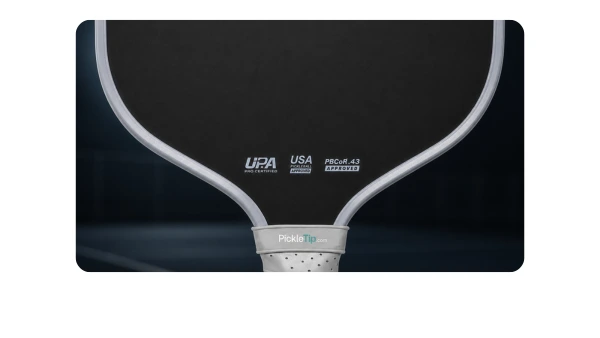

Banned Pickleball Paddles: Current Removed, Delisted, and Restricted Models
Which pickleball paddles are banned? The answer depends on the exact model, approval body, effective date, and event. Some paddles have been removed or decertified. Others face a manufacturer-wide restriction, have passed a sunset deadline, or were never approved. Start with the paddle in your bag, then check the rules for the event you entered.
Sources checked: . The tables distinguish current manufacturer restrictions from published removals, sunsets, and reversals. They do not cover every unapproved paddle. Recheck the official records before competing; status can change after this review.
Coach Sid’s Short Answer
If your event requires approval that your paddle has lost, you cannot use it there unless that exact model has been officially reinstated. An investigation alone is not a removal. Also check manufacturer restrictions: a model entry does not always tell the whole story.
Start with the current USA Pickleball restrictions, published removal and sunset decisions, or UPA-A status section. Then use the pre-tournament checklist to verify your exact paddle.
Current USA Pickleball Manufacturer Restrictions
USA Pickleball publishes model-level findings in its Paddle Compliance Report and broader restrictions in its Non-Compliant Manufacturer List. Read both together.
This restriction covers the manufacturer, not just the model named in the report. At the October 10 check, USA Pickleball listed Proton Sports Inc., Speedup, Facolos, Six Zero, and R.A.W. Reign and Win as non-compliant manufacturers. Its published rule excludes their paddles from USA Pickleball-sanctioned tournaments while that listing applies.
| Manufacturer | Reported Model Finding | Separate Manufacturer Restriction |
|---|---|---|
| Proton Sports Inc. | Series Three Project Peacock — S3PE15: Under Investigation | Listed as restricted; all manufacturer paddles excluded from USAP-sanctioned tournaments at review. |
| Speedup | Tide 14S: Under Investigation | Listed as restricted; all manufacturer paddles excluded from USAP-sanctioned tournaments at review. |
| Facolos | Pro Series — Elite X: Removed from USAP Approved List | Listed as restricted; all manufacturer paddles excluded from USAP-sanctioned tournaments at review. |
| Six Zero | Ruby Pro 14MM: Under Investigation | Listed as restricted; all manufacturer paddles excluded from USAP-sanctioned tournaments at review. |
| R.A.W. Reign and Win | Multiple models: Compliance Issue Resolved | Still listed as restricted; all manufacturer paddles excluded from USAP-sanctioned tournaments at review. |
Two records, two different answers: R.A.W.’s model-level entry says its compliance issue was resolved, but its name remained on the manufacturer restriction list at our October 10 check. The resolved entry alone does not clear its paddles for sanctioned play. These records do not establish eligibility at every other event.
AJ and I once drove all the way to Hattiesburg, Mississippi, only to learn that the paddle he had been playing with was not allowed in the tournament he entered. Luckily, he had another paddle in his bag. That trip permanently changed how I think about backups: the argument over whether a paddle should be allowed matters a lot less when your first match is about to start.
Looking for a replacement? Search PickleTip’s USA Pickleball approved paddle list or UPA-A certified paddle list. Match the exact model, then check any separate restrictions and your event’s requirements.
Published Paddle Removals, Sunsets, and Reversals
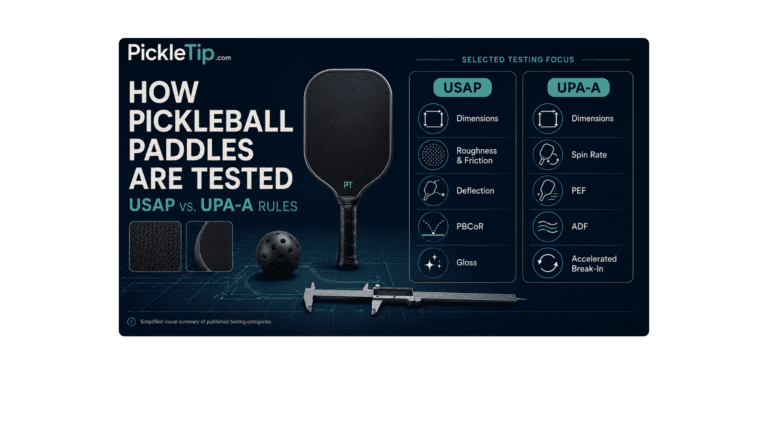
PBCoR is USA Pickleball’s Paddle/Ball Coefficient of Restitution test. It measures rebound performance—the spring off the paddle face. The decisions below followed the introduction of this standard. For the testing details, read how USA Pickleball and UPA-A test paddles.
Decision history, not a live eligibility database: The Black Ace LG row includes a reversal. Read the outcome for your exact model rather than treating every paddle in this table as currently banned.
| Manufacturer | Affected Model | Published Decision |
|---|---|---|
| Chorus | Fire EX and Fire SX | Removed February 13, 2025, after failing PBCoR testing. |
| Chorus | Fire HX | Sunset effective July 1, 2025. |
| JOOLA | Perseus Mod TA-15, 14mm and 16mm | Sunset effective July 1, 2025. |
| Gearbox | Pro Power Elongated | Sunset effective July 1, 2025. |
| ProKennex | Black Ace Ovation, Pro, and XF | Sunset effective July 1, 2025. |
| ProKennex | 11mm Black Ace LG | Removal reversed June 3, 2025. The planned July 1 removal did not take effect for this model. |
A sunset gives an affected paddle a transition period. Once the published removal date takes effect, that version is no longer eligible where the approval is required. A later reversal can change the outcome, as it did for the Black Ace LG.
Are ProKennex Black Ace Paddles Banned?
The model matters. The Black Ace Ovation, Pro, and XF were included in the July 2025 sunset. The 11mm Black Ace LG received a different outcome: USA Pickleball reversed its planned removal before the deadline. Calling every Black Ace paddle banned overlooks that exception.
Which JOOLA Paddles Were Banned or Removed?
USA Pickleball’s 2024 action affected specific Gen 3 and Alpha 2024 paddles. Its statement described incorrect certification submissions and subsequent testing that did not meet approval requirements. It was not a blanket removal of every JOOLA paddle.
The official JOOLA removal notice identified the following 17 models:
View all 17 affected JOOLA Gen 3 and Alpha 2024 models
- Tyson McGuffin Magnus 3 – 14mm
- Tyson McGuffin Magnus 3 – 16mm
- Collin Johns Scorpeus 3 – 16mm
- Anna Bright Scorpeus 3 – 14mm
- Simone Jardim Hyperion 3 – 16mm
- Ben Johns Hyperion 3 – 14mm
- Ben Johns Hyperion 3 – 16mm
- Ben Johns Perseus 3 – 14mm
- Ben Johns Perseus 3 – 16mm
- Perseus Alpha 2024 – 14mm
- Perseus Alpha 2024 – 16mm
- Magnus Alpha 2024 – 14mm
- Magnus Alpha 2024 – 16mm
- Hyperion Alpha 2024 – 14mm
- Hyperion Alpha 2024 – 16mm
- Scorpeus Alpha 2024 – 14mm
- Scorpeus Alpha 2024 – 16mm
The 2024 Gen 3 and Alpha removals and the 2025 Mod TA-15 sunset were separate decisions. Neither is a blanket ruling on every later JOOLA generation.
For the background and model-submission dispute, read PickleTip’s JOOLA Gen 3 approval controversy.
UPA-A De-Listed Paddles and Certification Restrictions
UPA-A’s public de-listed page identified Soxter when reviewed on October 10, 2026. Its April 2026 statement says submitted Soxter paddles did not receive certification, despite paddles being sold bearing or implying UPA-A approval.
Soxter’s case concerns an approval claim it had not earned, rather than certification it later lost. A printed stamp alone is not proof of approval.
Are Luzz Paddles Still De-Listed?
UPA-A announced the removal of all Luzz paddles then holding approved or provisional status on March 31, 2025. Its approved list checked October 10, 2026 includes later models—for example, Inferno2 M1, model number INFERNO2 M1, 16MM, certified July 20, 2026. That later entry is not a reinstatement of every paddle covered by the 2025 removal.
Does “Blackout Only” Mean Banned?
No. Blackout Only is a presentation restriction on a certified paddle. Check the list’s designation for professional PPA or MLP play. UPA-A’s FAQ separately allows full graphics at PPA Challenger events when certification and required markings are valid.
Have an interim UPA-A stamp? The FAQ gives a current “UPA PRO CERTIFIED” stamp requirement but also permits interim-stamped listed models during a transition, ending for professional competition in 2027. If those passages leave your paddle’s eligibility unclear, use the verification checklist and obtain written confirmation for your division.
Use PickleTip’s UPA-A certified paddle list for model details. The table below explains which event requirements to check.
Can a Paddle Be Legal at One Tournament and Rejected at Another?
Yes. USA Pickleball and UPA-A operate different approval systems. Independent tournaments and clubs also publish equipment policies. Approval by one organization does not automatically satisfy another organization’s requirements.
| Playing Environment | What to Check |
|---|---|
| USA Pickleball-sanctioned tournament | Exact-model approval, compliance notices, manufacturer restrictions, effective dates, and individual-paddle condition. |
| Professional PPA or MLP competition | UPA-A certification, required markings, applicable presentation rules, and onsite testing. |
| Senior Open or PPA Juniors divisions in the U.S. | UPA-A certification has been required since August 30, 2026. |
| Other UPA amateur divisions | Currently USAP-approved or UPA-A-certified paddles, subject to applicable event rules. |
| PPA Europe | USAP-approved paddles remain eligible at every level through December 31, 2026. UPA-A certification is required for professional play from January 1, 2027. |
| Independent tournament, league, or moneyball | The organizer’s written equipment policy and inspection procedure. |
| Club or recreational play | Facility rules and paddle condition. Some groups adopt tournament standards. |
The UPA-A division eligibility FAQ and PPA Europe announcement explain those requirements. Not sure which organization’s rules apply? Read who governs your tournament.
What Paddle Status Labels Actually Mean
Players often use “banned” or “illegal” for any paddle they cannot bring to a tournament. Official records use more specific terms. Those differences tell you whether a paddle lost approval, never had it, faces a temporary review, or needs a different event check.
| Status | Practical Meaning |
|---|---|
| Pass / Approved / Certified | The exact model has approval under that system. Separate restrictions and individual-paddle compliance still matter. |
| Under Investigation | A review is open. This label alone does not establish removal or permission to play. |
| Manufacturer Restricted | A broader restriction applies to the manufacturer’s paddles within the stated scope. |
| Removed / Decertified / De-listed | Approval was withdrawn. Check the effective date and any later reversal. |
| Sunset | Eligibility ends on a published date unless a later decision changes it. |
| Restored / Relisted | A prior removal or planned removal was reversed for the specified model. |
| Blackout Only | Certification remains active, with a presentation restriction where applicable. |
| Never Approved | No active approval was obtained under that system. That does not, by itself, establish a failed test. |
| Withdrawn | Check what was withdrawn and when: a submission or an existing approval. The term alone does not establish the paddle’s approval history. |
| Unauthorized Logo or Stamp | The printed approval claim is unsupported by the official certification record. |
Why an Approved Pickleball Paddle Can Still Be Rejected
Compliance involves the submitted model, the production paddles sold to players, and the individual paddle brought to an event.
| Level | What Must Remain Compliant |
|---|---|
| Certified model | The submitted model must complete the approval process. |
| Production paddles | Retail units must match the certified design and applicable performance requirements. |
| Individual paddle | The paddle in your hand must remain within the rules after use and any permitted modifications. |
Facolos Elite X: When Production Paddles Differed
USA Pickleball’s Facolos Elite X statement explains that additional testing found excessive surface roughness. It also says Facolos acknowledged that production paddles differed from the version submitted for certification. The model was removed. The paddle sold to players still has to match the paddle that passed certification.
In hundreds of local tournaments around New Orleans, I have rarely seen organizers inspect every paddle. When checks are that uncommon, it is easy to assume the paddle you used last weekend will be accepted next weekend.
I coach and play in local tournaments around New Orleans, but I am not a paddle-certification official. I can help you read these records. I cannot clear your paddle for a tournament.
Historical Paddle Cases That Still Cause Confusion
These are historical examples, not current blanket bans. An old headline can describe a different version from the paddle you own.
| Case | What Happened | What to Check Today |
|---|---|---|
| CRBN, 2022 | Surface-roughness concerns led to restrictions and corrective production work. In its May 26, 2022 statement, CRBN described approval of its new serialized batch and the serial marking used to distinguish it from older paddles. | For a paddle from the affected period, identify the batch and applicable serial requirement. Do not apply the 2022 decision to every later CRBN model. |
| Ronbus Ripple beta and prior versions | USA Pickleball’s May 9, 2025 update distinguished beta and production testing. Previous Ripple versions were voluntarily removed effective July 1, 2025. | Distinguish the earlier versions from Ripple V2 R1.14, R2.14, and R4.14, which the notice identifies as approved. Then check the current record for the paddle you own. |
Not Approved Does Not Always Mean Decertified
- A paddle approved by another organization: it may be eligible under that system while lacking the approval your event requires.
- A paddle absent from a database: absence establishes no active listing there; it does not, by itself, prove failed testing.
- A withdrawn prototype: it may never have completed approval.
- A recreational concept paddle: tournament ineligibility does not necessarily prohibit permitted casual use.
- An unusual approval process: questions about the OWL paddle approval case should not be converted into an unsupported blanket-ban claim.
Diadem Vice: Recreational Concept Paddle
Diadem’s Vice product page expressly describes a concept paddle not intended for USA Pickleball tournament play. That is different from approval followed by decertification. Our Diadem Vice review discusses its playing characteristics.
Do not decide tournament eligibility from “EVA” on a product page. Check the finished paddle’s approval and the rules your event uses.
How to Check Whether Your Pickleball Paddle Is Legal
- Identify your exact paddle. Record the full brand and model name, model number, thickness, shape, generation, and relevant serial information. Check the paddle, packaging, receipt, and manufacturer documentation.
- Identify the event’s approval system. Read the tournament and division requirements rather than assuming last month’s event used the same rules.
- Match the current official entry. Search the full model, not just the brand. A similar family name or another thickness is not enough, and a printed approval mark may refer to an outdated or different version.
- Check separate restrictions. Review compliance reports, manufacturer restrictions, de-listed records, and model-specific notices. Do not stop at a Pass entry when another active record limits play.
- Check effective dates and event instructions. Read later reversals, division requirements, required markings, artwork restrictions, and onsite testing procedures. Recheck near the event; last month’s screenshot may be out of date.
- Resolve conflicting records before traveling. Send the organizer photos of your paddle’s markings, the exact model and thickness, and links to the conflicting records. Ask for a written answer for your division that is consistent with its governing rules. Keep the reply and dated records; an organizer’s email does not override a governing-body restriction or guarantee an onsite pass.
- Pack an eligible backup. Check its status and condition too. Put it in your bag before leaving.
Check the paddle you will actually bring. Your backup should not feel like a stranger, either. Practice with it before the tournament; having another paddle helps a lot less if your first match is also your first time hitting with it.
Can Damage or Modifications Make an Approved Paddle Illegal?
Yes. An approved model does not make every altered or damaged copy compliant. Added surface texture, spray-on grit, anti-skid coatings, or other prohibited changes can cause rejection. Cracks, delamination, severe damage, or performance outside applicable limits can also make an individual paddle ineligible.
Does weighted tape or an overgrip make a paddle illegal? Not automatically. Permitted weight tape and grip changes still have to meet the event’s rules for placement, dimensions, and other alterations. Adding texture or a spin-enhancing coating to the hitting surface is a different matter. Use the current USA Pickleball rulebook and equipment standards, especially Equipment Standards Manual sections 2.E.5 and 2.E.6, or the corresponding rules for your event before modifying a tournament paddle.
What to Do If Your Paddle Is Removed or Decertified
- Confirm the exact affected model, approval system, and effective date.
- Switch paddles for events where the removal applies.
- Ask the seller or manufacturer about current replacement, exchange, refresh, or refund options.
- Save your receipt, serial information, paddle photos, and the official notice.
- Check other models separately, including whether a manufacturer-wide restriction applies.
- Use it recreationally only where permitted and only if it remains safe and undamaged.
Decertification does not tell you what the seller currently offers. Ask directly about returns, exchanges, or replacements. An offer described in a 2022 or 2025 announcement may have expired.
Official Sources for Current Paddle Status
- USA Pickleball live approved paddle list
- USA Pickleball Paddle Compliance Report
- USA Pickleball Non-Compliant Manufacturer List
- USA Pickleball certification and sunset announcement
- USA Pickleball rules and equipment standards
- UPA-A live approved paddle list
- UPA-A de-listed paddle records
- UPA-A certification, markings, and event-eligibility FAQ
If official records appear inconsistent, follow the conflicting-records step in the checklist before traveling.
Banned Pickleball Paddle FAQ
“Banned” is an informal label. A paddle may have lost approval, passed a removal deadline, fallen under a manufacturer restriction, or never been approved. Check which decision applies to your paddle and event.
An investigation alone is not a removal. Check the current model entry and any separate manufacturer restriction. An open investigation does not give permission to ignore a broader active restriction.
No. The 2024 Gen 3 and Alpha removals affected specific models. The 2025 Perseus Mod TA-15 sunset was a separate decision. Other JOOLA paddles require their own exact-model status check.
A club or recreational group may permit it, but some adopt tournament equipment rules. Confirm the facility policy and retire any paddle that is unsafe or seriously damaged.
Yes. Model approval can change, and an individual paddle can become non-compliant through prohibited modifications, damage, delamination, or performance outside applicable limits.
A later official decision can restore an exact model or reverse its planned removal. Check the version and current record; related paddles do not automatically receive the same outcome.
Ask the seller or manufacturer about current returns, exchanges, or replacements. Keep your receipt, serial information, photos, and the official notice. Decertification does not establish the seller’s policy, and older offers may have expired.
Compare the paddle markings, packaging, receipt, and manufacturer documentation. Match the full model name, model number, thickness, shape, generation, and relevant serial or production information.
Yes. Model approval does not guarantee that your particular paddle will pass inspection. Separate restrictions, required markings, division rules, prohibited alterations, damage, or a failed onsite test can affect eligibility.
Send the organizer photos of the paddle’s markings, its exact model and thickness, and links to the conflicting records. Request a written answer for your division before traveling, consistent with the governing rules. Bring a familiar eligible backup if the issue remains unresolved.
Related Paddle Approval Guides
- Paddle Rules & Approvals: find the guide that matches your equipment question.
- USA Pickleball Approved Paddle List: search exact models and consolidated paddle details.
- UPA-A Certified Paddle List: compare certified models and available specifications.
- How Pickleball Paddles Are Tested: understand certification and compliance testing.
- Who Governs Pickleball?: identify the organization behind your event’s rules.
- JOOLA Gen 3 Approval Controversy: explore the 2024 submission and testing dispute.
- OWL Paddle Approval Investigation: distinguish questions about approval procedures from removal decisions.