12 Best Pickleball Paddles for Spin in 2026: Tested for Usable Spin
After testing hundreds of paddles, these are my top 12 for usable, repeatable spin on court, not simply the faces that felt roughest under my thumb.
The Honolulu Pickleball J2CR Crystal Blue Long Handle is the best pickleball paddle for spin that I have tested. It gave me the strongest mix of surface bite, paddle speed, launch control, and repeatable ball shape on serves, drives, roll volleys, and other real-game swings.
A high-spin paddle should help you bend the ball more than once on perfect contact. I want the spin to survive a rushed counter, a roll below net height, a drive struck a little away from center, and the ordinary ugly contact that shows up in actual games.
What “usable spin” means here: repeatable ball shape you can access across real shots and imperfect contact, not the single highest RPM result a paddle might produce under a controlled test. Surface friction matters, but so do paddle speed, dwell, stability, launch control, shape, balance, and the way those traits fit your swing.
If spin is only one part of a broader paddle decision, start with how to choose a pickleball paddle. If you want the strongest current recommendations regardless of spin bias, use the best pickleball paddles guide.
Updated August 16, 2026: The J2CR Crystal Blue remains my top spin paddle. The 11SIX24 Vapor Power 2 remains the closest fast-hand alternative, while the Rizen Ascent is my current choice for the strongest blend of spin and control. These are on-court rankings, not universal RPM claims.
Top 12 Picks
Hundreds Tested
Outdoor Testing
Franklin X-40
Doubles + Drilling
Stock Weight
Best Pickleball Paddles for Spin at a Glance
| Spin Need | Best Pick | Why It Fits | Main Tradeoff |
|---|---|---|---|
| Best Overall Spin | Honolulu J2CR Crystal Blue Long Handle | Turns obvious surface bite into repeatable shape on serves, drives, rolls, and counters | More aggressive face feel than players seeking a muted connection may prefer |
| Best Spin Paddle for Fast Hands | 11SIX24 Vapor Power 2 | Elite grip plus quick acceleration on compact and full swings | Livelier response than a calm control-first player may want |
| Best Pickleball Paddle for Spin and Control | Rizen Ascent | Dwell-based connection makes drops, rolls, drives, and controlled topspin easy to shape | Does not provide the same aggressively rough tactile feel as the leaders |
| Best Topspin Paddle for Drives | RPM Q2 Elongated | Elongated leverage and committed acceleration create heavy, dipping pace | Less natural for compact kitchen play |
| Best High-Spin Value | Enhance Turbo EPP | Premium-level usable spin on a forgiving widebody platform at a lower price | Not the best fit for players wanting a long handle or elongated reach |
| Best for Soft-Shot Spin | Ronbus Quanta | Connected dwell helps shape drops, dinks, rolls, and compact swings | Lower explosive spin ceiling than the most aggressive surfaces |
| Best Foam-Assisted Spin | CRBN 3 TruFoam Waves | Combines face grip, leverage, compression, and dwell | Premium and more demanding than quicker alternatives |
| Best for Spin and Slice | RPM Friction Pro Elongated V2 | Strong friction and elongated leverage on drives, serves, and aggressive cuts | Less effortless during fast kitchen exchanges |
| Best Heavy, Planted Spin | Spartus P1 Hybrid | Rewards a committed swing with forceful serves and drives | Not especially light or quick at the kitchen |
| Best Controlled Spin | Volair Shift | Precise, placement-oriented shape on drops, rolls, and touch shots | Lower maximum spin ceiling than the leaders |
| Most Forgiving Spin Paddle | Holbrook Fuze | Preserves useful shot shape when contact moves away from center | Does not create the most rotation on perfect contact |
| Best Affordable Speed-Assisted Spin | Maverix Havik 2 | Fast aerodynamic handling creates strong topspin without premium pricing | Less forgiving and connected than the higher-ranked options |
Which Kind of Spin Player Are You?
The paddle with the highest spin ceiling is not automatically the easiest one for your swing. Start with how you create spin and where you need help.
| Your Spin Game | Best Starting Point | How You Know This Is You | Why |
|---|---|---|---|
| Fast hands and compact swings | 11SIX24 Vapor Power 2 | Your best offense comes from counters, rolls, and quick acceleration instead of a long backswing | Quick acceleration makes spin accessible when there is not much time or backswing |
| Long, committed baseline swings | RPM Q2 Elongated | You already have developed mechanics and want the paddle to reward a full swing | Elongated leverage rewards acceleration on drives and serves |
| Control-first intermediate player | Rizen Ascent | You are still building drops, resets, and a calmer kitchen game and do not want a paddle that makes every miss louder | Connected dwell gives you a bigger window to shape the ball without chasing an extreme surface |
| Control and soft-shot shaping | Rizen Ascent | You use spin to manage height, depth, and angles more than to chase a huge RPM ceiling | Connected dwell helps control launch on drops, rolls, and shaped drives |
| Spin on short, awkward balls | Ronbus Quanta | Your spin often has to come from below net height or with almost no backswing | Useful spin remains available when a large swing is not |
| Forgiveness away from center | Enhance Turbo EPP or Holbrook Fuze | Your real misses happen when you are late, jammed, stretched, or outside the sweet spot | Both preserve useful shape when contact is less than perfect |
| Heavy serves, drives, and slices | RPM Friction Pro Elongated V2 | You are an aggressive player who is willing to trade some kitchen speed for leverage and a nastier baseline ball | Friction and elongated leverage reward a committed swing path |
How I Tested for Usable Spin, Not Just Maximum Spin
The PickleTip Usable Spin Test
I ranked these from playing with them, not from pretending I ran a laboratory test I did not run.
Consistent machine testing is useful, but it answers a different question. It cannot fully show what happens when the ball is below the net, somebody is crashing the kitchen, and only a compact swing is available.
I did not assign RPM numbers because I did not test every paddle under one controlled machine protocol. This ranking is about which paddles gave me the most useful and repeatable spin during play.
My test is pretty simple: Can I still make the ball move when the point stops being pretty?
Maximum spin and easy spin are different things. One paddle may produce a nastier ball when I have time for a full swing. Another may give me more spin when the ball is low, my feet are late, and the swing has to be six inches long. I care about both.
- Shape: Could I make the ball dip, bend, or stay low?
- Access: How much swing speed and precision did the paddle require?
- Control: Could I add rotation without losing predictable launch and depth?
- Range: Did the spin show up on serves, drives, counters, rolls, drops, dinks, and slices?
- Repeatability: Did useful shape remain after perfect contact disappeared?
- Connection: How did friction, dwell, compression, stability, speed, shape, and balance work together?
All paddles were tested outdoors with Franklin X-40 balls over multiple playing and drilling sessions. Each paddle was broken in before I finalized my impressions. I used stock weight with Vyce overgrips, without lead or tungsten tape.
“Hundreds Tested” means hundreds played over time, not one giant 12-paddle laboratory test. These are the paddles I trust most right now for usable spin.
The ball can change the result. A harder, quicker ball may leave the face differently and change how much hold and spin you feel. These rankings also reflect the stock setups I played. Change the ball, add weight, or put the paddle in a different player’s hand, and the order may move. Read How We Test Pickleball Paddles for the broader process.
Why the Best Spin Paddle Is Not Always the Grittiest
Remember the shirt test?
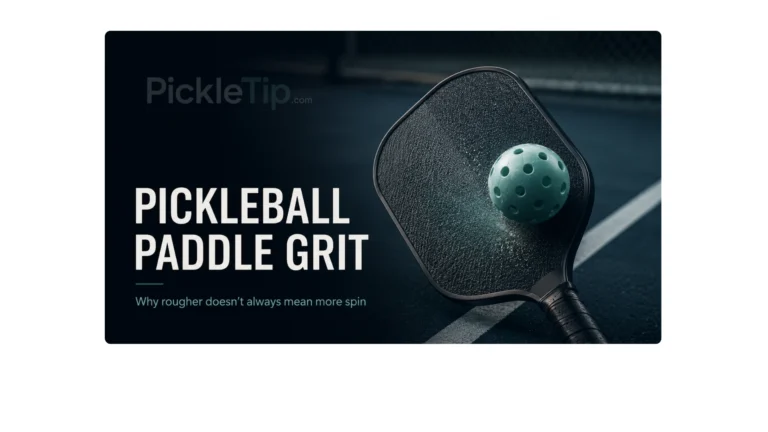
Pressing a paddle face against a shirt and showing that it could hang there proved the surface was rough. It did not prove how much usable spin the paddle would produce during a game.
What Grit Can Do
A rougher face can create more friction and make topspin, slices, and aggressive rolls easier to access.
What Grit Cannot Tell You
It does not reveal paddle speed, dwell time, stability on mishits, launch control, or repeatability under pressure.
Grit helps, but the paddle still has to arrive on time, hold steady, and send the ball where I expected. A rough face on the wrong shape or balance is not automatically a good spin paddle. The Rizen Ascent and Ronbus Quanta proved that to me: neither depended entirely on an extremely abrasive feel, yet both let me shape the ball because contact felt connected.
Coach Sid’s grit rule: Touching the face tells me what the surface feels like. Hitting the ball tells me whether the paddle can use it.
Spin durability deserves its own test. A paddle can spin the ball like crazy when the face is fresh and tell a very different story after the hours pile up. Read Pickleball Grit Durability in 2026: Which Surfaces Hold Spin? for the durability evidence.
The 12 Best Pickleball Paddles for Spin
1. Honolulu Pickleball J2CR Crystal Blue Long Handle — Best Overall Spin
The rough face that actually paid off
The Honolulu Pickleball J2CR Crystal Blue Long Handle produced the best overall spin of the paddles I have tested.
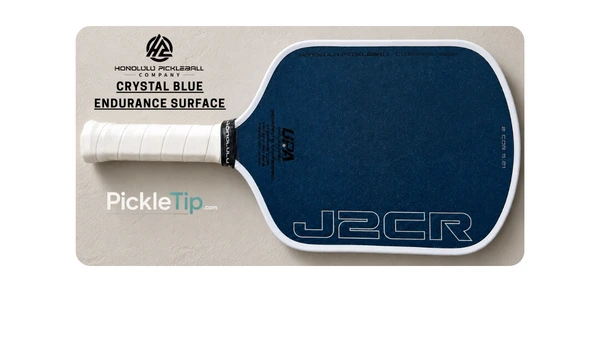
Unlike the smoother paddles in this ranking, the Crystal Blue feels distinctly aggressive at the surface. The face grabs the ball immediately, but the important part is what happened next.
Plenty of paddles feel rough. The Crystal Blue actually lets me cash in on that roughness.
I could accelerate through the ball and trust that a hard drive would dip. On roll volleys, it was easier to pull the ball down instead of sending it beyond the baseline. I could hit serves with pace and still see noticeable shape.
The long handle gives two-handed backhand players more room and leverage, while the paddle still gets around quickly enough to create the face speed needed for spin. The bite and the speed help each other instead of getting in each other’s way.
The Crystal Blue may attract players because of how gritty it feels, but it earned the top position because of what happened to the ball, not simply because of what the surface felt like under my thumb.
Read my complete Honolulu J2CR versus J2CR Crystal Blue comparison for a closer look at the differences in surface, feel, spin, and overall play.
Best for: Players who want maximum access to topspin, aggressive shot shaping, and extra handle room for a two-handed backhand.
Consider another paddle if: You prefer a softer, smoother, or more muted connection with the ball.
2. 11SIX24 Vapor Power 2 — Best Spin for Fast Hands
Almost the same spin without slowing my hands
The 11SIX24 Vapor Power 2 came remarkably close to the J2CR Crystal Blue in overall spin production, but it reached the ball in a different way.
Its HexGrit surface provides substantial grip, and the paddle moves quickly through the hitting zone. That speed made it easier for me to accelerate through contact without feeling late.
I noticed the advantage most on compact counters, roll volleys, and quick topspin swings. Some high-spin paddles ask for more room than a kitchen exchange gives you. The Vapor did not force the same compromise.
It also avoided the one-shot problem. This was not a paddle that produced one spectacular baseline drive and then became difficult to spin everywhere else. I could still create shape during kitchen exchanges and transition shots.
I like the newer 11SIX24 Ultre Power 2 more overall. For spin alone, I still give the Vapor Power 2 the edge because its faster hybrid handling and HexGrit made shape easier to access.
I also have more than a day-one impression here. In my 45-hour Vapor testing, the bite stayed usable: roll dinks did not suddenly start floating, and shaped drives did not lose their dip. That does not make HexGrit immortal, but it is much better evidence than rubbing a new face with my thumb. Read my full 11SIX24 Vapor Power 2 review for the longer testing notes.
Best for: Aggressive players whose spin comes from quick acceleration and who do not want to sacrifice hand speed.
Consider another paddle if: You want a softer, more control-oriented paddle with a calmer response.
3. Rizen Ascent — Best Pickleball Paddle for Spin and Control
The ball seems to stay for an extra beat
The Rizen Ascent is the paddle that made me stop treating roughness and spin as the same thing.
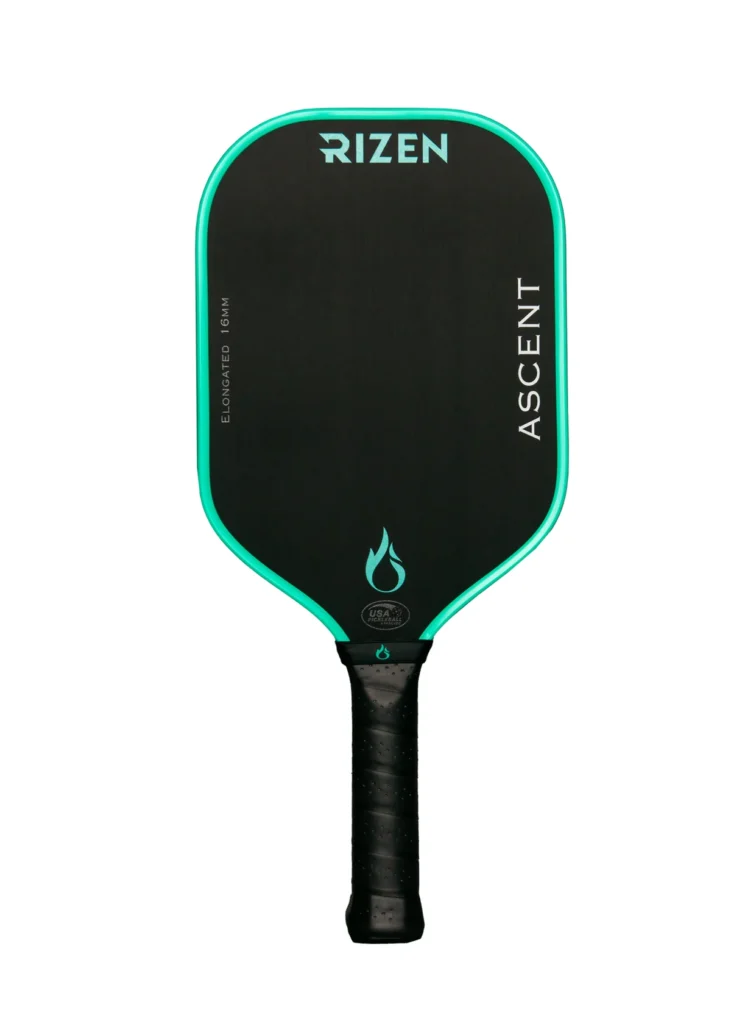
Its surface did not feel as aggressively abrasive as the Crystal Blue, HexGrit, or some of the other grit-focused faces I tested. The ball still kept doing what I asked.
What I felt was more dwell. Contact felt connected instead of immediate and jumpy, which gave me confidence to roll the ball, manipulate launch angles, and add topspin without brushing every shot perfectly.
I noticed it most on drops, roll volleys, dipping counters, and drives where I wanted the ball to clear the net safely and then dive toward the court. In my longer Ascent testing, the pocketing was the part I kept coming back to: the shot felt connected enough to carve instead of slap. The face was not brutally rough. I still kept bending the ball where I wanted it.
Compared with the Ronbus Quanta, the Ascent was the more complete spin-and-control option for me across drives, drops, and rolls. The Quanta’s clearest advantage came when the swing became especially short or awkward.
Read my complete Rizen Ascent 16mm elongated review for a deeper look at how its dwell time and connected feel affect shot shape.
Best for: Players who want natural, controllable spin through feel, dwell, and sustained contact rather than pure surface bite.
Consider another paddle if: You specifically want the tactile response of an extremely rough face or the quickest possible hand speed.
J2CR Crystal Blue vs Vapor Power 2 vs Rizen Ascent
| Paddle | How It Creates Spin | Where It Stands Out | Main Limitation | Choose It If |
|---|---|---|---|---|
| J2CR Crystal Blue | Aggressive face bite plus enough speed to use it | Serves, drives, roll volleys, and all-around shot shaping | More tactile and aggressive than muted-control players may prefer | You want the best complete spin package |
| Vapor Power 2 | HexGrit plus quick hybrid acceleration | Counters, compact rolls, drives, and fast exchanges | Livelier response than calm control-first options | Your hands and swing speed create the spin |
| Rizen Ascent | Dwell and connected contact | Drops, rolls, controlled topspin, and launch management | Less aggressively rough at the face | You want spin without giving up control |
4. RPM Q2 Elongated — Best Topspin Paddle for Drives
The Q2 came alive on a full swing
The RPM Q2 Elongated pairs strong spin potential with the reach and leverage of an elongated paddle.
Hard baseline drives came off with weight behind them. I could carry pace through the court and still get enough shape to bring the ball down inside the baseline.
The same leverage helped on serves, where reach, paddle-head speed, and a committed swing could create a difficult blend of depth, pace, and rotation.
The Q2 is more about forceful topspin than delicate manipulation. Compared with the RPM Friction Pro Elongated V2, the Q2 was my stronger dedicated topspin-drive choice. The Friction Pro separated itself more clearly when slice and aggressive backspin entered the decision.
Best for: Baseline attackers with developed mechanics who want heavy topspin, elongated reach, and leverage.
Consider another paddle if: You prioritize compact kitchen play or prefer a lighter, faster-feeling hybrid.
5. Enhance Pickleball Turbo EPP — Best High-Spin Value
The bargain that surprised me
The Enhance Pickleball Turbo EPP produced spin that belongs in the same conversation as paddles costing considerably more. When I reviewed the Turbo line, MSRP was $119.99. That price is part of why it ranks this high.
The widebody face stayed steady when I missed the center, and the EPP response gave me enough hold to still do something useful with the ball. In my Turbo session, clean brush contact produced clearer shape while sloppy brush contact showed more float. Real games include plenty of contact that is not pretty. The Turbo kept the face from wandering and helped preserve a usable result.
The Turbo EPP does not have the price tag or status of several paddles above it. The ball did not care.
The Holbrook Fuze is also forgiving, but the Turbo ranks higher because it combined that off-center stability with more high-level spin value for the money. The Fuze is the calmer choice for the player who cares more about broad contact tolerance than peak rotation.
Read my full Enhance Turbo EPP review for more on how its EPP response, widebody stability, and price affect its value as a spin paddle.
Best for: Value-conscious players who want high-level spin with a forgiving widebody platform.
Consider another paddle if: You need a longer handle or prefer the reach and leverage of an elongated paddle.
6. Ronbus Quanta — Best for Soft-Shot Spin
Spin when there is no room for a full swing
The Ronbus Quanta earns its position without depending on an unusually coarse face.
The Quanta gave me a strong sense of connection with the ball. Contact felt controlled and shapeable instead of bouncing away before I could influence it.
Its clearest advantage appeared when there was no room for a full swing. A drive gives you time to build acceleration. A dink, drop, or roll from below net height does not. The Quanta made those softer, awkward shots easier to manipulate without demanding a violent brush or large backswing.
The Rizen Ascent was my better all-around spin-and-control paddle. I preferred the Quanta when the decision narrowed to short swings, soft shots, and difficult contact below net height.
Read my full Ronbus Quanta review for more on how its connected feel affects spin during compact and softer shots.
Best for: Players who want spin on drops, dinks, rolls, and controlled drives when swing space is limited.
Consider another paddle if: Your priority is maximum surface bite on explosive full swings.
7. CRBN 3 TruFoam Waves — Best Foam-Assisted Spin
The face grabs; the foam gives it time
The CRBN 3 TruFoam Waves feels like a familiar CRBN face sitting on top of a calmer, more compressible foam body.
The face is only part of the story. I felt useful grip, but I also felt enough compression and dwell to keep the ball controllable through contact. The useful test was not whether the foam sounded different; it was whether I could take a fuller swing and still know where the ball was going.
That mix helped most when I attacked from deeper in the court. I could take a fuller swing without feeling like the landing spot had become a guess. The elongated shape added leverage on serves and groundstrokes, while the foam response kept transition shots from feeling completely disconnected.
The TruFoam Waves felt more settled than paddles that announce their grit the moment you touch them. It ranks below the Rizen Ascent and Ronbus Quanta because those paddles made shaping the ball feel more natural to me, especially as the swing became shorter.
Best for: Experienced players who want spin from a blend of face grip, elongated leverage, compression, and foam-assisted dwell.
Consider another paddle if: You want easier spin from a faster paddle or more natural shape on compact swings.
8. RPM Friction Pro Elongated V2 — Best for Spin and Slice
For drives, serves, and nasty cuts
The RPM Friction Pro does not hide what it is trying to do. The face grabs the ball, and the elongated build rewards a committed swing.
Topspin drives could be hit aggressively, and the surface provided enough grip to help pull the ball down. The more distinctive difference came when I added backspin. Slices stayed low, and aggressive cuts created a different kind of problem for the opponent than the Q2’s heavier topspin ball.
The tradeoff is speed at the kitchen. The Friction Pro did not feel as effortless during quick exchanges as the Vapor Power 2 or the faster shapes near the top of the list.
A baseline banger may happily make that trade. Someone who relies on fast counters and compact rolls probably will not.
Best for: Strong baseline players who want spin on serves and drives, plus the best slice and aggressive-cut option in this ranking.
Consider another paddle if: Fast hands and effortless maneuverability are more important than elongated leverage.
9. Spartus P1 Hybrid — Best Heavy, Planted Spin
It puts some paddle behind the ball
The Spartus P1 Hybrid combines a distinctive surface, foam-based construction, and enough mass to drive through the ball.
Its spin felt forceful rather than effortless. When I accelerated and made clean contact, drives and serves left with weight and substantial shape. What surprised me in my earlier P1 testing was that PermaGrit did not need a giant swing to matter: topspin drops and roll dinks were where the extra friction was easiest to feel. Spin that only shows up on full swings is not very useful spin.
The hybrid format kept it more versatile than a traditional elongated paddle, but it still favored swinging through the ball instead of guiding it. This is not the paddle I would choose first for someone whose spin comes from quick hands and tiny kitchen strokes.
From the baseline, I could make the Friction Pro’s spin nastier. The Spartus felt more substantial through contact and better fits the player who wants power, spin, and a planted response in one package.
Read my complete Spartus P1 Hybrid review for more on how its PermaGrit surface, foam construction, and weighting affect spin.
Best for: Strong swingers who want a planted paddle with heavy, forceful spin.
Consider another paddle if: You prefer an especially light or quick paddle at the kitchen.
10. Volair Shift — Best Controlled Spin
More control over the arc than raw rotation
The Volair Shift is not trying to rip the cover off the ball. Its spin is more about controlling the arc and landing spot.
I trusted it on controlled topspin, dipping drops, accurate rolls, and touch shots where placement mattered as much as rotation. It also moved quickly enough to help on compact kitchen swings without requiring a large backswing.
The Shift did not produce the same overall spin as the paddles near the top. Its advantage was that I could shape the arc without feeling like I was fighting the paddle. In my broader Shift testing, that lived result stayed remarkably consistent across the widebody, hybrid, and elongated shapes: topspin felt reliable, and roll opportunities showed up without me having to swing out of my shoes.
If I want more dwell and a softer spin-and-control connection, I still choose the Rizen Ascent. If I want a quicker, placement-first paddle that lets me shape the arc without chasing maximum rotation, the Shift makes more sense. Read my full Volair Shift review for the shape-by-shape testing.
Best for: Control-oriented players who use spin to manage trajectory, placement, and angles.
Consider another paddle if: You want maximum power or the most aggressive surface grip.
11. Holbrook Fuze — Most Forgiving Spin Paddle
The spin survived my mishits
The Holbrook Fuze earned its place by producing useful spin without demanding perfect center contact.
Its forgiving face, dwell, and steady response helped preserve shot shape when contact wandered away from the middle. I could add enough topspin to keep aggressive shots in the court while still shaping slower rolls and touch shots predictably.
The leaders created more rotation and gave me more confidence when I was deliberately trying to bend the ball. The Fuze asked less from me when the strike was ordinary.
Compared with the Enhance Turbo EPP, the Fuze forgave more kinds of ordinary contact. The Turbo ranks higher because it paired widebody stability with stronger high-spin value.
Best for: Players who want dependable, repeatable spin across a wider range of contact quality.
Consider another paddle if: Your priority is the highest possible spin ceiling.
12. Maverix Havik 2 — Best Affordable Speed-Assisted Spin
The speed is the selling point
The Maverix Havik 2 made its case with speed. I could get the face moving quickly enough to shape drives and speedups without feeling like I had to manufacture a huge swing.
Its aerodynamic shape helped the face accelerate through contact without requiring excessive effort. That made the Havik useful for aggressive players who use topspin to keep drives and speedups inside the court.
It did not provide the refined dwell or connected feel of the foam paddles ranked higher, and it was less forgiving when contact moved away from center.
The Havik 2 feels less refined than the paddles above it, but the speed is real. Players who generate spin through acceleration can get a lot from it without entering the highest price tier.
Best for: Intermediate and advanced players seeking affordable, speed-assisted topspin.
Consider another paddle if: You need more forgiveness away from center or more dwell on compact shots.
Which Spin Paddle Works Best for Each Shot?
| Spin Shot | Traits That Matter | Best Fits | Alternative |
|---|---|---|---|
| Topspin drives | Surface grip, acceleration, and predictable launch | J2CR Crystal Blue, RPM Q2 | Vapor Power 2 for quicker handling |
| Roll volleys and counters | Quick handling and accessible grip on compact swings | Vapor Power 2, J2CR Crystal Blue | Volair Shift for calmer trajectory control |
| Drops and spin dinks | Dwell, connection, and face control | Rizen Ascent, Ronbus Quanta | Volair Shift for placement-first spin |
| Heavy serves | Leverage, speed, grip, and launch control | J2CR Crystal Blue, RPM Q2 | CRBN 3 TruFoam Waves for grip plus foam dwell |
| Slices and cuts | Friction, stability, and committed swing path | RPM Friction Pro Elongated V2 | J2CR Crystal Blue for the stronger all-around option |
| Spin on imperfect contact | Forgiveness, stability, and useful dwell | Enhance Turbo EPP, Holbrook Fuze | Rizen Ascent for more control-oriented shaping |
Equipment boundary: A paddle can enhance spin, but it cannot replace swing path, contact point, acceleration, or face-angle control. A spin paddle gives good mechanics more teeth; it does not build the mechanics for you. If the mechanics are the problem, start with how to use topspin, slice, and sidespin on real shots.
What if You Need More Than Spin?
- Need the broad selection framework? Read How to Choose a Pickleball Paddle.
- Want the strongest overall options regardless of spin bias? See the best pickleball paddles.
- Is control the primary problem? Compare the best control pickleball paddles.
- Is price the hard constraint? Use the best budget pickleball paddles guide.
- Is foam construction itself the reason you are shopping? Use the best foam-core pickleball paddles guide.
- Coming from tennis? See the best pickleball paddles for tennis players.
- Want to know whether the surface will keep its spin? Read Pickleball Grit Durability in 2026.
Questions Players Ask About Spin Paddles
The Honolulu Pickleball J2CR Crystal Blue Long Handle is the best spin paddle Coach Sid has tested because it turned aggressive surface bite into repeatable shape on serves, drives, roll volleys, and other real-game shots.
The Rizen Ascent is PickleTip’s current spin-and-control choice because its dwell-based connection made drops, rolls, drives, and controlled topspin feel natural without requiring the roughest face in the ranking.
The RPM Q2 Elongated is the strongest dedicated topspin-drive choice for players with a long, committed swing. The J2CR Crystal Blue and Vapor Power 2 are stronger all-around alternatives when roll volleys, counters, or quicker handling also matter.
No. Surface friction helps, but dwell time, core compression, paddle speed, stability, launch control, shape, balance, and player mechanics also affect usable spin.
The Holbrook Fuze is PickleTip’s most forgiving spin choice, while the Enhance Turbo EPP combines off-center stability with stronger high-spin value.
RPM data is useful for standardized comparison, but it does not fully show how easily a paddle shapes low balls, compact rolls, rushed contact, drops, or kitchen exchanges. PickleTip prioritizes usable and repeatable on-court spin.
A paddle can enhance spin, but it cannot replace acceleration, contact point, swing path, or face-angle control. The equipment should support the spin shots you use rather than substitute for mechanics.
Tournament approval can change by governing body and event. Check the exact paddle model on the current official approval list before sanctioned competition rather than assuming every version of a paddle family has the same status.
If you play sanctioned events, check the exact model before you buy or compete. I keep the USA Pickleball Approved Paddle List updated as approval status changes.
Final Verdict
The Honolulu Pickleball J2CR Crystal Blue Long Handle is the best pickleball paddle for spin that I have tested.
It turned obvious surface bite into repeatable shape on serves, drives, rolls, and other shots during actual play. The 11SIX24 Vapor Power 2 is the closest fast-hand alternative, while the Rizen Ascent is the best current choice for spin and control.
Bottom line: Spin is not a surface specification. It is an on-court result.
Coach Sid’s spin rule: Do not buy the paddle that wins the thumb test. Buy the one that still bends the ball when your contact, timing, and swing size stop being perfect.