RPM Jade Review: 14mm vs. 16mm Elongated After 44 Hours
I almost skipped this RPM Jade review. Everybody and their mamma seemed to have an opinion about this paddle before the conversation had even settled into what it was like to play with.
There was the anticipation, the price, and the promise of a surface that would keep its bite. Somewhere in all that noise was the question I actually cared about: would this paddle help me play better pickleball?
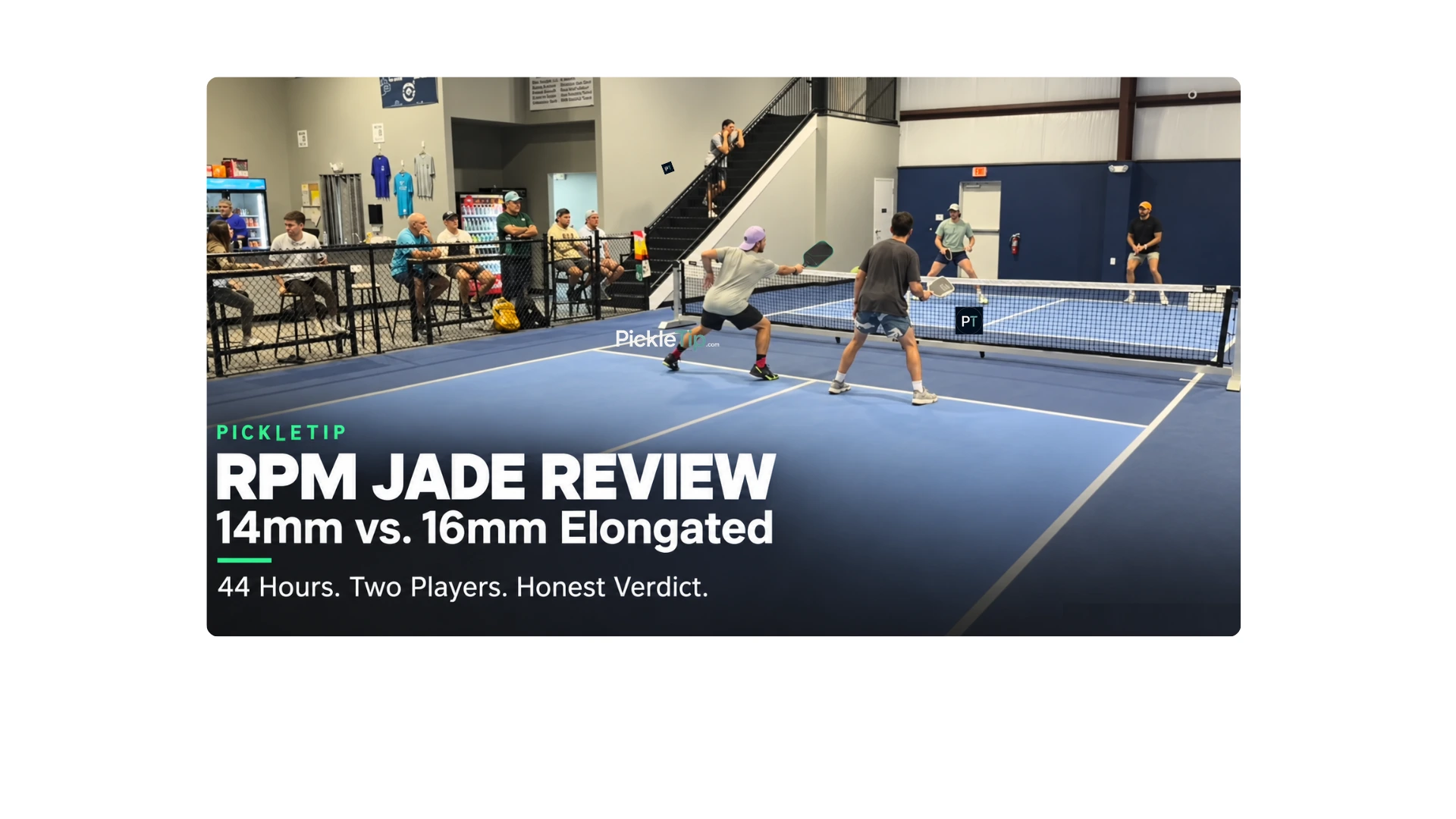
Coach AJ and I tested the RPM Jade 14mm Elongated and RPM Jade 16mm Elongated for about 44 hours between the two paddles. AJ preferred the 14mm. I preferred the 16mm.
Neither of us changed our main paddle.
Disclosure: RPM provided both review paddles directly to us at a discount through our affiliate relationship. As RPM affiliates, we may earn a commission on qualifying purchases through our affiliate links or codes. That relationship does not and will never affect our opinions, criticism, or recommendations.
What Worked, and What Held Us Back
The RPM Jade gave us spin we could use on drops, drives, and counter-rolls. The 14mm had more immediate pop; the 16mm gave me softer, more forgiving touch. Both felt more dependable on off-center hits after we added 3 grams total, split evenly at 3 and 9 o’clock.
The sticking point for me was defense. I liked the cushioning, but some passive resets died in the net. AJ enjoyed the 14mm’s offense and still preferred his RPM Q2 Hybrid across a complete match. At $269.99, I would want to demo the Jade before buying it.
RPM Jade 14mm vs. 16mm Elongated
AJ preferred the Jade 14mm for counters and quick wrist flicks. I preferred the 16mm for softer touch. The 14mm was harsher when I missed the middle, while the 16mm still needed enough input to keep some passive resets out of the net.
| What we noticed | Jade 14mm Elongated | Jade 16mm Elongated |
|---|---|---|
| Approximate hours across both testers | 26 hours | 18 hours |
| Counters and wrist flicks | AJ’s quicker-feeling choice; more immediate pop | More cushioning against incoming pace |
| High-ball putaways off the bounce | More immediate attacking response | AJ wanted a little more punch |
| Dinks and touch | Harsher when I missed the center | My preferred soft-game feel |
| Defensive drawback | Less forgiving off-center mid-court resets in stock form | Some passive resets needed more input to clear the net |
| Weighting | More dependable off-center contact after weighting; no noticeable hand-speed loss | |
| Our preferred use | AJ’s attacking game | My softer touch game; AJ also liked it weighted for all-court control |
Two Players, Two Different Jobs for the Same Paddle
I am the more defensive, reactive player. I like to slow a rally down, absorb pressure, and make an opponent hit another ball. When a paddle makes a fast exchange exciting, that is nice. When it helps me escape that exchange and reset the point, that is more useful to my game.
AJ plays at the 5.0 level. He is more aggressive, but he is also calculating. He looks for a ball he can attack, chooses a target, and uses spin and placement to make the next shot difficult. Calling him aggressive does not mean he tries to hit through every rally.
He played the original RPM Friction Pro, moved to the V2, and currently uses the Q2 Hybrid as his main. Our earlier RPM Friction Pro review covers that paddle’s performance and the durability concerns reported during our coverage. Those concerns are background, not evidence that the Jade has the same problem.
Our Testing Time and Setups
We received both paddles and began testing on September 14, 2026. The observations in this review reflect approximately 26 hours on the 14mm and 18 hours on the 16mm, shared across both testers. We did not separately log each player’s time with each thickness.
We played games and drilled with stock and weighted setups. Our added-weight test used 3 grams total per setup: 1.5 grams at 3 o’clock and 1.5 grams at 9 o’clock on the edgeguard. We noticed changes with use and changes after adding weight, but we did not isolate those effects in a controlled test.
These are court observations, not laboratory measurements of spin, launch angle, dwell time, or changes in swing weight. You can read more about how we test pickleball paddles. This review was prepared October 31, 2026.
What Is the RPM Jade?
RPM describes the Jade as a full-foam paddle with an MPP floating core surrounded by EVA foam and a silicon-carbide SICmatrix surface. We tested the two elongated thicknesses. This review does not cover the widebody versions.
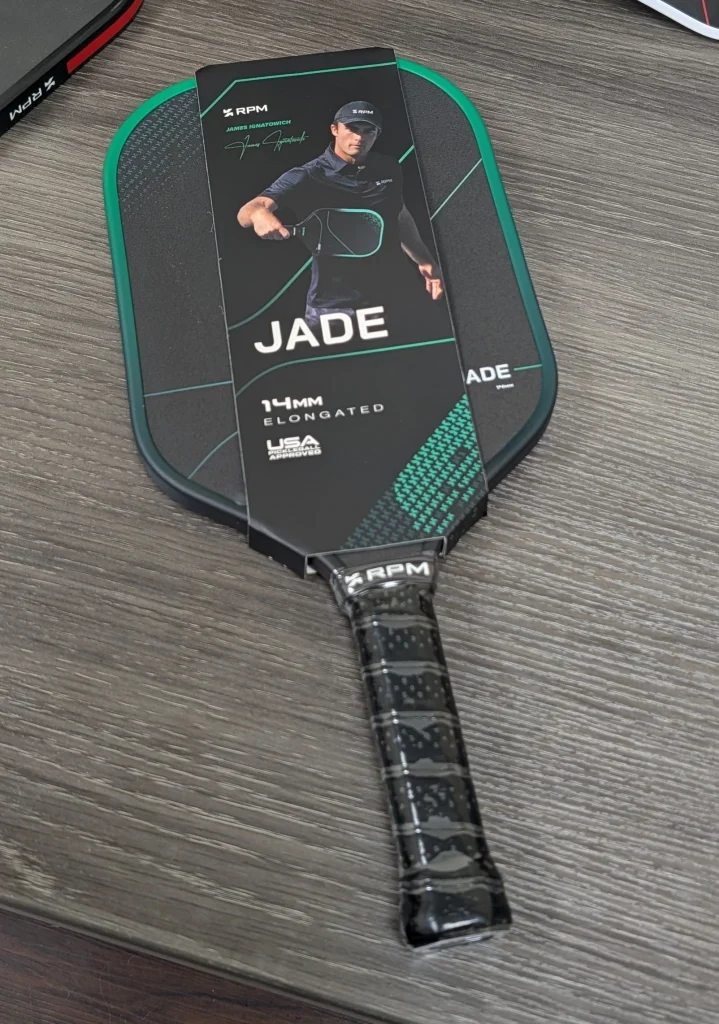
The specifications below are RPM’s listed specifications, not measurements of our test units. Both models were listed at $269.99 when checked October 31, 2026. See RPM’s product pages for the Jade 14mm Elongated and Jade 16mm Elongated for current pricing and availability.
| Manufacturer-listed specification | 14mm Elongated | 16mm Elongated |
|---|---|---|
| Core thickness | 14mm | 16mm |
| Length × width | 16.5 × 7.5 inches | 16.5 × 7.5 inches |
| Handle length | 5.5 inches | 5.5 inches |
| Grip circumference | 4.125 inches | 4.125 inches |
| Average weight | 7.7 ounces | 7.8 ounces |
| Listed price | $269.99 | $269.99 |
Tournament approval: The official USA Pickleball records for the Jade 14mm Elongated and Jade Elongated 16mm both showed a Pass status when checked October 31, 2026. Confirm your exact model’s current status and your event’s equipment requirements before competing.
The Spin Stood Out Immediately
The first thing I noticed was the bite on the ball.
On third-shot drops, I could brush upward confidently and see the ball dip toward the kitchen line. On baseline drives, I hit shots that felt as though they carried too much pace, only to watch the topspin bring them down inside the baseline. I could finish the stroke instead of cautiously guiding the ball.
AJ found that bite useful on roll volleys and sharp cross-court speedups. His backhand counter-roll was particularly effective when opponents attacked down the middle: he could absorb the incoming ball and redirect it toward their hips without turning the counter into a sitter.
AJ also demonstrated an around-the-post shot while teaching ball shaping. Fun to watch, but his skill and the available angle were part of that shot. The drops, dipping drives, and counters we kept using in games told me more about whether the Jade’s spin was useful.
Power and Pop: Full Swings vs. Compact Contacts
In this review, power means the pace available when we accelerate through a full swing. Pop means the immediate rebound we get from a short contact, such as a punch volley, block, or compact counter. A paddle can deliver useful drive power without sending a passive defensive contact as deep as we expect.
Full-Swing Power: Enough Pace to Attack
The RPM Jade had enough pace for aggressive baseline drives when I accelerated through contact. Its spin gave me confidence to finish the stroke and bring the ball down inside the court. I could create a threatening drive without feeling that the paddle was running away from me.
That does not tell us which thickness produces the highest ball speed. We did not run a controlled speed test. Our clearest thickness difference was on shorter contacts, where the 14mm gave us more immediate attacking response.
Compact-Contact Pop: More Immediate Response From the 14mm
The 14mm felt faster in AJ’s hands and gave him more immediate pop on counters and quick wrist flicks. I noticed that extra response on counters and putaways too. When he could absorb an incoming speedup and immediately counter-roll toward an opponent’s hips, the ball stayed threatening without becoming a sitter.
The 16mm was AJ’s stronger choice for taking pace off an opponent’s attack. The trade-off was a little less punch when putting away high balls off the bounce. I also needed more input on some passive resets, particularly from farther back.
Compared with his Q2 Hybrid, AJ needed more acceleration from the Jade on some compact strokes to produce familiar depth. That is a comparison with his regular playing setup: his Q2 is a hybrid, while our Jades were elongated. We did not isolate shape, construction, or weighting as the cause.
Feel: Hollow and Thuddy, Then Softer With Use
The Jade had a hollow, thuddy character. As we used it, the contact felt plusher and the impact sound became deeper. AJ noticed that progression too.
I have called the sound a softer “hollow crunch.” I mean the impact sound and feedback. Neither of us reported internal crunching or rattling on these Jades during testing.
I noticed the softer feel particularly around the third week, approximately 10 to 12 hours into testing. That is my approximate recollection, not a separately logged break-in time for either model. Touch dinks came off more consistently than on day one, and I felt more pocketing, especially with the 16mm.
I preferred that settled feel. If you demo one, ask how much use it has had. A well-used demo may feel different from the fresh paddle that arrives at your door. And if hollow feedback bothers you, try the routine dinks and returns before getting carried away by a spin demonstration.
Dinks: Where the Softer Response Helped
As I became more comfortable with the Jade, my dinks stayed lower and I felt more confident controlling height and depth. The 16mm gave me the more forgiving touch. When I missed the center with the 14mm, the response felt harsher and less dependable.
AJ appreciated the manageable pop during patient kitchen exchanges. He could work the ball and wait for an opening without feeling as though every small input would send it upward.
Resets: Soft Contact, but Some Balls Died in the Net
The Jade absorbed incoming pace well, yet some of my resets caught the net when I became too passive. I needed enough forward movement to carry the ball over the tape and into the kitchen, particularly when resetting from farther back with the 16mm.
AJ found that same thickness useful for absorbing high-pace speedups and resetting hard body drives. I liked the cushioning too. I was less comfortable when I was late and needed a small defensive contact to rescue the point.
On off-center mid-court resets, the stock 14mm was less forgiving than AJ wanted when his footwork or timing slipped. My own misses felt harsher and could come off weakly. I liked it on a clean counter. Miss the middle on a reset, and it was much less friendly.
That does not mean punch every reset. Grip pressure, contact height, paddle angle, and the incoming ball still determine what the shot needs.
I value what happens when I am in trouble as much as what happens when I have time to swing.
Does the RPM Jade Need Added Weight? Our 3-Gram Test
The RPM Jade does not require added weight for every player. On our setups, 3 grams total (1.5 grams at 3 o’clock and 1.5 grams at 9 o’clock on the edgeguard) made off-center hits feel more dependable. Neither of us noticed slower hands in kitchen exchanges. Start stock and consider weighting if you notice twisting or unreliable off-center contact.
The paddle felt steadier on off-center contact against pace, and we did not feel as though we had turned the paddle into something heavily head weighted. When I say the usable sweet spot improved, I mean those imperfect contacts felt more reliable. We did not measure new sweet-spot dimensions or before-and-after swing weights.
AJ particularly liked the weighted 16mm for control-oriented all-court play. The extra solidity worked well with the cushioning he already liked against hard incoming balls.
Try the stock paddle first. If it twists on the contacts you regularly make, our 1.5-grams-per-side setup is a specific adjustment you can test. Check it on blocks, counters, resets, and a full game. Our paddle weight placement guide explains how placement can change stability and handling.
AJ Had to Adjust to the Lower Launch
AJ felt both thicknesses launched lower than he expected from paddles that gripped the ball this well. He could use that trajectory on roll volleys and angled attacks, but he had to account for it when clearing the net.
When teaching third-shot rolls from the transition zone, he emphasized lifting through the ball rather than expecting rebound alone to provide clearance. The grip gave him room to shape the shot; he still needed a swing path and face angle that got it over the net.
Durable Grit: What SICmatrix Promises and What We Observed
Durable grit is about retaining useful spin as a surface wears, not simply feeling rough when the paddle is new. Initial spin, texture you can feel with your fingers, and spin retention over time are related questions, but they are not interchangeable results.
RPM describes SICmatrix as its silicon-carbide surface and markets it as Tier 1 durable roughness, with spin intended to last longer than the surfaces on its earlier paddles. That is RPM’s durability claim. The Tier 1 label is not a USA Pickleball approval category or a guarantee that every retail paddle will retain identical spin for its lifetime.
The relevant question for a buyer is whether the paddle keeps producing the ball shape they rely on after repeated use. A rough-feeling new face cannot answer that by itself. Neither can a tournament-approval record, which should not be read as a surface-longevity rating.
Our Contact Zone Felt Smoother, but Spin Remained Strong
Around a month into use, I wondered whether the surface was smoothing sooner than the launch promises had led me to expect. AJ also noticed that the main contact zone felt smoother than the outer edges after extended drilling.
The RPM Jade’s main contact zone felt smoother after use, but we were still getting strong spin. AJ could still put heavy slice on his serves. That supports our confidence in its usable spin during these sessions; it does not establish that spin was unchanged.
We did not measure spin before and after testing or control for balls, conditions, and stroke variation. We therefore cannot turn the smoother feel into a percentage loss, independently assign a durability tier, or declare that the surface failed its promise.
Our 14mm received approximately 26 hours and our 16mm approximately 18 hours across both testers. The unequal use and lack of controlled retention measurements also prevent us from ranking one thickness as more durable. I enjoyed the spin we got, but season-long retention remains unproven by our testing.
RPM’s Expanded Jade Warranty
RPM emailed me on October 30, 2026, announcing an increase from one to three lifetime warranty claims for the Jade. The published warranty, checked October 31, now confirms three claims, including previously purchased Jades. For an approved claim, RPM ships the replacement without waiting for the original paddle to come back.
RPM may still request the original, and its return-shipping section assigns that cost to the customer. Approval is at RPM’s discretion. Coverage applies to the original owner with proof of an eligible purchase, and normal grit smoothing is excluded.
Three approved claims give a buyer more backup. They do not make this a lifetime spin guarantee. If return cost affects your decision, get RPM to clarify what applies to your claim rather than assuming replacement-before-return means no return will ever be required.
Who Should Consider Each Jade Thickness?
Consider the Jade 14mm Elongated if you build offense through quick counters, wrist flicks, and deliberate ball shaping. Its immediate pop appealed to AJ. Include off-center mid-court resets in your demo, because that was where its forgiveness fell short for us.
Consider the Jade 16mm Elongated if you prioritize softer dinks and cushioning against hard incoming balls. It was my preferred Jade, and AJ liked our weighted setup for control-oriented all-court play. Test deeper resets too: a comfortable impact did not automatically give me enough clearance.
Be cautious with either version if your recurring problem is a late, passive reset that dies short, or if you dislike hollow feedback. Your recurring miss is a better starting point than your rating. Our guide to choosing a paddle for your game explains how to turn that miss into a useful demo plan.
Is the Jade Worth $269.99?
At the listed $269.99, I would pay for a clear improvement in the shots that decide my games. The Jade’s particular combination of spin, contact feel, and thickness options may justify that price for a player who connects with it. Enjoying a handful of great drives would not be enough for me.
If lasting grit is the reason you are paying the premium, treat that as a separate buying question. Our court time supports the playing observations above, while long-term spin retention remains open. RPM’s expanded warranty provides additional backing for approved defects, but normal grit smoothing is excluded. Decide whether the performance you can assess today justifies the price before assuming a future durability advantage.
Why Neither of Us Switched
AJ stayed with his Q2 Hybrid because he preferred its familiar response across a complete match. I stayed with the setup I trusted more on rushed defensive contacts. We could appreciate what the Jade did well without choosing it as our everyday paddle.
The Jade gave me shots I enjoyed. My regular paddle gave me more trust when I was in trouble. When you demo one, spend as much time on the ball you barely reach as the drive you cannot wait to hit again.