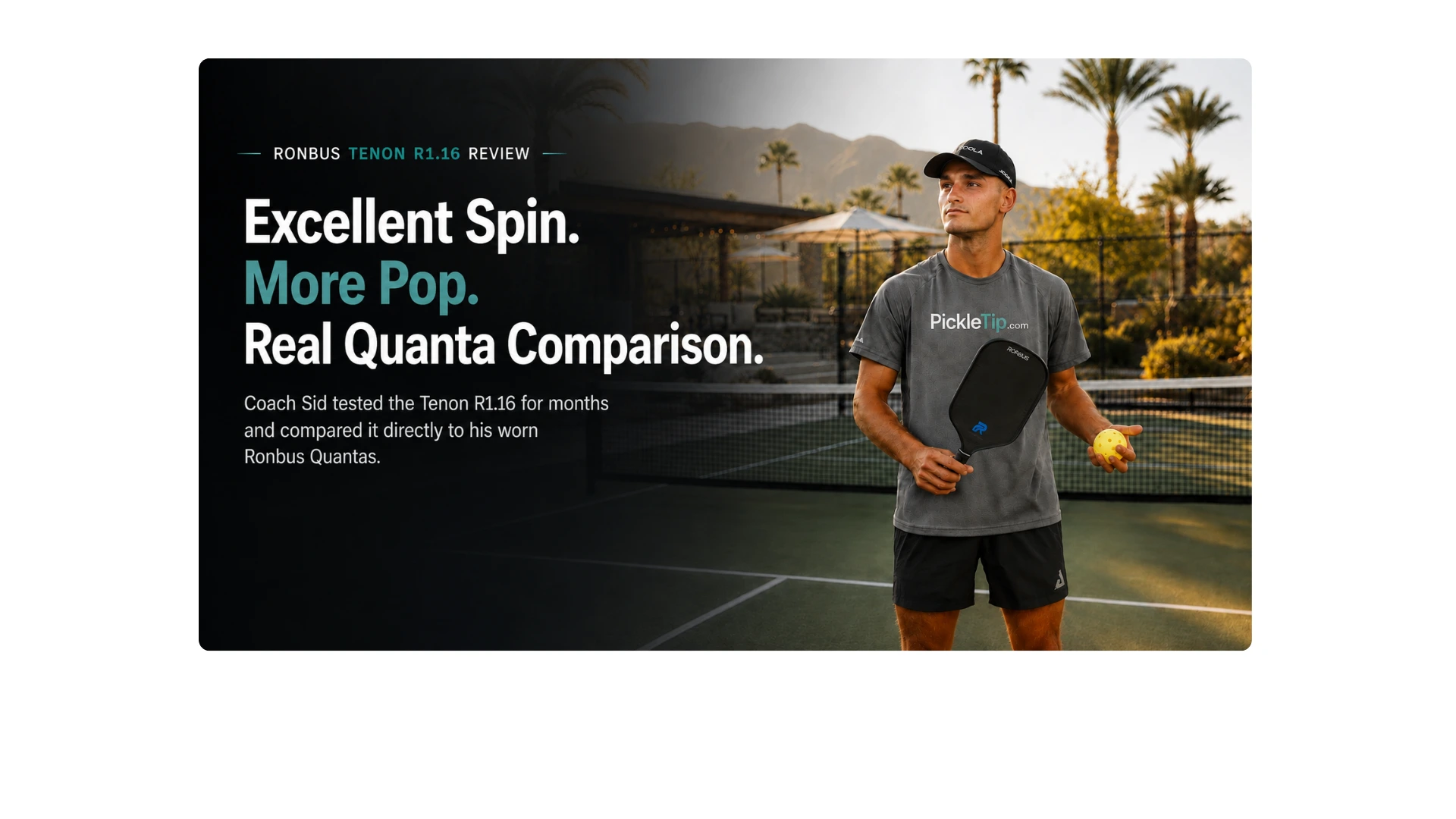
Ronbus Tenon R1.16 Review: Excellent Spin, More Pop & Ronbus Quanta Comparison
I went into the Ronbus Tenon R1.16 with pretty specific expectations.
I’ve been a huge fan of the Ronbus Quanta series. I’ve played and drilled enough with my Quantas that their original surface texture has worn down considerably, but that hasn’t stopped me from generating a ton of spin with them. The dwell time is so good that I can still grab the ball, shape shots, and spin the hell out of it even with a pretty bald paddle face.
So when Ronbus announced the Tenon with its new NanoBond surface and a focus on longer-lasting grit, I thought I knew what I was getting:
A Quanta with better, more durable grit.
That sounded pretty close to perfect.
I received my R1 Tenon in June 2026 and have been using it in drilling and live play. What I found wasn’t quite what I expected.
The Tenon is a very good paddle. It has excellent spin, a familiar soft-game personality, and a little more offense than I expected when I accelerate through the ball.
But it isn’t simply a Quanta with better grit.
That difference ended up mattering more to me than the extra surface texture.
Quick Verdict
The Ronbus Tenon R1.16 feels softer than it hits. I can play a comfortable short game with it, then find noticeably more pace when I accelerate. For my game, it lands as a power-leaning all-court paddle with a soft-game personality.
The NanoBond face doesn’t feel nearly as gritty as I expected, but the Tenon still gives me excellent spin.
The unanswered question for me isn’t whether NanoBond spins. It does. It’s whether the surface keeps producing this kind of spin after the paddle has been drilled with and played hard for months.
How I’ve Been Testing the Tenon R1.16
I received this Tenon R1.16 in June 2026 and have put about 20 hours on it through drilling and live play. I wrote down my own impressions before digging into other reviews.
I didn’t measure RPM or try to put a number on dwell time myself, so any test numbers I mention below come from the source I name. That’s the same basic approach I use in the PickleTip paddle testing method: play first, write down what I actually felt, then use measurements and outside evidence to help explain it.
Ronbus Tenon R1.16 Specs at a Glance
- Shape: Elongated with a curved top
- Dimensions: 16.5″ long × 7.5″ wide
- Core: 16 mm EPP + EVA mortise-and-tenon construction
- Surface: NanoBond textured raw carbon fiber
- Handle: 5.5″ long, 4.125″ octagonal grip
- Published weight: 7.9 oz ± 0.2 oz
- Published swingweight: 114
- Published twistweight: 5.92
- Ronbus list price: $169.99 as of August 2026
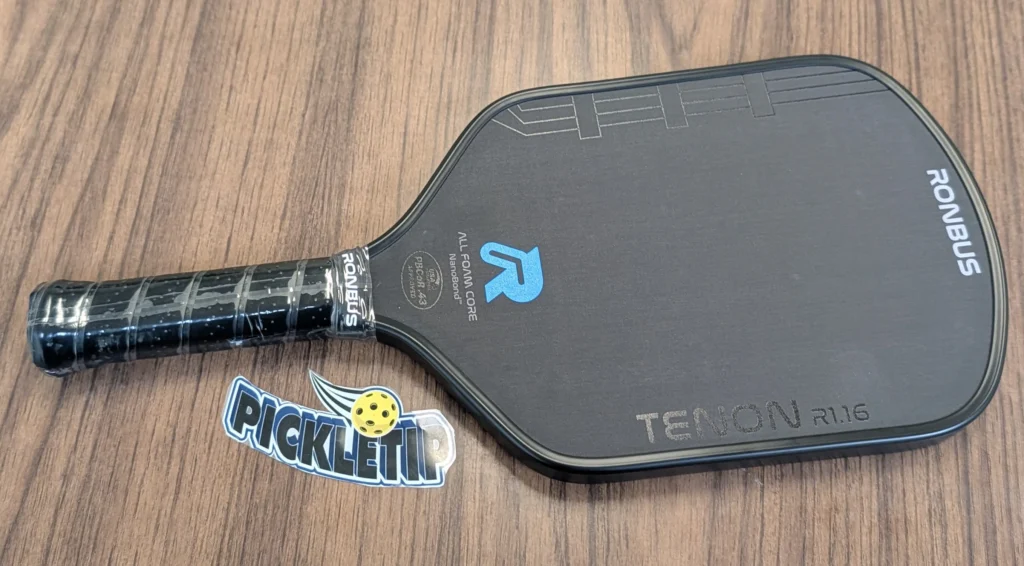
Those are Ronbus’s published specifications, not measurements from my individual paddle. Ronbus currently lists the Tenon R1.16 as USAP PBCoR.43 approved for sanctioned tournament play. If tournament eligibility matters to you, verify the exact model on the current USA Pickleball equipment list before an event because approval status can change.
The Quanta Set My Baseline for the Tenon
If I had never played a Quanta before picking up the Tenon, I might have reacted differently.
But I wasn’t coming into this paddle cold.
The Quanta had already established a baseline for me. I knew how much I liked its dwell and ball connection. I knew how well I could manipulate the ball with it. And I knew that even after wearing down the surface, I could still create tremendous spin.
If Ronbus could keep the things I liked about the Quanta and give me a surface that stayed useful longer, that would address one of the biggest frustrations with traditional textured carbon faces.
When I opened the Tenon package, the first thing I did was run my hand over the face.
My reaction wasn’t:
Wow.
It was more like:
That’s it?
There was more texture than on my used Quantas, but nothing close to the obvious bite I’ve felt on more aggressive durable surfaces like Honolulu’s Crystal Blue Endurance Surface or the HexGrit face on the 11SIX24 Vapor Power 2.
Of course, rubbing a paddle with your thumb isn’t a spin test.
The Tenon ended up being a pretty good reminder of why surface grit and usable spin aren’t the same thing.
Ronbus Tenon R1.16 vs. My Worn Quanta at a Glance
| Trait | Tenon R1.16 | My Worn Quanta | What I Notice |
|---|---|---|---|
| Spin | Excellent | Excellent | Roughly comparable in my play |
| Surface texture | More noticeable | Much of the original texture is worn away | More texture has not produced noticeably more spin |
| Dwell / ball connection | Good | Better in my hands | I still prefer the Quanta here |
| Short game | Very good | Very good | The Tenon feels familiar around the kitchen |
| Pop when I accelerate | Slightly higher for me | Slightly lower for me | The Tenon gets livelier when I lean into it |
| Surface longevity | NanoBond; still testing | Original texture has worn substantially | This may become the Tenon’s biggest advantage |
Does the Ronbus Tenon R1.16 Have Good Spin?
Yes. The Tenon spins the ball extremely well. Don’t confuse a smooth-feeling face with bad spin.
If I say its spin is roughly comparable to what I’m getting from my worn Quantas, understand what I’m comparing it to: a paddle I can already spin the hell out of the ball with.
I can rip topspin drives with the Tenon, shape serves, roll balls, brush dinks, and get the ball diving. I don’t feel like I’m searching for spin.
What surprised me is that I can do essentially the same things with my Quantas even though much of their original tactile grit is gone.
That’s where the dwell comparison becomes important.
With my Quantas, the ball feels connected to the face long enough for me to manipulate it extremely well even after the surface has become relatively smooth.
My R1 Tenon doesn’t give me quite as much of that dwell-time sensation.
So I have a Tenon with more remaining surface texture and a Quanta with less tactile grit but more ball connection in my hands.
The result?
For me, the spin is roughly comparable. More texture did not produce a noticeable jump in spin.
That is not a Tenon spin problem.
It’s a reminder that surface roughness is only one part of what happens when a player actually shapes a ball.
I expected NanoBond’s additional texture to move my spin ceiling even higher.
So far, it hasn’t.
NanoBond May Be More About Keeping Spin Than Adding It
For me, NanoBond’s more important question is spin retention, not peak spin.
It isn’t:
Does NanoBond create more spin?
It’s:
Does NanoBond keep producing useful spin longer?
Ronbus describes NanoBond as a wear-resistant surface technology designed for persistent spin. That’s the manufacturer’s claim.
There is already encouraging evidence that NanoBond retains physical surface texture better than ordinary raw carbon. What I don’t think we have yet is enough evidence to say how well that translates into long-term spin retention on court.
Pickleball Effect’s R1.16 testing measured 2,067 RPM and currently places NanoBond in its Tier 3 durable-grit category based on controlled abrasion testing. That backs up what I’m feeling on court: whatever the face feels like under my thumb, the R1 is not short on spin, and there is real evidence that the physical texture holds up better than a typical raw-carbon face.
That’s meaningful texture-retention evidence. It still isn’t the same thing as watching a complete before-and-after spin-retention curve on enough NanoBond paddles.
That’s why my current PickleTip durable-grit evidence tracker still keeps NanoBond unverified for long-term spin retention. The surface-texture evidence is promising. The on-court spin-retention story still needs more time and better before-and-after data.
I’m not going to turn “promising” into “proven” just because I like the paddle.
What I’m actually testing now: not whether the Tenon spins, but whether it keeps spinning this well after months of drilling and play.
If the face eventually feels smoother but my normal drives, rolls, serves, and brushed balls keep behaving the same way, NanoBond will have made a much stronger case for itself.
If that happens, I won’t care very much that the paddle never won the thumb test.
The Tenon R1.16 Feels Familiar Until You Accelerate
The short game is where I feel the strongest connection to the Quanta family.
Dinking feels natural. Drops feel comfortable. On resets, I don’t feel like I’m constantly fighting the paddle just to keep the ball soft.
When I’m not asking much from it, the R1 has a relatively soft, controlled personality.
Then I speed up.
That’s when the paddle changes character.
My Tenon R1.16 gets a little poppier when I accelerate through the ball, particularly when I move farther back on the court or become more aggressive with the swing.
It’s not an uncontrollable jump.
I wouldn’t describe the Tenon as some wild cannon that’s constantly trying to launch the ball off the court.
But there’s more energy hiding underneath that soft feel than my hands initially expect.
That part of my experience lines up nicely with the independent R1 data. Pickleball Effect describes its R1 test unit as soft and dense at impact while classifying the paddle itself in the power category.
If I had to explain the Tenon R1.16 in one sentence, that’s it: it feels softer than it hits.
Is the Ronbus Tenon R1.16 Really an All-Court Paddle?
Ronbus positions the Tenon as an all-court paddle.
I understand the label.
The R1 behaves like an all-court or even control-oriented paddle when I’m playing softly.
Start accelerating, though, and there’s enough pace available that it creeps toward power-paddle territory.
For my R1, I’d call it:
A power-leaning all-court paddle with a soft-game personality.
If you have decent mechanics and want to drive the ball, the Tenon isn’t going to leave you begging for power.
At the same time, I don’t feel like I’m wrestling with it every time I want to dink, drop, or reset.
That’s why I’d rather describe how its response changes with swing speed than force it into a cleaner marketing category.
If you’re still figuring out whether a power, control, or all-court paddle actually fits your game, my pickleball paddle selection guide goes deeper into that decision.
Where My R1.16 Matches (and Doesn’t Match) Other Tenon Feedback
Once I had my own notes down, I went back and compared them with outside Tenon testing and player feedback.
The funny part is that most of us seem to agree on what the Tenon feels like.
- The NanoBond face doesn’t feel nearly as aggressive as some other durable-grit surfaces.
- The Tenon still produces high spin.
- Contact has a soft, dense quality.
- There is more offensive pace available than that soft contact initially suggests.
Pickleball Effect’s R1 testing and Spinwave’s R2/R3 review both land in that same general neighborhood: soft, dense contact with more firepower than the feel initially advertises.
Things get more interesting when the comparison turns specifically to the Quanta.
Dwell Time Compared With the Quanta
This is one place where my experience does not line up neatly with everyone else’s.
A longtime Quanta player describing an R2 Tenon in public player feedback felt more dwell from the Tenon than the Quanta.
That’s not what I experienced with my R1.
I prefer the dwell sensation and ball connection I get from my Quantas.
That’s one reason I think my worn Quantas continue producing so much usable spin even after losing much of their tactile grit.
I don’t feel quite the same amount of connection from my Tenon R1.
I’m not going to massage that opinion simply because somebody else’s paddle or swing told them something different.
Tenon vs. Quanta Pop
There’s disagreement here too.
I’ve seen Quanta players describe the Tenon as less poppy than the Quanta.
My R1 experience has been the opposite once I start accelerating.
During the short game, they’re fairly similar.
When I speed the ball up or start hitting from farther back, I notice a little more pop from my Tenon.
It’s not a huge difference.
But it’s noticeable enough that I wrote it down before looking at what anyone else had to say.
That disagreement doesn’t bother me.
The outside feedback covers different Tenon shapes, different Quanta shapes, different paddle setups, and different players. Shape, individual paddle variation, weighting, swing mechanics, and the way somebody loads the paddle can all change what they feel.
The Tenon family includes R1, R2, R3, and R4 shapes. I’m not going to pretend every one of them should feel exactly like the R1 in my hand.
I can only tell you what happened with mine.
I also don’t want to pretend these are laboratory-matched paddles. My comparison is based on the Tenon R1 in my hand and the worn Quantas I actually play with, not identical setups engineered to isolate one variable.
And frankly, I like the disagreement.
Paddle reviews get less useful when everybody sounds like they passed around the same talking points:
Soft.
Plush.
Great spin.
Big sweet spot.
Plenty of power.
Buy it.
The useful part is often where good players disagree, because that’s where equipment fit becomes personal.
The Mortise-and-Tenon Core
The Tenon’s other unusual piece is buried inside the core.
Ronbus uses an EPP/EVA foam construction built around an interlocking mortise-and-tenon-style structure.
The name comes from woodworking, where mating pieces interlock mechanically. Ronbus applies a similar idea inside the paddle’s foam structure.
It’s interesting engineering.
What I’m not going to do is point at one internal joint and claim that it caused one specific shot characteristic.
There is no practical way for me to isolate the mortise-and-tenon structure from the foam densities, face, frame, shape, weight distribution, and everything else happening in the finished paddle while I’m standing on a pickleball court.
I can evaluate the finished product.
And the finished R1 gives me an unusual combination: relatively soft contact with more pace underneath it than that contact suggests.
The core construction may help explain that. I just won’t pretend my hand is a materials lab.
Who Should Buy the Ronbus Tenon R1.16?
I think the Tenon R1.16 makes the most sense for someone who wants a softer-feeling paddle without giving up the ability to attack.
I wouldn’t sort buyers by DUPR number first. The more useful question is whether you already generate your own spin and pace, and whether you like a paddle that stays comfortable during the soft game but gets livelier when you lean into it.
You should consider it if:
- You like soft or dense paddle feedback.
- You want a comfortable short game with more offense available when you accelerate.
- You generate your own spin and don’t need an extremely rough face to create shape.
- You drill or play enough that long-term surface retention matters to you.
- You like the general Ronbus foam-paddle personality but want a different response from the Quanta.
I’d be more cautious if:
- You’re buying it because you expect NanoBond to feel extremely gritty.
- You assume durable grit automatically means dramatically more spin.
- The specific dwell sensation of the Quanta is one of your favorite things about that paddle.
- You want the stiff, loud, immediate response of a traditional power paddle.
- You’re expecting the Tenon to simply be “the Quanta, but better.”
That last one was my mistake.
Is the Ronbus Tenon R1.16 Worth $169.99?
As of August 2026, Ronbus lists the Tenon R1.16 at $169.99. The comparable Quanta R1.16 is $119.99.
That’s a $50 difference, and I don’t think the honest answer is that the Tenon is simply 50 bucks better.
The extra $50 makes sense if you prefer the Tenon’s softer contact, want the extra pace I find when I accelerate, and care enough about surface life to bet on NanoBond.
If you already love the Quanta’s dwell, you’re happy with its power, and surface longevity isn’t costing you paddles, I’m not convinced you need to spend another $50 just because the Tenon is newer.
That value equation could change if NanoBond proves itself over the long haul.
Ronbus Tenon R1.16 vs. Quanta: Is It an Upgrade?
I don’t think “upgrade” is the right word.
At least not universally.
The Tenon doesn’t make me want to throw my Quantas in the trash.
Far from it.
There are still things I prefer about the Quanta, especially the dwell-time sensation and the way I feel connected to the ball.
The Tenon gives me something different.
For my game, the comparison looks like this:
Ronbus Quanta: exceptional dwell in my hands, excellent control, and excellent usable spin even after the original surface texture wears substantially.
Ronbus Tenon R1.16: excellent spin, more remaining surface texture, a little less dwell in my hands, and a little more pop when I accelerate.
That’s not one paddle defeating the other.
They’re two different ways of getting to a very good all-court result.
If you’re deciding between them, my full Ronbus Quanta review gives more context for why I still value that paddle so highly.
Long-Term NanoBond Test: Still Open
Status: August 2026. I’m still testing the long-term NanoBond question.
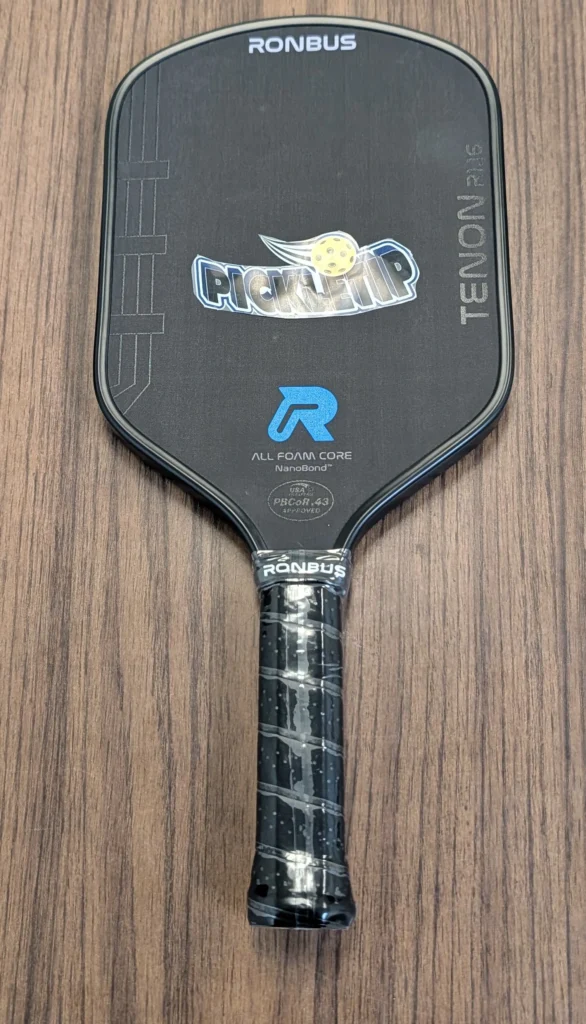
Short-term court time can tell me how the Tenon plays now. It cannot honestly prove how the surface will behave after months of drilling.
I’ll update this review when I have enough wear to say whether my normal spin, shot shape, and surface feel have materially changed.
Final Verdict: Excellent Spin, but NanoBond Still Has Something to Prove
The Ronbus Tenon R1.16 wasn’t the paddle I expected.
I expected something much closer to a Quanta with a more aggressive, longer-lasting face.
Instead, I got a paddle that keeps a lot of the comfortable Ronbus soft-game personality, feels softer than it hits, and gives me a little more pop than my Quantas when I accelerate.
The spin is excellent.
The surprise is that my worn Quantas still hang right there with it even though much of their original tactile grit is gone.
That makes NanoBond’s long-term retention story more interesting to me than its day-one roughness.
For now, I think the Ronbus Tenon R1.16 is a very good soft-feeling, power-leaning all-court paddle with excellent spin and more offensive capability than its contact feel initially suggests.
Just don’t assume it’s automatically a better Quanta.
If you already love the Quanta, the better question is:
Does the Tenon give you something your Quanta doesn’t?
For me, the answer right now is a little more pop when I accelerate and the possibility of a longer-lived surface.
The first part I’ve felt on court.
The second part still has to prove itself.
Ronbus Tenon R1.16 Frequently Asked Questions
Yes. The Ronbus Tenon R1.16 produces excellent spin in my testing. What surprised me is that it has not produced noticeably more spin than my heavily worn Ronbus Quantas, which still generate tremendous spin despite losing much of their original tactile texture.
Not noticeably for me. Both produce excellent usable spin. My Tenon has more tactile surface texture, while my worn Quantas give me more perceived dwell and ball connection.
Not in my hands. I prefer the perceived dwell and connection of my Quantas. Some other Tenon players have reported the opposite, which is why I treat dwell as a player-and-paddle comparison rather than a universal fact.
My R1.16 feels slightly poppier when I accelerate, especially from farther back or during speedups. During softer play, the Tenon and my Quantas feel much closer.
Not automatically. I still prefer the Quanta’s dwell and ball connection, while the Tenon gives me slightly more pop when I accelerate and the possibility of a longer-lived surface. NanoBond’s long-term spin-retention advantage still needs more testing.