Honolulu J2CR vs J2CR Blue Grit: Crystal Blue Comparison
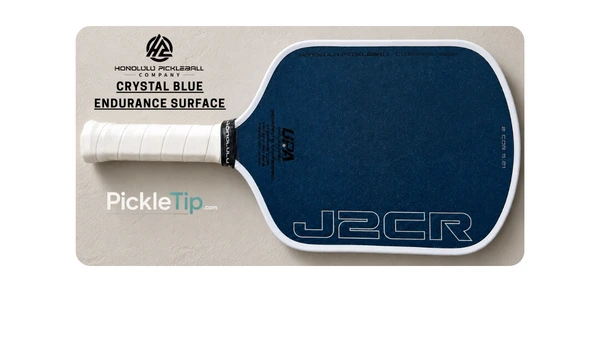
Honolulu J2CR vs J2CR Blue Grit is not a comparison between two completely different paddles. It is a decision about whether the newer Crystal Blue Endurance Surface is worth choosing over the original J2CR platform.
I have played with both versions of this paddle, along with the other paddles mentioned in this article. The Blue Grit version was my latest test, and I spent the last two weeks using it in drilling, rec play, coached situations, and local testing with students and higher-level players who were willing to give honest feedback. That matters because this is not just a spec-sheet comparison. The question is whether the blue face actually changes shots in real points.
The core personality is still familiar. The J2 shape is still the J2 shape. The CR foam feel is still the CR foam feel. What changes is the face. The original J2CR gives you the proven Core Reactor paddle. The J2CR Blue Grit gives you that same basic idea with a more aggressive surface, more grab, more spin confidence, and one bigger approval question.
Honolulu J2CR vs J2CR Blue Grit: Is the Crystal Blue Surface Worth It?
Straight answer: Choose the J2CR Blue Grit if you already like the J2CR shape and want more bite, more surface grab, and more confidence shaping the ball. Choose the original J2CR if you want the simpler approval path, hit flatter, or already like the standard J2CR and do not need the newer face. The Blue Grit version sharpens the J2CR more than it reinvents it.
Do not come into this expecting a brand-new paddle personality. That is not what this is. If you already liked the J2CR but wished the face grabbed the ball harder, now we have something to talk about.
If you have not read my full Honolulu J2CR review, start there for the baseline feel. Here, I am assuming you already like the J2CR idea and are trying to answer the real buying question: do you stay with the standard face, or do you move to the Crystal Blue / Blue Grit version?
How I Tested the J2CR Blue Grit
I tested the J2CR Blue Grit over roughly two weeks against my experience with the original J2CR and the other paddles mentioned in this article. That included repetitive drilling, rec games, kitchen work, hand-speed exchanges, spin-focused shots, and feedback from students and local higher-level players who hit with it.
I paid the most attention to the shots where a surface change should actually matter: low roll volleys, topspin drives, spin dinks, flicks, counters, resets, and blocks. I also wiped the face during testing because the Blue Grit surface picked up visible ball dust faster than a cleaner black carbon-style face. If you test this paddle dirty, you may be testing the dust as much as the paddle.
| Test area | What I was looking for | What stood out |
|---|---|---|
| Low roll volleys | Could I brush the ball up and down without floating it? | Blue Grit gave more confidence closing the face and rolling the ball down. |
| Topspin drives | Could I swing through the ball and still trust the dip? | The blue face made the J2CR power easier to shape, not dramatically hotter. |
| Spin dinks | Could I add shape without popping the ball too high? | The surface helped when I brushed the dink instead of pushing it flat. |
| Blocks and counters | Did the paddle still feel like the J2CR family? | Yes. Pop and hand speed stayed familiar. |
| Student/player feedback | Did other players notice the same thing? | The players who used spin noticed the surface faster than the flatter hitters. |
Coach Sid testing note: The biggest separation was not on flat drives. It was on brushed contact. The Blue Grit version gave me and the spin-based testers more trust on roll volleys, flicks, spin dinks, and dipping drives. The flatter hitters noticed less of a gap.
The Quick Pick
Pick the original J2CR if:
- You want the simpler approval path for tournament play.
- You already like the J2CR and do not need more surface bite.
- You hit flatter and do not rely heavily on rolls, flicks, and spin drops.
- You want the calmer, simpler version of the CR platform.
- You want the baseline paddle before chasing the durable-grit upgrade.
Pick the J2CR Blue Grit if:
- You want the J2CR with more grab on the ball.
- You use topspin drives, roll volleys, flicks, and spin dinks.
- You play mostly rec, club, DUPR, or events that accept the paddle.
- You care about the newer durable-grit direction in paddle design.
- You want more bite without jumping to a totally different paddle family.
One thing to remember: this matchup is not mainly about power. It is about surface, approval, and how much your game actually uses spin. Same J2CR family, different face, different risk.
Best For and Not For
| Version | Best for | Not ideal for |
|---|---|---|
| Original Honolulu J2CR | Players who want the proven J2CR feel, good pop, good forgiveness, and fewer approval questions. | Players who constantly want more face bite on rolls, flicks, and dipping drives. |
| Honolulu J2CR Blue Grit | Players who already shape the ball and want the J2CR platform with more grab, more spin confidence, and better brushed-contact control. | Players who hit mostly flat, want a soft control paddle, or need to know exactly how their tournament will treat the paddle before buying. |
Same J2CR Bones, Different Teeth
The J2CR Blue Grit keeps the basic CR identity. It is still a 16mm hybrid foam paddle. It still sits around the 8-ounce range. It still has the quick, stable J2 shape that made Honolulu’s hybrid paddles popular. It still has enough pop to attack, enough forgiveness to survive hand battles, and enough dwell to shape the ball when your mechanics are clean.
The change is the Crystal Blue Endurance Surface, often called Blue Grit. That surface gives the paddle a rougher, more aggressive face than the standard J2CR. It grabs the ball harder, especially when you brush instead of punch.
The J2CR already had a good engine. Blue Grit gives that engine better tires. You are not buying a new car. You are buying the version that grips the road better when you turn hard.
What actually changed: the J2CR Blue Grit does not feel like a new paddle family. The core, shape, pop, and power lane stay familiar. The change is the face. Blue Grit gives the J2CR more bite on brushed contact, especially on roll volleys, spin dinks, flicks, and topspin drives.
What did not change: Blue Grit does not turn the J2CR into a soft control paddle or a max-power paddle. It is still a lively 16mm hybrid. The upgrade is control through spin, not a completely different engine.
J2CR vs J2CR Blue Grit Comparison Table
Honolulu lists the J2CR Crystal Blue Endurance Surface version at $195 retail, with a 16mm core, J2 hybrid dimensions, and low-110s swing-weight range. Specs and approval status can change, so always check the current manufacturer page and current approval lists before treating any paddle as event-ready.
| Category | Original Honolulu J2CR | Honolulu J2CR Blue Grit |
|---|---|---|
| Core | Core Reactor foam construction | Same Core Reactor family |
| Shape | J2 hybrid shape | J2 hybrid shape |
| Surface | Standard carbon-style face | Crystal Blue Endurance Surface / Blue Grit |
| Typical size | 16mm hybrid paddle | 16.2″ x 7.8″, 16mm hybrid lane |
| Weight feel | Quick hybrid feel | Generally around 8 oz with a low-110s swing-weight feel |
| Power | Power-leaning, but not max-power | Very similar power profile |
| Pop | Medium-high pop | Similar pop, but easier to shape with spin |
| Spin | Strong modern spin | More bite and more spin confidence |
| Soft game | Good, but pop must be managed | Blue Grit helps control pop with shape |
| Ball dust | Normal surface cleanup | Grabs ball dust more, so cleaning matters |
| Durability story | Traditional surface-wear concern | Longer-lasting grit is the main pitch, but long-term play data still matters |
| Approval concern | Simpler if USAP approval matters | Check UPA-A, USAP, and your specific event before using it |
| Price/value | Good value if you want the proven CR platform | $195 retail, or $175.50 with code PICKLETIP |
| Best fit | Players who want the proven J2CR platform | Players who want J2CR feel with more surface grab |
What the Blue Face Actually Changes
| Question | Coach Sid answer |
|---|---|
| Did the core change? | No. Treat this as the J2CR platform with a different face. |
| Did power change? | Not meaningfully. Blue Grit is not a new power engine. |
| Did spin confidence change? | Yes. The Crystal Blue face gives shape players more bite. |
| Did soft-game control change? | Yes, if you use spin to manage pop. |
| Did approval risk change? | Yes. This is the biggest reason not to blindly upgrade. |
| Did value improve? | For rec, club, DUPR, and events that accept the paddle, yes. With code PICKLETIP, the Blue Grit version drops from $195 to $175.50. |
| Did everyone notice the same difference? | No. Spin-based players noticed the upgrade faster than flatter hitters. |
Price and Value: Use Code PICKLETIP
The J2CR Blue Grit retails for $195, but PickleTip readers can use code PICKLETIP to bring the price down to $175.50. You can use the PickleTip Honolulu discount link to apply the code directly.
Because the J2CR and J2CR Blue Grit are the same price, cost does not really separate them. The decision comes down to approval status and playing style: the original J2CR is the safer approval pick, while the Blue Grit version is for players who want the newer Crystal Blue surface.
My read: if approval does not get in your way, the Blue Grit version is the more interesting buy because the checkout price stays sane. You are not paying luxury-paddle money just to see whether the new face actually bites.
For players who mostly play rec, club, DUPR, and local events that accept the paddle, $175.50 is a strong value for this surface upgrade. For players who need one paddle for a strict tournament environment, the price only matters after approval is confirmed.
Safe Paddle or Sharper Paddle?
This matchup comes down to one question: are you buying for the approval list, or are you buying for the way the ball comes off the face?
The original J2CR is the calmer choice. It gives you the CR platform without making the surface the whole story. If tournaments decide what goes in your bag, that matters.
The J2CR Blue Grit is the version with more teeth. Same general paddle identity, but more bite when you roll, flick, dip, and shape the ball.
- If tournament approval is your first filter, verify the exact paddle first.
- If spin confidence is your first filter, lean J2CR Blue Grit.
- If price is your first filter, compare the real checkout price, not just retail.
- If you hit mostly flat, the upgrade may feel smaller.
- If you brush the ball constantly, the upgrade becomes much more useful.
- If you hated the original J2CR feel, Blue Grit probably will not fix that.
- If you liked the original J2CR but wanted more face bite, Blue Grit is the obvious version to try.
Surface Feel: The Blue Grit Difference
The original J2CR already spins the ball well. Blue Grit just gives the face a more obvious job.
The Crystal Blue surface feels more aggressive. It has more bite by hand and more purchase on the ball when you brush through contact. It also picks up ball dust more easily, which is what you would expect from a face that grabs more. Clean it before you decide the surface has changed. Ball dust can lie to you.
Blue Grit does not make every shot feel wildly different. The upgrade shows up when you are trying to shape the ball on purpose. Roll a low ball, flick from the kitchen, or drive with topspin, and the face gives you more confidence that the ball will grab instead of slide.
That is where the CR core and the Crystal Blue face make sense together. The J2CR already gives you enough dwell to work the ball. The Crystal Blue face gives that dwell more bite. That combination is more important than the blue sparkle.
PickleTip read: rougher does not automatically mean better. Better means the ball comes off the face with the shape you expected. That is where Blue Grit helps.
Uneven Look vs Uneven Performance
The Crystal Blue face is not supposed to look like a perfectly flat painted surface. That is part of the confusion. Some Blue Grit paddles may show more sparkle, more visible texture, more ball dust, or more surface variation than a normal carbon face.
Do not judge this paddle the same way you judge a clean black raw-carbon face. With Blue Grit, the better question is not, “Does the surface look perfectly uniform?” The better question is, “Does the paddle grab the ball consistently across the strike zone?”
That is why I separate cosmetic variation from playability. A little visual character is not automatically a defect. But if one part of the paddle clearly feels slicker, grabs less, or produces a different ball off the same swing, that is different. Cosmetic variation is one thing. Performance variation is the problem.
Cosmetic variation is not the same as performance variation. A Blue Grit face can show sparkle, dust, and uneven visual texture. The concern is not how perfect the face looks. The concern is whether one area grabs differently than another on the same swing.
Spin: More Bite, More Trust
Blue Grit is the better spin face. Not because it magically teaches anyone how to brush the ball, but because it gives players who already shape the ball more bite to work with.
On topspin drives, the difference is confidence. You can swing through the ball and trust the face to help it dip. On roll volleys, the face gives you a better chance to create shape from a short swing. On spin dinks and soft lifts, it helps the ball stay connected long enough to come off with purpose.
In my testing, the Blue Grit version separated itself most when I had to brush the ball from an uncomfortable contact point. Low roll volleys were the easiest place to feel it. With the original J2CR, I could still roll the ball, but I had to be cleaner with the face angle. With the Blue Grit version, I trusted the ball to grab a little longer and come down into a safer window.
The original J2CR still has good spin. I would not call it weak or outdated. But once you put the Crystal Blue surface into the same paddle family, the standard face becomes the conservative choice.
That does not make the original bad. It just makes Blue Grit more attractive for players who use spin as a control tool.
Flat Hitter vs Spin Shaper
This is the cleanest way to decide whether the Blue Grit upgrade matters for you.
If you mostly block, punch, and drive through the ball without much brush, Blue Grit may feel like a smaller upgrade. You will still notice the face texture, but you may not unlock enough of it to make the approval question worth dealing with.
If you roll counters, brush dinks, flick from the kitchen, and use topspin to bring drives down, the surface becomes a bigger deal. Those are the players in my testing who noticed the Blue Grit advantage fastest.
Flat hitter warning: if your swing does not use the face, do not overpay for the face. Blue Grit helps most when your swing path actually brushes, rolls, or shapes the ball.
Soft Game: Where Blue Grit Helps More Than Expected
Most players hear “grit” and think about serves and drives first. That is only half the story.
Blue Grit may be most useful at the kitchen. The J2CR has pop. That pop is useful when you are speeding up or countering, but it can get expensive when you are trying to dink, reset, or take a low ball out of the air.
The Crystal Blue surface helps because it gives you another way to manage that pop. You can add shape. You can brush the ball. You can roll it instead of just blocking it. That is how a poppy paddle becomes easier to control without becoming soft.
When the paddle grabs better, your dink does not have to be a dead push. Your low volley does not have to be a panic block. Your flick does not have to be a prayer. You can use spin to keep the ball down.
The students and local players who liked the Blue Grit version most were not just saying, “This spins more.” They were saying some version of, “I can do more with the ball.” That is the better way to describe it. The paddle gives you more surface to work with when you already know how to shape the shot.
What happens in real points: with the original J2CR, a poppy touch can float if your face angle is lazy. With Blue Grit, you have more ability to brush the ball down into a safer window.
Power and Pop: Mostly the Same Engine
Blue Grit does not turn the J2CR into a totally different power paddle. The J2CR was already power-leaning. The Crystal Blue face stays in that same lane.
This is not Boomstick-level raw explosion. It is not trying to be the biggest hammer in the bag. The J2CR is more of an all-around power paddle: enough juice to attack, enough pop to win hands battles, but not so much that every soft shot feels like a tax audit.
The surface matters because spin is how power becomes usable. If you can drive hard and trust the ball to dip, you can use more of the paddle. If you can roll a counter instead of punching flat, you can attack without feeding a chest-high ball. That is where Blue Grit earns its keep.
So no, I do not see Blue Grit as a power upgrade. I see it as a control-through-spin upgrade. The ball did not feel dramatically faster. It felt easier to make the same speed more useful.
Sweet Spot and Stability
The J2 shape is still one of the main reasons this paddle works. Both versions give you that familiar Honolulu hybrid stability: quick enough in hand battles, forgiving enough on off-center contact, and stable enough that you do not feel punished every time you miss the exact middle.
Grit only helps if you can find the face under pressure. A tiny sweet spot with a great surface is still a tiny sweet spot. The J2CR works because the usable face is generous enough for real games, not just clean-feed testing.
Blue Grit does not need to change that. It just gives the same shape a better surface weapon.
Handle, Shape, and Stock Setup
The J2CR Blue Grit sits in the familiar hybrid lane: about 16.2 inches long, 7.8 inches wide, 16mm thick, and generally around 8 ounces. Swing weight commonly lands in the low 110s, which is exactly why the paddle feels quick for a power-leaning hybrid. It gives you room to play stock or add a little weight without turning the paddle into a slow club.
The handle choice matters. The shorter-handle version keeps the classic J2 feel and hand speed. The extended-handle version makes more sense if you want extra room for a two-handed backhand.
I would not make the whole decision about one number. Make it about your contact. If you live at the kitchen and want quick hands, the classic J2 handle makes sense. If your two-handed backhand feels cramped, do not be stubborn. Get the longer handle.
| Handle choice | Choose it if | Tradeoff |
|---|---|---|
| Shorter classic J2 handle | You want the fastest J2 feel and mostly hit one-handed shots. | Less room for a comfortable two-handed backhand. |
| Extended handle | You use a two-handed backhand or want more leverage. | Slightly less compact in hand than the classic J2 feel. |
Do Not Pick the J2 Shape by Accident
The J2CR is the hybrid shape, but the Crystal Blue surface conversation does not stop there. Honolulu is also applying the Blue Grit idea across the CR family, including the J6CR elongated shape and the J3-style wider body direction.
Do not force yourself into the J2 shape just because the J2CR is the one getting all the attention here. If you want extra reach and leverage, the J6CR Blue Grit may be the more natural shape. If you want more face and forgiveness, the wider J3-style version may deserve a look.
The face may be the headline, but the shape still decides whether the paddle feels right in your hand. Pick the J2CR Blue Grit if you want hybrid balance. Look elsewhere in the CR family if your game needs more reach, more face, or a different contact window. For the shape-specific breakdown, read Honolulu J6CR vs J2CR: Pick the Right CR Shape.
Where Each Paddle Gets the Nod
| Decision point | Winner | Why it matters |
|---|---|---|
| Approval simplicity | Original J2CR | The Blue Grit version creates a bigger event-check burden. |
| Surface bite | J2CR Blue Grit | The Crystal Blue face grabs the ball harder. |
| Raw power | Tie | The core personality is very similar. |
| Pop | Tie | Both live in the same lively J2CR family. |
| Spin confidence | J2CR Blue Grit | The surface gives shape players more trust. |
| Soft spin | J2CR Blue Grit | Dinks, rolls, and flicks benefit from extra grab. |
| Flat blocking | Original J2CR | If you do not use spin, the Blue Grit advantage shrinks. |
| Hand speed | Tie | The J2 hybrid shape keeps both versions quick. |
| Two-handed backhand comfort | Extended-handle Blue Grit version | The short handle works for some players, but extra room matters. |
| Durability story | J2CR Blue Grit | Longer-lasting surface grip is the main point of the update. |
| Simple buy | Original J2CR | Less approval confusion, less surface hype to sort through. |
| More interesting buy | J2CR Blue Grit | The surface upgrade fits where paddle design is going. |
The Biggest Buying Mistake
The mistake is assuming Blue Grit is automatically better for everyone. It is not.
Blue Grit is better for players who use the surface. If you brush, roll, flick, and shape the ball, the surface gives you a real advantage. If you slap everything flat, block everything flat, and never use spin to control depth, the difference gets smaller.
The second mistake is buying the Blue Grit version for tournament play without checking approval. That is how a good paddle becomes a bad purchase. You can love the feel and still be holding the wrong paddle for the wrong event.
The third mistake is buying the short-handle version when your two-handed backhand really wants the extended handle. That has nothing to do with grit, but it can decide whether the paddle feels right after the honeymoon period.
Regret Triggers
- You will regret the original J2CR if you constantly wish your paddle had more bite on rolls, flicks, and dipping drives.
- You will regret the J2CR Blue Grit if you buy it for tournament play without checking the exact approval requirements first.
- You will regret the J2CR Blue Grit if you expect the surface to turn a lively power paddle into a soft control paddle.
- You will regret the J2CR Blue Grit if you hit mostly flat and do not use the surface enough to justify the upgrade.
- You will regret the short-handle version if your two-handed backhand already feels cramped on compact grips.
- You will regret either version if you want the absolute highest raw power above everything else.
The 3-Shot Test
If you can demo both versions, do not start by blasting serves. Start with the three shots that actually reveal the Blue Grit difference.
- Low roll volley: can you brush the ball up and down without floating it?
- Spin dink: can you add shape without the ball jumping too high?
- Topspin drive: can you swing freely and trust the ball to dip?
If Blue Grit wins those three shots, the surface is doing something useful for your game. If both paddles feel the same because you mostly block, punch, and drive flat, the original J2CR may already be enough.
Then wipe the face clean and repeat the same shots. Blue Grit grabs ball dust, so do not confuse a dirty face with a dead face.
Tournament Approval: Do Not Skip This
The J2CR Blue Grit is the more complicated paddle for tournament players. It has been discussed and sold through the UPA-A approval lane, but that does not mean every event will treat it the same way as the original J2CR.
This is where players get sloppy. They see “J2CR” and assume every version is equal. Surface changes matter. A paddle can be accepted in one environment and not accepted in another.
If you are playing sanctioned events, check the current approval requirements before you buy or compete. If you are playing rec, club, DUPR, and local games where nobody is checking lists, the approval issue probably matters less than how the paddle actually plays.
For the bigger approval split, read my USAP vs UPA-A paddle approval breakdown. That article explains why “Is it approved?” is no longer a complete question. The better question is whether this exact paddle is approved for the events you actually play.
Rule of thumb: if your tournament schedule decides your paddle, verify approval first. If your weekly games decide your paddle, the Blue Grit version becomes much easier to recommend.
J2CR Blue Grit vs Boomstick: Power or Spin Confidence?
The Boomstick comparison helps explain why the J2CR Blue Grit is getting attention. The Boomstick is still the louder answer if your first priority is raw power. It hits like a door got kicked open.
The J2CR Blue Grit is not trying to win that exact fight. It is more about usable offense. It gives you power, but it also gives you surface bite to keep that power in the court.
That matters for most real players. A ball that is five miles per hour faster but floats high is not offense. It is a donation. A ball that comes in fast and dips below the opponent’s comfortable contact point is a problem.
That is the Blue Grit argument: not maximum violence, better shape. If you are a pure power player who wants the hottest paddle you can control, the Boomstick lane still has a case. If you want power that is easier to keep down with spin, the J2CR Blue Grit makes more sense.
Blue Grit Is Honolulu Joining the Face-Grip Arms Race
Blue Grit is part of the same 2026 surface conversation as HexGrit, Permagrit, Infinigrit, Diamond Tough Grit, and other longer-lasting paddle faces. Useful context, but we do not need to turn this into a full grit science class.
For this matchup, keep it simple: the J2CR Blue Grit gives the J2CR platform a more aggressive, more durable-surface pitch. If you want the bigger breakdown of how Blue Grit fits against other long-lasting grit technologies, read the full pickleball grit durability guide.
My honest limitation: two weeks of testing is enough to judge the early play difference, but it is not enough to declare the long-term durability story finished. The early bite is real. The bigger question is how much of that bite stays after more weeks of play, cleaning, and ball contact. That is the part I would update after more court time.
Durability note: Blue Grit’s long-term value depends on whether the surface keeps its grab after real court wear. The early advantage is easy to feel on brushed contact. The longer-term question is how much of that bite remains after repeated play and cleaning.
Who Should Stick With the Original J2CR?
Stick with the original J2CR if you want the proven paddle without the surface complication. It still gives you the CR platform, the J2 hybrid shape, good power, good forgiveness, and enough spin for a lot of players.
It also makes sense if you play in events where the Blue Grit approval status creates a problem. There is no reason to buy the more complicated version if the original already fits your hand and your schedule.
The original J2CR is not suddenly old trash because Blue Grit exists. It is just the safer, simpler choice. Sometimes safer is boring. Sometimes safer is exactly what you need.
Who Should Buy the J2CR Blue Grit?
Buy the J2CR Blue Grit if you already like the J2CR idea but want the face to grab harder.
This is the better fit for players who use topspin to control drives, who roll counters instead of punching everything flat, and who like to take low balls out of the air with a little brush. The more you shape the ball, the more the surface matters.
It is also the more interesting paddle if you care about where the market is going. Foam cores helped address the core-durability problem. Now the face is the next fight. The J2CR Blue Grit is Honolulu stepping directly into that fight.
The Blue Grit version is also a strong value play at $175.50 with code PICKLETIP. That puts it below several premium durable-grit competitors while keeping the Honolulu CR feel that players already trust. Use the PickleTip Honolulu discount link if the Blue Grit version is the right fit for your game.
My Final Read on Blue Grit
Yes, the J2CR Blue Grit is worth it for the right player.
If you play mostly rec, club, DUPR, or events that accept the paddle, I would choose Blue Grit over the original. It keeps the J2CR identity and adds the thing that matters most in the current paddle market: better surface grab.
If you play strict tournaments where approval uncertainty creates a problem, or if you do not want any approval confusion, I would choose the original J2CR or verify the exact Blue Grit listing before buying. It is the safer decision-making process.
That is the split. Buy for approval if your events demand it. Buy for bite if your game can actually use the face.
Coach Sid verdict: Blue Grit does not change the soul of the J2CR. It changes the bite. For spin-based players, that is enough to matter.
The Stuff Players Will Ask Before Buying
Is the J2CR Blue Grit a completely different paddle?
No. It is the J2CR platform with a different surface. The core feel, hybrid shape, and power-leaning identity remain familiar. The Blue Grit face is the main difference.
Does the J2CR Blue Grit have more power?
Not in the way players usually mean power. Blue Grit does not feel like a new engine. It feels like the same J2CR family with more surface grip, which can make your power easier to control with spin.
Where will I notice Blue Grit most?
You will notice it most on shaped shots: roll volleys, flicks, spin dinks, dipping drives, and low balls you brush instead of block. If you play flat, the difference will feel smaller.
Is the original J2CR still worth buying?
Yes. The original J2CR still makes sense if you want the CR platform without the Blue Grit approval question. It is also the better choice if the standard surface already gives you enough spin.
Is the J2CR Blue Grit good for beginners?
It can work for improving players, but it is still a lively power-leaning paddle. Beginners who struggle with pop, depth control, or resets may need time with it. The surface helps shape the ball, but it does not replace touch.
Should two-handed backhand players choose the extended handle?
Probably, if you do not like feeling cramped. The shorter handle keeps the classic J2 feel, but the extended handle gives two-handed players more room. Do not let the surface distract you from the handle decision.
Is Blue Grit mainly about durability?
Durability is a major part of the pitch, but the immediate playing difference is surface grab. The face feels more aggressive and more connected on brushed contact. The long-term value comes if that grab holds up over time.
Which one would I choose for rec play?
For rec play, I would lean J2CR Blue Grit if approval does not matter where you play. It gives you the same basic J2CR idea with more bite. If you want simple and safe, the original J2CR still makes sense.
Is the Honolulu J2CR Blue Grit worth the price?
Yes, if you can use the surface. The J2CR Blue Grit retails for $195, but code PICKLETIP brings it down to $175.50. If approval blocks you from using it, the value disappears fast.
How does the J2CR Blue Grit compare to the J6CR Blue Grit?
The J2CR Blue Grit is the hybrid choice. The J6CR Blue Grit is the elongated choice. Pick the J2CR if you want faster hands and hybrid balance; look at the J6CR if you want more reach and leverage.
Should I worry if the Blue Grit face looks uneven?
Not automatically. Blue Grit can show more visible texture, sparkle, ball dust, and surface variation than a normal carbon face. What matters is whether the paddle grabs consistently across the strike zone.
How should I test the J2CR Blue Grit before buying?
Do not only hit serves and flat drives. Test low roll volleys, spin dinks, flicks, resets, and topspin drives. Those shots reveal whether the Blue Grit face actually helps your game.
Glossary
- Blue Grit
- Honolulu’s Crystal Blue Endurance Surface, a textured paddle face designed to increase ball grab and support longer-lasting spin performance.
- Core Reactor
- Honolulu’s CR foam-core construction concept used in paddles like the J2CR and J6CR.
- UPA-A
- An approval pathway used in certain competitive environments. Players should verify whether their event accepts UPA-A paddles.
- USAP
- USA Pickleball approval. Some sanctioned tournaments require paddles to appear on the current USAP approved list.
- Swing weight
- How heavy a paddle feels when swung. Lower swing weight usually helps hand speed; higher swing weight usually adds plow and power.
- Twist weight
- A measure related to how much the paddle resists twisting on off-center hits. Higher twist weight usually improves stability.
- Pop
- How quickly the ball jumps off the paddle on short swings, counters, blocks, and speedups.
- Dwell
- The feeling that the ball stays on the paddle face long enough to shape or guide the shot.
- Brushed contact
- A swing path that uses the paddle face to grip and shape the ball instead of driving straight through it.
FAQ: Honolulu J2CR vs J2CR Blue Grit
The main difference is the surface. The original J2CR uses the familiar J2CR platform, while the J2CR Blue Grit adds Honolulu’s Crystal Blue Endurance Surface for more bite, grab, and spin confidence.
It is better for players who use spin to control power and shape the ball. The original J2CR may still be better for players who want the simpler tournament-approval path or do not need the newer surface.
Not much. Blue Grit feels like the same J2CR family with a different face. The upgrade is more about surface grab and spin confidence than raw power.
Do not assume approval from the paddle name alone. USA Pickleball lists a Honolulu J2CR entry, and UPA-A lists Honolulu J2CR entries, but players should check the exact current list and their specific tournament rules before competing with the Blue Grit version.
Choose the original J2CR if you want the proven CR platform, do not need extra surface bite, or want the simpler approval decision. It is the safer and simpler choice for many players.
Choose the J2CR Blue Grit if you use topspin drives, roll volleys, flicks, and spin dinks, and you want the J2CR platform with more surface grab. It is the sharper choice if approval status does not create a problem for where you play.
Probably less so. Blue Grit helps most when you brush, roll, and shape the ball. Flat hitters may not use enough of the surface advantage to make it worth the approval complication.
The J2CR Blue Grit retails for $195, and code PICKLETIP brings it down to $175.50. That makes price less of the issue than approval status and whether your game can use the surface.
Choose the J2CR Blue Grit if you want the hybrid shape with faster hands and a bigger practical sweet spot. Choose the J6CR Blue Grit if you prefer an elongated paddle with more reach and leverage.
Not automatically. The Crystal Blue surface can show more visible texture, sparkle, ball dust, and surface variation than a normal carbon face. What matters is whether the paddle grabs consistently across the strike zone.
Coach Sid tested the J2CR Blue Grit over roughly two weeks in drilling, rec play, coached situations, and local player testing. The focus was on low roll volleys, spin dinks, flicks, topspin drives, blocks, counters, and whether the surface helped players shape the ball.
Still Stuck Between Honolulu Paddles?
If you are still stuck, keep the next step narrow. Decide whether you need the original J2CR baseline, the right CR shape, the larger grit-durability context, or a broader foam-core comparison.
- Read the full Honolulu J2CR review if you want the baseline paddle before Blue Grit.
- Compare the J6CR vs J2CR shapes if you are unsure whether hybrid or elongated fits your game better.
- Understand pickleball grit durability in 2026 if you want the bigger surface-tech picture.
- Compare more foam core pickleball paddles if the J2CR platform is close but not quite your fit.
Which version would you choose: the safer original J2CR, or the sharper Blue Grit version?