11SIX24 Pegasus Jelly Bean 2 Review: Earned Power in a Widebody
I have never been much of a widebody paddle player.
Hybrid and elongated shapes have always felt more natural to me. Widebodies tend to turn a little too quickly in my hand, and that difference in timing has usually been enough to send me back to something longer and narrower.
Because of that, I was actually a little hesitant to spend much time with the Pegasus Jelly Bean 2. Widebody paddles had never felt especially comfortable to me in the past, and I expected the Pegasus to come with the same adjustment problem.
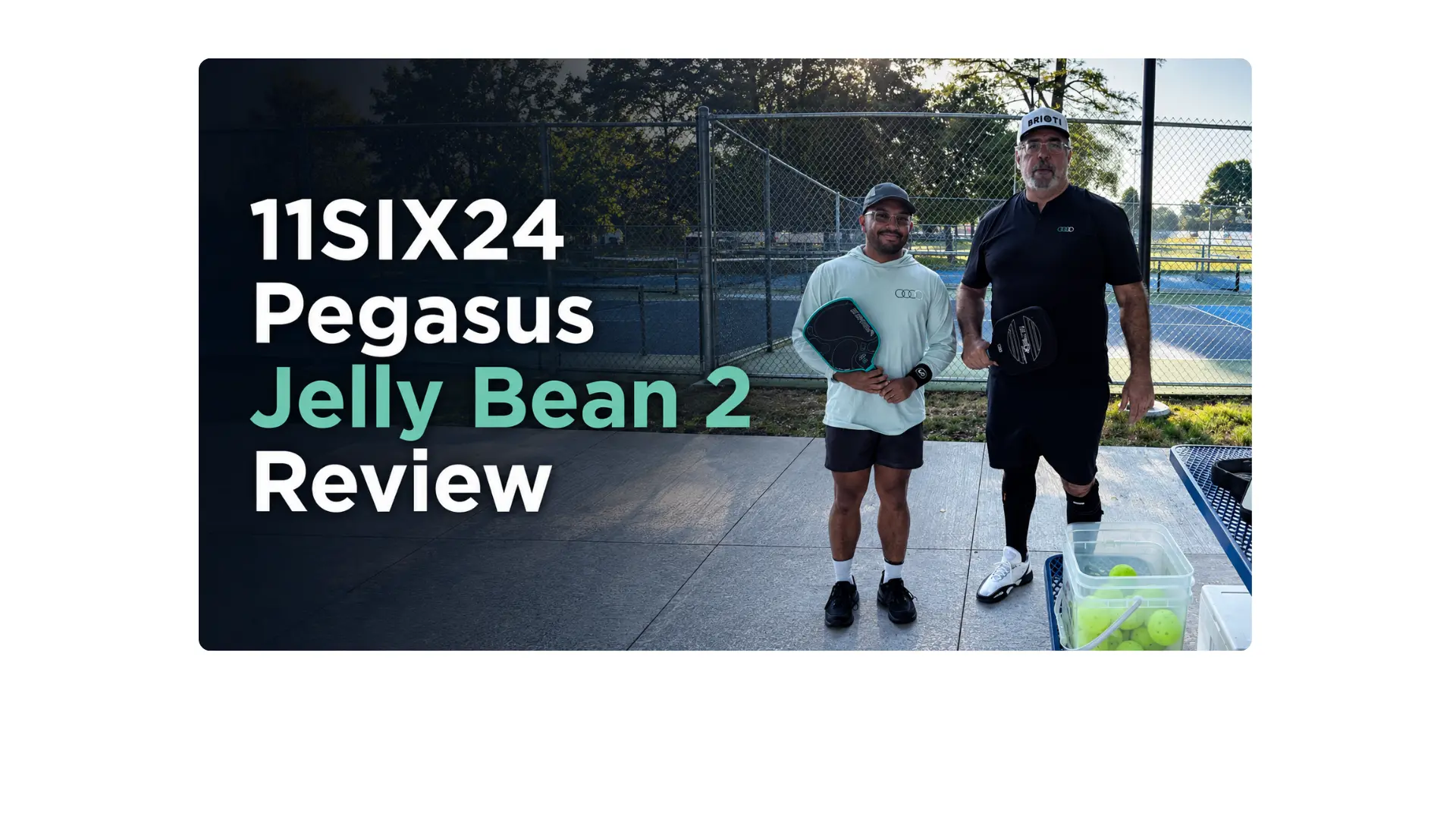
Coincidentally, on the first day I tested the paddle, fellow 11SIX24 ambassador AJ from Apple Juice Pickleball Club in New Jersey was visiting New Orleans. AJ is a big fan of widebody paddles, especially the Pegasus shape.
Watching him play with the Pegasus gave me a little hope that maybe I could adapt to the shape instead of writing it off based on my previous experience with widebodies.
I was fortunate to receive the Pegasus JB2 early, which gave me enough time to put roughly 26 hours of play on it before writing this review.
After that amount of court time, I can comfortably play with this shape.
That may not sound like a dramatic endorsement, but considering my history with widebody paddles, it is significant.
I am not suddenly ready to give up hybrid and elongated paddles. What the Pegasus JB2 has done is remove the feeling that I am fighting the widebody shape. I can settle into it, trust it and play my normal game rather than constantly thinking about how quickly the paddle wants to move.
The more complicated question is power.
11SIX24 describes the Jelly Bean 2 as having “sneaky power,” and after 26 hours I understand why that phrase can be interpreted differently depending on what someone expects from a paddle. The Pegasus is not a paddle that creates a lot of free speed for me. I have to supply the swing. But when I do, there is enough power to drive the ball, serve deep and finish points.
I eventually started thinking about it this way: the Pegasus JB2 gives me earned power rather than free power.
My answer after 26 hours: the Pegasus JB2 is a control-first widebody with quick hands, excellent stability and enough offense when I create the pace. Its real strengths are control, spin, resets and forgiveness rather than automatic rebound.
The Pegasus Jelly Bean 2 is now available from 11SIX24 for $169.99. Use code PICKLETIP at checkout to save $10. The current purchase also includes a free neoprene paddle cover.
Buy the Pegasus Jelly Bean 2 from 11SIX24 and use code PICKLETIP for $10 off.
11SIX24 currently lists free U.S. shipping on orders over $75, a 12-month warranty and 30-day returns. Because the Pegasus is $169.99, it qualifies for the stated free-shipping threshold. Purchase terms can change, so confirm the current details on the product page.
What kind of paddle is the Pegasus Jelly Bean 2?
The Pegasus is the widebody member of the four-shape Jelly Bean 2 family. Before getting into how it plays, here are the specifications and measured numbers that matter most.
| Specification | Pegasus Jelly Bean 2 |
|---|---|
| Price | $169.99 MSRP; use code PICKLETIP for $10 off |
| Thickness | 16 mm |
| Shape | Widebody |
| Brand-published dimensions | 15.8″ long × 8.2″ wide |
| Brand-published grip length | 5.5″ |
| Grip circumference | 4.125″ |
| Brand-published weight range | 8.0–8.3 oz |
| Measured weight | 8.11 oz blended average |
| Surface | HexGrit |
| Core / construction | EMA-centered full-foam construction with EVA and expanding foam; CFC face layup with Toray T700 carbon fiber and fiberglass |
| Approval | UPA-A approved; not USA Pickleball approved. I also track current listings in my UPA-A paddle database. |
| Brand-published swing weight | 109–112 |
| Measured swing weight | 111.38 blended average |
| Brand-published twist weight | 7.1–7.3 |
| Measured twist weight | 7.16 blended average |
| Colorways | Cosmic Grape, Cornflower Blue, Island Punch |
| Included | Free neoprene paddle cover |
| Warranty | 12 months against manufacturing defects, subject to 11SIX24’s warranty policy |
| Returns | 30-day returns, subject to 11SIX24’s return policy |
| Shipping | Free U.S. shipping over $75; 11SIX24 states orders placed before 2 PM Eastern ship the same day |
| Buy | Pegasus Jelly Bean 2 at 11SIX24 — use code PICKLETIP for $10 off |
11SIX24’s published retail specifications and my compiled measurements are intentionally shown separately. Static weight, swing weight and twist weight can vary from paddle to paddle. My measured values are blended averages compiled in my Jelly Bean 2 family guide, so I would not assume every retail Pegasus will measure exactly the same.
My test: roughly 26 hours of play before this review. That was enough time for the paddle’s feel to settle and for me to stop judging it like a brand-new foam paddle.
Those numbers help explain why the Pegasus feels different from the other JB2 shapes. It has the lowest measured swing weight in the family while also producing the highest measured twist weight, giving it an unusual combination of quickness and lateral stability.
That matches what I feel on the court: the paddle gets into position quickly, but it does not feel flimsy or unstable when I catch the ball away from center.
My biggest takeaway after 26 hours is simple:
This is a widebody I can comfortably play with.
Jelly Bean 2 is not really a sequel to the original Jelly Bean
The Jelly Bean 2 name is a little misleading if you expect this to be a normal second-generation Jelly Bean.
The original Jelly Bean was a sub-$100 polypropylene honeycomb paddle built primarily around easy control and value. JB2 moves to an EMA-based foam construction, adds HexGrit and lands at $169.99. The core, face construction, surface and performance platform all changed substantially.
What carries over is the basic philosophy: control first, predictable response and the expectation that the player will create much of the offense.
The construction changed dramatically. The control-first DNA did not. I go deeper on that family-wide change in my Jelly Bean 2 family guide, but the Pegasus-specific version of that story becomes much clearer once you hit with it.
Soft, dense and much more linear than explosive
The first thing I notice with the Pegasus JB2 is that the response is not explosive.
The contact feels soft, dense and dampened. The ball seems to sit on the face longer than it does on a stiffer, hollower power paddle, and I get a noticeable pocketing sensation before the ball leaves.
What I like is how linear the response feels.
If I put a little into the shot, I get a little back. If I accelerate through the ball, the pace climbs with the swing. I never get the feeling that the core suddenly activates and sends the ball faster than I intended.
That predictability is particularly useful in this shape. The Pegasus itself is quick enough that I can get the paddle into position early, while the low-pop face gives me time to control what happens after contact.
I think that combination is a big reason I have become more comfortable with this widebody than I expected.
Don’t judge the Pegasus JB2 in the first hour
I would not judge this paddle from the first hour.
My Pegasus felt firmer and less open when it was new. With more court time, the response became plusher and the usable hitting area felt easier to trust. I did not experience some dramatic transformation into a powerful paddle, but the feel became more natural and predictable as I played with it.
Some of that break-in may actually have been me breaking in to the Pegasus. The soft, dense EMA response is different enough from a traditional honeycomb paddle or a stiff foam power paddle that part of the adjustment is simply calibrating to what the face gives back.
By the time I had significant hours on it, I was no longer thinking about the unusual foam feel. I was simply playing.
Is the Pegasus Jelly Bean 2 underpowered?
I do not think “underpowered” tells the full story of the Pegasus JB2.
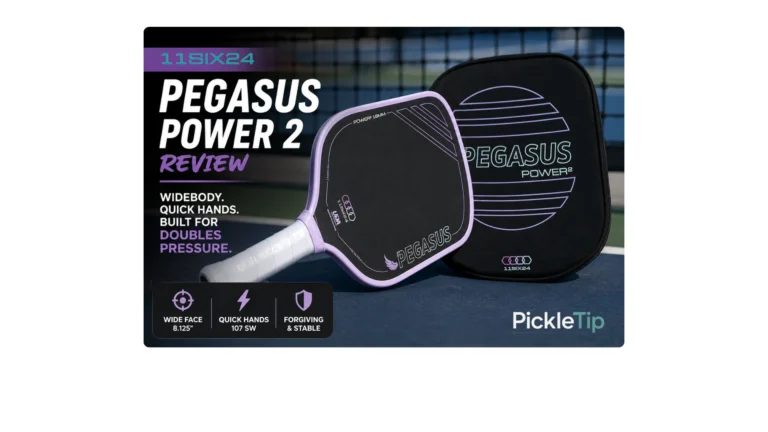
It is absolutely less powerful than a true power paddle, and it gives me far less free pace than the Pegasus Power 2. If I shorten my stroke and expect the paddle to create the rest of the speed, the ball comes off slower than I want.
When I take a full swing, however, there is enough power there to play aggressively.
This is what I mean by earned power.
The Pegasus JB2 is not powerless. It simply makes me responsible for generating more of the pace.
That can actually be an advantage when I want to accelerate hard. I can take a fuller cut at the ball without having to protect against the paddle suddenly adding another layer of rebound. The result is more confidence swinging through serves, drives and attacking balls while still keeping the ball inside the court.
Players coming directly from something hot and springy may initially think the Pegasus is dead. Players who already create their own racket-head speed are more likely to understand what the paddle is offering.
Serves and drives: I can swing through the ball
On serves, the Pegasus JB2 gives me enough pace to keep the ball deep, but depth comes more from committing to the swing than allowing the paddle to do the work.
The payoff is that I can swing aggressively and use the HexGrit surface to shape the ball. Topspin gives me confidence to accelerate because the ball dips instead of simply carrying long.
Drives work the same way.
If I get lazy with my feet or shorten the stroke, the Pegasus will not rescue the shot with free pace. When I get behind the ball and accelerate properly, I can generate plenty of usable drive speed while getting more shape and margin than I typically get from a hotter paddle.
I would describe the drive profile as controlled aggression. I can hit hard, but I have to be the one creating the hard part.
Third-shot drops are one of the Pegasus JB2’s strengths
The softer response makes third-shot drops easier for me to trust.
I can swing through the ball instead of trying to manufacture a delicate touch with my hands. The paddle takes enough pace away that I have room to use a natural stroke, and the dwell gives me time to shape the ball with topspin.
I especially like being able to hit a more aggressive topspin drop without feeling as though a small timing mistake is going to turn it into a chest-high attackable ball.
The Pegasus does not make every third automatic, but it gives me a large margin for error. That fits the personality of the paddle much better than chasing outright power does.
Resets and transition defense may be even better
Resets are one of the areas where the low pop becomes a clear advantage.
When someone drives the ball hard at me in transition, I do not feel like I am fighting rebound from the core. The Pegasus absorbs pace well, and I can either block softly or push through the reset depending on how much depth I need.
The wide face also helps here. When I do not catch the ball perfectly in the center, the paddle remains stable enough that the miss is often still playable.
This is where I think the combination of the Pegasus shape and the JB2 core makes the most sense: quick enough to get behind the ball, stable enough to survive the miss and soft enough to take pace away.
Dinks and rolls reward spin more than pop
At the kitchen, the Pegasus gives me a lot of confidence to be aggressive without necessarily hitting harder.
Crosscourt dinks are easy to shape, and I can brush up the back of the ball without worrying as much about the face throwing it too far. The lower pop lets me create spin and angle while still maintaining depth control.
Roll volleys are particularly good because the HexGrit gives me plenty of bite and the paddle is fast enough to get into position quickly.
The same characteristics help when I want to attack a dink from below net height. Instead of relying on raw rebound, I can use spin to get the ball down.
With the Pegasus, spin supplies some of the offense that raw pop normally would.
Hands and counters expose the main tradeoff
The kitchen is also where the Pegasus JB2’s biggest limitation becomes obvious.
The paddle itself is very quick through the air, so getting it into position is not a problem. The issue is what happens after contact.
Counters do not have the same automatic jump that I get from the Pegasus Power 2 or another hotter paddle. If I simply stick the paddle out and expect incoming pace to turn into offense, the result can be more defensive than threatening.
I have to be more intentional with the counter. Good preparation, getting the paddle in front and driving through contact matter more.
The upside is that the lower pop also helps me keep the ball down. I have less fear of an ordinary counter sailing long or climbing because the face gave me more rebound than I expected.
Blocking is a different story. When I keep the paddle quiet, the softer face and widebody stability make it easy to redirect hard drives without sending the ball deeper than I intended. Against someone who wants to keep driving through transition, I like that trade.
So the widebody geometry partly offsets the low-pop core, but it does not erase it. If your hands game is built around creating your own speed, this combination can work very well. If you depend on the paddle to amplify incoming pace, this is probably where you will miss a power paddle most.
Overheads: enough power when I supply the swing
I do not have trouble finishing normal overhead opportunities with the Pegasus JB2.
Again, the paddle is not doing the work for me. If I make a compact or lazy overhead, I notice the lower power. With a full overhead swing and clean contact, there is enough mass and speed to put the ball away.
HexGrit gives the Pegasus plenty of usable spin
The Pegasus JB2 gives me as much spin as I need on serves, drives, drops, rolls and attacking dinks. What I notice more is what happens when that spin is paired with the slower launch.
Because the ball is not leaving the paddle as violently as it does from a true power paddle, the spin has more time to influence the flight. I see a lot of useful dip on topspin shots, which lets me swing harder while maintaining margin over the net.
That is especially useful on third-shot drives, drips and roll volleys where the goal is not simply maximum speed. I want the ball moving forward aggressively and then dropping at my opponent’s feet.
HexGrit is a major part of why that works.
HexGrit has also held up extremely well in the durability testing I track on PickleTip. I go deeper into the construction and family-wide surface data in my Jelly Bean 2 guide. On the Pegasus itself, the practical result is simpler: I get excellent usable spin on court.
A big sweet spot without the flimsy widebody feel
The Pegasus shape gives me one of the largest-feeling usable hitting areas in the JB2 family.
I can tell when I miss the center, but the paddle does not punish every slight mishit with a dramatic loss of control. Off-center contact remains predictable enough that I can stay in the point.
The lateral stability is one of the characteristics I notice most because it keeps the paddle from feeling flimsy despite how quickly it moves.
The sample data compiled in my JB2 family guide supports that impression. Pegasus came in around a 7.16 blended twist weight, the highest measured number in the four-shape lineup.
For me, this is also one of the reasons the widebody shape stopped bothering me. It may rotate quickly, but once I get the face behind the ball it feels solid.
I prefer the Pegasus close to stock
One advantage of the Pegasus is that I do not feel like it needs much help from added weight.
The stock shape already gives me good stability, a generous sweet spot and quick hands. Adding perimeter weight can give the ball a little more authority, but it also starts eating into one of the reasons I like this particular JB2 shape in the first place.
If someone feels the Pegasus is too light or wants a little more plow-through, modest weighting makes sense. I would not assume it needs to be heavily customized before playing it, though.
The stock balance is part of what differentiates Pegasus from the heavier-swinging JB2 shapes.
Don’t judge its power with one ball in one session
One thing I would keep in mind before judging the Pegasus from a single session is that its soft foam response can feel different depending on the ball and playing conditions.
With a slower or softer ball, the combination can make the paddle feel more control-heavy because neither the ball nor the face is contributing much rebound. With a faster ball, the Pegasus has more pace to redirect and the balance between control and offense feels different.
That does not turn the Pegasus into a power paddle, and I would not choose it because I expected a particular temperature to unlock hidden power. It does mean I would be cautious about forming a final opinion after one outing with one ball.
Between the break-in period, the unusual EMA feel and normal differences in ball speed, this is a paddle that benefits from real playing time.
Why this widebody finally stopped bothering me
Widebody paddles have traditionally felt too quick to me.
It isn’t that I don’t understand their advantages. A wider face generally gives me more lateral stability and a forgiving hitting area. They can also be extremely quick during kitchen exchanges.
My problem has always been timing.
They tend to rotate faster than the hybrid and elongated paddles I naturally prefer, and I often feel like I have to slow the paddle down rather than simply letting my normal timing take over.
The Pegasus JB2 has not converted me into someone who suddenly believes every paddle should be a widebody.
But after roughly 26 hours, I can comfortably play with it.
I think the reason is the combination of quick geometry and restrained response. The paddle moves fast, but the ball does not explode off the face. That gives me time to use the widebody’s hand-speed advantage without feeling like both the paddle and the ball are moving faster than I want.
Eventually you have to stop thinking about the paddle.
The Pegasus has reached that point for me.
Pegasus Jelly Bean 2 vs original Pegasus Jelly Bean
This comparison is more important than the shared name makes it seem.
The original Pegasus Jelly Bean was a sub-$100 control paddle built around a conventional polypropylene honeycomb core. What I remember about it is that the paddle did not need to be powerful to be useful. You supplied the offense; the paddle gave you control and an approachable response.
The Pegasus JB2 still feels related to that idea, but it is not simply an original Pegasus with foam stuffed inside it. The new version feels softer and denser, pockets the ball more, produces better spin and gives me a higher performance ceiling when I want to attack.
| Trait | Original Pegasus Jelly Bean | Pegasus Jelly Bean 2 |
|---|---|---|
| Construction | Polypropylene honeycomb | EMA-centered full-foam platform |
| Feel | Conventional, control-first response | Softer, denser, more pocketing |
| Power philosophy | Player-generated pace | Still player-generated, with a higher offensive ceiling |
| Pop | Low dependence on free pop | Still restrained rather than explosive |
| Spin | Previous-generation surface | HexGrit with substantially stronger usable spin |
| Price position | Sub-$100 value paddle | $169.99 modern performance paddle |
The family-wide side-by-side data I compiled in my Jelly Bean 2 guide points in the same direction: JB2 gains some power while keeping a low-pop identity, and the foam version feels softer and plusher than the original honeycomb paddle.
So I would not describe the Pegasus JB2 as “the original Pegasus Jelly Bean, only better.”
The Pegasus JB2 is not an upgraded original Pegasus Jelly Bean. It is a different construction and performance platform built around much of the same control-first philosophy.
Pegasus Jelly Bean 2 vs Pegasus Power 2
If you’re actually deciding between two Pegasus paddles, this is the comparison I’d pay attention to.
The Pegasus JB2 and Pegasus Power 2 share a shape, but they do not play like two versions of the same paddle.
The Power 2 gives me considerably more immediate pace. The ball jumps faster on counters, speedups and other short-stroke exchanges, and I do not have to supply as much acceleration to make offense happen.
The JB2 moves in the opposite direction. It gives me more dwell, a softer response and more freedom to swing through the ball without worrying about excessive rebound.
Choose the Pegasus Power 2 if you want:
- more free pace,
- more reactive pop,
- easier offensive counters,
- faster putaway speed,
- and a paddle that contributes more of the offense for you.
Choose the Pegasus Jelly Bean 2 if you want:
- a softer and denser response,
- more dwell and pocketing,
- lower reactive pop,
- more freedom to take full swings,
- easier resets and blocks,
- greater margin in the soft game,
- and a paddle that mostly returns the amount of pace you put into it.
The buying decision: if I want the paddle to help create offense, I take the Pegasus Power 2. If I want the same widebody idea with more dwell, less rebound and more freedom to swing through the ball, the Jelly Bean 2 makes more sense.
Both can produce excellent spin.
If the JB2 side of that comparison sounds more like your game, the Pegasus Jelly Bean 2 is now live on 11SIX24 at $169.99. Use code PICKLETIP for $10 off.
Where the Pegasus fits in the Jelly Bean 2 lineup
In the full four-shape Jelly Bean 2 comparison, the Pegasus has a very clear role in the family.
It is the widebody option, the quickest-feeling shape and the one I would look at first if stability, hand speed and a large usable hitting area matter more to you than reach or plow-through.
What makes the Pegasus interesting is that those widebody traits are paired with the JB2’s low-pop core. That gives it a different personality from the hot widebodies that use their fast geometry to amplify offense.
The Pegasus uses its quickness more for positioning, defense and controlled aggression.
Who should buy the Pegasus Jelly Bean 2?
I think the Pegasus JB2 makes the most sense for a player who:
- wants widebody stability without a hot face,
- values control and placement,
- generates much of their own pace,
- wants to take fuller swings,
- relies heavily on spin,
- wants easier resets and blocks,
- prioritizes stability and forgiveness,
- or finds today’s power paddles too reactive.
And I would add one group I did not expect before testing it:
players like me who traditionally have not loved widebody paddles.
I am not saying the Pegasus will convert every hybrid or elongated player. It did not suddenly make me prefer widebodies. It simply made the shape comfortable enough that the geometry stopped being the reason I wanted to put the paddle down.
Who should skip the Pegasus JB2?
I would look elsewhere if your biggest priorities are:
- maximum free power,
- explosive counters,
- automatic putaway pace,
- elongated reach,
- or a crisp, highly reactive impact.
If you already play the Pegasus Power 2 and love how much offense the paddle creates for you, do not assume the Jelly Bean 2 is an upgrade.
It is not.
It is an alternative built for a different kind of player.
Pegasus Jelly Bean 2 FAQ
No. I consider the Pegasus Jelly Bean 2 a control-first widebody with earned rather than free power. It gives me enough pace to serve deep, drive aggressively and finish overheads when I supply the swing, but it does not produce the automatic rebound or counter speed of a true power paddle.
Not for me. I prefer the Pegasus Jelly Bean 2 close to stock because it already combines quick hands, a large usable sweet spot and strong lateral stability. A small amount of perimeter weight can add plow-through, but too much starts to reduce one of the shape’s biggest advantages: how quickly it moves.
I would not judge the Pegasus JB2 from its first hour. Mine felt firmer and less open when new, then became plusher and more natural with court time. I cannot give every paddle a universal break-in duration, but after significant play the response became more predictable and I stopped thinking about the unusual foam feel.
It can be. I have traditionally preferred hybrid and elongated paddles because widebodies tend to rotate too quickly for my timing. After roughly 26 hours with the Pegasus JB2, I became comfortable enough with the shape that I could stop thinking about the geometry and simply play. That does not mean every non-widebody player will have the same experience, but the combination of quick handling, strong stability and restrained rebound made this widebody easier for me to adapt to.
Yes. The Pegasus Jelly Bean 2 is UPA-A approved. It is not currently USA Pickleball approved.
I would recommend the Pegasus JB2 most strongly to players who want widebody stability, quick hands, strong spin, forgiving resets and the freedom to take fuller swings without managing a hot face. It makes the most sense for players who generate much of their own pace and value control and placement more than automatic power.
My verdict after 26 hours
The Pegasus Jelly Bean 2 surprised me for a reason I did not expect. I went into the test wondering how 11SIX24’s softer EMA foam, HexGrit surface and “sneaky power” would translate into a widebody. I did not expect the widebody shape itself to become this comfortable.
The one thing I would not call it is a power paddle. If I expect the paddle to generate speed for me, the Pegasus can feel underpowered. It does not give me the automatic pace or explosive counter speed of the Pegasus Power 2. When I create the speed myself, though, there is enough offense to play aggressively without constantly managing excess rebound.
That is the identity of the Pegasus JB2 for me: control, spin, stability and enough earned power to attack when I choose to.
The original Pegasus Jelly Bean delivered control and surprising capability from an inexpensive honeycomb paddle. JB2 keeps that basic philosophy, but the foam construction, dwell, HexGrit and higher performance ceiling make it a very different paddle rather than a simple sequel.
And for someone who has spent years preferring hybrid and elongated shapes, the strongest compliment I can give the Pegasus is still the simplest one: eventually you have to stop thinking about the paddle. After roughly 26 hours, I can pick up this widebody and simply play.
If that sounds like the kind of widebody you want, you can buy the Pegasus Jelly Bean 2 directly from 11SIX24 and use code PICKLETIP for $10 off.
Current listed price: $169.99. 11SIX24 also lists a free neoprene cover, free U.S. shipping over $75, a 12-month warranty and 30-day returns.