
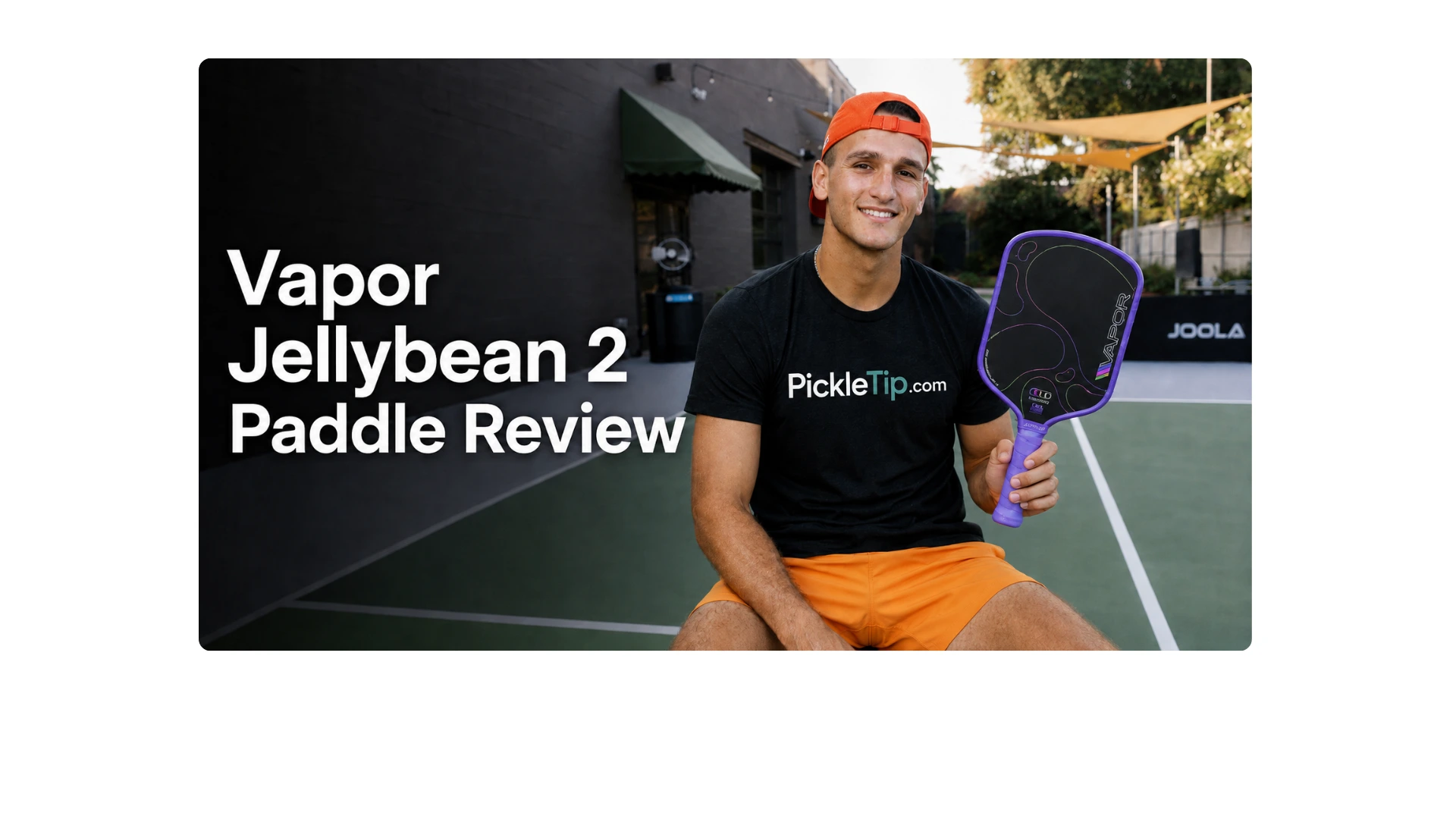
11SIX24 Vapor Jelly Bean 2 Review: Soft Control With Serious Spin
The Vapor was the Jelly Bean 2 shape I expected to understand the fastest.
I naturally gravitate toward hybrid and elongated paddles, so unlike the Pegasus, I did not have to convince myself to give the Vapor shape a chance. The geometry already felt familiar. The question was what 11SIX24’s softer Jelly Bean 2 foam platform would do to a shape I already understood.
That familiarity ended up being useful. I was not spending my first sessions adjusting to an unfamiliar shape, so I could pay attention to the core, dwell, pop, spin, sweet spot and how much pace the paddle was actually giving me.
My takeaway: the Vapor Jelly Bean 2 is a plush, predictable hybrid that gives me plenty of control, excellent spin and enough offense when I commit to the swing.
It is not explosive, and it does not give me the automatic counter speed of the Vapor Power 2. What it gives me instead is a very usable middle ground between soft-game confidence and the ability to accelerate when I choose to.
Testing note: I used the Vapor across multiple sessions rather than judging it straight out of the box. That distinction matters with this paddle because its feel changed enough with court time that I would not want my first few games to be the basis of the review.
The Vapor Jelly Bean 2 officially launches today at 3:00 PM Eastern for $169.99. The 11SIX24 product page may show “sold out” before the launch time because purchasing has not opened yet. Once sales go live, use code PICKLETIP at checkout to save $10. A free neoprene paddle cover is also included with the paddle.
11SIX24 currently lists free U.S. shipping on orders over $75, a 12-month warranty and 30-day returns. Orders placed before 2 PM Eastern are normally listed as shipping the same day when inventory is available. Purchase terms and stock status can change, so confirm the current details on the product page.
What kind of paddle is the Vapor Jelly Bean 2?
The Vapor is the traditional hybrid shape in the four-paddle Jelly Bean 2 family. It gives me more reach and rotational mass than the Pegasus while still keeping the familiar proportions that make hybrid paddles comfortable from almost anywhere on the court.
| Specification | Vapor Jelly Bean 2 |
|---|---|
| Price | $169.99 MSRP; use code PICKLETIP for $10 off when available |
| Launch / availability | Officially launches today at 3:00 PM Eastern; the product page may show “sold out” before purchasing opens |
| Thickness | 16 mm |
| Shape | Hybrid |
| Brand-published dimensions | 16.25″ long × 7.75″ wide |
| Brand-published grip length | 5.5″ |
| Grip circumference | 4.125″ |
| Brand-published weight range | 8.0–8.3 oz |
| Measured weight | 8.22 oz blended average |
| Surface | HexGrit |
| Core / construction | EMA-centered full-foam construction with EVA and expanding foam; CFC face layup with Toray T700 carbon fiber and fiberglass |
| Approval | UPA-A approved; not USA Pickleball approved. I also track current listings in my UPA-A paddle database. |
| Brand-published swing weight | 114–117 |
| Measured swing weight | 119.23 blended average |
| Brand-published twist weight | 6.6–6.9 |
| Measured twist weight | 6.71 blended average |
| Colorways | Cosmic Grape, Cornflower Blue, Island Punch |
| Included | Free neoprene paddle cover |
| Warranty | 12 months against manufacturing defects, subject to 11SIX24’s warranty policy |
| Returns | 30-day returns, subject to 11SIX24’s return policy |
| Shipping | Free U.S. shipping over $75; same-day shipping is listed for in-stock orders placed before 2 PM Eastern |
| Buy | Vapor Jelly Bean 2 at 11SIX24 — use code PICKLETIP for $10 off when available |
11SIX24’s published retail specifications and my compiled measurements are intentionally shown separately. Static weight, swing weight and twist weight can vary from paddle to paddle, and published ranges do not always match compiled measurements from individual paddles. The 8.22 oz, 119.23 swing weight and 6.71 twist weight shown here are blended averages from the measurement data I compiled for my Jelly Bean 2 family guide; they are not a promise that every retail Vapor will measure exactly the same.
The measurements explain something I notice immediately on court: the Vapor feels more substantial through the swing than the Pegasus.
A swing weight around 119 in the compiled measurements is not especially cumbersome, but this is not an ultra-light hybrid either. I get enough mass moving through the ball that the paddle feels planted on drives and blocks without turning into something I have to drag through every kitchen exchange.
The Vapor feels balanced in the original meaning of the word: not because every performance trait is identical, but because nothing about the shape forces me to build my game around one extreme.
The Vapor feels better after it opens up
The Vapor is another JB2 paddle I would not judge from the first few games.
When new, the face can feel firmer and a little more bound than what the paddle becomes with use. As it settles in, I get more of the plush, pocketing sensation that defines the Jelly Bean 2 platform.
The sweet spot also feels easier to trust once I have some time with it. Contact becomes less numb, the ball seems to sit on the face more naturally and I stop having to think about how long I need to hold the stroke through contact.
I would not describe the break-in as the paddle suddenly becoming hot. It does not transform into a Power 2. It simply becomes more comfortable, more responsive and easier to predict.
I have enough time with the Vapor to know the early change is real, but I would rather keep watching how the foam and surface behave than pretend I already know exactly where long-term break-in ends.
Soft and plush without feeling useless
The Vapor JB2 has the same broad soft-and-dense personality I get from the rest of the Jelly Bean 2 family.
The ball pockets into the face instead of immediately springing away. I feel more dwell than I do with the Vapor Power 2, and the response is much less abrupt.
The hybrid shape adds some substance back into that soft response. There is enough swing weight behind the ball that the paddle still feels planted when I move through a full stroke.
The Vapor JB2 feels soft at impact but planted through the stroke.
That lets me swing through a drive without feeling like I brought a power paddle into the kitchen.
Does the Vapor Jelly Bean 2 have enough power?
For me, yes—but I would still classify the power as player-generated rather than automatic.
If I accelerate through the ball, the Vapor gives me enough pace for serves, drives, speedups and overheads. If I shorten the stroke and expect the core to create the speed for me, I notice the lower output immediately.
The Vapor feels more substantial through contact than the quicker Pegasus because there is more rotational mass behind the swing. I can lean into a drive and feel the paddle carry through the ball, but I would not confuse that plow-through with free power.
For my game, that trade is useful. I still have enough offense to attack, while the paddle stays calm enough that I am not protecting against an unexpectedly hot response when I want to play soft.
Serves and drives benefit from the extra mass
On serves, I can generate good depth with the Vapor JB2 as long as I commit to the stroke.
The combination of a more substantial hybrid swing and HexGrit lets me accelerate hard while using topspin to pull the ball back down. I do not get Power 2 speed for free, but I also do not feel like I have to guide the ball just to keep it inside the baseline.
Drives are where I notice the shape helping most. I like the Vapor when I use a full stroke and let the paddle travel through the ball. The swing weight gives me more plow-through than I get from the Pegasus, while the lower rebound gives me room to shape the drive instead of simply trying to keep a hot ball from flying long.
The Vapor rewards a committed swing more than a shortened one.
Drops are where the plush feel starts paying me back
Third-shot drops are one of the shots that make the Vapor JB2 easy to trust.
The softer face takes some of the urgency out of contact. I can use a normal stroke, let the ball pocket and send it forward without feeling like I have to decelerate at the last second to keep it out of the air.
Topspin drops are especially comfortable because the HexGrit gives me enough bite to shape the trajectory while the core keeps the launch relatively controlled.
That gives me room to hit a more assertive third instead of treating every drop like a touch shot that has to be perfectly feathered.
Resets may be the Vapor JB2’s easiest shot
The Vapor is extremely comfortable when I am trying to absorb pace.
If someone drives at me while I am moving through transition, the face does a good job of taking energy out of the ball. I do not feel like I am constantly fighting the paddle to keep the reset low.
The hybrid shape also feels planted enough that I can catch a hard ball slightly off center without the face twisting excessively.
For resets, the Vapor gives me the combination I want: enough mass to stay stable and little enough rebound that I can control where the ball goes.
This is one of the biggest differences from the Vapor Power 2. With Power 2, I have to manage more of the paddle’s response. With JB2, I can be more aggressive with my hands while still taking pace away.
Dinks feel natural rather than overprotected
Dinks feel natural, which may be the least complicated part of playing with the Vapor.
I can move the ball crosscourt, change direction, add spin and push into the corners without constantly thinking about how lively the face is going to be.
The paddle gives me enough dwell that I feel connected to the ball, but I do not have to exaggerate the stroke to make anything happen.
That familiarity is one reason I think the Vapor may be one of the easiest JB2 shapes for a player to understand. The hybrid geometry feels normal to me, and the low-pop response does not demand that I reinvent my soft-game mechanics.
Rolls and speedups lean heavily on HexGrit
When I attack from the kitchen, I rely more on spin and placement than raw rebound.
Roll volleys are excellent. I can brush the ball aggressively, create visible dip and aim for feet or open court without needing a huge amount of face pop.
Speedups require more intention. If I simply flick at the ball and expect the paddle to create a burst of speed, the shot can feel tame compared with a Power 2. If I accelerate through the speedup and use the surface to shape it, I have enough offense to create pressure.
The Vapor creates more of its kitchen offense through spin and stroke speed than through trampoline-like pop.
Hands and counters are good, but not effortless
The Vapor is not as quick through the air as the Pegasus, and I can feel the difference when exchanges get very fast.
A swing weight around 119 in my compiled measurements gives me a more planted paddle, but that mass still has to be moved. I have a little less recovery speed than I do with a lighter widebody.
The bigger limitation is the low reactive pop. When I counter hard pace, the Vapor JB2 does not automatically turn an incoming ball into an offensive missile. I need good preparation and some forward intention through contact.
What I get back for that missing pop is margin. I can counter aggressively without feeling as though every slight mistake is going to sail long.
This is also where the Power 2 comparison becomes easiest for me to feel rather than explain. A compact counter that can come off the Power 2 with very little help from me asks for more contribution with the JB2. The Vapor is happier when I am prepared and moving through the ball than when I ask a reflexive block or punch to become offense on its own.
The Vapor JB2 is not slow-handed, but it rewards preparation more than reflexive paddle pop. If your counter game depends heavily on the paddle creating speed for you, the Vapor Power 2 will feel much more dangerous.
Blocks are easier than punch counters
For straight defensive blocks, I like the Vapor a lot.
The extra mass keeps the face reasonably stable and the softer core takes enough pace away that I can redirect drives without sending everything toward the baseline.
When I want to turn that same ball into an aggressive punch counter, I have to contribute more of the acceleration myself.
HexGrit remains one of the Vapor’s biggest strengths
I get plenty of bite on serves, drives, drops, rolls and attacking dinks. The surface lets me shape shots aggressively even when the core itself is not producing a lot of free speed.
That combination is particularly useful on drives and roll volleys. I can accelerate, trust the topspin and let the ball dip instead of relying on raw velocity to make the shot difficult.
The independent measurement data I track also puts the Vapor JB2 in the same high-spin HexGrit territory as the other Jelly Bean 2 shapes. I keep the broader surface-performance and durability data in my pickleball grit durability testing and the family-level construction and measurement data in my Jelly Bean 2 guide.
11SIX24’s pitch for this generation is essentially that the Jelly Bean is back with grit that lasts. I am more interested in what happens after continued play than repeating a durability promise, so HexGrit longevity is something I will keep judging with use rather than declaring finished on launch day.
The sweet spot feels predictable
The Vapor does not give me the same wide-face forgiveness as the Pegasus, but the usable hitting area feels predictable and stable enough for a hybrid.
I know when I miss the center. The important part is that a small miss does not suddenly produce a completely different ball.
The 6.71 blended twist-weight average sits right inside 11SIX24’s current published 6.6–6.9 range. It is not an extreme stability number, but it is enough that the paddle does not feel nervous through normal off-center contact.
Once the paddle settles in, the softer response also makes the sweet spot feel more generous because mishits are not accompanied by the same harsh, abrupt feedback I get from some stiffer paddles.
I would not rush to add much weight
The Vapor JB2 already carries enough swing weight in the measurements I have compiled that I would play it stock before deciding it needs customization.
There is certainly room for small adjustments if I want more lateral stability or a slightly more planted ball, but I would be careful about automatically loading the perimeter.
The 119.23 blended swing-weight average I have compiled is higher than 11SIX24’s current published 114–117 range. That is why I show the published range and compiled measurements separately instead of treating them as interchangeable. Either way, this is not a shape I would automatically assume needs more mass.
Adding weight can improve one trait while quietly taking away hand speed and recovery time. For me, the stock balance is already close to the point where the Vapor feels substantial without becoming cumbersome.
Vapor Jelly Bean 2 vs original Vapor Jelly Bean
The shared Jelly Bean name makes this comparison more important than it might look. The Vapor Jelly Bean 2 is not simply the original Vapor Jelly Bean with an updated surface.
The original Vapor Jelly Bean and the Vapor JB2 occupy a similar philosophical role, but they get there through very different construction.
The original Vapor Jelly Bean was the affordable control-oriented version of this hybrid shape. It used a traditional polypropylene honeycomb construction and asked the player to create most of the offense.
The JB2 preserves that control-first idea while moving to a much softer, denser, dwell-heavy foam platform with considerably more ability to shape the ball through spin.
| Trait | Original Vapor Jelly Bean | Vapor Jelly Bean 2 |
|---|---|---|
| Construction | Polypropylene honeycomb | EMA-centered full-foam platform |
| Feel | Crisper traditional response | Softer, denser and more pocketing |
| Power philosophy | Player-generated pace | Still player-generated, with more modern offensive capability |
| Pop | Control-oriented | Restrained rather than explosive |
| Spin | Previous-generation surface | HexGrit with much stronger modern spin performance |
| Price position | Sub-$100 value paddle | $169.99 performance paddle |
The Vapor JB2 feels like a familiar idea rebuilt around a completely different core.
If someone already liked what the original Vapor Jelly Bean was trying to do, I think the transition to JB2 makes sense. The control-first personality remains recognizable, but the impact feel, construction and surface performance make this a fundamentally different paddle rather than a routine second generation.
Vapor Jelly Bean 2 vs Vapor Power 2
This is the comparison I think matters most for a player who already knows they like the Vapor shape.
I have spent time with the Vapor Power 2, and the difference is not subtle.
The Power 2 is stiffer, livelier and more immediate. It helps me create offense in short exchanges because I do not need as much stroke to generate speed.
The JB2 is softer, more muted and easier to control when I am trying to take pace off the ball.
Choose Vapor Power 2 if you want:
- more free power,
- more reactive pop,
- more dangerous short-stroke counters,
- easier finishing speed,
- and a crisper, more immediate response.
Choose Vapor Jelly Bean 2 if you want:
- a softer and denser impact,
- more dwell and pocketing,
- easier resets,
- more margin on drops and dinks,
- more freedom to accelerate through full swings,
- and less rebound to manage under pressure.
The buying decision: Power 2 helps me manufacture offense. Jelly Bean 2 gives me more control over how much offense I create.
If the JB2 side of that comparison sounds more like your game, you can check the Vapor Jelly Bean 2 at 11SIX24. Use code PICKLETIP for $10 off when available.
Where the Vapor fits in the Jelly Bean 2 family
Within the four-shape Jelly Bean 2 lineup, the Vapor has the easiest role for me to explain.
It is the familiar hybrid.
That sounds almost boring, but I mean it as a compliment. The shape does not force me toward the extreme quickness of a widebody or the added reach and leverage of an elongated paddle.
It gives me enough of everything to play a normal all-court game while letting the soft JB2 core become the defining characteristic.
If the Jelly Bean 2 core is what interests you and you already know you like hybrid paddles, the Vapor is the easiest shape for me to understand.
If you are choosing between Vapor, Hurache-X, Pegasus and Ultré, my Jelly Bean 2 shape comparison breaks down which shape fits which player.
Who should buy the Vapor Jelly Bean 2?
I think the Vapor JB2 makes the most sense for a player who:
- already likes hybrid paddle geometry,
- wants a soft and predictable impact,
- values resets, drops and dinks,
- creates much of their own pace,
- wants excellent spin without a hot face,
- likes a more planted swing than a very light paddle provides,
- or finds the Vapor Power 2 more reactive than they want.
Who should skip the Vapor JB2?
I would look elsewhere if your biggest priorities are:
- maximum free power,
- explosive counter pop,
- the lightest possible hand speed,
- maximum elongated reach,
- or a crisp, trampoline-like response.
If you already love the Vapor Power 2 specifically because of its pop and explosive offense, do not assume JB2 is the next version you should automatically buy.
The Vapor Jelly Bean 2 is the control-side alternative, not a Power 2 replacement.
Is the Vapor Jelly Bean 2 worth $169.99?
I think the value depends on what you are actually buying it for.
If all you want is a conventional control-oriented hybrid, $169.99 is more than you have to spend. The reason I would pay the premium for the Vapor JB2 is the combination: the unusually soft full-foam feel, high-spin HexGrit surface, planted hybrid swing and enough offense that I do not feel trapped in a pure-control paddle.
The other part of the value equation is whether the HexGrit surface proves as durable as intended. Spin is one of the paddle’s major strengths, so long-term surface performance matters more here than it would on a paddle I liked for some other reason. I am continuing to track that rather than treating durability as settled because the paddle is new.
At $169.99, I would buy the Vapor JB2 for its specific combination of soft foam feel, spin and control—not simply because it is a hybrid paddle with the Jelly Bean name on it.
Vapor Jelly Bean 2 FAQ
I consider the Vapor Jelly Bean 2 a control-first paddle with enough offense for an all-court game. Its biggest strengths are its soft response, spin, resets and shot-shaping rather than free power or explosive pop.
Yes. I would give it more than the first few games. The Vapor feels firmer and more bound when new, then becomes plusher and easier to predict with court time. I see that as a change in feel and predictability rather than the paddle turning into a power paddle.
Yes. The Vapor Jelly Bean 2 is UPA-A approved. It is not currently USA Pickleball approved.
I would recommend the Vapor JB2 most strongly to players who like hybrid geometry and want a soft, spin-heavy paddle with predictable resets, controlled drops and enough pace when they generate the speed themselves.
I think it can be if you specifically want the Vapor JB2’s combination of soft full-foam feel, high spin, predictable control and enough player-generated offense for an all-court game. If you only want a conventional control-oriented hybrid, there are cheaper ways to get one.
The 11SIX24 Vapor Jelly Bean 2 officially becomes available for purchase on August 21, 2026 at 3:00 PM Eastern Time. Before the launch time, the product page may show “sold out” even though sales have not opened yet.
My verdict on the Vapor Jelly Bean 2
The Vapor Jelly Bean 2 may be the easiest paddle in the family for me to explain because I already know what I expect from this shape. Most of what feels different comes from the JB2 platform itself.
It starts firmer than it finishes. With court time, the face becomes plusher and easier for me to read. The hybrid geometry gives the paddle enough mass to feel planted through drives and blocks, while the restrained rebound gives me confidence when I want to drop, reset or dink.
There is enough power for me to play aggressively, but I have to create it. A short counter or abbreviated speedup does not become a missile simply because I put the paddle behind the ball.
For some players, that will be the reason to skip it. For me, it is also a big part of why the Vapor is predictable.
The Vapor Jelly Bean 2 gives me a familiar hybrid shape, a planted swing and a soft enough response that I can stop managing the paddle and concentrate on the shot.
That trade makes sense if you want to swing freely without babysitting the paddle in the soft game. It is not trying to replace Power 2’s explosive offense. It gives up some automatic speed for more freedom to swing, reset and shape the ball.
At $169.99, I think that combination—not the Jelly Bean name by itself—is what has to justify the purchase. If you want the JB2 foam feel, HexGrit spin and a traditional hybrid shape that still lets you create offense, the Vapor makes a strong case for itself.
The Vapor Jelly Bean 2 officially launches today at 3:00 PM Eastern. You can check the Vapor Jelly Bean 2 at 11SIX24, and once purchasing opens, use code PICKLETIP for $10 off.
Current listed price: $169.99. 11SIX24 also lists a free neoprene cover, free U.S. shipping over $75, a 12-month warranty and 30-day returns. Stock and purchase terms can change.


