11SIX24 Jelly Bean 2 Guide: Foam Core, Feel, Specs & Reviews
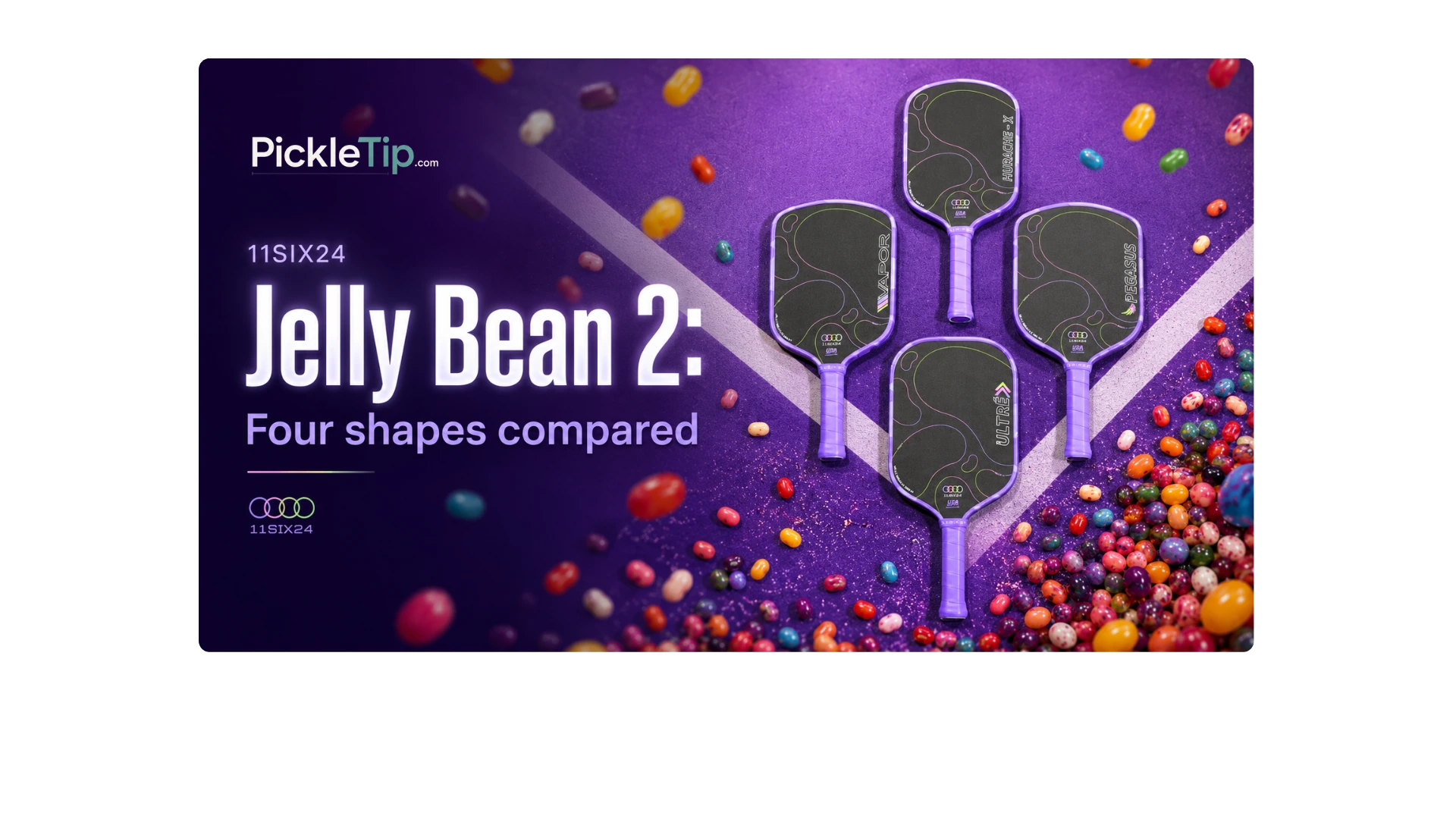
The 11SIX24 Jelly Bean 2 is a four-shape, 16 mm foam paddle family built around a softer, denser EMA-centered core and HexGrit surface. It launched August 21, 2026 at $169.99 in Hurache-X, Vapor, Pegasus and Ultré shapes.
The name makes Jelly Bean 2 sound like a simple sequel to 11SIX24’s original value paddle. After following the project from its early development through prototype revisions and then testing the final-production paddles, I think that undersells what changed.
The original Jelly Bean remains the lower-priced entry point. Jelly Bean 2 is a different performance platform: softer than Power 2, substantially more modern than the original Jelly Bean, extremely spin-friendly, and built around the idea that the player should control how much offense comes out of the paddle.
My takeaway after testing all four: Jelly Bean 2 is best understood as a control-first all-court foam platform. The core is soft and dense, the ball stays on the face longer than it does with Power 2, HexGrit gives me plenty of spin, and the four shapes change the handling enough that they should not be treated as interchangeable paddles.
If you are already sold on Jelly Bean 2, the harder question is which shape fits your game. I get into that after the four individual shape notes below.
How I tested Jelly Bean 2: David Groechel first shared the Jelly Bean 2 concept with me roughly nine months before launch. I followed the project through core discussions, prototype revisions, early-player feedback and the expansion into four shapes. I have since played the final-production Hurache-X, Vapor, Pegasus and Ultré paddles and completed individual reviews of all four. Pegasus reached roughly 26 hours of my own play before I finished that review; Hurache-X, Vapor and Ultré were each around 12 hours, give or take.
My own court time is only part of the picture. I also collected private tester feedback, publicly available measurements and testing, and feedback from local players. What I feel with the final-production paddles matters most to my verdict; I use those other sources to pressure-test what I am feeling on court, not to make the verdict for me.
Long-term foam behavior, surface wear and unit-to-unit variation remain things I will continue watching. Static weight, swing weight, twist weight and balance can vary from paddle to paddle.
Jelly Bean 2 is listed at $169.99 per shape. Use code PICKLETIP at checkout to save $10. Current model listings also include a free neoprene paddle cover.
See the current Jelly Bean 2 lineup at 11SIX24 and use code PICKLETIP for $10 off.
11SIX24 currently lists free U.S. shipping over $75, a 360-day warranty for Jelly Bean 2 and 30-day returns. Its return policy applies a $10 return-shipping fee. Stock, colors and promotional terms can change.
11SIX24 Jelly Bean 2 at a glance
| Detail | Current information |
|---|---|
| Launch date | August 21, 2026 |
| MSRP | $169.99 |
| Shapes | Hurache-X, Vapor, Pegasus, Ultré |
| Colorways | Cosmic Grape, Cornflower Blue, Island Punch |
| Core thickness | 16 mm |
| Core | Softer, denser EMA-centered full-foam platform |
| Surface | HexGrit |
| Family identity | Control-first all-court |
| Feel | Soft, dense, muted and high-dwell |
| Approval | UPA-A certified |
| USA Pickleball approval | Not currently USA Pickleball approved |
| Included | Free neoprene paddle cover on current model listings |
| Warranty | 360 days / approximately 12 months |
| Returns | 30 days, subject to 11SIX24’s return policy and $10 return-shipping fee |
| Shipping | Free U.S. shipping over $75 |
What is the 11SIX24 Jelly Bean 2?
Jelly Bean 2 is 11SIX24’s softer foam-performance family. It sits below Power 2 in automatic pace and reactive pop but above the original Jelly Bean in construction, spin potential and performance ceiling.
11SIX24 describes the core as a softer, denser EMA foam designed to create more dwell and more control on resets, with “sneaky power” when the player swings. After testing the finished paddles, the soft-and-dense part is exactly how I would describe the family.
The important distinction is where the offense comes from.
Power 2 helps manufacture pace. Jelly Bean 2 lets me decide how much pace I want to create.
Jelly Bean 2 does not feel like a weak Power 2. It feels like a different answer to the same question: how much help do you want the paddle to give you?
The Jelly Bean name is still a little misleading
The original 11SIX24 Jelly Bean earned its reputation as a value-focused control paddle. It uses a more conventional construction and remains the lower-priced option in the lineup.
Jelly Bean 2 keeps the value philosophy, but it moves into a different category. At $169.99, this is no longer the inexpensive first-paddle Jelly Bean. You are paying for a full-foam platform, HexGrit, four established 11SIX24 shapes and a much higher performance ceiling.
| Feature | Original Jelly Bean | Jelly Bean 2 |
|---|---|---|
| Product role | Entry-level / value | Modern foam-performance family |
| Price | Lower-priced value tier | $169.99 |
| Core style | Conventional non-full-foam platform | EMA-centered full-foam platform |
| Surface | Previous-generation surface | HexGrit |
| Feel | Traditional control-paddle response | Softer, denser and more dwell-heavy |
| Offensive ceiling | Lower | Higher when the player supplies the swing |
| Shape lineup | Legacy value shapes | Hurache-X, Vapor, Pegasus and Ultré |
The cleanest distinction: buy the original Jelly Bean because you want an inexpensive control paddle. Buy Jelly Bean 2 because you want the modern foam/HexGrit experience without moving all the way to Power 2’s reactive personality.
What is inside Jelly Bean 2?
11SIX24 publicly identifies Jelly Bean 2 around two headline technologies: the softer, denser EMA foam core and the HexGrit surface.
Publicly available independent testing adds more detail. That work identifies a full-foam blend of EMA, EVA and expanding foam beneath a Toray carbon face.
I keep those evidence levels separate. 11SIX24 confirms the EMA/HexGrit platform; the fuller material description comes from independent testing rather than the manufacturer.
The construction matters because the softness is not just surface feedback. The entire paddle behaves differently from Power 2 when it absorbs and returns energy.
How Jelly Bean 2 actually feels
The one thing I felt immediately in every shape was the core.
Jelly Bean 2 feels soft, dense and muted. The ball stays on the face long enough for me to feel like I am shaping the shot rather than simply redirecting rebound. I notice that softness most on drops and resets, where taking pace off the ball matters more than getting an immediate rebound, and on dinks and roll volleys where I want time to shape the ball.
The family is not dead or lifeless. When I accelerate, the paddles can produce useful pace. What they generally do not provide is the automatic short-stroke speed I associate with Power 2.
That difference is why I now prefer describing Jelly Bean 2 as control-first all-court rather than trying to force it into a simple “power paddle” label.
Does Jelly Bean 2 need a break-in period?
Jelly Bean 2 is one of the more obvious break-in foam platforms I have encountered, although I would not expect every retail paddle to change by the same amount.
My Vapor became plusher and easier to predict with court time, and that matches a recurring pattern in the broader early-player feedback. Some new JB2 paddles were described as unusually stiff or bound at first, with the outer areas of the face becoming more responsive as the paddle was played.
What I would not do is turn that into a universal break-in timeline. Different samples behaved differently, and I do not have enough evidence to tell you that every JB2 needs a specific number of games.
I also would not recommend manually bending, kneeling on or “cracking open” the paddle. Some early players experimented with manual flexing and stomping, but that was player practice, not a published 11SIX24 break-in procedure.
My advice: play it before you judge it. If a new Jelly Bean 2 initially feels firmer or more bound than expected, give the foam some normal court time before deciding that is its permanent personality.
Jelly Bean 2 vs Power 2
If you are deciding between Jelly Bean 2 and Power 2, this is the difference I would start with.
Jelly Bean 2 is not Power 2 with a small percentage of the power removed. The two platforms respond differently enough that I think choosing between them should start with feel and rebound, not price.
| Trait | Jelly Bean 2 | Power 2 |
|---|---|---|
| Impact feel | Soft, dense, muted | Stiffer, crisper, more immediate |
| Dwell | Higher | Lower by comparison |
| Free pace | Lower | Higher |
| Kitchen pop | Restrained | More reactive |
| Resets | Easier pace absorption | Requires more rebound management |
| Offensive counters | More player effort | More help from the paddle |
| Spin confidence | Excellent; high dwell helps me shape the ball | Excellent; same HexGrit family technology |
| Best fit | Players who want to control how much offense they create | Players who want easier pace and explosive response |
| MSRP | $169.99 | $209.99 for current Power 2 models |
The buying decision: choose Jelly Bean 2 if you want softness, dwell, resets and spin confidence without giving up the ability to attack when you provide the swing. Choose Power 2 if you want the paddle to do more of the offensive work, especially on abbreviated swings, speedups and counters.
For the shape-specific side of the flagship family, see my 11SIX24 Power 2 comparison.
Jelly Bean 2 specifications: all four shapes
The measurements below are blended averages from independent samples I compiled while researching the family. Individual retail paddles can vary, so these numbers are most useful for understanding the differences between shapes rather than predicting the exact paddle that will arrive at your door.
| Shape | Type | Length | Width | Handle | Weight | Swing weight | Twist weight | Balance |
|---|---|---|---|---|---|---|---|---|
| Pegasus | Widebody | 15.83″ | 8.09″ | 5.61″ | 8.11 oz | 111.38 | 7.16 | 23.95 cm |
| Hurache-X | Elongated | 16.41″ | 7.49″ | 5.96″ | 7.96 oz | 116.60 | 6.05 | 24.50 cm |
| Vapor | Hybrid | 16.18″ | 7.78″ | 5.59″ | 8.22 oz | 119.23 | 6.71 | 24.15 cm |
| Ultré | Flat-top hybrid | 16.28″ | 7.63″ | 5.61″ | 8.20 oz | 121.08 | 6.78 | 24.40 cm |
The nearly ten-point swing-weight spread from Pegasus to Ultré is large enough that “same core, different shape” does not mean “same paddle with a different outline.”
Swing weight can help explain rotational effort. Twist weight can help explain resistance to lateral twisting. Neither measurement tells me everything about the usable sweet spot, foam response, launch or how a paddle behaves when contact is rushed.
Same foam does not mean same paddle. The shape changes how much of the Jelly Bean 2 platform you actually feel.
What I learned from testing all four Jelly Bean 2 shapes
Hurache-X
My personal favorite. The elongated shape gave me the best overall blend of reach, spin, resets, control and usable player-generated offense. It also felt more forgiving to me than its lower measured twist weight initially suggested.
Vapor
The most familiar of the four. Vapor made it easiest for me to isolate what the new core was doing. It is plush, predictable and strong on resets, with enough offense when I commit to the swing.
Pegasus
Widebody stability with earned power. After roughly 26 hours, I stopped thinking about the widebody shape and simply played. Pegasus combines the family’s lowest blended swing weight with its highest blended twist weight, but it still asks me to create most of my own pace.
Ultré
The most planted, and the one I would be most careful recommending blindly. Ultré was the shape I expected to prefer because Ultré Power 2 had been my favorite Power 2 shape. Instead, the 121.08 blended swing weight paired with the softer core taught me that the right shape and the right core are two separate decisions.
Trying to choose between the four? My Jelly Bean 2 shape comparison ranks the matchups and breaks down which shape fits which player.
HexGrit gives the whole family elite spin potential
All four Jelly Bean 2 shapes use HexGrit, so I would not choose a shape because one sample produced a few dozen more RPM than another.
The published spin measurements I compiled from multiple independent tests put all four shapes in the same high-spin range. More importantly, accelerated wear testing has strengthened the durability case for HexGrit.
In one 200-impact accelerated wear test on a Pegasus Jelly Bean 2, measured RPM actually increased 3.4% across the test instead of showing an early spin crash. In the same protocol, a traditional raw-carbon comparison lost roughly a third of its starting spin.
I do not interpret an accelerated test as proof that a paddle face can never change in real-world play. But HexGrit has now performed well enough across multiple tests that surface durability is not one of my major concerns with this family.
I track the methodology and ongoing results separately in my pickleball grit durability analysis.
Why Jelly Bean 2 spin can look especially dramatic
There is another piece of the spin story that raw RPM does not capture.
Jelly Bean 2 generally launches the ball more slowly than Power 2. That slower flight gives topspin more time to bend the trajectory before the ball reaches the other side of the court.
That helps explain why I can see pronounced dip on JB2 serves, drives and rolls even when the measured RPM difference from another HexGrit paddle is not enormous.
Spin is not only how fast the ball rotates. Ball speed determines how much time that rotation has to change the flight.
Is Jelly Bean 2 a power paddle?
I would not call Jelly Bean 2 a true power paddle.
That does not mean it cannot hit hard.
The family gives me enough offensive ceiling to serve deep, drive aggressively, roll the ball and finish points. The difference is that most of that speed comes from the swing I supply rather than a highly reactive face doing the work for me.
That is why player reactions to JB2 power can vary so much. Someone who naturally accelerates may describe “sneaky power.” Someone who relies on paddle-supplied pace may call the same construction underpowered.
The shape also changes the answer. Hurache-X gave me the easiest access to useful offensive leverage. Ultré is the shape where I most understood complaints about having to work for pace. Pegasus power feedback has been unusually sensitive to player, setup and conditions.
Jelly Bean 2 gives me offensive capability without making automatic offense the personality of the paddle.
Is Jelly Bean 2 tournament legal?
The 16 mm Pegasus, Hurache-X, Vapor and Ultré Jelly Bean 2 paddles are UPA-A certified. They were added to the official UPA-A certified paddle list on July 24, 2026.
They are not currently USA Pickleball approved. UPA-A approval and USA Pickleball approval are different systems, and event requirements can vary by governing body, league and tournament.
Before tournament play, verify the current paddle list used by your event. You can also use my UPA-A approved paddle database, USA Pickleball approved paddle guide and USAP vs UPA-A approval explainer.
Tournament warning: “UPA-A approved” and “USA Pickleball approved” are not interchangeable labels. Check the rules for the event you actually plan to enter.
Is Jelly Bean 2 worth $169.99?
I think the value case makes sense for a player who specifically wants the combination Jelly Bean 2 provides: soft full-foam feel, high dwell, strong spin, predictable control and enough offensive ceiling to play an all-court game without a hot face.
At $169.99, this is not a bargain-bin Jelly Bean. It is a lower-priced alternative to Power 2 with a deliberately different response.
The wrong reason to buy JB2 is simply that it costs less than Power 2. The better reason is that you actually prefer what the softer core does.
If you love Power 2 because it makes speedups, counters and short strokes easier, spending less on JB2 may leave you missing the part of the paddle you valued most. If Power 2 feels too stiff, too immediate or too reactive around the kitchen, JB2 may be the better fit even before price enters the discussion.
Who Jelly Bean 2 fits best
- Players who want a soft, dense foam response
- Players who value dwell, pocketing and shot shaping
- Players who prioritize resets, drops and controlled transition play
- Players who generate much of their own pace
- Players who want elite spin without a highly reactive face
- Players who find Power 2 too stiff or too poppy
- Players who can create their own pace but still want more help controlling drops, resets and transition balls
- Players who want to choose among widebody, elongated and two different hybrid geometries without leaving the same core platform
Who may prefer something else?
- Players who want maximum paddle-supplied pace
- Players who rely heavily on reactive kitchen pop and short-stroke counters
- Players whose events require USA Pickleball approval
- Players who prefer a crisp traditional polypropylene-honeycomb response
- Budget shoppers expecting the original Jelly Bean’s lower price tier
11SIX24 Jelly Bean 2 FAQ
The 11SIX24 Jelly Bean 2 is a four-shape, 16 mm foam paddle family built around a softer, denser EMA-centered core and HexGrit surface. I consider it a control-first all-court platform with strong spin and high dwell rather than a true power-paddle family.
The original Jelly Bean remains the lower-priced value/control option. Jelly Bean 2 moves into a modern full-foam performance category with an EMA-centered core, HexGrit, higher offensive ceiling and four current shapes. It is better understood as a separate performance family than a simple replacement for the original.
Jelly Bean 2 is softer, denser and more dwell-heavy, with less automatic pace and kitchen pop. Power 2 is stiffer, more reactive and gives me easier speedups and offensive counters. Jelly Bean 2 lets me control how much offense I create; Power 2 supplies more of that offense for me.
I would not call Jelly Bean 2 a true power paddle. It has enough offensive ceiling for an all-court game when the player supplies the swing, but it offers much less automatic rebound than Power 2. The difference is how much of the pace comes from me versus the paddle.
The Jelly Bean 2 comes in four 16 mm shapes: Hurache-X elongated, Vapor hybrid, Pegasus widebody and Ultré flat-top hybrid. The core and HexGrit surface are shared, but the handling changes substantially between shapes.
My Jelly Bean 2 shape comparison directly compares Hurache-X, Vapor, Pegasus and Ultré for reach, control, stability, hand speed, power and player fit. Hurache-X was my personal favorite, but the right shape depends on which tradeoffs matter most to your game.
Yes. All four Jelly Bean 2 shapes use HexGrit, and the published spin measurements I compiled from multiple independent tests placed the family in the same high-spin range. Accelerated wear testing also showed strong early spin retention, although no accelerated test can prove how every retail paddle will age in real-world play.
The 16 mm Hurache-X, Vapor, Pegasus and Ultré Jelly Bean 2 paddles are UPA-A certified. They are not currently USA Pickleball approved. Tournament players should verify the paddle list and governing body used by the event they plan to enter.
The Hurache-X, Vapor, Pegasus and Ultré Jelly Bean 2 are listed at $169.99 each. Code PICKLETIP saves $10 at checkout when available. Current model listings also include a free neoprene cover, while stock and promotional terms can change.
It can be, especially for an improving beginner who wants a paddle they can grow into. The soft response, lower pop and strong spin create useful control margin, while the performance ceiling is much higher than the original Jelly Bean. But at $169.99, and with substantial swing weights in shapes like Vapor and Ultré, I would not automatically recommend JB2 as every new player’s first paddle.
My verdict on the Jelly Bean 2 platform
When I first published this guide, I had measurements, prototype feedback and months of development context, but I was still waiting for final-production testing to answer the important questions.
Jelly Bean 2 is not a cheaper Power 2, and it is not simply the old Jelly Bean rebuilt in foam. It has its own identity.
The soft, dense EMA-centered construction gives me more dwell and pace absorption. HexGrit gives the entire family serious spin. The restrained rebound makes drops, resets and controlled transition shots easier to manage, while committed swings still give me enough offense to play aggressively.
The biggest lesson from testing all four is that the shared core does not erase geometry. Pegasus, Hurache-X, Vapor and Ultré all have the Jelly Bean 2 feel, but their swing mass, width, reach, handle length and stability change how much of that feel I actually get in my hand.
For me, the platform succeeds because it gives control-oriented players a modern foam paddle without forcing them into either a dead traditional control paddle or a highly reactive power paddle.
Jelly Bean 2 gives me room to create offense without making offense happen before I ask for it.
See the current Jelly Bean 2 lineup at 11SIX24 and use code PICKLETIP for $10 off.
Update log
- August 1, 2026: Published the original pre-launch guide with blended measurements, early tester feedback, approval resources and a final-testing checklist.
- August 21, 2026: Updated after final-production testing of all four shapes. Added my final Hurache-X, Vapor, Pegasus and Ultré conclusions, current construction and HexGrit durability evidence, Power 2 comparisons, approval status, pricing and purchase information.