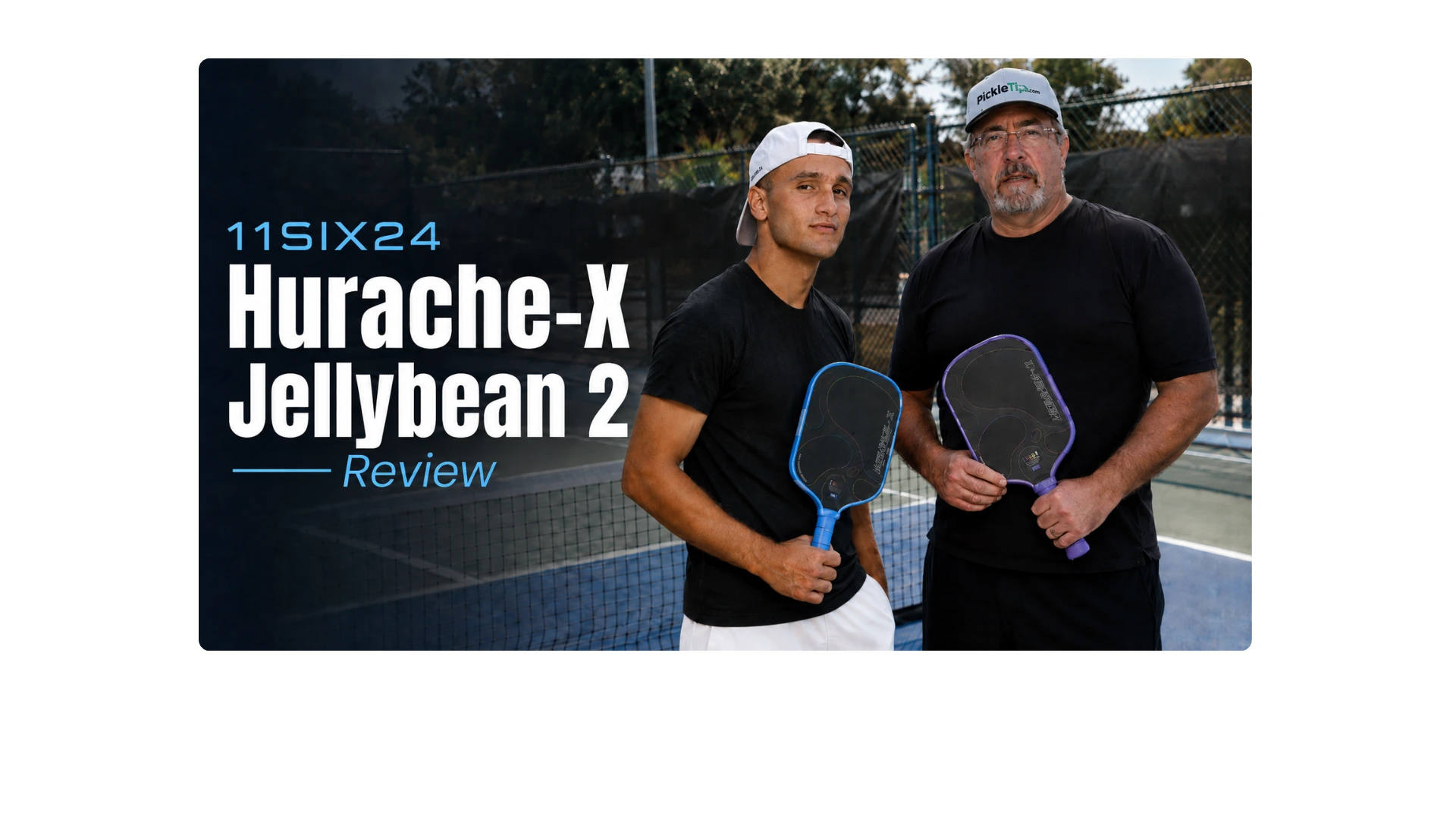
11SIX24 Hurache-X Jelly Bean 2 Review: The Surprise Favorite
Of the four Jelly Bean 2 shapes I tested, the Hurache-X was the one that felt the best to me.
I did not expect that conclusion to come as easily as it did.
The Pegasus surprised me because I normally do not gravitate toward widebodies. The Vapor made immediate sense because hybrid geometry already feels familiar to me. The Hurache-X was different. It was the shape where the individual strengths of Jelly Bean 2 seemed to come together most naturally.
The soft foam response worked. The spin worked. The reach worked. Resets were excellent. Most importantly, I still had enough power to attack without constantly feeling like I had traded away my offense for control.
And apparently I was not the only one having that reaction.
In the early player feedback I collected around Jelly Bean 2, Hurache-X produced the clearest positive response of the four shapes. Resets, defensive control, spin and surprisingly useful power kept coming up, and several experienced players independently ended up preferring this shape. I would not pretend that was a formal survey, but hearing the same strengths from several experienced players got my attention.
My takeaway: the Hurache-X Jelly Bean 2 is the shape where the JB2 formula felt most complete to me.
It gives me the soft, dwell-heavy control I expect from Jelly Bean 2, but the elongated geometry adds enough reach, leverage and offensive authority that I do not spend much time wishing the paddle would give me more.
That does not automatically make it the best Jelly Bean 2 for everyone. Shape preference still matters too much for that.
What I can say is simpler: when I was actually playing rather than comparing specifications, this was the JB2 that felt the best in my hand.
Coach Sid Testing Summary: This review is based on my court time with the final-production Hurache-X Jelly Bean 2, direct comparison with the other Jelly Bean 2 shapes, and my previous experience with the Hurache-X Power 2. I had also been following the Jelly Bean 2 project for months before launch, including the core discussions, prototype revisions and early testing feedback.
I wanted the production paddle to earn its own verdict. My on-court testing came first; published specs and measured data came second. The earlier reports were useful afterward, mostly as a check on where my experience matched—or did not match—what other players were seeing.
I have enough court time to judge how this paddle plays now, but not enough to call long-term foam behavior, surface wear or unit-to-unit consistency settled yet.
The Hurache-X Jelly Bean 2 officially launches today, August 21, 2026 at 3:00 PM Eastern for $169.99. The 11SIX24 page may show the paddle as sold out before purchasing actually opens. Once sales go live, use code PICKLETIP at checkout to save $10. A free neoprene paddle cover is also included.
Check Hurache-X Jelly Bean 2 availability at 11SIX24 and use code PICKLETIP for $10 off.
11SIX24 currently lists free U.S. shipping over $75, a 12-month warranty and 30-day returns. Stock and purchase terms can change.
What kind of paddle is the Hurache-X Jelly Bean 2?
The Hurache-X is the elongated member of the four-shape Jelly Bean 2 family. It gives me the most traditional elongated combination of reach, leverage and handle room while putting that geometry around the softer JB2 foam platform.
| Specification | Hurache-X Jelly Bean 2 |
|---|---|
| Price | $169.99 MSRP; use code PICKLETIP for $10 off when available |
| Current availability | Sold out before the 3:00 PM Eastern launch window at the time of this update; back-in-stock notification is available from 11SIX24 |
| Thickness | 16 mm |
| Shape | Elongated |
| Brand-published dimensions | 16.5″ long × 7.5″ wide |
| Measured dimensions | 16.41″ long × 7.49″ wide blended average |
| Brand-published grip length | 6″ |
| Measured handle length | 5.96″ blended average |
| Grip circumference | 4.125″ |
| Brand-published weight range | 8.0–8.3 oz |
| Measured weight | 7.96 oz blended average |
| Surface | HexGrit |
| Core / construction | EMA-centered full-foam construction with EVA and expanding foam; CFC face layup with Toray T700 carbon fiber and fiberglass |
| Approval | UPA-A approved; not USA Pickleball approved. I also track current listings in my UPA-A paddle database. |
| Brand-published swing weight | 114–117 |
| Measured swing weight | 116.60 blended average |
| Brand-published twist weight | 6.1–6.3 |
| Measured twist weight | 6.05 blended average |
| Colorways | Cosmic Grape, Cornflower Blue, Island Punch |
| Included | Free neoprene paddle cover |
| Warranty | 12 months against manufacturing defects, subject to 11SIX24’s warranty policy |
| Returns | 30-day returns, subject to 11SIX24’s return policy |
| Shipping | Free U.S. shipping over $75 |
| Buy | Hurache-X Jelly Bean 2 at 11SIX24 — use code PICKLETIP for $10 off when available |
11SIX24’s published retail specifications and my compiled measurements are intentionally shown separately. Static weight, dimensions, swing weight and twist weight can vary from paddle to paddle, and published ranges do not always match compiled measurements from individual paddles. The 7.96 oz, 116.60 swing weight and 6.05 twist weight shown here are blended averages from the measurement data I compiled for my Jelly Bean 2 family guide; they are not a promise that every retail Hurache-X will measure exactly the same.
That variation is worth remembering with this shape. One independently measured Hurache-X sample came in particularly quick at 7.93 ounces, a 113.6 swing weight and 6.1 twist weight. My broader compiled average lands at 116.60 swing weight and 6.05 twist weight. The 11SIX24 retail page currently publishes a 114–117 swing-weight range and 6.1–6.3 twist-weight range, so the compiled data is close to the brand range overall even though individual samples can land outside it.
What matters more to me is that the Hurache-X does not feel like a cumbersome elongated paddle.
There is enough mass and leverage to drive through the ball, but I can still get the paddle into position quickly enough that the extra reach does not become a liability every time the game speeds up.
The Hurache-X feels longer when I need reach and smaller when I need to move it.
Why did the Hurache-X feel the best to me?
The simplest answer is balance.
Not balance in the sense that every performance category scores exactly the same. I mean that the tradeoffs bothered me less with the Hurache-X than they did with the other JB2 shapes.
The lower pop never made me feel like I had lost all of my offense. The elongated shape did not feel so heavy that I was late at the kitchen. The relatively low twist-weight number did not translate into the small or punishing sweet spot I might have expected from the spec sheet.
Instead, I kept finding that the things I wanted from Jelly Bean 2 were available at the same time.
- Soft enough for resets.
- Enough dwell for drops and rolls.
- Enough leverage for serves and drives.
- Enough spin to attack with shape instead of relying only on speed.
- Enough reach to make the elongated shape matter.
- Quick enough that I did not feel like I was dragging the paddle around the kitchen.
The Hurache-X is the JB2 where I spent the least time thinking about what the paddle was missing.
How the Hurache-X changes the Jelly Bean 2 feel
The Hurache-X does not abandon the basic Jelly Bean 2 personality just because the elongated shape gives me more leverage.
Impact is still soft, dense and relatively muted. The ball pockets into the face more than it does on the Hurache-X Power 2, and I get that same longer-contact sensation I have felt across JB2.
What changes is what happens when I accelerate.
The longer shape gives me more leverage, so the player-generated nature of the JB2 core does not feel as limiting here. I still have to create the speed, but the geometry helps me convert that swing into a heavier ball.
That extra leverage is what keeps the softer JB2 response from feeling limiting in the elongated shape.
The Hurache-X gives me more power than I expected from JB2
I still would not call the Hurache-X Jelly Bean 2 a true power paddle. 11SIX24 is unusually direct about that too, describing Jelly Bean 2 as “not a power paddle” and positioning the softer, denser EMA platform around dwell, feel and control rather than raw rebound.
What surprised me is how rarely I felt like it was underpowered.
The paddle gives me enough leverage and mass through the swing that serves and drives have useful depth and pace without requiring the kind of effort I sometimes associate with a very soft control paddle.
That matches one of the clearest themes in the broader early feedback I collected. Hurache-X repeatedly generated fewer complaints about power than I expected from the JB2 platform, and several players specifically praised how naturally it drove the ball.
The core itself is still restrained. I am not getting a trampoline response. The elongated geometry simply gives my swing more leverage, so the player-generated power feels easier to access.
This is still earned power, but the Hurache-X makes the earning easier.
Serves may be where the shape advantage is easiest to see
I really like serving with the Hurache-X JB2.
The extra length gives me leverage, and the HexGrit surface lets me take advantage of it. I can accelerate through the serve, produce good depth and use topspin to bring the ball back down.
That combination creates a serve that feels more aggressive than the soft impact might lead someone to expect.
I am not relying on flat paddle speed alone. The ball leaves with enough pace, but the spin is doing a significant part of the work by creating dip and making the depth easier to control.
There is another reason that dip can look especially dramatic on Jelly Bean 2. In the independent spin-and-speed data I compiled alongside the family testing, JB2 was not necessarily producing meaningfully more RPM than the corresponding Power 2 shapes, but the ball was leaving the face slower. That gives topspin more time to influence the flight path before the ball reaches the other side. In practical terms, I can see more downward movement without needing to pretend the paddle is creating some impossible amount of extra spin.
Deep topspin serves were also one of the more consistent positives in the early feedback I collected, which closely matches what I experienced.
Drives are stronger than the soft face suggests
The Hurache-X is also the JB2 shape where I most naturally forget that I am hitting a softer foam paddle when I drive.
I still need to accelerate properly. If I get lazy, the core does not suddenly supply the missing speed.
With a committed stroke, however, the elongated leverage gives me a ball that carries enough pace to create pressure while the HexGrit lets me play with more shape and margin.
That is an appealing combination because I can hit aggressively without feeling like I have to shorten the stroke to keep a hot paddle under control.
I can swing like I am trying to create offense without feeling like the paddle is trying to create extra offense behind my back.
Third-shot drops feel unusually natural
Drops are one of the areas where the elongated leverage and softer core work particularly well together.
I have enough paddle behind the ball that I do not have to manufacture depth with my wrist, but the face is soft enough that I can still swing through the shot without worrying about excessive rebound.
That makes topspin drops especially comfortable.
I can use a normal forward stroke, brush the ball and trust the spin to help pull it down. I do not feel like I need to choose between getting the ball to the kitchen and keeping it low once it arrives.
The result is a third shot that feels repeatable rather than delicate.
Resets may be the defining Hurache-X JB2 strength
If I had to pick one area that best explains why so many players responded positively to this shape, it would probably be resets and transition defense.
The Hurache-X absorbs pace extremely well.
When I am caught in transition and someone drives through me, I can put the paddle behind the ball and take enough energy out of the shot to keep the reset playable.
I also have the reach to catch balls that would force me into a more desperate contact with a shorter paddle.
That combination makes the Hurache-X unusually comfortable when the point stops going according to plan.
This is the “reset machine” part of the Hurache-X reputation that I understand completely.
The paddle gives me reach to get behind the ball, enough stability to survive imperfect contact and a soft enough response to remove pace instead of adding more.
Dinks are controlled, but the long shape still matters
At the kitchen, the Hurache-X gives me the same low-pop advantage I like from the rest of JB2.
I can dink with a normal stroke, add spin and move the ball around without constantly managing a lively face.
The elongated shape also gives me a little more reach into the kitchen, which is useful when I am trying to take balls early or reach into a wider crosscourt exchange.
What I do notice is that the longer paddle requires a little more awareness in very fast exchanges than something like Pegasus. That is normal geometry rather than a flaw in the JB2 platform.
For ordinary dinking, though, I never felt like the shape was working against the soft core.
Rolls and attacking dinks are where the spin becomes offense
The Hurache-X gives me enough spin that I do not need raw pop to make every kitchen attack threatening.
Roll volleys are particularly good. The extra reach helps me contact the ball farther in front, and HexGrit gives me enough bite to accelerate upward and pull the ball down.
The same thing applies when I attack a dink from below net height.
I am not trying to blast through the opponent with rebound. I am using speed that I create plus spin that lets me find steeper angles.
The Hurache-X turns spin into usable offense without requiring a hot face.
Hands and counters are where Power 2 still has the advantage
The Hurache-X JB2 is not perfect, and the biggest tradeoff shows up when the point turns into a pure hands battle.
The paddle is quicker than I would expect from some elongated shapes, but the core still does not provide a lot of automatic rebound.
If I block a hard ball and want to keep it controlled, that is great.
If I want an abbreviated counter to immediately become an offensive ball, I have to contribute more of the speed myself.
This is where the Hurache-X Power 2 has the clearer advantage. Power 2 gives me more pop, more immediate speed and easier offense from a short stroke.
The JB2 gives me more margin.
Which one is better depends heavily on what I am trying to accomplish in that exchange.
The main Hurache-X JB2 tradeoff is not that it lacks offense. It is that the offense comes more from my stroke than from reactive face pop.
Blocks are much easier than offensive counters
For defensive blocks, I love the response.
The paddle takes enough speed away that I can redirect hard drives without automatically sending the ball deep.
The longer reach also helps me get the face behind balls that might otherwise catch me late.
For punch counters, I need more intent. That is the price of the softer face.
Overheads have enough finishing power
I do not have a meaningful problem putting away normal overhead opportunities with the Hurache-X.
The elongated leverage helps here. With a complete overhead motion and clean contact, I can generate plenty of finishing speed.
A lazy or abbreviated overhead still exposes the lower core output, but this is not a shot where I found myself wishing for dramatically more paddle.
HexGrit is a major reason the Hurache-X works
I can generate heavy topspin on serves and drives, shape thirds, roll volleys aggressively and use spin to turn lower kitchen balls into attacks. Because I am not managing a huge amount of reactive pop, I have confidence accelerating the paddle and letting the surface work, which gives me a lot of usable dip and margin.
HexGrit has also performed extremely well in the durability testing I track on PickleTip. In that accelerated wear test, a Jelly Bean 2 sample showed no measurable spin loss after 200 repeated impacts to the same area, while the raw-carbon comparison run under the same protocol lost roughly a third of its starting spin. The JB2 sample actually finished slightly above its starting RPM. I break down the full family-level spin and construction data in my Jelly Bean 2 guide.
I would not interpret that as a promise that the surface never changes. Real-world texture measurements have shown some surface wear with use. The more useful takeaway is that the available HexGrit testing keeps showing the same thing: the texture can change without the paddle suffering the kind of early spin collapse that is common with many raw-carbon surfaces.
The part I actually care about is simpler: I never felt like the Hurache-X was short on spin.
The sweet spot feels better to me than the twist-weight number suggests
The sweet spot is where the numbers and my paddle started arguing with each other.
On paper, the twist-weight data gives me a reason to be cautious. My blended measurement is around 6.05, and 11SIX24 currently publishes a 6.1–6.3 range. Either way, Hurache-X sits at the low end of the JB2 family for resistance to side-to-side twisting.
If I looked only at that number, I would expect the Hurache-X to feel clearly less forgiving laterally than the other shapes.
That is not how my paddle felt to me on court.
I can tell when I miss the center, but the usable hitting area feels larger and more predictable than the twist-weight number alone would make me expect. That also matches a meaningful portion of the early player feedback I collected, where Hurache-X was repeatedly described as having a large, responsive sweet spot.
But that experience is not universal. In the independent subjective testing I compiled, the Hurache-X was also described as the narrower-feeling JB2 shape laterally, which makes sense given its low twist weight. One tester also gave the Power 2 family the overall sweet-spot edge because some JB2 off-center contacts seemed to lose a little more energy.
What the twist weight missed: my Hurache-X sat around the low-6 range, which would normally make me expect less lateral forgiveness. On court, the usable hitting area felt better than that number suggested.
Twist weight still tells me something useful about resistance to rotation. It just does not tell me everything about how the face, foam, launch, vibration and feedback combine to make an off-center ball feel playable.
The Hurache-X JB2 felt more forgiving to me than I would have predicted from its twist-weight number. Another player may be more sensitive to that lower lateral stability, and the measurement gives a legitimate reason to expect that.
There is room to add weight—but I would play it stock first
The manageable swing weight gives me some room to experiment if I eventually want more lateral stability or plow-through. One independently measured sample came in at 113.6 swing weight, while my broader compiled average is 116.60, leaving more headroom than the heavier-swinging Vapor and Ultré samples I compiled.
I still would not add weight automatically. The paddle already felt very good to me stock, and I would rather learn what I actually want to change before turning the setup into a project.
Customization is an option here, not a requirement.
Hurache-X Jelly Bean 2 vs original Hurache-X Jelly Bean
The shared name makes this comparison look simpler than it really is.
The original Hurache-X Jelly Bean was the value-oriented control version of the elongated shape. It used traditional polypropylene honeycomb construction and relied heavily on the player to create pace.
The Hurache-X JB2 keeps that control-first philosophy but rebuilds almost everything underneath it.
The new paddle feels softer and denser, gives me more dwell and pocketing, produces dramatically more usable spin through HexGrit and has a higher offensive ceiling.
| Trait | Original Hurache-X Jelly Bean | Hurache-X Jelly Bean 2 |
|---|---|---|
| Construction | Polypropylene honeycomb | EMA-centered full-foam platform |
| Feel | Traditional control-oriented response | Softer, denser and more pocketing |
| Power philosophy | Primarily player-generated | Still player-generated with more usable offensive capability |
| Pop | Control-oriented | Restrained rather than explosive |
| Spin | Previous-generation surface | HexGrit with elite modern spin |
| Price position | Sub-$100 value paddle | $169.99 foam performance paddle |
The construction changed much more than the philosophy did.
The original Hurache-X Jelly Bean was about elongated control at an accessible price. JB2 keeps the elongated control identity but gives me considerably more spin, dwell and performance headroom.
Hurache-X Jelly Bean 2 vs Hurache-X Power 2
This is the comparison I would care about most if I already knew I wanted the Hurache-X shape.
The Hurache-X Power 2 gives me more immediate offense.
It is stiffer, faster off the face and easier to use when I want a short counter, speedup or compact swing to produce a dangerous ball.
The Jelly Bean 2 gives me the opposite advantage.
I get more dwell, a softer impact, easier pace absorption and more freedom to accelerate without managing as much rebound.
Choose Hurache-X Power 2 if you want:
- more free pace,
- more reactive pop,
- easier offensive counters,
- faster speedups,
- and a paddle that contributes more of the offense.
Choose Hurache-X Jelly Bean 2 if you want:
- a softer and denser response,
- more dwell and pocketing,
- easier resets and defensive control,
- more freedom to swing through drops and drives,
- excellent spin with less reactive pop,
- and a paddle that gives me more control over how much pace I create.
The buying decision: Power 2 makes offense easier. Jelly Bean 2 makes control easier without taking away enough offense to make the Hurache-X feel passive.
What makes Hurache-X different from the other JB2 shapes
The Hurache-X is the elongated JB2: extra reach, the longest handle in the family and more leverage through serves and drives. What surprised me was how naturally that geometry worked with the softer foam.
I expected an elongated control paddle. I ended up with something closer to an all-court paddle that happens to lean control. Hurache-X will not be everybody’s favorite shape, but it was mine.
If you are deciding between all four shapes, my Jelly Bean 2 shape comparison breaks down the differences and which shape fits which player.
Who should buy the Hurache-X Jelly Bean 2?
I think the Hurache-X JB2 makes the most sense for a player who:
- prefers elongated paddle geometry,
- wants extra reach and a longer handle,
- values resets and transition defense,
- wants strong spin without a hot face,
- creates much of their own pace,
- wants more usable drive power than they expect from a soft control paddle,
- likes taking full swings,
- or wants an elongated paddle that still feels relatively quick.
Who should skip the Hurache-X JB2?
I would look elsewhere if your biggest priorities are:
- maximum reactive pop,
- automatic counter speed,
- the fastest possible widebody-style hand speed,
- a crisp and explosive impact,
- or a paddle that creates most of the offense for you.
If you already play the Hurache-X Power 2 and the main reason you love it is its pop in counters and hands battles, do not assume Jelly Bean 2 is automatically an upgrade.
For me, JB2 is the softer, more controllable alternative—and unusually, it gives up less usable offense than I expected.
Hurache-X Jelly Bean 2 FAQ
I would not classify it as a true power paddle. I consider it a control-first all-court paddle with surprisingly useful player-generated power. The elongated shape gives me enough leverage for deep serves, strong drives and normal putaways without the explosive rebound of the Hurache-X Power 2.
It gave me the fewest meaningful tradeoffs during testing. I got the soft JB2 control, strong spin and excellent resets while the elongated shape added enough reach, leverage and drive authority that I rarely felt short on offense.
It was more forgiving for me than the twist-weight number alone suggests. My compiled twist-weight average is about 6.05, and 11SIX24 publishes 6.1–6.3. Independent testing has also described a narrower-feeling sweet spot, so I would not call forgiveness a universal strength. My own paddle simply felt more predictable off center than those numbers led me to expect.
Yes. Resets and transition defense are among its strongest qualities for me. The soft foam absorbs incoming pace, while the elongated reach helps me get the paddle behind balls that might otherwise force a more desperate contact.
Yes. The Hurache-X Jelly Bean 2 is UPA-A approved. It is not currently USA Pickleball approved.
I think the price makes sense if you specifically want its combination of soft full-foam feel, elongated reach, excellent spin, easy resets and enough player-generated offense for an all-court game. If you only want a traditional elongated control paddle, there are cheaper ways to get one.
The 11SIX24 Hurache-X Jelly Bean 2 officially becomes available for purchase on August 21, 2026 at 3:00 PM Eastern Time. Before launch, the product page may show sold out even though purchasing has not opened yet.
My verdict on the Hurache-X Jelly Bean 2
The Hurache-X Jelly Bean 2 is the paddle in this family that made the strongest first impression on me and continued to make sense as I played with it.
I like what the elongated geometry does for the JB2 platform. It adds reach and leverage without burying the soft core under so much swing mass that the paddle becomes cumbersome. Serves and drives have enough authority. Drops feel natural. Spin is excellent. Resets are one of the biggest strengths.
The biggest compromise is still reactive pop. The Hurache-X Power 2 is clearly more dangerous when I need a short stroke to create immediate speed. Jelly Bean 2 asks me to provide more of that acceleration.
But this is the JB2 shape where that tradeoff bothered me the least.
The Hurache-X Jelly Bean 2 feels like the most complete expression of the platform to me: soft enough to control the point, spinny enough to shape it and powerful enough that I do not feel like I have to apologize for choosing control.
The low twist-weight number is worth knowing, but it did not predict my on-court experience particularly well. The usable sweet spot felt better than the measurement alone suggested, which is another reason I came away more impressed than the specifications initially led me to expect.
Of the Jelly Bean 2 shapes I tested, the Hurache-X felt the best to me.
At $169.99, that combination—not simply the Jelly Bean name—is what has to justify the purchase. If you want elongated reach, soft foam control, excellent spin and enough offense to play a complete game, the Hurache-X makes a very strong case for itself.
Check the Hurache-X Jelly Bean 2 at 11SIX24 and use code PICKLETIP for $10 off when purchasing is available.
Current listed price: $169.99. 11SIX24 also lists a free neoprene cover, free U.S. shipping over $75, a 12-month warranty and 30-day returns. Stock and purchase terms can change.