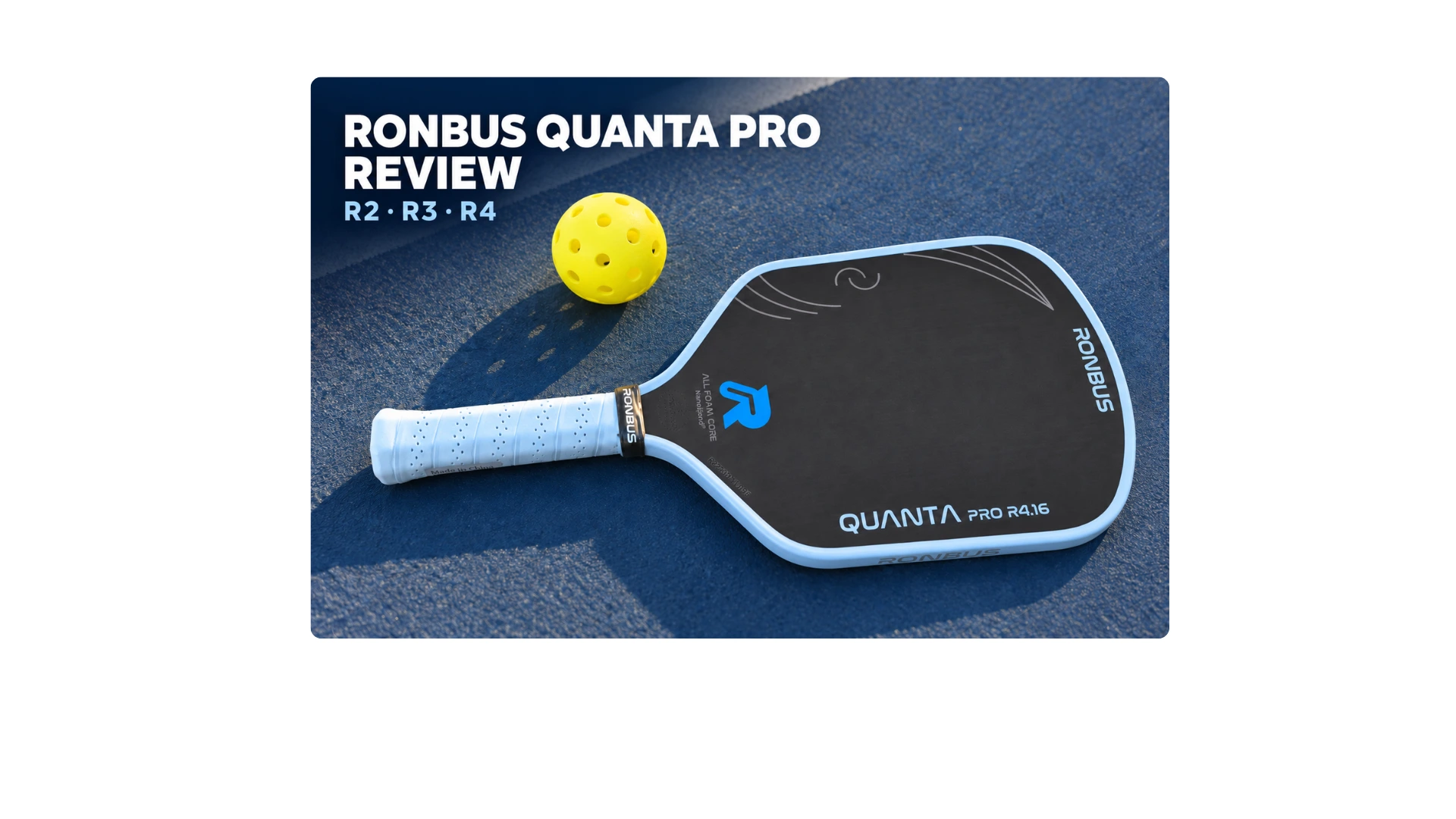
Ronbus Quanta Pro Review: R2 vs R3 vs R4 After 22 Hours Each
I mained the original Ronbus Quanta R4 for a few months. I liked the way it held the ball, the spin I could put on it, and the freedom to make it my own with added weight. But from the time I reviewed it, I kept wishing for one thing: grit that would stick around.
After a few weeks, the face of my original R4 felt smooth as a baby’s bottom. Here’s the part that made me question my own complaint: I could still spin the hell out of a pickleball with it, and I still can. I suspect the dwell and the connection I feel with the ball have something to do with that. I haven’t measured the cause, and a thumb across the face has never told me the whole spin story.
Why I wanted to try the Quanta Pro
When Ronbus released the NanoBond-faced Tenon, I thought I might finally have my Quanta with a more lasting surface. Instead, the Tenon felt softer at contact and a little poppier when I accelerated, while I still preferred the Quanta’s ball connection. I went into that in my Tenon R1 review. So when Ronbus put NanoBond on an actual Quanta, I wanted to know whether this was the paddle I had been waiting for.
I’ve now played about 22 hours apiece with the Quanta Pro R2, R3, and R4. The R4 was my favorite shape in the original Quanta lineup, and it’s my favorite shape in the Pro lineup too. After testing all three Pros, the Pro R4 is the one I kept reaching back into the bag for. That doesn’t mean I’d put every player on an R4; the R2 and R3 suit different games.
Quanta Pro: My quick verdict
The Pro addresses the two things I wanted changed on my Quanta: a more settled starting feel and a new surface with the potential to hold its texture longer. Ronbus added internal weight and NanoBond without taking away the Quanta character I liked. Whether the texture lasts through months of my own play is still an open question.
If a hard ball keeps twisting your paddle, start with the Pro R2. If your offense comes from a full swing and you want reach, try the Pro R3. Of the three Pros, I’d choose the R4: it gives me enough offense and quickness without asking me to play an elongated paddle at the kitchen.
Quanta Pro R2 vs R3 vs R4: Which fits your game?
These are three 16 mm Quanta Pro shapes: a widebody R2, an elongated R3, and a hybrid R4. I’d choose based on the shot that keeps costing you points.
| Shape | How it plays | Who I’d point toward it |
|---|---|---|
| R2 widebody | The steadiest defensive platform of the three, with plenty of pop when you attack. | A player who wants help on blocks, off-center counters, and rushed contact. |
| R3 elongated | More reach and the strongest full-swing drive of the three in my play, without feeling like the jumpiest one in a quick exchange. | A player who likes to serve and drive aggressively and can handle a more substantial swing. |
| R4 hybrid | Quick enough in exchanges, with enough substance to play offense. It’s the blend I keep coming back to. | An all-court player who wants a little of each shape’s strengths. |
Each shape can attack and defend. The difference is where you get the most help: across the face on the R2, through a full swing on the R3, or in a little of everything on the R4.
If one of these shapes sounds right for you, click its name in the table to shop at Ronbus. Those links should apply my $20 PickleTip discount; confirm that it appears in your cart before you order.
How I tested the three Quanta Pros
I put roughly 22 hours of play on each of the R2, R3, and R4. I paid particular attention to drives, resets, counters, blocks, and what happens when contact isn’t perfect. Those shots tell me more about a paddle than its prettiest warm-up drive. My months with the original R4 gave me a longer-use point of comparison. I explain that approach in how I test paddles.
I played all three, but I didn’t set up a lab-matched comparison to isolate every difference. I did not measure RPM or before-and-after surface roughness. The shape comparisons here describe what I felt and how the paddles played for me.
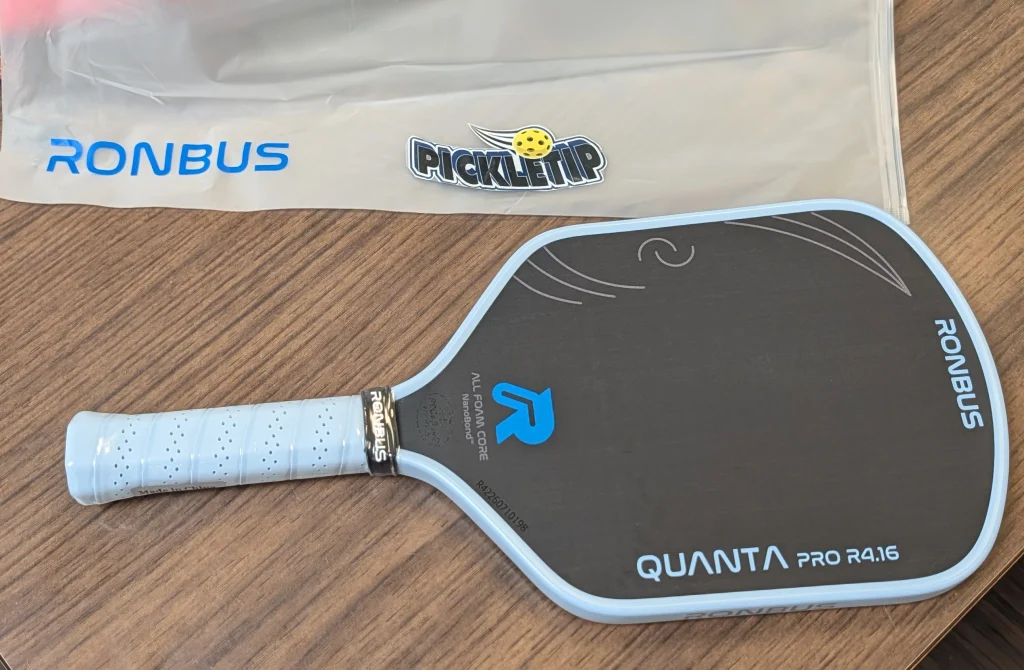
What changed from the original Quanta?
The original Quanta gave me a light frame I could build up. Adding weight made a real difference to how planted it felt against a hard ball. My original Ronbus Quanta review covers the older R1–R5 lineup and its room for customization in more detail.
The Pro begins with more substance built in. That fuller starting feel is welcome when I have to get the paddle on a drive or send a counter back with purpose. If you loved starting with an especially light Quanta and building it yourself, you may miss that freedom. My paddle weighting guide explains what different placements can change, though I wouldn’t copy an original Quanta setup straight onto a Pro.
The other change is NanoBond. Ronbus uses an EPP foam core, an EVA elastomer ring, and its NanoBond surface in the Pro. The new face addresses the complaint that brought me here, at least in design. But my old R4 lost the rough feel I could detect with my hand and kept giving me excellent usable spin. A surface that holds its texture longer could be valuable without automatically giving me a dramatic jump in spin.
I could still tell I was playing a Quanta. The new surface and added substance haven’t erased the ball connection that made me like the original. The differences among the three Pro shapes matter more to my recommendation than the word Pro on the face.
How the three shapes play
R2: The steadier widebody
The Pro R2 is the widebody I’d put into someone’s hand when they tell me their paddle has to help them survive an ugly point. You get more face to work with, and contact away from the center feels steadier. Picture a block where you barely get the paddle across your body or a counter you catch farther toward the edge than you meant to. That’s where I’d start comparing the R2 with the other two Pros.
It isn’t a passive control paddle. There’s plenty of pop for a counter or a put-away, and that liveliness asks for some care on soft shots. A wider, steadier face helps you reach and return a rushed ball; it doesn’t make every reset land perfectly by itself. If you want a quiet paddle that does most of the work of softening the ball, don’t choose the R2 just because its wide face looks forgiving.
R3: Reach and full-swing drive
The Pro R3 makes its case when you take a full cut at the ball. Its elongated shape gives you reach, and the extra substance behind the face suits a hard serve or a purposeful third-shot drive. If that’s how you create offense, the R3 has a clear reason to be in this lineup.
What surprised me is that the Pro R3 gives me the most on a full swing without feeling like the jumpiest of the three during a quick exchange. Those are different jobs. A hard drive asks me to load the paddle; a rushed counter asks me to get it into place and control the next contact.
I like the way its more substantial swing carries through a drive. I still prefer a quicker-feeling paddle when the next ball comes straight at my body. If you often get jammed on that next counter, try the Pro R2 or R4 beside it before choosing the R3 for its drive alone.
R4: My favorite is still the hybrid
The original R4 wasn’t an occasional demo for me. I mained it for months, added weight to make it my own, and kept playing it after the face felt worn smooth. That time told me I liked the hybrid shape. The Pro R4 gave me a chance to see how that shape played with Ronbus’s new starting weight and NanoBond face.
The original Quanta had already earned my trust in chaotic open play. Rushed counters stayed useful, and I could still work through drops, drives, dinks, and rolls. That was the range I wanted to keep. The Pro R2 gives me more help across the face, and the Pro R3 makes a stronger case on a full drive. But after playing all three Pros, the Pro R4 is still the one I reach for when I want one paddle for the entire point.
The added substance is meaningful compared with the light original R4. The old one invited me to figure out the weight it needed. The Pro R4 feels more settled when I first pick it up. I like being able to get into a counter without feeling that I gave up the offense I wanted from the Quanta.
If you’re regularly catching the ball toward the edge, I’d give the Pro R2 a serious look. If you win points by loading up on serves and drives and want elongated reach, the Pro R3 may do more for you. Among the three Pros, I keep coming back to the R4 because its compromises suit my game.
Does NanoBond solve my grit complaint?
It addresses the complaint that made me want this paddle. Whether it has solved it for the long haul is still an open question.
My original R4 taught me that a smooth-feeling face can still put serious shape on a ball. My Tenon taught me something related: more texture under my thumb didn’t automatically mean more usable spin for me when the paddle’s ball connection felt different. That’s why I separate how rough a face feels from how my serves, drives, rolls, and brushed balls actually behave. I go deeper into that distinction in my guide to paddle grit and spin.
My friend Travis also mained an original Quanta for a while, so I was interested in what he noticed with the Pro. He found the grit consistent across the face, with no strange bounces or trouble placing the ball. He thought it might play a little softer, though he wasn’t certain, and felt he needed to push through some shots more. The payoff for him was spin: he liked what it did for his serves and how it helped his third shots dip. That’s Travis’s experience, not a measurement of spin or an answer to how the face will hold up over months.
- How does it play now? After about 22 hours per shape, I can still shape my shots with the Pros in normal play. I haven’t measured their RPM.
- Will the physical texture last longer? NanoBond is meant to address surface wear, but I haven’t measured how much texture my paddles have retained.
- Will my shots behave the same way months from now? I haven’t put enough time on the Pros to answer that honestly.
I’m not ready to call NanoBond a permanent fix based on the name of the surface or 22 hours with each paddle. What I can say is that the Pros give me the spin I want now. The longer test is whether my serves, drives, and rolls still behave the way I expect after the face has spent months in my bag.
I’ll update this section after enough additional play to judge whether the face changes and, more useful to me, whether the ball still does what I ask it to do. My worn original R4 is why I keep those two questions separate.
Should you replace your original Quanta?
If you’re buying your first Quanta and want a paddle that feels more settled before you start experimenting with perimeter weight, I’d start with the Pro. You get the familiar lively Quanta character and a new surface whose long-term wear I’m still testing. Ronbus listed the three Pro shapes at $119.99 each when I checked in September 2026. The model links in my comparison table should take $20 off; check the current price and confirm the discount in your cart before you buy.
If you’ve already dialed in an original Quanta, I wouldn’t replace it just because the Pro exists. My old R4 still gives me excellent spin with a smooth-feeling face. And if you deliberately chose the original because you wanted a very light frame to build yourself, the Pro’s more substantial starting point may be less appealing.
For me, the Pro R4 earns its place because I already trust the shape and like its more settled starting feel. For the older lineup’s shapes and weighting detail, see my original Quanta review.
Are the Quanta Pros approved for tournament play?
USA Pickleball’s approved-paddle list showed Quanta Pro R2.16, Quanta Pro R3.16, and Quanta Pro R4.16 with Pass status when I checked in September 2026. Check your exact model against the current list before a sanctioned event, since equipment status can change.
The one I’m keeping in my bag
Of the three Quanta Pros, I’d choose the R4. About 22 hours on each shape hasn’t changed what I liked about the original hybrid: I can defend, counter, and build offense without feeling that I picked a paddle for only one of those jobs. The Pro starts with more substance, and NanoBond gives me a better reason to watch what happens to the face over time. Now I want to see whether its texture lasts and whether the ball still does what I ask of it after the Pro has spent the same kind of time in my bag as the original.


