Foam-Core Pickleball Paddle Comparison: Ultré Power 2 vs. J2CR vs. Coral Pro
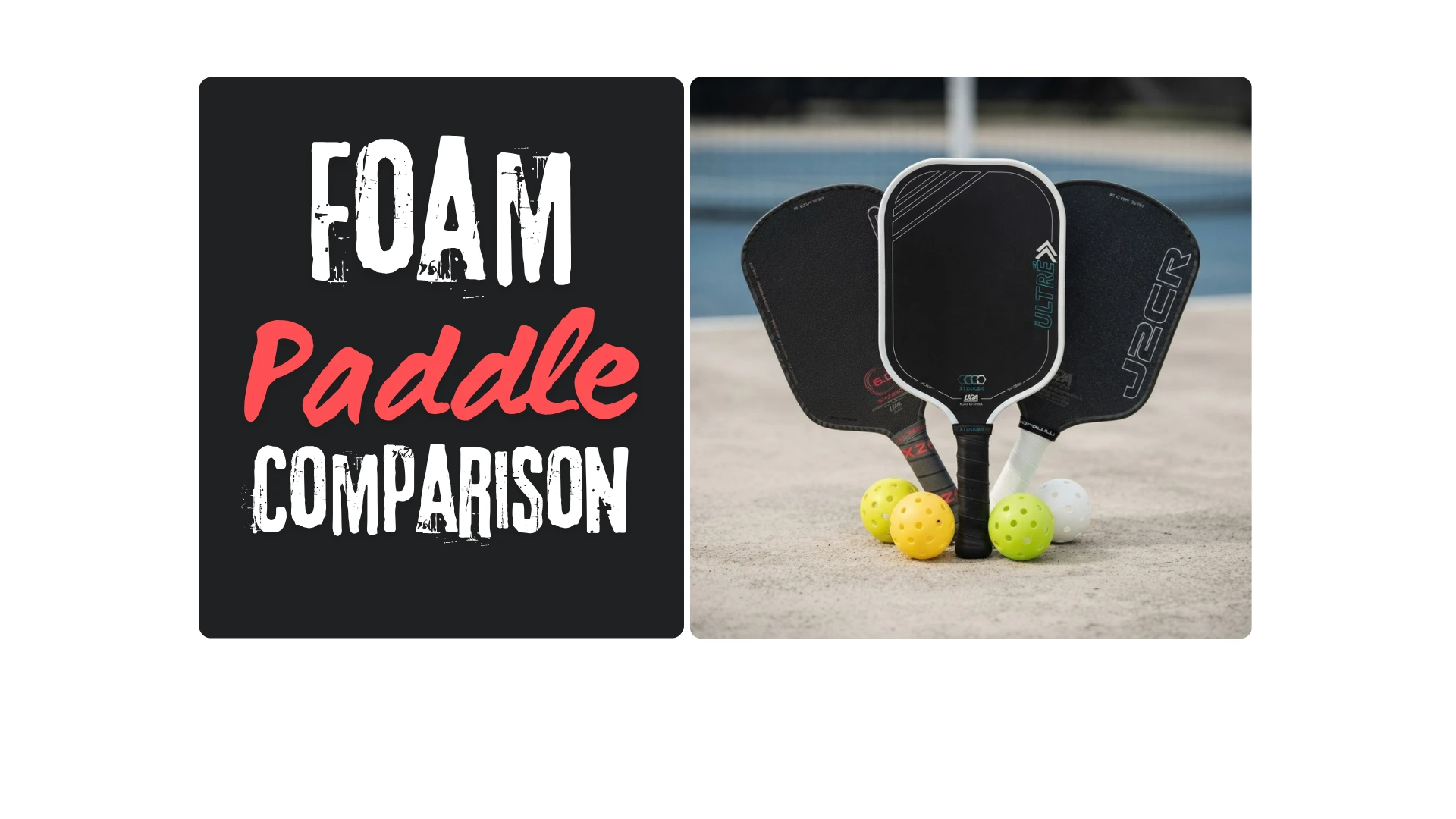
These three paddles look like close competitors because they all use modern foam-core construction, aggressive textured faces and hybrid shapes. They are not interchangeable.
The 11SIX24 Ultré Power 2 is the most aggressive all-around option here. It gives you the most immediate offense, strong pop and a high, familiar contact window for counters, drives and roll volleys.
The Honolulu J2CR Crystal Blue Grit is the better fit if your points are won with quick hands, blocks, resets and compact counters. It is lively, but its hybrid shape and CR construction make it easier to manage than a max-power foam paddle.
The Six Zero Coral Pro Hybrid is the easiest paddle here to trust across the entire court. It gives up some raw firepower to the Ultré and J2CR, but its soft, dense feel, stable face and useful spin make it the most balanced choice for many doubles players.
This comparison tests the hybrid-shaped Honolulu J2CR Crystal Blue Grit. The Crystal Blue Grit surface is also referred to as Crystal Blue Endurance.
My comparison combines Coach Sid’s PickleTip testing, previously published reviews and independent measurements. The paddles were not tested under identical laboratory conditions, so small numerical differences are context—not automatic verdicts.
The J2CR review includes a ten-hour field update. I tested the Ultré across prototype and production use, while the Coral Pro comparison covered 13.5 hours across drills, recreational games and competitive points. Those testing windows are not identical, so the durability conclusions remain provisional.
My simplest recommendation is this:
- Choose the Ultré Power 2 for the easiest offense and most immediate pop.
- Choose the J2CR Crystal Blue Grit for fast hands and compact countering.
- Choose the Coral Pro Hybrid for the softest, most forgiving all-court response.
What changes when the rally speeds up
The technology names are less useful than the response each paddle gives you when a point gets ugly.
The Ultré Power 2 and J2CR can create depth and pace without a full swing, which is useful in counters and hands battles. The cost is that they expect you to manage paddle angle and rebound when you are late.
The Coral Pro supplies its offense in a calmer way. Its spin and predictable acceleration let you swing aggressively without making every block feel like a launch experiment.
The three paddles at a glance
| Paddle | Shape | Core / thickness | Best fit | Main trade-off |
|---|---|---|---|---|
| 11SIX24 Ultré Power 2 | Flat-top hybrid | Gen 4 foam, 16 mm | Easy offense, drives and high contact | More reactive on short swings |
| Honolulu J2CR Crystal Blue Grit | Hybrid | Core Reactor, 16 mm | Compact counters, blocks and quick hands | Less baseline power; light units may need tuning |
| Six Zero Coral Pro Hybrid | Hybrid | Floating foam, 16 mm | Forgiveness, resets and controlled spin | Less firepower than the other two |
Individual paddle weight and balance vary, and a one-point difference in a laboratory measurement is not automatically something you will feel on court.
The independent measurements referenced in the linked reviews are useful context, but they should not override what a paddle does in your hands when you are late, stretched or trying to soften a hard ball.
11SIX24 Ultré Power 2: the most aggressive overall choice
My own testing of the production Ultré Power 2 changed my opinion from “interesting shape” to “this is the Power 2 shape that makes the most sense for me.” I tested the early prototype and then the production model, and the retail paddle felt lighter, quicker and more playable stock than some early prototype reports suggested.
The flat-top hybrid shape is the main reason I keep reaching for it. It gives me a more familiar elongated-hybrid contact window without making the paddle feel skinny or awkward at the kitchen. Counters, rolls and blocks often happen above the geometric center of the face, and the Ultré gives that area more usable room than the Vapor shape.
The paddle has controlled power rather than reckless explosiveness. When I catch the ball above center, the face feels stable and the ball leaves with organized pace. Lazy paddle angles can still produce a ball that climbs.
Compared with the J2CR, my Ultré feels more aggressive and more rigid. Independent measurements place the two close in serve speed and punch-volley performance, but the difference is more obvious in feel than in raw numbers: the Ultré rebounds faster and gives me more immediate offensive response.
The production paddle is playable immediately, although normal court time produces a short settling period. After a few sessions, the face softened slightly, the sound became deeper and resets felt more connected. I would not force a break-in with pressure, massage devices or other paddle rituals. Just play it.
The trade-off is the same one I identified in my full 11SIX24 Ultré Power 2 review: the flatter, squarer geometry gives me a better upper-middle contact window, but it does not provide as much rescue in the extreme top corners. It is also not the best choice if your priority is muted, control-first foam.
Choose the Ultré Power 2 if: you want high-level offense, strong pop, fast counters and a familiar hybrid shape that plays well stock.
Pass on it if: you want the softest response, maximum edge forgiveness or very little rebound on short swings.
Honolulu J2CR: quick hands without max-power chaos
The J2CR is the most nuanced paddle in this group. It has enough pop for hands battles without becoming a max-power launcher. After extended play, I came to see it as a quick hybrid that gives you easy offense while still allowing controlled blocks and resets.
The biggest difference between the J2CR and the Ultré is what happens when you shorten your swing. The J2CR gets the ball out quickly on a compact counter, but its response is more manageable and more pocketing-oriented. That makes it easier to reset at the kitchen even though it is not the softest paddle in Honolulu’s lineup.
My description of the J2CR is that it is what the NF feels like after it drank an espresso. It keeps the large sweet-spot identity that makes Honolulu foam paddles playable, but the face returns energy earlier and gives you more feedback. The paddle rewards quiet hands and disciplined angles. If you push a reset or leave the face open during a fast dink exchange, it can still send the ball long.
The J2CR is also the most tunable option here. Some samples come in light enough that a small amount of weight at 3 and 9 o’clock can increase stability and calm the face without destroying the hand-speed advantage.
This is the version I would choose over the Ultré if my biggest problem was not generating offense but controlling the first rebound in kitchen exchanges.
My full Honolulu J2CR review covers the Core Reactor construction, the ten-hour field update, the control trade-offs and tuning options in more detail.
Choose the J2CR if: you win points through fast hands, blocks, counters and resets, and want useful pop without max-power chaos.
Pass on it if: you want the biggest possible baseline power or a completely muted response.
If you prefer an elongated paddle, see my Honolulu J6CR review and J6CR vs J2CR comparison. The J6CR has the longer reach and leverage profile; it is not part of this three-paddle hybrid comparison.
Six Zero Coral Pro Hybrid: the most complete all-court fit
The Coral Pro Hybrid is the calmest and most forgiving choice in this group, but “calm” should not be confused with weak. I played the Hybrid, Widebody and Elongated versions across nine 90-minute sessions, roughly 13.5 hours total, using drills, recreational games and competitive points.
The Hybrid was my favorite shape. It gave me useful reach without charging as much for mishits as the Elongated, and it felt more balanced than the Widebody. The Widebody remains the better choice when forgiveness and quick defensive handling are the priority. The Elongated supplies the most reach but gives you a smaller margin near the edges.
What separates Coral Pro from the other paddles here is impact feel. The Ultré and J2CR land in a stiffer, more hollow-feeling area. Coral Pro feels softer and denser. The ball stays on the face long enough to shape drops and resets, while the DiamondGrit surface adds enough bite to make short rolls, dipping counters and topspin dinks more dangerous.
The added surface bite can make the first few soft shots move more than expected. Once I adjusted, that became an advantage rather than a problem. I could swing more aggressively and still bring the ball down because the spin did some of the control work.
Coral Pro does not produce the same raw firepower as the Ultré. It gives you offense that is easier to manage, especially when blocking, resetting or redirecting a hard ball under pressure. In my testing, the face remained aggressive and the spin did not noticeably fade during the test period. I still would not convert the manufacturer’s long-term durability claims into a six-month guarantee without more ownership time.
Approval is the main buying complication. When I checked on August 25, 2026, Coral Pro was listed by UPA-A but not by USA Pickleball. Players entering sanctioned events should check the current USA Pickleball approved-paddle database and the specific event rules before buying.
Read the full Six Zero Coral Pro review for the three-shape testing, surface discussion and comparison with the original Coral.
Choose the Coral Pro Hybrid if: you want a dependable doubles paddle with strong spin, predictable resets, useful offense and a soft, dense feel.
Pass on it if: you are chasing maximum firepower or require USA Pickleball approval.
Buy for the mistake you make most often
| If your common mistake is… | Start with… | Why |
|---|---|---|
| Not creating enough depth or pace | Ultré Power 2 | It supplies the easiest offense and most immediate rebound. |
| Overreacting on compact counters | J2CR | It gives you pop without demanding the same full-power commitment. |
| Losing control on blocks and resets | Coral Pro | Its softer, denser response absorbs more of the incoming pace. |
| Needing a wider usable contact area | Ultré Power 2 | The flat-top geometry gives the upper-middle face more useful room. |
| Wanting softer, denser feedback | Coral Pro | The ball stays on the face longer for drops and resets. |
Which paddle has the most power?
The Ultré Power 2 is the best answer if you want the most obvious offense without choosing a narrow, highly specialized shape. It supplies more pop and firepower than the Coral Pro and feels more immediately explosive than the J2CR.
The J2CR supplies easier short-stroke offense but is not the same kind of baseline power paddle. Coral Pro is the least powerful here, but it may be the most effective for a player who loses more points to poor control than to a lack of pace.
Which paddle has the best spin?
The J2CR and Ultré Power 2 are effectively tied for choosing purposes. Outside measurements put the J2CR slightly higher, while other testing puts the Ultré in the same elite range. That difference is not large enough to outweigh shape, feel or timing.
The Coral Pro measured slightly below the other two in the compiled data, but its surface still produced high-level, usable spin during my court testing. It is especially good at producing shape on short swings without becoming chaotic.
The number I would pay closer attention to is not the tiny spin difference between them. It is how long the surface keeps behaving like itself. My Coral Pro testing showed no noticeable spin decline during 13.5 hours, but that is not the same as proving a six-month durability claim.
Which is best for resets and soft play?
The Coral Pro Hybrid is the easiest recommendation for a player who wants soft-play confidence first. Its softer, denser feel absorbs pace and gives you time to shape the ball.
The J2CR is next if you want more hand speed and pop without giving up a manageable reset window. It asks you to hold your angle, but its response is easier to live with than a max-power build.
The Ultré can reset well, but it rewards cleaner face control and punishes lazy paddle angles more quickly.
Which is most forgiving?
For the hybrid versions, I would rank them this way:
- Coral Pro Hybrid for the most stable, dense and forgiving overall response.
- 11SIX24 Ultré Power 2 for its wider flat-top face and strong upper-middle contact zone.
- Honolulu J2CR for easy hand speed, although it is less forgiving of poor angles and loose resets.
Price and approval snapshot
These prices reflect the research and product checks used for this comparison. Discounts, availability and approval lists can change, so verify the current details before purchasing.
| Paddle | Listed price | Approval status |
|---|---|---|
| 11SIX24 Ultré Power 2 | About $199.99 with discount | UPA-A approved; not submitted to USA Pickleball |
| Honolulu J2CR Crystal Blue Grit | About $175.50 with discount | UPA-A; check event rules |
| Six Zero Coral Pro Hybrid | About $198 with discount | UPA-A; not USA Pickleball-listed when checked Aug. 25, 2026 |
The Honolulu paddle offers the strongest price argument. The Ultré makes the most sense if its shape and more aggressive response are worth paying extra for. Coral Pro is close to the Ultré in price, so its value comes from its more forgiving and balanced personality rather than a lower cost.
Which one I would actually buy
If I were choosing one paddle from this group for the broadest range of doubles situations, I would choose the Six Zero Coral Pro Hybrid. It does not win every laboratory category, but it gives me the fewest problems to manage. The face is stable, the soft game is predictable, and the surface supplies serious spin without turning every exchange into a power contest.
If I wanted more offense and a more reactive response, I would choose the 11SIX24 Ultré Power 2. It is the best match for the way I naturally like to counter, drive and attack with a hybrid shape.
If I wanted the quickest hands and the most compact countering platform, I would choose the Honolulu J2CR Crystal Blue Grit.
The winner depends on which mistake is costing you points when the rally speeds up. If you cannot create enough offense, start with the Ultré. If your first rebound gets away from you, look at the J2CR or Coral Pro. If you want the most forgiving all-court answer, Coral Pro is the safest place to begin.
The right paddle is not the one with the loudest launch story. It is the one that protects your real misses and supports the way you already win points.
FAQ
Not universally. The Ultré gives you more obvious power and pop, while the J2CR is faster and easier to manage in compact counters, blocks and resets. Choose the Ultré if you need more offense; choose the J2CR if you need more control over the first rebound.
The J2CR is Honolulu’s hybrid shape, while the J6CR is elongated. Crystal Blue Grit, also called Crystal Blue Endurance, is the shared version or surface. The J6CR gives you a different reach, leverage and timing profile, so see the dedicated J6CR versus J2CR comparison for that decision.
No. It is softer and denser than the Ultré and J2CR, but it still produces strong spin, useful pop and enough offense for competitive doubles. Its advantage is that it gives you more control over the offense you create.
The testing used for this comparison was encouraging, but it does not establish identical long-term durability for all three paddles. My Coral Pro testing showed no noticeable spin decline during 13.5 hours, while my early Ultré durability read remained encouraging but not definitive. Long-term ownership data is still more useful than a launch-week claim.
Do not assume so. Approval can change, and UPA-A approval is not the same thing as USA Pickleball approval. Check the current USA Pickleball approved-paddle database and the rules for your specific tournament or league before competing.
If you are still deciding whether foam-core construction is right for your game, start with my best foam-core pickleball paddles guide. This article assumes you have already narrowed your choice to these three hybrid models.
Disclosure: This comparison combines Coach Sid’s PickleTip testing and previously published reviews with independent measurements and player observations supplied for research. Affiliate relationships may exist for some links, but they do not determine the conclusions above. Prices, stock and approval status can change.