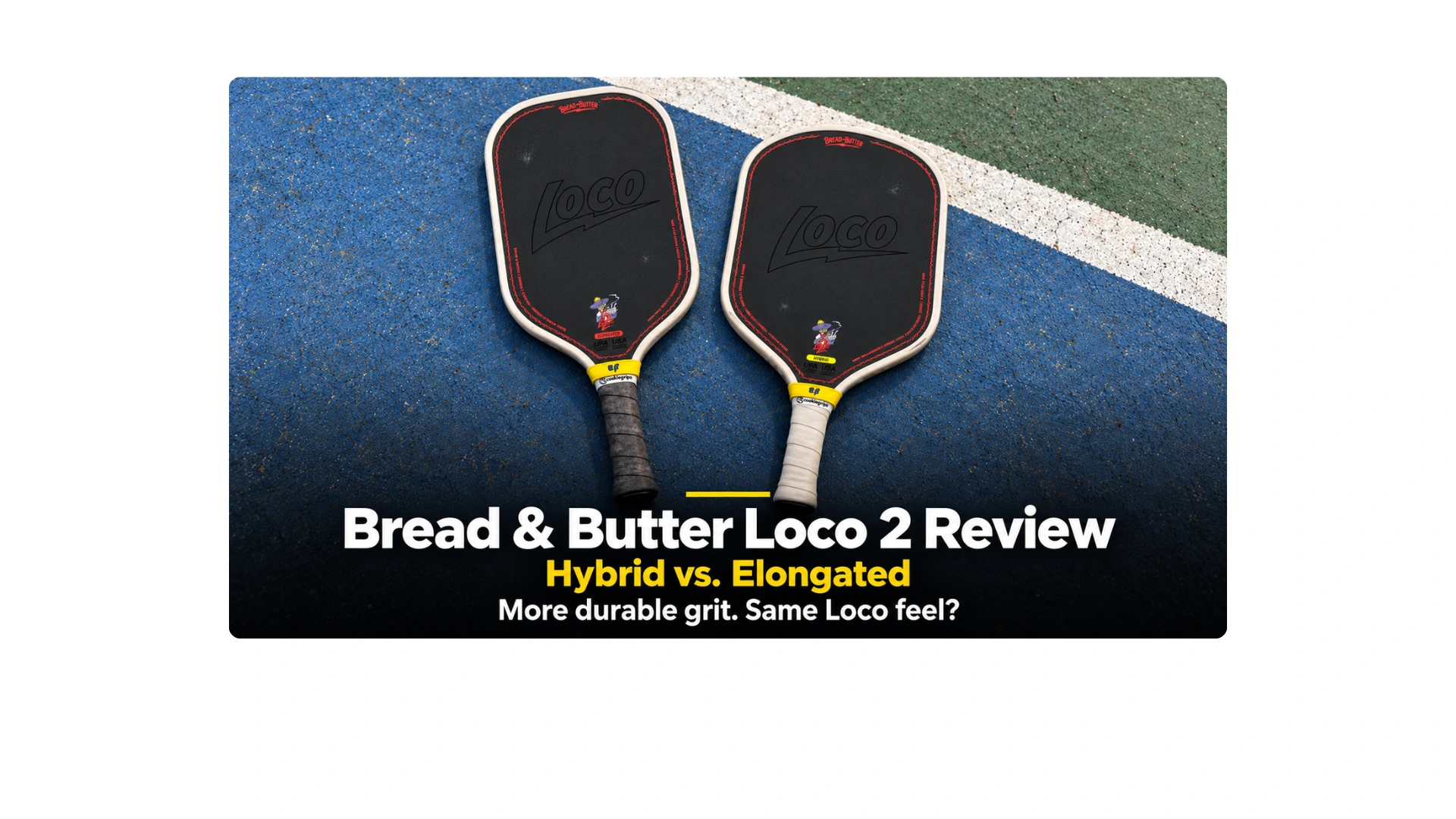
Bread & Butter Loco 2 Review: Hybrid vs. Elongated
The Bread & Butter Loco 2 felt like the same kind of paddle as the previous foam Loco: strong power, responsive pop, and touch I could use. Space Dust Grit is the main upgrade. I didn’t experience it as a substantially softer, control-first Loco.
I tested the Hybrid and Elongated for about 15 hours total, splitting the time roughly evenly. My choice was the Hybrid, by a little. It came around more easily in quick exchanges and gave me slightly more control. The Elongated offered more reach and a longer handle, but I needed to get it ready sooner.
Disclosure: Bread & Butter provided both paddles for testing and review. If you purchase using my affiliate code PickleTip, I may earn a commission. Both shapes are listed at $220; a 10% discount brings the paddle price to $198 before shipping and tax.
How I Tested Both Loco 2 Shapes
Those 15 hours were across drills, warmups, and recreational games. I swapped frequently so I could compare the paddles doing the same thing during the same session, rather than relying on my memory from another day.
Both paddles stayed stock apart from a Cookie Grips overgrip over each factory grip. I added no perimeter weight or counterweight. The handling and forgiveness observations below reflect that setup; I haven’t tested weight modifications.
Loco 2 Hybrid and Elongated Specifications
These are Bread & Butter’s published specifications for the Loco 2 Hybrid and Loco 2 Elongated. The weight ranges, swing weights, and twist weights are manufacturer figures, not measurements of my individual paddles.
| Specification | Loco 2 Hybrid | Loco 2 Elongated |
|---|---|---|
| Surface | Space Dust Grit | Space Dust Grit |
| Face | T700 raw carbon fiber | T700 raw carbon fiber |
| Additional face layer | Fiberglass | Fiberglass |
| Core | Dual-density EPP and EVA foam | Dual-density EPP and EVA foam |
| Thickness | 16mm | 16mm |
| Published weight range | 7.9–8.2 oz | 7.9–8.2 oz |
| Published swing weight | 111 | 118 |
| Published twist weight | 6.7 | 6.3 |
| Paddle length | 16.2 inches | 16.5 inches |
| Paddle width | 7.6 inches | 7.375 inches |
| Grip length | 5.3 inches | 5.5 inches |
| Grip circumference | 4.25 inches | 4.25 inches |
| Handle | Octagonal with vibration-dampening wrap | Octagonal with vibration-dampening wrap |
| Manufacturer-listed approvals | USAP and UPA | USAP and UPA |
| Paddle cover | Included | Included |
| Listed price | $220 | $220 |
| Price with 10% PickleTip discount | $198 | $198 |
The published static-weight range is the same, but the two shapes didn’t swing the same for me. The Hybrid was easier to bring around. The Elongated’s higher published swing weight fits the more substantial swing I felt.
Space Dust Grit: What I Noticed So Far
Space Dust Grit is B&B’s name for the upgraded face texture on both shapes. B&B describes it as an ultra-durable surface designed to retain spin. In my testing so far, I haven’t felt meaningful grit wear or noticed spin falling off.
I could shape the ball with both paddles while using their power. I didn’t notice a clear spin advantage from either shape. My preference for the Hybrid came from control and handling.
The bite is still there through this early testing. I haven’t measured RPM, a spin increase over the previous Loco, or a retention percentage. With about 15 hours total split between the shapes, I can’t establish a months-long surface lifespan. My pickleball grit durability guide explains what playing observations and controlled wear tests can each tell us.
Power and Pop
Both shapes gave me substantial pace on drives and serves. With room to swing, I could use that power from the baseline. On counters and speed-ups, the responsive face produced pace with a shorter motion. That difference is how I separate power from pop during play.
The Hybrid was easier to prepare in quick exchanges. With the Elongated, I appreciated the reach and more substantial swing when I had time to set up. I would choose the longer shape for those benefits, rather than assuming extra length would make every defensive contact easier.
Contact Feel and the Soft Game
Both shapes felt firm and responsive, with clear feedback at contact. They weren’t deeply plush or muted, but I didn’t find the response overly harsh. Foam construction alone doesn’t tell you how a paddle will feel.
I could play soft with both. A quiet paddle and relaxed grip worked better when I wanted to soften the ball; a short attacking motion brought the pop into play. I was adjusting my contact to the paddle’s response.
Drops and Dinks
Hybrid: I found pace and placement a little easier to manage on drops and dinks. The advantage was control over a lively response, rather than a deeply muted feel. I could play the soft shot, but I still had to keep the motion quiet instead of letting a little jab turn it into a faster ball.
Elongated: Drops and dink exchanges were still available, but I needed more attention to the face and the amount of motion. The extra reach helped me get to the ball. Once I got there, I still needed controlled contact; reaching the ball and softening it were separate jobs. Preparing the paddle early helped me keep that contact compact.
With either shape, the mistake was bringing an attacking motion into a touch shot. A jab or squeeze added pace when I wanted to soften the ball. That is the adjustment I would expect a player moving from a muted touch paddle to notice first. I slightly preferred the Hybrid for managing that response.
Resets, Blocks, and Counters
Hybrid: It gave me the easier defensive package: quicker preparation and a more forgiving response on imperfect contact. Getting it set sooner helped me choose a soft reset instead of rushing into a counter motion. A relaxed grip and quiet paddle worked for taking pace off; when I wanted to attack, the face gave me useful counter pace with a short motion.
Elongated: I could take pace off and reset with it, but preparation and contact demanded more attention. Its reach helped me get to the ball; when I was rushed, there was more paddle to bring around before I could soften the contact. I liked its attacking response when I was ready. I would not buy the extra length expecting it to fix late defensive preparation.
The short punch I liked on a counter could give me too much rebound on a soft reset. With either shape, I had to decide whether I was absorbing pace or adding it. The paddle’s pop helped the counter; that same pop made extra motion work against the reset. My guides to resetting in pickleball and blocking a hard drive explain the compact contact behind taking pace off.
Sweet Spot and Off-Center Contact
Hybrid: The extra forgiveness mattered most when an exchange became hurried. I preferred its easier preparation and response on imperfect contact. That is why I would start here if getting the paddle set and making clean contact are regular problems in your game.
Elongated: I noticed more sensitivity as contact moved away from the center. Clean contact gave me the response I wanted more consistently. For someone who frequently reaches and misses the center, that is a reason to consider the Hybrid first. Extra reach helps you get to a ball; it does not guarantee a forgiving contact once you get there.
The published twist weights are 6.7 for Hybrid and 6.3 for Elongated. They describe resistance to twisting, not the size of a usable sweet spot. I preferred the Hybrid on imperfect contact, but I haven’t mapped either sweet spot.
Handle Fit With an Overgrip
Both handles are octagonal and have a published 4.25-inch circumference. I used a Cookie Grips overgrip over the factory grip, so that published circumference is not the finished grip size I held.
The Elongated has a 5.5-inch grip, compared with 5.3 inches on the Hybrid. If you use two hands, that extra 0.2 inch is worth considering alongside your hand size and grip placement. My preference for the Hybrid doesn’t tell you which handle will fit your hands better.
Which Loco 2 Shape Fits Your Game?
I’d start with the Hybrid if quick preparation and off-center forgiveness are your priorities. I’d consider the Elongated first if you want more reach, more grip space, and a more substantial swing. Either can work in singles or doubles; start with the exchanges that give you trouble.
| Your priority | Shape to consider first | What informed my recommendation |
|---|---|---|
| Quick preparation in counters and hurried exchanges | Hybrid | It came around more easily during my swaps. |
| More forgiving imperfect contact | Hybrid | I preferred its off-center response; it also has the higher published twist weight. |
| More reach | Elongated | It is 0.3 inch longer. |
| More grip space for two hands | Elongated | Its grip is 0.2 inch longer. |
| Fuller swings with time to prepare | Elongated | I felt a more substantial swing; published swing weight is 118 versus 111. |
When preparation time shrank, I preferred the Hybrid. I appreciated the Elongated when I had time to prepare and use its reach.
Which Players May Struggle With Each Shape?
Hybrid: Players wanting a deeply muted touch paddle may still find it too responsive. Players who need generous room for a two-handed backhand should check the shorter grip.
Elongated: Players who prepare late in hands exchanges or frequently miss the center may find it more demanding. If easier pressured contact is your main goal, I’d start with the Hybrid.
Both shapes: If you habitually punch at drops, dinks, and resets, the lively face may make keeping the ball soft more difficult. That applies to beginners as well as experienced players. I’d choose by your contact habits and preferred feel rather than a fixed skill-rating cutoff.
Loco 2 vs. the Previous Foam Loco
Is this essentially the previous foam Loco with upgraded grit? That’s how its basic playing character felt to me. The power, responsive pop, and usable touch were familiar. I didn’t experience a move to a substantially softer, control-first paddle.
Bread & Butter describes the same preceding foam-core platform with an upgraded face. That fits my playing impression. My previous Bread & Butter Loco review covers the earlier paddle’s character and shape tradeoffs.
Compare Hybrid with Hybrid and Elongated with Elongated when weighing an upgrade. Switching shapes changes reach, grip space, and handling as well as the surface. The 111-versus-118 swing-weight figures in this review compare the two Loco 2 shapes; they are not a measured change from the previous generation.
If your foam Loco still plays well and its bite remains useful, I wouldn’t replace it just because a successor exists. I’d consider Loco 2 for the upgraded surface, especially if my current Loco’s bite had faded. The previous foam lineup already included an Elongated; this release updates that shape rather than introducing it.
Price and Launch Availability
Both shapes are listed at $220. Use PickleTip for 10% off, bringing the paddle price to $198 before shipping and tax. You can use the PickleTip discount link for the Loco 2 collection.
As of October 4, 2026, the official collection lists the Elongated as sold out with an expected preorder shipping window beginning the week of October 26. The Hybrid is listed as Coming Soon and unavailable. Check the official Loco 2 collection for current ordering and shipping status.
A paddle cover is included. B&B also advertises a limited-edition box and Chamoy Peach Rings for the first 1,000 orders. The extras are a bonus; I’d choose by the paddle’s response and shape.
Warranty and Return Eligibility
B&B’s official warranty and returns policy lists a one-year warranty against manufacturing and material defects for qualifying U.S. website purchases, beginning at delivery. Normal wear is excluded, and international coverage and other conditions differ.
Confirm return eligibility before buying for an on-court trial. As of October 4, 2026, both Loco 2 product pages display a sale-item notice excluding 30-day returns alongside the general return language. Do not assume the general trial policy applies to your order.
For eligible U.S. website orders, the general policy gives 30 days from delivery, with the customer paying return shipping and original shipping charges remaining non-refundable. It permits overgrips over the factory grip, lead tape, and edge guard tape. Removing the factory grip or modifying the handle or butt cap can void return eligibility. Warranty conditions are separate; check them before modifying a paddle.
My Verdict: Which Loco 2 Would I Choose?
My choice is the Hybrid, by a small margin. It was easier to prepare in quick exchanges and gave me slightly more control. I’d consider the Elongated first if extra reach and a longer handle mattered more to my game.
Both make sense for players who want an offensive foam paddle and can manage a responsive face when taking pace off. The paddle can help you attack, but it won’t make a large, tense reset motion disappear.
For an existing foam Loco owner, I’d make the upgrade decision around the condition of the paddle you already have and whether you want the new surface. For someone choosing a shape now, I’d start with preparation, contact, and handle fit.
Frequently Asked Questions
Yes. Both the Hybrid and Elongated feature Space Dust Grit on a T700 raw carbon fiber face.
That is how its basic playing character felt to me: familiar power, responsive pop, and usable touch. B&B describes the same foam-core platform with Space Dust Grit as the main upgrade. Compare matching shapes, because shared construction does not mean identical handling specifications.
I haven’t felt meaningful grit wear or noticed spin loss during about 15 hours total testing, split roughly evenly between the shapes. I haven’t measured RPM or established long-term durability.
As of October 4, 2026, B&B’s official Loco 2 collection lists Hybrid and Elongated. A Standard model is not currently listed.
Both have a published static-weight range of 7.9–8.2 ounces. Their published swing weights differ: 111 for Hybrid and 118 for Elongated. The Hybrid was easier to bring around for me.
I would choose by contact habits rather than a rating cutoff. A beginner who struggles to soften drops and resets may find the lively response demanding. The Hybrid was easier for me to prepare and more forgiving than the Elongated, but both remain offensive paddles.
B&B lists both shapes as USAP and UPA approved. That is manufacturer-listed status. Before competing, check the exact model and version through the approval resources in my USA Pickleball approved paddle guide or UPA-A certified paddle guide, according to your event’s requirements.
Confirm your exact order’s eligibility with B&B first. As of October 4, 2026, both product pages display a sale-item return exclusion alongside the general 30-day policy. I would not assume this purchase qualifies for an on-court trial.
The listed price is $220. With the 10% PickleTip discount, the paddle price is $198 before shipping and tax.