Holbrook Fuze VantaGrit Review: 16mm Elongated vs. Hybrid
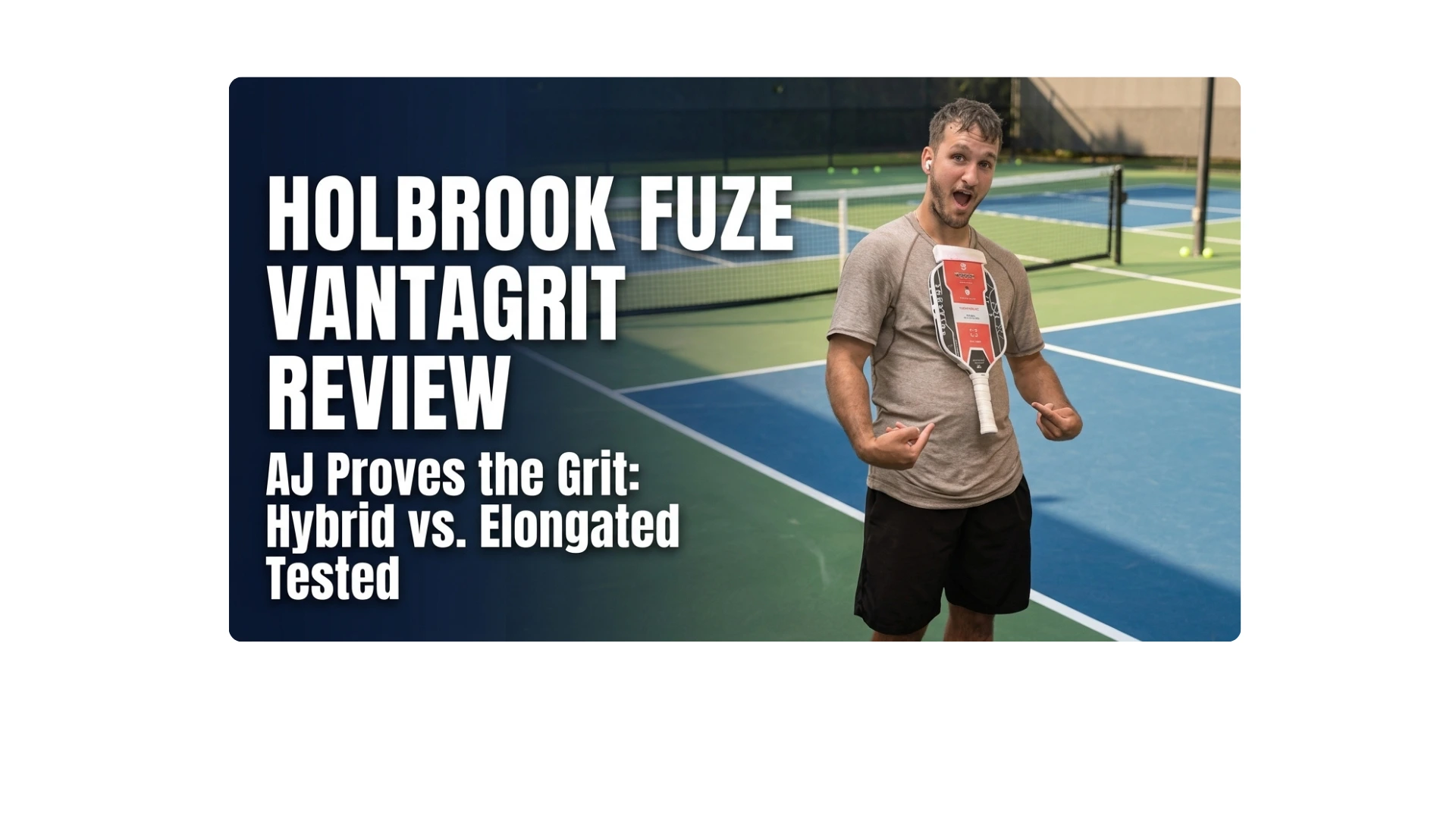
The Holbrook Fuze VantaGrit pairs the Fuze’s foam construction with a noticeably textured face. After roughly 20 hours with each 16mm version, the clearest difference between the Elongated and Hybrid was how they moved in hand: the Hybrid felt quicker through exchanges at the kitchen, while the Elongated offered more reach and a familiar longer shape.
What really defines the VantaGrit is how it pairs aggressive surface bite with a remarkably calm, controllable response. Players in our private groups repeatedly described a grittier, more spin-friendly feel than the original Fuze, paired with a soft, composed touch on dinks, drops, and resets. Power was less consistent from player to player: some found plenty of offense, while others wanted to swing harder to produce pace. If you’re looking for a paddle that hands you free, effortless power on a lazy swing, look elsewhere. But if you want to dictate points with heavy spin and dialed-in control, it’s a completely different story.
AJ and I tested both shapes side by side. I usually play the 11SIX24 Jelly Bean 2 Pegasus and prefer control-oriented paddles. AJ plays at a higher level, normally uses the RPM Q2 Elongated, and is comfortable with more power. We each played both versions, so the notes below reflect two distinct playing styles rather than one person’s preference alone.
Disclosure: I purchased both paddles with my own money at a discount. The discount did not influence my review. If you buy through my Holbrook affiliate link, You will save money and I may earn a commission. Use code PICKLETIP.
| Core Thickness | 16mm Foam Core |
|---|---|
| Face Surface | Textured VantaGrit Face |
| Available Shapes | Hybrid vs. Elongated |
| Testing Baseline | Stock with Vyce Overgrips |
Coach Sid’s Take: The Holbrook Fuze VantaGrit isn’t a magic paddle. It’s a spin-heavy, foam-core control paddle that rewards players who create their own pace. Choose the Hybrid if you want fast hands at the kitchen; grab the Elongated if you live on reach and drives.
How AJ and I tested the Fuze VantaGrit
We played outdoors in New Orleans in weather around 85°F with a slight wind, using the Franklin X-44 ball. We drilled at Adventure Quest and played open play at Mike Miley. Both paddles were stock except for Vyce overgrips.
We used the two paddles during the same sessions. AJ and I started with one version each, then swapped halfway through drilling and open play. After roughly 20 hours on each paddle, both of us had substantial time with the Elongated and the Hybrid under identical court conditions.
What players on the court actually noticed
When other players got their hands on them during open play, a few clear themes popped up right away:
- Spin: Noticeably higher bite than the original Fuze on topspin drives and late-dipping dinks.
- Soft Game: Controlled, predictable dampening on dinks, blocks, and resets.
- Power: Requires active acceleration; not a free-power weapon for lazy swings.
There was no strong consensus that one shape was universally better for power, control, dinking, or resetting. The clearer shape distinction was handling: players more often called the Hybrid quicker in hand battles, while the Elongated’s advantage was reach. A few players found the Elongated head-heavy or slightly slower at the kitchen. Those are useful tendencies, not absolute guarantees for every player.
What the VantaGrit Actually Does on Court
The VantaGrit’s textured surface gives the ball visibly more shape than a smooth or less aggressive face. The most common reports were that topspin drives dipped more sharply, rolls and dinks carried extra bite, and serves sometimes required a small adjustment because the added spin altered their flight path. Spin was a far more dependable point of praise than raw power.
My control-oriented Jelly Bean 2 Pegasus is a calmer reference point, so the VantaGrit’s added offensive options stood out more to me than they would to AJ. AJ’s RPM Q2 Elongated gives him a more power-oriented baseline; from that comparison, the VantaGrit’s appeal is clearly its spin and control, while its pace is less automatic. The Elongated gives more reach and leverage for drives and serves, while the Hybrid is easier to whip around in fast exchanges. Neither shape claims a reliable group-wide advantage in raw power.
The soft game: Dinks, drops, and panic resets
The soft game is where the VantaGrit’s controlled foam response shines most consistently. Players repeatedly described a settled feel on dinks and drops, with useful dwell time and predictable placement. Resets and blocks were also widely praised for staying manageable when absorbing heavy pace.
The Soft Game Verdict: The foam construction shines brightest when absorbing heavy pace. Panic resets stay low and predictable in the kitchen rather than popping up for an easy put-away.
That profile suits a player who wants to attack without giving up confidence on the next soft shot. For me, coming from a control-leaning paddle, the benefit is having a little more offense available while retaining a composed response. For AJ, who is used to a firmer, more power-oriented setup, the VantaGrit delivers a calmer touch game and added spin without making the paddle feel dead on aggressive attacks.
The group feedback did not establish a soft-game winner between the two 16mm shapes. Most differences came down to movement and reach rather than a distinct Hybrid advantage in dinking. The Hybrid’s quickness helps you get into position for a counter, while the Elongated makes reaching stretched balls easier. Contact point, footwork, and player preference still matter far more than the shape label on the edge guard.
Handling and hand speed: Hybrid vs. Elongated
The Hybrid is the easier choice if hand speed is your top priority. Other reviewers and local players found it noticeably quicker through kitchen exchanges, and several elongated-paddle loyalists actually preferred the Hybrid after trying both. Its shorter profile makes it much easier to reposition when a point turns into a firefight.
The Elongated gives up some of that compact hand speed in exchange for reach. It helps on wide balls, serves, and groundstrokes, feeling instantly familiar to players who already lean toward longer shapes. The tradeoff is that some testers found it a bit slower or head-heavy during rapid hand battles. Other players adapted easily, so it isn’t a universal drawback.
Our experience highlights this split: AJ’s usual RPM Q2 is elongated, while my usual Jelly Bean 2 Pegasus is control-focused. If you value reach and time your swings with a longer lever, the Elongated is your starting point. If you live for fast hands at the kitchen line, grab the Hybrid.
The transition period: What to expect on day one
Adjustment reports across our group ranged from feeling comfortable right out of the wrapper to needing a solid session or two. The VantaGrit’s soft, predictable response helped players settle in quickly, but the aggressive surface bite changed the flight path on familiar shots. A few players had to fine-tune their serves or drop shot trajectory because their normal swing generated unexpected spin and depth.
Give yourself a short transition period, especially on serves and topspin drives. Because the Elongated and Hybrid share the exact same core VantaGrit DNA, most adjustments come down to paddle geometry: players switching from standard shapes to the Elongated will need to account for the extended contact window.
The Grit Question: How Long Does the Texture Last?
The biggest open question with the VantaGrit is long-term durability. I’ve talked to quite a few players that tested these paddles. Some players reported that the center sweet spot felt noticeably smoother after only a few hours of hard play. Others noted that the grit remained aggressively textured past 20 hours, with testing showing the center holding up just as well as the edges. Right now, individual reports point both ways.
Holbrook paused the initial release for additional quality checks and later stated internal testing proved the VantaGrit outlasted the original Fuze face. That is the manufacturer’s data, not independent multi-month proof across hundreds of players. Our roughly 20 hours per paddle gives us a solid early-play sample, but long-term wear remains an open question. For now, keep a damp cloth on hand for cleaning and skip abrasive surface erasers.
Which Fuze VantaGrit shape should you choose?
| If you value… | Start with… | Why |
|---|---|---|
| Faster hands and quicker repositioning | 16mm Hybrid | The most repeated shape-specific advantage in player feedback was quickness in kitchen exchanges. |
| More reach and a longer contact window | 16mm Elongated | Its longer profile can help on wide balls, serves, and groundstrokes. |
| A clear power, control, or reset winner | Neither by default | Group feedback did not establish a consistent winner in those categories; the feel and handling tradeoff matters more. |
| Added spin with a controlled response | Either shape | Spin and soft-game control were strengths reported across the VantaGrit line. |
For a control-first player, the Hybrid is the safer starting point if quickness matters most. For a player who already loves an elongated paddle and leverages extra reach, the Elongated is the natural fit. AJ’s preference for the Elongated and my leaning toward the Hybrid follow those exact priorities: his game maximizes reach, while I prioritize maneuverability and control.
Pros and tradeoffs
What stands out
- Noticeably grippy surface with exceptional spin potential
- Soft, controlled response on dinks, drops, resets, and blocks
- Spin and control make aggressive drives feel remarkably manageable
- Two distinct shapes let you choose between hand speed and reach
What to weigh
- Power requires active acceleration rather than feeling effortless
- The Elongated can feel slightly head-heavy or slower during rapid kitchen exchanges
- The Hybrid sacrifices some reach compared to the Elongated
- Long-term grit retention is still debated, with conflicting early reports
Final verdict
The Holbrook Fuze VantaGrit’s greatest assets are its heavy spin and composed, soft-game feel. It isn’t a brute-force power cannon that wins points on raw pop alone. Instead, it’s a spin-forward control paddle that gives players supreme confidence in touch battles while offering plenty of offense when you step into your swing.
Coach Sid’s Bottom Line: The Holbrook Fuze VantaGrit isn’t a free-power cheat code. It’s a spin-forward, foam-core control paddle that rewards players who create their own pace. Choose the Hybrid for fast hands at the kitchen, or the Elongated if you live on reach and drives.
When choosing between the two 16mm models, let how you move dictate your choice. The Hybrid suits quick hands and lightning-fast kitchen firefights. The Elongated is built for reach and players accustomed to a longer stick. Our own testing mirrored that exact divide: I preferred the nimble Hybrid, while AJ gravitated toward the reach of the Elongated.
The main caveat is surface longevity. Because player experiences span both early wear and solid 20+ hour grit retention, neither our testing nor Holbrook’s internal data provides the final word on multi-month wear. If you prioritize spin, touch, and calm control over effortless power, the VantaGrit is well worth testing. If guaranteed long-term grit life or free power is your primary requirement, keep those tradeoffs in mind.
Where to buy the Holbrook Fuze VantaGrit
Shop through my Holbrook affiliate link and use code PICKLETIP. I may earn a commission if you purchase through the link. I bought both paddles myself at a discount, which did not influence my review.