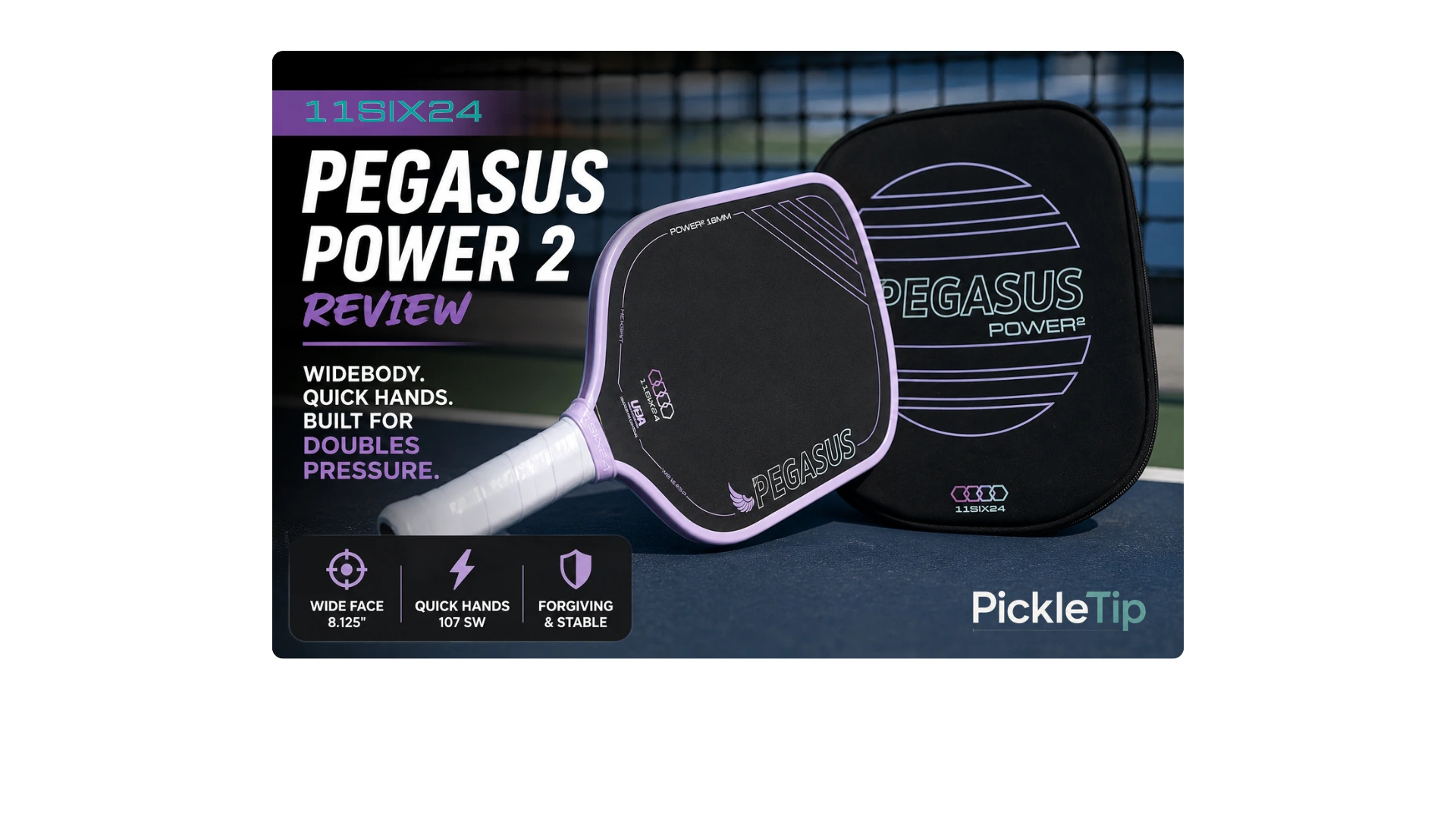
11SIX24 Pegasus Power 2 Review: Best Widebody for Doubles?
The 11SIX24 Pegasus Power 2 is the widebody Power 2 shape I trusted most when doubles got rushed, crowded, or ugly. Not when I had time to tee off. When I was late, handcuffed, blocking from my ribs, or just trying to keep one more ball low enough, it gave me a bigger margin for average contact without making the paddle feel slow.
Updated: July 5, 2026
Tested by: Coach Sid
Play time: About 12 hours
Best fit: Doubles players who like widebody paddles
Discount note
11SIX24 discount code: use PICKLETIP for $10 off at 11SIX24. If I were ordering the Pegasus Power 2 today, I would use it before paying full price.
16mm
Widebody Power 2 build
8.125″
Wide face for messy contact
107-ish
Very low swing weight range
Trying to decide between the Vapor, Ultre, Hurache-X, and Pegasus? Read my complete Power 2 Shape Comparison.
Quick answer
The 11SIX24 Pegasus Power 2 is the Power 2 shape I’d hand to a doubles player who wants the safest contact window. Its widebody face, quick hands, and lively pop make it easier to manage messy kitchen exchanges without feeling stuck with a slow paddle. It is not the best fit for players chasing maximum reach or heavy baseline power, and the pop takes soft hands on resets and dinks.
Best use
Doubles points where you have to block first, reload fast, and stop a rushed ball from turning into a free point for the other team.
Not ideal for
Players who want maximum reach, heavy baseline drive weight, a long attacking profile, or a soft muted feel from the first session.
The Pegasus is the widebody shape in the 11SIX24 Power 2 lineup, so I’m looking at it that way: same family, different shape, different feel in the hand. I’ve also played the other Power 2 shapes, but the full shape-by-shape comparison needs its own breakdown. For this review, I’m focused on what the Pegasus shape changes during real doubles points, where the extra width helps, and where its poppier widebody feel may take a little adjustment.
Most of my Pegasus testing came through doubles games, drilling, kitchen exchanges, resets, counters, and normal open-play situations. When testing this paddle on a humid day at the Miley courts, the Pegasus did not make me hit dramatically better shots. It simply erased enough of my average mistakes that I stayed in more rallies. With a widebody, that is the test for me.
Coach Sid testing snapshot
After about 8 hours, the biggest change was predictability. Early on, the face could jump on touch shots if my grip got firm. Once it settled, its value showed up in doubles when I needed a wider face, fast recovery, and enough pop to counter without taking a full swing. I could block hard drives, absorb pace, and reset from awkward contact with fewer surprise popups.
Testing note: I tested the Pegasus mostly in doubles, open play, drilling, kitchen exchanges, resets, and counter battles. I did not treat this as a singles power test, and I would not judge this paddle mainly by baseline drives.
🎧 Prefer listening? Hear a summary of Coach AJ’s take on the Pegasus Power 2 shape:
How the Pegasus Power 2 fits the lineup
The Pegasus is the widebody shape in the 11SIX24 Power 2 lineup. If you are comparing Power 2 paddles, that shape choice matters more than the marketing name. Compared with the Hurache-X, I felt like I had to think less with the Pegasus in crowded doubles points. The Hurache-X gives you more reach and a longer attacking shape. The Pegasus gives you the safer contact window.
| Power 2 shape | Best reason to start there |
|---|---|
| Pegasus Power 2 | Most forgiving widebody feel |
| Hurache-X Power 2 | More reach and a longer attacking shape |
| Vapor Power 2 | Hybrid shape balance instead of true widebody |
| Ultre Power 2 | Hybrid option for players who do not want the Pegasus shape |
| Dedicated Power 2 comparison | The full shape-by-shape answer once testing is complete |
I would not treat this as the final Power 2 ranking. Shape preference matters too much for that. If you are shopping for the widebody Power 2 feel, this is the one I would start with.
My first few games with it
The first thing I noticed with the Pegasus Power 2 was how easy it was to get the paddle behind the ball. Widebody paddles are supposed to feel forgiving, but this one also stayed quick. It did not feel like I was dragging a kitchen cutting board through a hands battle.
The Pegasus started making sense on the ugly stuff: body blocks, crowded counters, rushed resets, and balls I caught just enough face on to keep low. I am normally not a widebody guy, but this paddle gave me more confidence when doubles points got crowded.
The surprise was not that the Pegasus was forgiving. A widebody paddle should be forgiving. The surprise was how much that forgiveness affected my choices. With narrower paddles, I sometimes feel pressure to force a counter because a defensive block has less margin if I am late. With the Pegasus, I was more willing to block, reset, and extend the point because I trusted the paddle to keep the ball playable.
That showed up across the net too. A few rallies that normally would have ended after a body speedup stayed alive long enough to force one more exchange. My opponents were not commenting on the paddle. They were simply surprised that the ball kept coming back low.
The face is still lively, so this is not a dead, soft, sleepy control paddle. That pop helps on punch volleys and quick redirects, but it also means your hands have to stay honest on resets and dinks.
What surprised me most
The Pegasus did not just forgive mishits. It made the higher-percentage play feel safer. That is not something you see on a specification sheet, but over several hours of doubles it became one of the biggest differences I noticed. The paddle did not create chaos. It just helped me survive more of it.
The player I’d hand this to first
I would hand the Pegasus Power 2 to a doubles player who loses more points from rushed counters, defensive popups, and body-ball panic than from a lack of baseline power. If most of your trouble starts at the kitchen instead of the baseline, this shape makes sense.
It also makes sense for someone who already likes widebody paddles but wants a more modern foam-core response instead of a soft, muted control feel. The Pegasus keeps the contact window friendly while still giving you enough face speed to counter and redirect pace.
If your doubles game looks like this
- You get sped up into your body more than you like.
- You block first and need time to reload for the next ball.
- You like widebody forgiveness but hate feeling slow in hand battles.
- You want a paddle that helps your average contact, not just your best swing.
Buy it if
- You already like widebody paddles.
- You want a bigger sweet spot without giving up hand speed.
- You value stability in fast doubles exchanges.
- You want pop, spin, and forgiveness in the same paddle.
- You need more help keeping rushed contact low and playable.
Skip it if
- You dislike widebody paddles.
- You want maximum reach from your paddle.
- You want a soft, muted feel from the first game.
- You struggle with poppy paddles around the kitchen.
- You prefer a narrow, whippy attacking shape.
Don’t buy it if
Do not buy the Pegasus Power 2 expecting it to turn into an elongated power paddle. If your game is built around reach, heavy baseline drives, or a long attacking profile, this shape may feel like it helps your defense more than your offense. That is not a flaw. You are paying for forgiveness with a little reach.
There is one type of player I would actually caution against buying the Pegasus.
If your game depends on reaching into the kitchen with an elongated paddle to attack balls just outside your body, you’ll immediately notice the missing reach.
The Pegasus wins those exchanges differently.
Instead of stealing balls with extra length, it wins by making average contact more reliable.
Is the Pegasus Power 2 easy to control?
The Pegasus Power 2 is easy to control, but not because it feels dead or muted. Most paddle reviews talk about sweet spots. I kept noticing something different: the Pegasus shape has a big “good enough” spot. Slightly late or slightly jammed contact still came off well enough to keep the rally alive.
The adjustment is touch. Right out of the wrapper, the face can jump if you squeeze too hard around the kitchen. I had to soften my hands sooner than expected, and around the 8 to 10 hour mark the response felt more predictable on resets, dinks, blocks, and touch shots.
Compared with traditional control paddles, the Pegasus asks for softer hands because of its livelier face.
Compared with elongated power paddles, it gives up some leverage but rewards you with a larger margin when contact isn’t perfect.
Compared with many older widebody paddles, it feels significantly quicker during hand battles.
That combination is what gives the Pegasus its own identity instead of simply being “another forgiving paddle.”
Pegasus Power 2 specs that actually matter
On court, one spec combination explained almost everything I was feeling: short enough to stay quick, wide enough to give you more usable face, and lively enough that you still have to manage your hands around the kitchen.

| Paddle | 11SIX24 Pegasus Power 2 16mm |
|---|---|
| Shape | Widebody |
| Length | 15.875 inches |
| Width | 8.125 inches |
| Handle length | 5.75 inches |
| Best shots in testing | Blocks, counters, resets, punch volleys, quick hands exchanges |
| Hardest adjustment | Managing pop on soft shots |
| Best player fit | Widebody doubles players who want forgiveness, stability, and speed |
The short, wide shape explains most of the on-court feel: easier off-center contact, quicker hands than expected, and a lively foam-core response that still needs soft hands around the kitchen.
| Length | 15.875 inches |
|---|---|
| Width | 8.125 inches |
| Thickness | 16mm |
| Handle length | 5.75 inches |
| Handle circumference | 4.125 inches |
| Surface | Carbon fiber with Hex Grit |
| Core | MPP foam / Gen 4 floating foam core |
| Construction | Thermoformed |
| Approval note | UPA-A Approved; verify current approval before sanctioned events |
Manufacturer specifications: At the time of this review, 11SIX24 lists the Pegasus Power 2 as UPA-A Approved with a HexGrit surface (patent pending), a 15.8-inch length, 8.12-inch width, 5.75-inch grip length, 4.125-inch grip circumference, 8.0–8.3 oz weight range, 105–110 swing weight, 7–7.25 twist weight, 30-day returns, and a 12-month warranty. The company also reports laboratory testing of 2,335 RPM spin and 98% grit retention after 100+ hours. My on-court review focuses on how those specifications translated into actual play rather than verifying the manufacturer’s laboratory measurements.
Spec note: Paddle specs and approval listings can change, so I would still verify current dimensions and event approval before using the Pegasus Power 2 in a sanctioned tournament.
Jump to the Review
Where the Pegasus actually saved points
The best Pegasus moments came on balls I normally do not grade as highlight shots: body speedups, half-late counters, low defensive blocks, and resets made from a crowded stance. It mostly turned those situations into a playable next ball. That matters in doubles. A low block that lets your partner recover is often more valuable than a flashy counter attempt that misses by two feet.
The moment that sold me was a body speedup at the kitchen where I was late, jammed, and basically blocking from my ribs. With a narrower paddle, that ball probably floats. With the Pegasus, I caught enough face to keep it low and get back into the point. That is where the wider face felt less like a spec and more like the reason this shape exists.
The mistakes the Pegasus could not erase
The Pegasus covered up more mistakes than most widebody paddles I’ve tested, but it did not fix bad pickleball.
- If I reached with my arm instead of moving my feet, the wider face did not magically rescue the shot.
- If I opened the paddle face too much on a reset, the extra forgiveness simply produced a higher popup.
- If I was completely late on a speedup, the point was still over.
What changed was the number of rallies where I was almost in position. Those are the shots where this paddle quietly earned points over the course of a match.
The second-ball recovery was the surprise
In doubles, paddles get exposed after the first block. A paddle can have great power on a clean swing and still feel useless when a firefight starts. The Pegasus felt quick enough to reload and stable enough to survive contact away from the center.
In quick kitchen exchanges, I noticed I could block first and still have enough time to get the paddle back for the next ball. That second-ball recovery is where this shape started to make sense to me.
Resets were better after it settled down
I was curious about resets with the Pegasus because the Power 2 line has a lively face. Early on, I had to respect the pop. Closer to the 8 to 10 hour mark, the paddle softened up and touch shots felt more comfortable, less jumpy, and easier to read.
The paddle did not turn into a pillow after break-in, and I would not describe it as muted. The ball still came off lively, but the response felt more predictable on blocks, drops, and resets.
It has pop more than raw power
The Pegasus Power 2 gave me more quick pop than heavy drive weight. Punch volleys came off fast, counters had easy speed, and I could redirect pace without taking a giant swing. From the baseline, though, I did not feel the same heavy leverage I would expect from a longer attacking shape.
That is useful in doubles, especially when you are countering from a compact position. The downside shows up on soft shots. If your grip pressure gets too firm, the ball can jump higher than you planned.
The grit still lets you shape the ball
The Hex Grit face is still doing real work here. The Pegasus gives you the forgiving widebody shape without giving up the spin-friendly surface. Serves, rolls, and shaped counters all had enough bite to keep the paddle fun.
I did not feel like the Pegasus needed spin to survive every shot, though. That is part of why I liked it. The paddle gives you forgiveness even when the swing is simpler, but the grit is there when you want to shape the ball.
Serves, rolls, and finishing balls
On serves, the Pegasus gave me enough spin and pace to stay aggressive, but I did not think of it as a serve-dominant paddle. The widebody shape made placement feel comfortable, while the Hex Grit face gave me enough bite to roll the ball and keep it from floating.
On overheads and putaways, it had enough pop to finish normal doubles points. I would not buy it only for maximum overhead power, but when the ball was sitting up, the Pegasus had no problem ending the point if my footwork did its job.
My weight setup thoughts
I would be careful with weight on the Pegasus Power 2. You can add tape if you want more punch or a slightly more planted feel, but I would not rush to change the stock setup.
If I were tuning it, I would start small. Bottom-corner or lower-side weight makes sense if you want to shore up stability without turning the paddle into something sluggish. I would not immediately load the top unless I specifically wanted more drive weight and was willing to give up some hand speed.
I would not fix what is not broken just because lead tape is sitting in your bag looking lonely.
| Setup idea | What I would expect | Best for |
|---|---|---|
| Stock | Quick, lively, easy to maneuver | Players who want the stock feel first |
| Small amount at lower corners | More planted without killing hand speed | Players who block and reset often |
| Weight higher on the head | More drive weight but slower hands | Players chasing extra power |
The feel: lively, firm, not cheap-harsh
The Pegasus Power 2 has that Power 2 foam-core feel: lively, firm, and poppy, but not harsh in a cheap way. It feels more like a modern foam paddle than a soft traditional control paddle.
The larger contact window makes the lively face easier to manage. You still feel the ball jump, but mishits are not as punishing as they would be on a narrower profile.
The handle length is listed at 5.75 inches. That should be enough for many players, but if your two-handed backhand needs extra room, pay attention to the handle feel before buying. Shape and handle preference matter more than people admit.
Pros and cons after testing
Here is the cleaner version after testing. The Pegasus has a clear lane, but it is not trying to be every paddle at once.
Pros
- Big usable face.
- Quick reloads in hand battles.
- Strong counter stability.
- Useful speed on punch volleys and redirects.
- Spin-friendly Hex Grit surface.
- More predictable after break-in.
Cons
- Less reach than elongated shapes.
- Not the highest raw power ceiling.
- Touch takes adjustment early.
- Not ideal if you dislike wider paddle shapes.
- Handle length may matter for two-handed backhands.
What changed in my actual results?
The biggest improvement was not my winners, my serve, or my speedups. It was the number of rallies that continued after I thought I had hit an average or slightly late shot.
Over several sessions, I realized I was staying neutral in more points instead of immediately becoming defensive after imperfect contact. That does not make for exciting highlight videos, but it does win doubles matches.
Looking back through my testing notes, that was the recurring theme. The Pegasus rarely produced the best shot of the day. It consistently prevented some of the worst ones.
For the right player, that is a far more valuable characteristic than five percent more power.
Pegasus Power 2 FAQ
11SIX24 discount code note: For readers checking current 11SIX24 pricing, code PICKLETIP provides $10 off at 11SIX24. Here is the direct 11SIX24 Pegasus Power 2 discount link.
Yes. The Pegasus Power 2 is forgiving because the wider face gives you more usable contact area on late, crowded, and off-center shots.
It is best for doubles players who like wider paddle shapes and need help on blocks, counters, resets, and quick exchanges.
Yes. Around the 8 to 10 hour mark, mine felt more predictable on resets, dinks, blocks, and touch shots.
Yes, but it is not a dead-feeling reset paddle. It resets better after break-in, and soft hands still matter.
Pegasus is the widebody option. Hurache-X gives more reach, while Vapor and Ultre are hybrid shapes for players who do not want a true widebody.
At the time of this review, 11SIX24 lists the Pegasus Power 2 as UPA-A Approved. Verify the current approval listing before sanctioned tournament play.
I would start stock. If you want a more planted feel, try a small amount near the lower corners or lower sides before adding weight higher on the head.
Where I landed
Final verdict
The 11SIX24 Pegasus Power 2 has a clear job in the Power 2 family: make the lively foam-core build easier to trust in crowded doubles points.
It would not be my first choice for singles, maximum reach, the heaviest drives, or a muted touch feel right out of the wrapper. Its value is simpler: it gives doubles players a quicker, safer widebody shape when the exchange gets tight.
After coaching for years, I’ve watched hundreds of recreational players lose points for the same reason: not because they chose the wrong shot, but because they simply didn’t catch enough paddle on the ball.
The Pegasus doesn’t solve poor strategy.
It simply increases the number of contacts that stay playable long enough for strategy to matter.
Those are two completely different things.
If you want the Power 2 feel in the easiest widebody shape to manage during doubles pressure, this is where I would start.