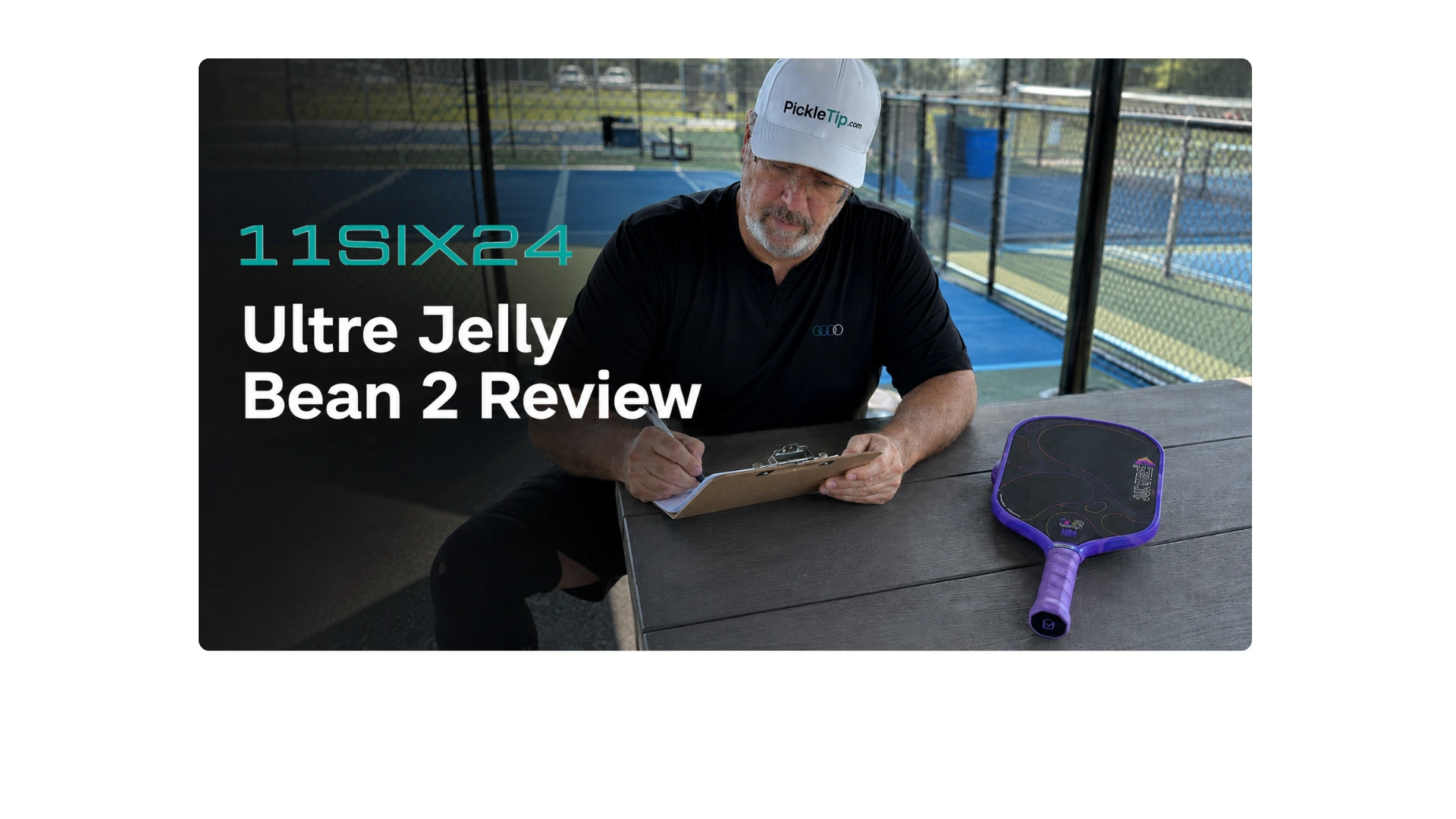
11SIX24 Ultré Jelly Bean 2 Review: Soft Control, Heavy Swing
Going into my Jelly Bean 2 testing, I thought I already knew which shape was going to be my favorite.
Ultré.
That was not a random guess. The Ultré Power 2 was my favorite shape in the Power 2 family. I already liked what the flatter, longer hybrid geometry did for my game, so when 11SIX24 put the softer Jelly Bean 2 core inside that same general footprint, I expected the result to be easy.
I expected Ultré to win again.
It did not.
What surprised me is that I do not think the Ultré Jelly Bean 2 failed at all. In several areas, it is excellent. The spin is outstanding. The paddle gives me a lot of dwell. Drops and resets are easy to control. The substantial swing gives the paddle a planted feel, and when I have time to complete my stroke, there is plenty of mass moving through the ball.
But testing all four JB2 shapes taught me something I did not fully appreciate before I started:
Loving a paddle shape does not mean I will love every construction built around that shape.
The Ultré geometry worked beautifully for me with Power 2 because the shape and the more reactive core reinforced each other. Jelly Bean 2 changes that relationship. I get more softness, dwell and control, but I am moving a substantial paddle through the swing while the core asks me to create more of the pace myself.
That combination never felt bad to me.
It simply did not feel as complete as I expected it to.
My takeaway: the Ultré Jelly Bean 2 is a soft, spin-heavy and extremely planted control-first all-court paddle with excellent dwell and placement. Its biggest tradeoff is that the substantial swing does not come with the same reactive power payoff I love from Ultré Power 2.
I expected Ultré to be my favorite JB2 because Ultré Power 2 was my favorite Power 2. Instead, the Hurache-X felt better to me in the Jelly Bean 2 platform.
That is a personal result, not a declaration that everybody should choose Hurache-X over Ultré. The full four-shape buying decision belongs in my Jelly Bean 2 comparison.
What I really wanted to know was what happened when a shape I already loved met a completely different core.
Coach Sid Testing Summary: This review is based on my court time with the final-production Ultré Jelly Bean 2, direct comparison with the other Jelly Bean 2 shapes, and my previous experience with the Ultré Power 2. I had also followed the Jelly Bean 2 project before launch through its core discussions, prototype revisions and early-player feedback.
I wanted the production paddle to earn its own verdict. My on-court experience comes first; published specifications and instrumented measurements come second. Earlier player reports are useful mainly for showing where my experience matches—or differs from—the broader feedback.
I have enough court time to judge how the Ultré JB2 plays now, but I am not treating long-term foam behavior, surface wear or unit-to-unit consistency as settled questions yet.
The Ultré Jelly Bean 2 is listed at $169.99. Use code PICKLETIP at checkout to save $10. The current purchase also includes a free neoprene paddle cover.
Check Ultré Jelly Bean 2 availability at 11SIX24 and use code PICKLETIP for $10 off.
11SIX24 currently lists free U.S. shipping over $75, a 12-month warranty and 30-day returns. Stock and purchase terms can change, so confirm the current details on the product page.
Ultré is the most substantial-swinging Jelly Bean 2
The Ultré is the flatter, longer hybrid in the four-shape Jelly Bean 2 family. 11SIX24 describes it as a hybrid with a “new-school feel,” but the defining characteristic in my compiled measurements is simpler: this is the most substantial-swinging JB2 shape.
| Specification | Ultré Jelly Bean 2 |
|---|---|
| Price | $169.99 MSRP; use code PICKLETIP for $10 off when available |
| Thickness | 16 mm |
| Shape | Hybrid / flat-top hybrid |
| Measured dimensions | 16.28″ long × 7.63″ wide blended average |
| Measured handle length | 5.61″ blended average |
| Measured weight | 8.20 oz blended average |
| Measured balance point | 24.40 cm blended average |
| Surface | HexGrit |
| Core / construction | EMA-centered full-foam construction with EVA and expanding foam |
| Approval | UPA-A approved; not USA Pickleball approved. I also track current listings in my UPA-A paddle database. |
| Measured swing weight | 121.08 blended average |
| Measured twist weight | 6.78 blended average |
| Colorways | Cosmic Grape, Cornflower Blue, Island Punch |
| Included | Free neoprene paddle cover |
| Warranty | 12 months against manufacturing defects, subject to 11SIX24’s warranty policy |
| Returns | 30-day returns, subject to 11SIX24’s return policy |
| Shipping | Free U.S. shipping over $75 |
| Buy | Ultré Jelly Bean 2 at 11SIX24 — use code PICKLETIP for $10 off when available |
11SIX24’s published product information and my compiled measurements are intentionally treated separately. Static weight, dimensions, swing weight and twist weight can vary from paddle to paddle. The 8.20 oz, 121.08 swing weight, 6.78 twist weight and 24.40 cm balance point shown above are blended averages from the measurement data I compiled for my Jelly Bean 2 family guide; they are not a promise that every retail Ultré will measure exactly the same.
That distinction is especially important with Ultré because individual units have shown meaningful weight variation. The broader pre-launch evidence included production-style paddles from the high-7-ounce range into the low-8-ounce range, so I would not assume every Ultré will swing exactly like the blended number.
Still, the pattern is clear enough for me to take seriously.
Ultré carries a lot of paddle through the stroke.
The Ultré JB2 feels planted because there is real mass moving through the ball. The question is whether you want to move that much paddle when the core itself is intentionally restrained.
Why wasn’t Ultré my favorite Jelly Bean 2?
The answer is not that it lacked control.
It has plenty.
It is not that it lacked spin. Spin is one of the best things about it.
It is not that I suddenly stopped liking the Ultré shape, either.
The issue is the relationship between effort and reward.
Ultré JB2 gives me the highest blended swing weight in this four-paddle family. That means I am moving plenty of rotational mass through the stroke.
With Ultré Power 2, that substantial contact is paired with a more immediate, reactive core. I swing, the paddle helps, and I get a lot of offensive payoff.
With Ultré JB2, the softer core absorbs more of that interaction. I get dwell, placement and margin—but when I want speed, I still have to provide much of it myself.
That feels backwards at first.
I am moving more paddle than I do with some of the other JB2 shapes, yet the face is still asking me to generate the offense.
The Ultré JB2 gives me plenty of mass, but not always the amount of free speed I expect that mass to produce.
That is the main reason the Hurache-X ultimately felt more complete to me in this platform. I got enough leverage and offensive help from the elongated geometry without feeling like I was moving quite as much paddle through every exchange.
Again, that belongs to my experience—not a universal ranking. But it explains why my favorite Power 2 shape did not automatically become my favorite Jelly Bean 2 shape.
How the Ultré Jelly Bean 2 feels at impact
At impact, Ultré still feels unmistakably like Jelly Bean 2.
The response is soft, dense and relatively muted. I feel more contact time than I do with Ultré Power 2, and the ball seems to settle into the face before leaving rather than immediately rebounding away.
The Ultré shape adds something different to that basic JB2 feel.
Because there is more mass moving through the stroke, contact feels very solid when I am balanced and on time. I do not get a flimsy or disconnected sensation.
That makes the paddle particularly good when I have time to use a complete stroke.
The tradeoff shows up when I do not.
Is the Ultré Jelly Bean 2 underpowered?
My answer: I would call the Ultré JB2 control-first and player-powered rather than simply underpowered.
But this is also the JB2 shape where I most understand why another player might use the word underpowered.
The broader early-player feedback was more divided on Ultré power than almost anything else in this family.
Some players described enough pace or even “sneaky power.” Others came away feeling that the paddle did not give them enough output, especially compared with Power 2.
Some of the strongest low-power reports also came with specific ball and outdoor-condition combinations. I treat that as a possible explanation for part of the disagreement, not proof that Ultré universally loses power in heat or with any particular ball.
I understand both reactions.
If I take a full swing and accelerate through the ball, I can create speed. The mass behind the stroke helps, and the spin gives me enough shape to swing aggressively.
But I do not get the same kind of immediate response from abbreviated swings.
Ultré JB2 can hit a heavy ball when I provide a heavy swing. It is much less interested in turning a small swing into a big ball for me.
Full drives are better than short-stroke offense
When I have time to set my feet and drive through the ball, the Ultré makes sense.
The mass creates good plow-through, the face lets me stay on the ball, and HexGrit gives me enough topspin to swing hard without flattening every drive toward the baseline.
On a full drive, that swing weight finally works in my favor.
I do not need to add a lot of weight to make the paddle feel solid through contact. It already does.
The problem is that pickleball does not always give me time for that complete stroke.
When the ball gets on me quickly, the same mass that feels great on a drive becomes harder to reposition, and the softer core does not bail me out with a huge amount of reactive pop.
The Ultré JB2 rewards complete swings more than emergency swings.
Serves reward a full swing
Serves are one of the better places to use what Ultré gives me.
I have time to prepare, the higher swing mass is not fighting a rushed exchange, and I can accelerate through the ball.
That produces useful depth and a lot of topspin.
The serve does not explode off the face like it does with Ultré Power 2, but the combination of mass and spin still lets me hit an aggressive ball.
Drops are one of the reasons Ultré still makes a strong case
If the power discussion sounds negative, drops are where the other side of the tradeoff becomes obvious.
The Ultré JB2 gives me plenty of dwell and a very predictable response on third-shot drops.
I can swing through the ball instead of decelerating and trying to manufacture softness with my hand.
The paddle absorbs enough energy that I have room to be aggressive with the stroke, and the HexGrit surface gives me enough spin to pull the ball down.
Topspin drops are particularly comfortable because the face gives me time to shape the ball.
Ultré JB2 makes me less afraid of swinging through a soft shot.
Resets may be the best argument for this version of Ultré
The Ultré JB2 is very good when I am absorbing somebody else’s pace.
That makes sense mechanically. I have enough mass behind the face to keep contact from feeling flimsy, but the softer core does not immediately throw all of the incoming energy back at my opponent.
In transition, that gives me a useful combination:
- a stable-feeling paddle behind the ball,
- low enough rebound to kill pace,
- good dwell for controlling launch,
- and enough surface bite to add shape when I need it.
This is also one of the areas where the broader player feedback was much less controversial. Ultré consistently drew praise for dwell, placement and controlled defensive shots even when players disagreed about its power.
The Ultré JB2 is much easier for me to understand when I am taking pace away than when I am asking the paddle to create pace for me.
The soft core makes the kitchen easy to trust
The kitchen is another area where the softer construction makes sense.
I can dink with a normal stroke and trust the paddle not to unexpectedly add too much pace.
That gives me confidence moving the ball around, using angles and changing height without treating the face like something I need to constantly manage.
The Ultré shape also gives me a substantial, connected feeling at contact. I like that on crosscourt dinks because the face does not feel flighty or unstable when I change direction.
If your game is built around patience, placement and waiting for the right ball, Ultré JB2 gives you a lot to work with.
Roll volleys lean on HexGrit more than pop
When I want to create offense from a lower kitchen ball, spin matters more than raw pop with this paddle.
Roll volleys are strong because I can accelerate up the back of the ball and trust HexGrit to create dip.
I am not relying on trampoline speed.
I am using paddle speed that I generate, plus enough surface friction to turn that speed into shape.
Ultré JB2 is at its best when I can turn my own swing into spin, placement and controlled weight—not when I ask the face to manufacture instant offense.
Hands and counters expose the biggest difference from Ultré Power 2
My Power 2 history matters most in hands battles.
I really liked the Ultré Power 2 in fast exchanges.
The shape gave me confidence at higher contact points, and the more reactive core rewarded short, compact counters.
Ultré Jelly Bean 2 changes both sides of that equation.
My compiled JB2 swing-weight average is 121.08, while one independent Ultré Power 2 measurement was around 114.8.
So I am moving more rotational mass with JB2.
At the same time, I am getting less reactive speed from the core.
That combination matters in a hands battle.
I can block extremely well because the paddle absorbs pace. But when I want to turn a compact block into an offensive counter, I need more intent than I do with Power 2.
This may be the defining Ultré JB2 tradeoff: the paddle has plenty of mass behind the ball, but it does not give me the same short-stroke reward as Ultré Power 2.
Blocks are easier than punch counters
If my goal is simply to survive pace, I like Ultré JB2.
The substantial face stays connected behind the ball, and the softer response gives me margin.
If my goal is to redirect that same pace aggressively with a very short punch, Power 2 does more of the work.
Hand speed is a real consideration
I would not ignore the swing-weight number.
Ultré does not feel impossible to move, but this is not the JB2 I would describe as effortlessly quick.
The 121.08 blended swing weight and 24.40 cm balance point already tell me what I need to know: this is a substantial paddle to reposition when an exchange speeds up.
That does not make the paddle unusable at the kitchen. It simply means the player should understand what they are buying.
Ultré prioritizes planted mass over minimal rotational effort.
Overheads finally let the swing mass cash the check
Overheads are one place where I appreciate the extra mass without worrying much about hand speed.
I normally have enough time for a full motion, and the Ultré moves through the ball with authority.
The core still does not provide Power 2-level rebound, but I do not have trouble finishing ordinary overhead opportunities when I make clean contact and accelerate.
Ultré JB2 is not incapable of power. It is selective about when that power is easiest to access.
Spin is the easy part with Ultré JB2
There is much less debate about spin.
My practical experience is simpler: the paddle gives me all the spin I need.
Topspin serves dip. Drives shape. Drops can be accelerated with more confidence. Roll volleys become a real offensive option.
What matters more to me than a lab number is what the spin does to the ball. The softer response gives me time to shape the shot, and HexGrit gives me enough bite to make that shape useful.
I track HexGrit wear separately in my pickleball grit durability analysis. For this review, I am keeping the claim narrower: the surface has given me plenty of bite during my current testing, but long-term real-world wear still needs time.
Right now, spin performance is not one of my concerns with the Ultré JB2.
Stability is not my concern with Ultré
The Ultré’s blended 6.78 twist weight is much less controversial than its 121.08 swing weight.
That number suggests reasonable resistance to twisting, and that generally matches the planted feel I get on court.
I do not think the Ultré needs perimeter weight simply to feel stable.
The face feels connected through normal contact, and the mass already provides plenty of substance.
That is why I would be cautious about treating Ultré like a paddle that automatically needs customization.
I would play the Ultré JB2 stock before adding weight
This is probably the JB2 shape where I have the least desire to start adding perimeter weight immediately.
At a blended 121.08 swing weight, I already have plenty of rotational mass.
Could additional weight change stability or plow-through? Of course.
But every gram also asks me to move more paddle during counters and hands battles, which is already one of the areas I would watch most carefully with Ultré.
With Ultré JB2, customization should solve a specific problem—not become the default starting point.
There was no original Ultré Jelly Bean
This is one place where Ultré is fundamentally different from Pegasus, Vapor and Hurache-X.
There was no original budget Ultré Jelly Bean.
The Ultré shape entered 11SIX24’s lineup at the Power 2 level, so Jelly Bean 2 is not a second-generation version of an older Ultré control paddle.
It is the first time this shape has been offered as a softer, lower-output alternative to the flagship Power 2 construction.
Do not think of Ultré JB2 as “Ultré Jelly Bean 1, but better.” That paddle never existed.
The useful question is whether you want the Ultré geometry paired with Power 2’s more explosive response or Jelly Bean 2’s softer, more controlled one.
Ultré Jelly Bean 2 vs Ultré Power 2
For me, Ultré JB2 makes the most sense when I put it beside Ultré Power 2.
Ultré Power 2 was my favorite Power 2 shape.
That experience is exactly why I expected Ultré JB2 to be my favorite Jelly Bean 2.
Instead, playing the two constructions taught me that some of what I loved about Ultré Power 2 was not merely the geometry.
It was the way that geometry interacted with the Power 2 core.
| Trait | Ultré Jelly Bean 2 | Ultré Power 2 |
|---|---|---|
| Overall response | Soft, dense, controlled | More immediate and reactive |
| Dwell | Higher | Lower by comparison |
| Free power | Lower | Clearly higher |
| Pop | Restrained | More reactive |
| Full swings | Stable, spin-heavy, player-powered | More explosive payoff |
| Resets | Easier pace absorption | Requires more rebound management |
| Hands / counters | More effort required for offensive counters | Easier short-stroke offense |
| Swing-weight context | 121.08 blended average | About 114.8 in one measured example |
| Best reason to choose it | Control the amount of offense you create | Get more offense from the paddle itself |
The swing-weight relationship supports what I feel on court.
My compiled Ultré JB2 average is 121.08, while one measured Ultré Power 2 example was around 114.8. Those numbers can vary from paddle to paddle, but the comparison helps explain why JB2 feels more substantial to me through the swing.
The key point is that more swing mass does not automatically mean more free pace.
I am moving more paddle and getting less automatic rebound.
For the right player, that can be a feature. More mass plus less pop can create a very planted, controlled experience.
For me, however, Power 2 makes better use of what I naturally like about the Ultré shape.
Choose Ultré Power 2 if you want:
- more free power,
- more reactive pop,
- easier offensive counters,
- more reward from abbreviated swings,
- and the version of the Ultré shape I personally prefer.
Choose Ultré Jelly Bean 2 if you want:
- a softer and denser impact,
- more dwell and pocketing,
- easier resets,
- excellent spin and placement,
- less reactive rebound at the kitchen,
- and a paddle that lets you determine how much offense you create.
The buying decision: I still prefer Ultré Power 2 because the more reactive core better complements what I like about the Ultré shape. Jelly Bean 2 is the better version for the player who wants to keep the shape but deliberately remove some of that rebound.
If that softer Ultré sounds more like your game, you can check the Ultré Jelly Bean 2 at 11SIX24 and use code PICKLETIP for $10 off when purchasing is available.
Where Ultré fits in the Jelly Bean 2 family
Within the Jelly Bean 2 family, Ultré has a clear identity: it is the most substantial, planted-feeling option for the player who wants the flatter hybrid shape, excellent spin and a softer response. The cost is maneuverability, and unlike Power 2, that extra mass does not automatically turn into free offense.
Ultré is the JB2 shape where the difference between “mass behind the ball” and “power off the face” matters most to me.
If you are trying to decide whether Ultré, Vapor, Hurache-X or Pegasus fits you better, my Jelly Bean 2 shape comparison breaks down the four shapes directly.
Who should buy the Ultré Jelly Bean 2?
I think the Ultré JB2 makes the most sense for a player who:
- already likes the flatter Ultré-style hybrid geometry,
- prefers a planted and substantial swing,
- values dwell and pocketing,
- wants excellent spin and placement,
- prioritizes resets and controlled defense,
- generates their own pace,
- likes taking complete swings,
- or wants the Ultré shape without Power 2’s more reactive response.
Who should skip the Ultré JB2?
I would look elsewhere if your biggest priorities are:
- maximum free power,
- reactive kitchen pop,
- effortless offensive counters,
- very fast hand speed,
- a light platform with lots of room for added weight,
- or the same offensive personality as Ultré Power 2.
If Ultré Power 2 is already your favorite paddle because of its counters, pop and effortless offensive response, do not assume Ultré Jelly Bean 2 is simply a softer upgrade.
It is a different interpretation of the same shape.
Ultré Jelly Bean 2 FAQ
I would call the Ultré Jelly Bean 2 control-first and player-powered rather than simply underpowered. It can hit a heavy ball with a complete swing, but it supplies much less automatic rebound than the Ultré Power 2.
I expected Ultré to be my favorite because Ultré Power 2 was my favorite Power 2 shape. The JB2 version kept the spin, dwell and planted feel I liked, but the softer core asked me to create more of the offense myself, and the Hurache-X ultimately felt more complete to me.
The Ultré Jelly Bean 2 is softer, denser and easier to control, with more dwell and easier pace absorption. Ultré Power 2 is more reactive and gives me more free pace and easier short-stroke offense.
It feels substantial rather than unplayably heavy to me, but hand speed is a legitimate consideration. My compiled swing-weight average is 121.08, the highest in the Jelly Bean 2 family. That planted mass helps on full swings and blocks but requires more effort to reposition during fast kitchen exchanges.
No. The Ultré shape previously existed at the Power 2 level, so the Ultré Jelly Bean 2 is not a successor to an original Ultré Jelly Bean. It is the first softer, lower-output Jelly Bean version of this shape.
Yes. The Ultré Jelly Bean 2 is UPA-A approved. It is not currently USA Pickleball approved.
I think the price makes sense for a player who specifically wants the Ultré shape with a softer full-foam response, excellent spin, strong resets and less reactive pop than Power 2. If the reason you love Ultré is the Power 2 version’s free offense and counter speed, I would spend more for the Power 2 instead.
The Ultré Jelly Bean 2 is listed at $169.99 on 11SIX24. Use code PICKLETIP at checkout for $10 off when available, and check the current product page for stock and purchase terms.
My verdict on the Ultré Jelly Bean 2
I went into this test expecting the Ultré Jelly Bean 2 to be my favorite paddle in the family because Ultré Power 2 had already proved that the shape worked for me.
Jelly Bean 2 taught me that I had been giving the shape too much of the credit. Some of what I loved about Ultré Power 2 was the interaction between the Ultré geometry and the Power 2 core.
Ultré JB2 keeps the geometry but changes the personality underneath it. It is softer, denser and easier to control, with excellent spin, comfortable drops and some of the best reset performance in the family. The substantial swing also makes clean contact feel extremely planted.
That same substantial swing is the tradeoff when the point speeds up. For a player who likes the Ultré shape but thinks Power 2 is too reactive, that may be exactly the point. It just was not the version I ended up preferring.
The Ultré Jelly Bean 2 taught me that the right shape and the right core are two separate decisions.
Hurache-X ultimately gave me more of what I wanted from the Jelly Bean 2 construction, but that does not make Ultré a disappointment. It makes the fit more specific.
If you want soft control, excellent spin, serious dwell and a planted hybrid that rewards complete swings, the Ultré Jelly Bean 2 makes a strong case. If the reason you love Ultré is the explosive response of Power 2, I would stay with Power 2.
At $169.99, that distinction matters more to me than where Ultré finishes in somebody else’s ranking.
Check the Ultré Jelly Bean 2 at 11SIX24 and use code PICKLETIP for $10 off when purchasing is available.
Current listed price: $169.99. 11SIX24 also lists a free neoprene cover, free U.S. shipping over $75, a 12-month warranty and 30-day returns. Stock and purchase terms can change.