21 Pickleball Tips I Teach Developing Players
Most pickleball players do not need 21 new shots. They need cleaner reads, better timing, and more control over the shots they already use.
After years of coaching recreational players, tournament players, and developing 3.0–4.0 players through clinics, lessons, drilling, and real match play, I see the same patterns repeat. The final miss may look like a paddle problem, but the useful priority is often something that happened earlier: late feet, poor timing, court position, or a rushed decision.
Most of these tips came from the same coaching process: watching a player miss, rewinding the point in my head, and asking what happened before contact. Did they move too soon? Did they attack from the wrong height? Did they leave their partner guessing? Did they turn a neutral ball into a problem?
The pattern is usually obvious from the sideline before the player feels it. They hit a decent ball, take two hopeful steps forward, get caught moving, then wonder why the next shot popped up. That is not a paddle problem. That is a timing problem.
The goal is to catch that mistake earlier—before a decent rally turns into three rushed saves and a pop-up. This guide is aimed at developing players, especially the 3.0–4.0 range I coach most often, who know the basic shots but still donate too many points through timing, balance, court position, shot selection, and team decisions. If you are brand new to the sport, the beginner learning path is a better place to start.
The PickleTip Court-Side Version
If you want to get better faster, get your returns deep, arrive at the kitchen under control, keep your paddle ready, attack balls that actually deserve to be attacked, and reset when the rally gets messy. If the ball makes you reach, reset. If it sits up while your feet are quiet, press. Most players do not need more shots first. They need fewer donated points.
Read These Tips With the LEAK Check
Do not ask which tip sounds the most interesting. Ask which problem keeps showing up in your games. The PickleTip LEAK Check grew out of years on court—drilling, teaching lessons, running clinics, and watching the same rally problems repeat. The method is simple: locate the repeated problem, examine the context around it, assign it to the broad lane that needs attention, and keep one priority long enough to learn whether it is changing.
Keep this in mind: The shot that missed is not always the problem worth fixing first. LEAK helps you choose the recurring priority. If you still do not know why that pattern is happening, use the ERROR framework to diagnose the real cause.
🎧 Prefer listening? Hear a summary of these 21 pickleball improvement tips:
Start With the Mistake You Keep Repeating
Four Fixes I Teach Almost Every Week
These are the habits I come back to with almost every player I coach. They are not flashy, but they clean up the rally problems that show up before the miss: late feet, rushed decisions, loose paddle position, and bad timing through transition.
Do not try to fix all four today. If one of these keeps showing up in your games, start there and leave the others alone for now.
1. Get to the Kitchen Line, But Do Not Rush Through the Transition Zone
Winning and holding kitchen position creates a major advantage in doubles, but that does not mean you should sprint forward blindly after every shot. Move forward, yes, but move when the ball lets you, not because you are hoping the next shot will be easy.
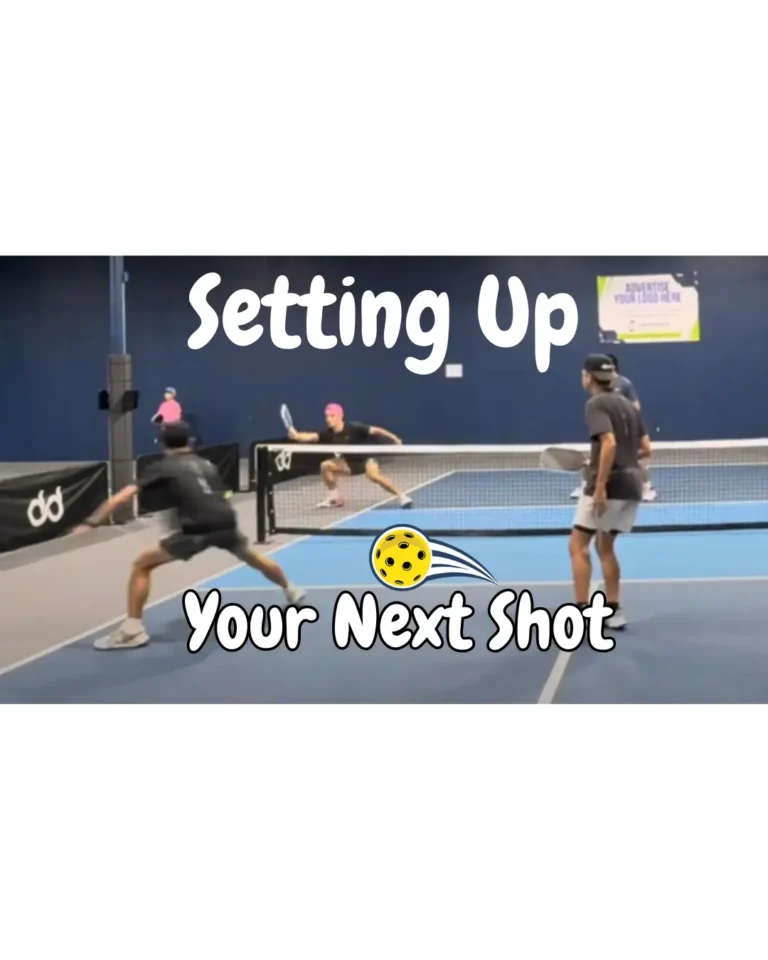
You can usually see this before the miss. A player hits a decent return or third shot, then runs forward while the opponent is already about to strike the ball. That player gets caught in motion, reaches for the next ball, and pops it up.
Hit first, then move. If your opponent is about to contact the ball, split step and get balanced before you take another step forward. You still want to win the race to the kitchen line, but you want to arrive under control.
Need help with that in-between part of the court? Start with Pickleball Transition Zone if your main issue is getting forward after the return.
PickleTip court check: If you are still moving when your opponent hits, you are not attacking the transition zone. You are gambling in it.
2. Prioritize Deep Serves and Deep Returns
Depth changes the point before the rally even gets interesting. A deep serve makes the returner hit from farther back. A deep return gives your team time to get in. A short return gives the serving team a running start at you. I see this all the time with players who think they lost the third shot battle, when the real mistake happened on the return before it.
The giveaway is easy to spot from the sideline. The return lands around the service line, the returner takes one or two rushed steps forward, then has to defend a drive or drop while still moving. That player feels late at the kitchen, but the problem was not their hands. They handed the serving team time and court position.
Beginners often chase power before they own depth. Intermediate players often miss returns because they try to hit a perfect low return instead of a deep, useful one. On serves and returns, aim for the back third of the court with enough net clearance to avoid cheap errors. A deep, boring return that lets you arrive balanced is usually worth more than a low, risky return that barely clears the net.
AJ pointed this out to me in my own game. Some of my lower returns were getting back to the serving team so quickly that I was still trying to establish position when the third ball arrived. Adding useful height without giving away depth bought me more time to get forward under control.
For more help on the first two shots, use Mastering the Pickleball Serve and Returning a Serve in Pickleball.
3. Keep Your Paddle Ready and Your Volleys Compact
Fast hands do not start with fast swings. They start with a paddle that is already in the right place. After every shot, bring the paddle back in front of your chest so you are ready to block, counter, reset, or volley without dragging it up from your hip.
This is where a lot of kitchen exchanges are lost before the ball even gets there. A player hits a dink or volley, lets the paddle drop, then the next ball comes into the body. Now the elbow gets jammed, the paddle has too far to travel, and the rally feels faster than it really was.
At the kitchen, keep the swing short. The ball is already close, so big backswings usually create late contact and pop-ups. Think punch or block more than swing, with soft hands for touch shots and a firmer grip when you need to absorb pace.
If your paddle keeps dropping or your volleys get too big under pressure, work on Paddle Position in Pickleball, and How to Hold a Pickleball Paddle.
4. Stop Trying to End Points Before They Are Ready to End
A lot of developing players make the rally harder by trying to finish a ball that was never asking to be finished. That usually looks like an attack on a low ball, an over-swing from the baseline, or a forced winner into a gap that was never really there.
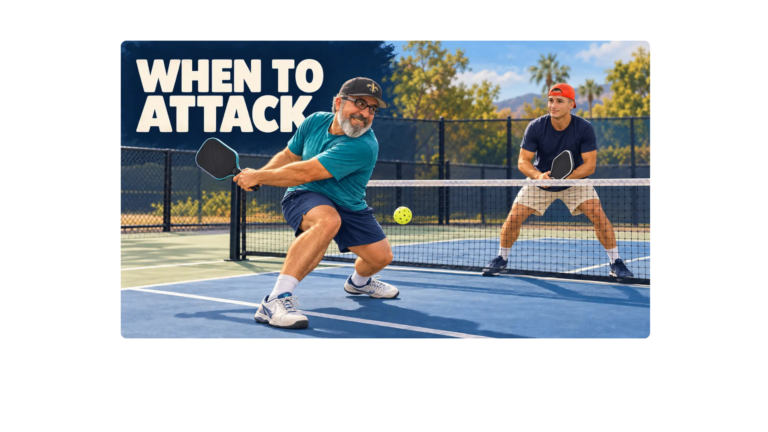
A better habit is to sort the ball before you swing: defend, neutralize, or attack. If the ball is low, wide, or heavy, get it back safely. If it is neutral, keep the rally stable. If it sits up and your feet are quiet, then you can apply pressure.
Before you speed up or go for a winner, ask yourself: did I earn this attack, or am I just tired of waiting? A lot of players are not losing because they lack offense. They are losing because their offense starts too early.
That decision gets easier once you understand Pickleball Shot Selection and High Percentage Pickleball Shots.
Better Shot Choices, Fewer Donated Points
You can have decent mechanics and still lose if you choose the wrong shot at the wrong time. The cleaner your choices get, the less pressure you put on your paddle to save you.
5. Hit Most Neutral Balls Cross-Court
Cross-court is often the boring answer, and boring wins a lot of rallies. The diagonal gives you more court to work with, and many cross-court paths travel over the lower middle portion of the net. That geometry is real: USA Pickleball’s official rules specify a net height of 36 inches at the sidelines and 34 inches at the center. Down the line can work, but if you are stretched, late, or guessing, that sideline starts looking a lot smaller than it did in your head.
This does not mean every ball has to go cross-court. It means that when you are neutral, stretched, or unsure, cross-court is usually the higher-percentage answer.
Save the sharp change of direction for balls you can control. When the ball is low, wide, or rushed, give yourself margin and make the opponent hit another shot. I see a lot of 3.0 and 3.5 players lose points by changing direction from a ball that never gave them permission to change direction.
If changing direction is the miss that keeps showing up, the Crosscourt Shots in Pickleball guide goes deeper on when the diagonal gives you useful margin and when a line change is actually there.
6. Attack the Backhand Early and Often
At the recreational and intermediate levels, the backhand side is often less stable than the forehand side. If you do not know where to hit the ball, the opponent’s backhand is usually a smart place to start.
This is especially true on returns, dinks, speed-ups, and passing shots. You are not trying to be mean. You are trying to make the opponent beat you with their less comfortable side.
Test the backhand early in the match. I like to learn that answer before the game gets tight. Some players will show you right away that their backhand is a safe place to work. Others will surprise you with a compact block or a clean counter, and that is useful information too.
This is a starting point, not a law. Some players have ugly-looking backhands that hold up just fine, and some forehands fall apart under pressure. The point is to test the pattern early, then believe what the court tells you.
If your own backhand is the side people keep finding, use the Pickleball Backhand Guide.
7. Change Speed, Height, and Trajectory
If your opponent keeps getting set comfortably, your ball may have become too predictable. Change one thing: height, pace, depth, or direction. You do not need a circus shot. You need to make them solve a different ball.
A soft dink after a hard drive can freeze a player. A higher, deeper return can push them back. A slower roll can make them generate their own pace. Variety makes your opponent solve a new problem every few shots.
From the sideline, comfort is easy to see. Their feet stop working, their paddle gets quiet, and they start taking the same swing over and over. Move them before you try to beat them. Make them adjust before you ask your own paddle to do something special.
To build smarter point patterns, read Smart Pickleball Shot Patterns. For the slower-pressure side of offense, read Off-Pace Offense in Pickleball.
8. Shape Your Dinks Instead of Pushing Them
Dinks that are pushed forward without enough lift or shape can sit up, and those are the balls that get attacked. When I see a player lose the same dink pattern over and over, I first look at whether the ball has enough height to clear safely and enough shape to come back down before it becomes attackable.
Instead of poking the ball forward, use a controlled lift and soft brush. You are not trying to hit a winner with your dink. You are trying to create a ball your opponent cannot attack.
Picture the ball traveling up, over, and down instead of being shoved straight through the net window. A useful dink clears the net with margin and still drops low enough that the opponent cannot attack it comfortably.
If your dinks float or sit up too often, start with How to Improve Your Pickleball Dinking. Then build the pattern side with the Pickleball Dinking Strategy Guide.
9. Stop Attacking Balls Below the Net
Many points are lost because a player tries to speed up a ball that is too low. If the ball is below net height, you usually have to lift it. When you lift an attack, the opponent gets to counter down on you.
The better choice is often a reset, a soft dink, or a controlled roll that buys you time. Strong players are not aggressive on every ball. They are aggressive when the contact point, balance, and ball height line up.
The three permissions to attack: the ball is high enough, your feet are quiet, and contact is available out in front. If one of those is missing—especially if you are reaching, falling, or lifting the ball from below the net—the smarter play is usually a reset, dink, or controlled roll. These are not laws; skilled players can roll some low balls safely. For most recreational players, though, missing one of the three permissions is a warning that the attack will need extra lift or improvisation. High balls give you permission. Low balls give you homework.
Use Speed-Ups in Pickleball when you are ready to attack better balls. Use Resetting in Pickleball when you keep forcing attacks from bad ones.
Make Their Next Ball Harder Than Yours
A good shot does more than survive this ball. It makes the next one easier for you and harder for them. That is the larger idea behind Pickleball Strategy: create pressure without giving away the rally.
10. Keep Opponents Back Whenever Possible
If you are established at the kitchen line while your opponents are still near the baseline, you usually have the positional advantage. Do not bail them out with an unnecessary low-percentage winner attempt or a soft ball that lets them walk forward comfortably.
Keep the ball deep, apply pressure to their feet, and make them hit difficult balls while moving. Give them a short float and the whole point can flip: now they are stepping forward into comfortable contact while you are the team reacting. The longer they stay back, the more likely they are to miss or give you something attackable.
When they are back, keep them back. Your job is not to hit the prettiest winner on the court. Your job is to make them hit one more uncomfortable ball from a bad spot.
If you keep giving away this advantage by moving at the wrong time, Advancing in Pickleball breaks down when to press forward and when to hold your ground.
11. Use Controlled Aggression, Not Blind Speed-Ups
Once the ball has actually earned an attack, the next question is what kind of pressure to apply. When the height, balance, and contact point are there, choose a target that makes the reply uncomfortable instead of swinging hard just because the ball appeared.
A good attack does not have to be wild. A firm roll at the hip, a speed-up through the middle, or a ball placed at the moving player’s feet can produce a weaker reply than a full swing hit directly into a prepared paddle.
If your feet are scrambling, your hands usually should not be gambling. A smart attack starts before the swing, with a ball you can contact in front and control. When I ask players why they sped a ball up, “because it was there” is usually the wrong answer. The better answer is, “because it was high enough, I was balanced, and I had a target.”
The Controlled Aggression in Pickleball guide builds from that same idea: earn the attack first, then choose pressure you can control.
12. Let the Return Decide Your Third Shot
Beginners often hear “third shot drop” and think every third shot has to be soft. Intermediate players learn that the third shot is not one automatic swing. It changes with the return, opponent position, and your own balance.
I would rather have a player read the return than walk to the baseline already committed to a drop. Instead of asking, “Should I always drop?” ask, “What does this return allow me to do?”
I had a player in a drill who was driving every return that landed inside the baseline. The ball was short, but he kept arriving on top of the bounce with his elbow trapped. Once we changed the rule from “short means drive” to “short plus balanced means drive,” the counters at his feet mostly disappeared. The return mattered, but his spacing and balance got the final vote.
Build that read with Third Shot Strategy, How to Hit a Better Third Shot Drop, and Third Shot Drive in Pickleball.
13. Aim at Feet, Not Just Open Space
Open court is nice, but the feet are often an excellent pressure target. A low ball at a moving player’s feet can force contact from below net height, making an upward reply more likely and reducing the options available on the next shot.
Against a moving player, placement often matters more than another few miles per hour. You do not have to hit the ball harder if you can make your opponent contact it from a worse spot.
This works best when opponents are moving through the transition zone. A player with excellent hands may handle a chest-high ball comfortably, but a player trying to volley or reset from the shoelaces while still moving has fewer aggressive options. Instead of trying to blast through that player, make the contact point uncomfortable.
In rec games, players often miss long trying to hit through someone when the easier pressure was sitting right at that player’s toes.
That is one of the simplest ways to make your shots more high percentage.
Do not ignore the middle either. A firm ball through the center can remove angles, create partner confusion, and keep both opponents from taking a full swing. When the sideline target feels too small, the middle is often the smarter pressure point.
Fix Your Feet Before You Blame the Shot
Pickleball footwork is not about looking athletic. It is about having your body in the right place when the ball arrives. If you are leaning, reaching, or drifting, even easy balls become harder.
Why you feel late: It is not always a reaction-speed problem. Your feet may still be moving when the opponent contacts the ball, your paddle may still be recovering from the last swing, or your body may be drifting away from the next shot. Fix the preparation and the rally often stops feeling so fast.
Better feet make your paddle look better. Many “shot problems” are balance problems first.
14. Split Step Before the Opponent Contacts the Ball
The split step is a small timing move that helps you stop, read, and react, especially when you are moving through the court. It does not need to be dramatic. The important part is being balanced enough to respond when your opponent contacts the ball.
This shows up when players are still moving at contact. They feel late because they are late. Their body is going one direction, the ball is going another, and the paddle has to make up the difference.
Move while the ball travels. Stop when the opponent hits. React after you read the shot. That rhythm is what keeps you from playing every ball in a panic.
If this timing feels awkward, the Footwork in Pickleball guide gives you the movement patterns to train instead of trying to solve the problem with faster hands.
15. Use Small Adjustment Steps Instead of Big Lunges
Big lunges usually mean you were late getting into position. Small adjustment steps help you stay balanced, keep the paddle stable, and make cleaner contact. When I see a player reaching with one long leg instead of taking two small shuffles, I already know the paddle is about to do emergency work.
You see it most at the kitchen. A dink lands a foot wider than expected, the player plants one foot, leans from the waist, and pokes the ball back while falling sideways. That dink usually floats because the body is moving away from the target at contact.
Let your feet adjust the shot before your hand has to save the shot. Small steps keep your chest behind the ball, your eyes level, and your paddle quiet. If you keep saying, “I should have had that,” check your feet before blaming your touch.
For simple ways to train that, use Pickleball Balance Drills.
16. Stay Low in Fast Exchanges
When the ball speeds up, many players stand taller, pull their head back, and swing from the shoulders. You can see the panic in their posture. Their chest rises, their paddle gets bigger, and every counter turns into a separate swing instead of a short reaction.
Staying low keeps your base strong and your paddle quieter. You can block, counter, and reset without overreacting. If your head is popping up during every speed-up, your paddle is probably moving more than the ball requires.
Bend your knees more than your waist. A low athletic base beats a tall panic swing, especially when the rally turns into a hand battle. You do not need a dramatic squat. Bend enough that your paddle can work out in front instead of chasing the ball late beside your body.
That base starts with a better pickleball stance.
Stop Making Your Partner Guess
Tips 17–19 are doubles-specific. Your decisions affect your partner, so the team has to move together, communicate early, and cover predictable patterns. Most of the other tips also carry into singles, but court recovery and target selection change when nobody is covering the other half.
A lot of doubles mistakes are not really shot mistakes. They are “we never decided who had that ball” mistakes.
17. Call “Mine,” “Yours,” and “Switch” Early
Silence loses games. Late calls create hesitation. Early calls help both players commit to the right ball.
The middle ball is where this matters most. If both players hesitate, the ball drops. If both players swing, paddles crash. A simple early call solves both problems.
Call the ball before it gets interesting. Communication should happen early enough to help, not late enough to explain the mistake. When I watch a team lose three middle balls in a game, I usually do not see a skill problem first. I see two players waiting for the other one to decide.
From the sideline, middle-ball confusion looks like a pause, not a swing problem. Both players know someone should take it. Neither player knows who is supposed to take it.
If this is a regular problem for your team, use the Pickleball Partner Communication Guide.
18. Decide Who Owns the Middle Before the Ball Comes
Forehand takes middle is a useful starting rule, not a law. Figure out the middle before the ball gets there. Your stronger shot, your position, and who is actually ready should make the decision—not panic.
If one player has a much stronger forehand, let that player take more middle balls. If one player is pulled wide, the other player may need to cover extra space. Decide the rule before the point so neither player has to negotiate it while the ball is arriving.
At a recent Exchange NOLA tournament, I watched both partners hesitate over the same middle dink. One player finally reached in with a forehand near the hip even though the partner already had a paddle set out front. The late decision turned a routine dink into a pop-up, and the other team put the next ball away. The mistake was not simply choosing the “wrong” paddle. They waited too long to choose anyone.
The more your team decides before the ball arrives—and the more willing both players are to let position and preparation override a default—the cleaner those exchanges become.
The Pickleball Middle Shot Strategy Guide goes deeper on the exceptions—handedness, ball direction, balance, and which paddle is already in the path—so “forehand takes middle” does not turn into another automatic rule.
19. Move as a Unit, Not as Two Separate Players
Good doubles teams shift together. If your partner gets pulled wide, shade toward the middle. If your team moves forward, arrive together. When one player retreats and the other stays planted, the open seam usually appears before either partner realizes how far apart they have become.
A simple way to think about this is the rope concept. Imagine a rope connecting you and your partner. You do not want to be stacked on top of each other, but you also do not want to leave a giant gap between you.
Stay connected. If your partner moves, your court responsibility changes too. The best teams look calm because they are rarely surprised by each other.
Build that connection with Doubles Pickleball Strategy and Pickleball Partner Strategies.
Keep One Miss From Becoming Three
The mental game gets practical after a miss: can you keep that mistake from leaking into the next two points? You do not need a perfect mindset. You need a quick reset and a simple next-ball plan.
20. Play the Rally in Front of You
Do not play the last miss. Do not play the score. Do not play the argument in your head about whether you should have attacked the previous ball. Play the rally in front of you.
When players stay stuck on the previous mistake, attention can drift and the next decision can become rushed. The next ball deserves your full attention.
After a mistake, use one short reset phrase: “Next ball.” Then actually move on. Acknowledge the miss, take the useful information from it, and do not let it follow you into the next two points.
That is where Learning From Mistakes in Pickleball becomes more than a nice idea.
21. Build a Neutralizing Shot You Trust Under Pressure
It helps to have one neutralizing shot you trust when the rally gets chaotic. For many players, that shot is a soft reset into the kitchen. A good reset can turn defense back into neutral and give you time to rebuild the point.
Transition is where this shows up the most. You will not always be able to attack your way out of trouble. Sometimes the smartest play is to absorb pace, soften the ball, and make the point start over.
The reset does not have to be pretty. Sometimes it is just the shot that keeps you from turning one rushed ball into a full panic rally.
When the rally feels too fast, make the next ball manageable. A soft reset can keep the point alive and give your team time to rebuild the rally. I see this difference often in recreational play: the steadier player has a boring neutralizing ball available when the point gets ugly instead of trying to attack out of every bad position.
If this is the shot you are missing under pressure, spend time with Resetting in Pickleball. If the whole point feels like survival, use Pickleball Defense.
Find the Leak That Is Actually Costing You Points
Use the PickleTip LEAK Check
Do not begin with “I need a better backhand” or “I need more power.” Start with the rally pattern that keeps donating points.
| Step | What to ask |
|---|---|
| L — Locate | Which problem appears repeatedly, not just once? |
| E — Examine | What was happening in the rally when that problem appeared? |
| A — Assign the lane | Does this look primarily technical, tactical, movement-related, mental, partnership-related, or preparation-related? |
| K — Keep one priority | Which single recurring problem deserves attention before you add another? |
Here is a common example of how LEAK narrows the priority without pretending it has finished the diagnosis. A player repeatedly pops up transition resets. Looking back, you notice that many of those rallies also include short returns and hurried movement forward. The useful LEAK may be arriving in transition without balance. Whether the true cause is return depth, movement timing, reset mechanics, or something else belongs in the deeper diagnosis.
PickleTip court check: LEAK asks, “Which recurring problem deserves attention?” ERROR asks, “Why is that problem actually happening?” Keep those jobs separate.
| If you keep losing points by… | Start with… |
|---|---|
| Popping balls up in transition | Split step, reset, and stop rushing forward while the opponent is about to hit |
| Missing too many returns | Return depth, bigger margin, and aiming for the back third of the court |
| Losing hand battles at the kitchen | Paddle ready position, compact volleys, and staying low in fast exchanges |
| Getting countered after speed-ups | Stop attacking below the net and wait for balls you can contact out in front |
| Confusing your partner on middle balls | Earlier calls, clearer middle-ball rules, and moving together as a unit |
| Feeling rushed even on decent shots | Better split-step timing and smaller adjustment steps before contact |
Use the table to choose one problem to investigate next. If the cause is obvious, move into practice. If it is not, take that problem to the ERROR framework before piling on repetitions.
Which Mistakes Matter Most at Your Level?
Not every player needs the same advice at the same time. The examples below are common coaching patterns, not rating definitions or a universal development ladder. For the broader question of which capabilities tend to matter at different stages, use the PickleTip Skill Hierarchy.
Beginner: Build Depth, Balance, and Position
Beginners should focus on depth, balance, and simple court position before worrying about advanced shots. Get your serve in, return deep, move to the kitchen under control, and keep the paddle ready. Those habits will win more points than trying to copy every shot you see online.
A good beginner path starts with Pickleball for Beginners and Pickleball Serves for Beginners.
Intermediate: Make Better Decisions Under Pressure
Intermediate players usually need better shot selection more than more power. Use more cross-court margin, recognize which balls are attackable, reset from trouble, and communicate earlier with your partner. At this level, cleaner decisions often look more “advanced” than a harder swing.
A common 3.0-to-3.5 coaching pattern: The shots may look similar, but the returns tend to land deeper, the attacks become more selective, the resets hold up more often, and the partner has fewer moments of uncertainty.
If that sounds like your game, work through Pickleball Shot Selection.
Advanced: Find the Pattern That Breaks First
With better players, the leak gets smaller. Sometimes it only appears when the score tightens or the first hand battle does not go their way: a shallow reset, an exposed backhand counter, a predictable third shot, or a player who stops moving after the first speed-up. Better players are not only hitting better shots. They are building points that keep steering the rally toward the weaker pattern.
If that is the level of pattern you are trying to solve, go deeper with Advanced Pickleball, High Level Pickleball Strategy, and Reading Opponents in Pickleball.
Pickleball Tips FAQ
A strong first pickleball tip for beginners is to get balanced before contact. New players often make the next ball harder by walking through contact, reaching, or standing up as the ball arrives. Focus on reliable serves, useful return depth, ready paddle position, and getting to the kitchen under control before chasing advanced shots. For a simple starting path, read Pickleball for Beginners.
There is no universally fastest way to get better at pickleball. A practical place to start is the recurring problem that affects many points. Use the PickleTip LEAK Check to identify that priority, then use ERROR if the cause is unclear and GROW to organize the improvement cycle.
Beginners should learn the third shot drop, but they should not treat it as the only third shot. The bigger skill is learning to read the return instead of deciding what to hit before the ball arrives. For choosing between a drop, drive, hybrid, or more neutral third, read Third Shot Strategy
Most of these pickleball tips still apply in singles, especially depth, balance, shot selection, and attacking only the right balls. Tips 17–19 are doubles-specific. In singles, deep returns, smart placement, and recovering toward the middle matter even more because you do not have a partner covering half the court.
Pick the Next Page by the Problem You Found
Do not read every guide next. Follow the path that matches the leak showing up in your games.
| Your main problem | Go here next |
|---|---|
| You found a recurring problem but still do not know the real cause | ERROR Framework: Common Pickleball Mistakes |
| You know what needs work and need a purposeful improvement cycle | GROW Plan: How to Improve at Pickleball |
| You know what needs repetitions but not which drill fits | DRILL Framework: Pickleball Drills |
| You need to organize several skills into one court session | Pickleball Practice |
| The correction works in drills but disappears in unpredictable rallies | Intentional Play |
| You need the basic learning path | Pickleball for Beginners |
| You are getting trapped between the baseline and kitchen | Pickleball Transition Zone |
| You keep choosing the wrong shot | Pickleball Shot Selection |
| Your third shot is breaking down | Third Shot Strategy |
| Your dinks sit up or become predictable | Dinking in Pickleball |
| You panic or pop the ball up in transition | Resetting in Pickleball |
| Your contact breaks down because of balance or spacing | Pickleball Footwork Guide |
| Your partner keeps guessing | Partner Communication Guide |
| One mistake keeps affecting the next rally | Learning From Mistakes in Pickleball |
| You need a broader tactical plan | Pickleball Strategy |
Pick one leak and make it boring. When a recurring problem stops showing up so often, you have better evidence that the work is transferring. Then choose the next priority instead of collecting another random tip.