Pickleball Skill Hierarchy: The 10 Skills That Matter Most
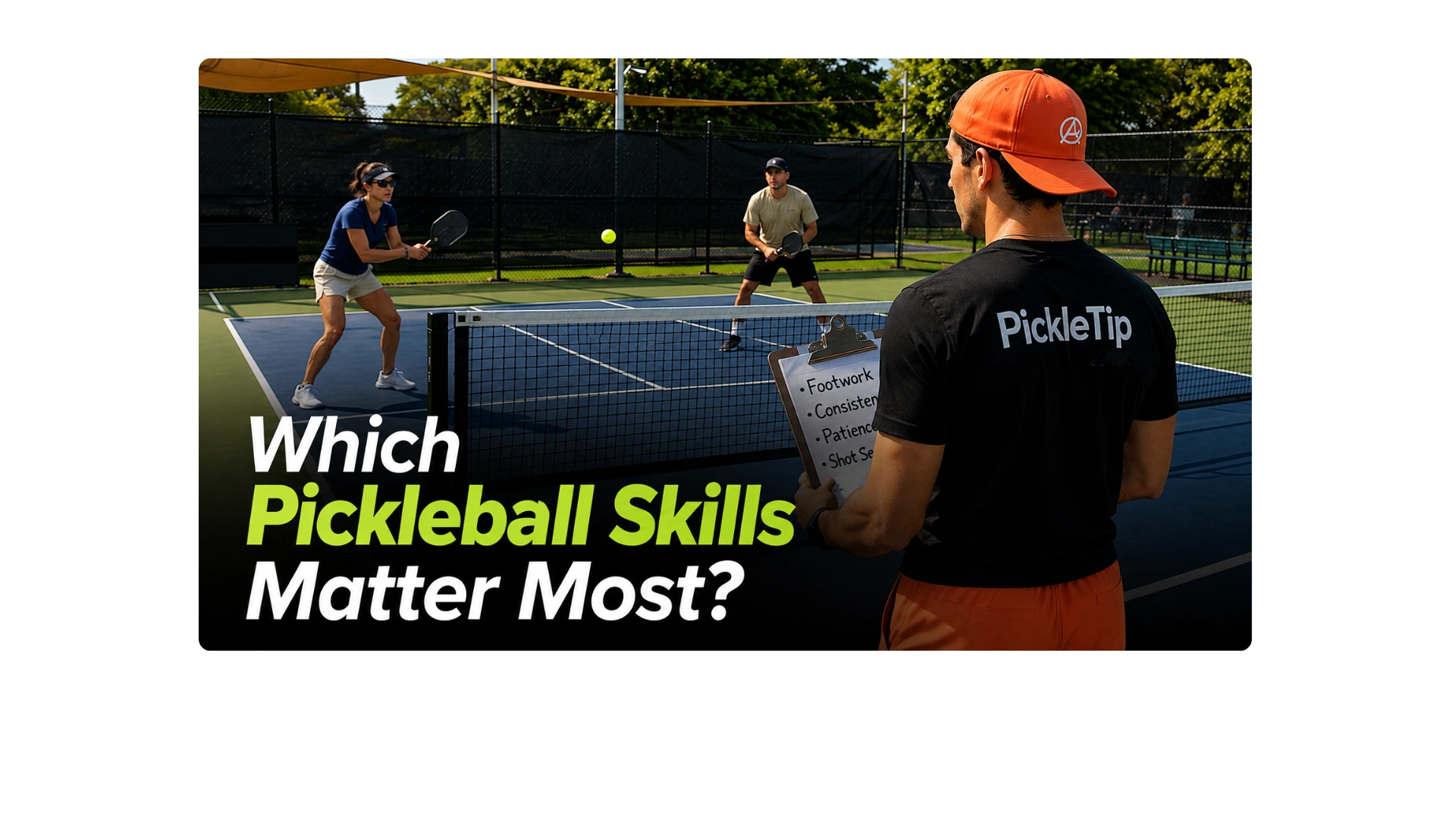
Which Pickleball Skills Matter Most?
Picture this: Late in a match, we are locked in a long dink rally. My partner Patrick is getting jittery, his paddle twitching for a speed-up. I whisper, “Wait.” One more neutral dink. The opponent leans. The ball sits up. We pounce.
The point may look as if it was won by the final attack. But the attack was only available because several quieter capabilities came first: balance, patience, control, recognition, and shot selection.
That is the difference I care about when I rank pickleball skills.
The PickleTip Skill Hierarchy, in One Sentence
The most important pickleball capabilities are not always the shots that finish points; they are the abilities that make more of your game available, repeatable, and usable under pressure.
The PickleTip Skill Hierarchy is my coaching model for ranking those broad player-development capabilities by how much they tend to support the rest of the game. It is not an official USA Pickleball rating system, and it is not a claim that every player should train the same ten things in the same order.
The Barstool View vs. the Coach’s View
This article started with a poolside conversation with my friend Pat. We began ranking pickleball skills, and I noticed how easy it was to rank the game by what looks impressive.
The barstool view tends to notice the visible weapon: the heavy drive, sharp angle, put-away, Erne, speed-up, or fast counter.
The coach’s view asks a different question:
What capability made that shot available in the first place?
A clean counter may depend on positioning and preparation. A great third-shot drop may depend on movement and balance. A smart speed-up depends on recognizing the right ball. A powerful put-away does not matter much if the player cannot reliably reach the point where the put-away appears.
So this hierarchy ranks broad capabilities, not highlight-reel shots.

The Hierarchy at a Glance
| Priority | Capability | Why I Rank It Here |
|---|---|---|
| 1 | Footwork & Balance | Improves your chance of arriving at a usable contact point and making the rest of the stroke work. |
| 2 | Consistency | A useful game has to survive repetition; isolated great shots do not create a dependable level. |
| 3 | Patience | Keeps a player from abandoning a good rally merely because an attack is possible. |
| 4 | Shot Selection | Determines which available tool fits the ball, position, score, and opponent. |
| 5 | Control & Finesse | Lets the player change pace, height, depth, direction, and defensive-to-neutral outcomes. |
| 6 | Speed & Reaction | Matters increasingly as pace rises and exchanges give players less time. |
| 7 | Court Positioning | Changes angles, available space, partner coverage, and how difficult the next ball becomes. |
| 8 | Communication | Turns two doubles players into a coordinated team rather than two people sharing a court. |
| 9 | Serve & Return Quality | Starts every rally and influences whether the serving team or returning team begins from a useful position. |
| 10 | Power | Creates pressure and finishes opportunities, but usually becomes more valuable after the player can create the right opportunity. |
This order is not a law of pickleball. I think of it in terms of developmental leverage: which capabilities make more of the rest of your game actually work.
Coach Sid’s Pickleball Skill Hierarchy
1. Footwork and Balance
I put footwork first because the quality of the contact point depends heavily on where the player arrives and whether the body is balanced enough to use the intended stroke.
That does not mean every miss is a footwork problem. Grip, swing path, timing, recognition, decision-making, visual tracking, and other factors can all matter. But when I coach a player whose strokes look different from ball to ball, I often check the feet before rebuilding the swing.
My coaching shorthand: better feet do not guarantee better contact, but bad positioning makes good contact harder to repeat.
If your feet are the problem, my pickleball footwork guide gets into the movement patterns and how to train them.
2. Consistency
Consistency is the odd one on this list because it is both a skill and the result of several other skills holding together.
A player can have excellent hands, plenty of power, and beautiful technique on individual repetitions but still struggle if the quality disappears when the feed changes, the feet move, the score tightens, or the opponent creates uncertainty.
That is why I rank consistency near the top: your useful level is closer to what you can repeat than to the best ball you can hit once.
If inconsistency itself is the problem you are trying to diagnose, that belongs in the RANGE/FLOOR framework for improving pickleball consistency.
3. Patience
Patience is not passive pickleball. It is the ability to keep playing a useful ball while waiting for the situation to justify something more aggressive.
The Patrick rally from the opening is a good example. The winning attack mattered, but attacking one ball earlier might have converted a neutral rally into our own mistake.
At the kitchen, patience helps a player distinguish between I can speed this up and this is actually a good ball to speed up.
4. Shot Selection
Shot selection is where technique becomes decision-making.
A player can own a good drive and still choose the wrong ball to drive. They can possess a quality drop and use it when another option would create more pressure. They can have fast hands and start an exchange from a position that favors the opponent.
The better your toolbox gets, the easier it becomes to choose a perfectly good shot at the wrong time.
I ran into this myself while working on third-shot drops during recreational games. A high, short return could give me a better opportunity to drive. A deep return that pinned me behind the baseline demanded more margin. Working on the drop made me read those differences more closely; it did not give me permission to force a drop just because that was the skill I was practicing.
That is intentional play: read what this ball allows before deciding what shot you want to hit. My third-shot strategy gets into one of the places that choice shows up most often.
5. Control and Finesse
Control is broader than dinking.
It is the ability to change pace, height, direction, depth, and intent without needing maximum swing speed. Dinks, drops, blocks, resets, rolls, controlled volleys, and changes of pace all depend on some version of this capability.
That makes control especially important when the goal is not to finish the rally immediately but to improve the next ball.
A lot of control is really buying yourself another ball. The reset that gets you neutral can be more useful than the pretty roll flick that tries to win too soon.
6. Speed and Reaction
As the pace increases, players get less time to recognize, prepare, contact, and recover. Faster hands and efficient preparation therefore become more valuable as competition gets faster.
The professional game has also trended toward greater pace and athleticism. That does not make the soft game obsolete. It means players increasingly need to be able to handle speed after the soft game creates or fails to prevent it.
I think of speed as an amplifier. If the player is positioned well and recognizes the ball early, speed helps. If the decision is poor or the paddle is late, moving faster does not automatically solve the problem.
7. Court Positioning
Positioning determines which angles you protect, which balls your partner expects you to cover, and how much court the opponents can attack.
A technically good shot played from poor court position may still leave the next ball difficult. Good positioning can make an ordinary ball much more useful because the team remains connected behind it.
During the Paddles for a Purpose charity tournament, I watched AJ make a small adjustment that showed this in real time. He is naturally aggressive and likes to cover ground, poach, and create angles, but on a few balls his paddle started reaching before his body had finished moving into the best position. When he gave himself the extra movement and arrived first, the attack became easier and he was better prepared for the next ball. Better positioning reduced how much the paddle had to solve.
I break that example down further in my pickleball positioning guide.
8. Communication in Doubles
Doubles adds a capability that singles does not: two players must continually coordinate ownership, movement, expectations, and adjustments. If you are ranking these strictly for singles, communication obviously drops out and court coverage carries more weight.
Communication does not replace positioning or decision-making, but it prevents a surprising number of avoidable problems: hesitation on middle balls, both players chasing the same lob, conflicting switch expectations, and silent disagreements about who is taking what.
If this is where your team keeps breaking down, my doubles communication guide gets into the calls, responsibilities, and partner decisions themselves.
9. Serve and Return Quality
The serve and return are the only shots guaranteed to appear in every normally played rally, so reliability matters at every level.
But I rank them below the broader capabilities because this is not a list of which individual shots matter most. A good serve or return still depends on balance, control, consistency, intent, and what the player does next.
Use the dedicated pickleball serve and return of serve guides for those individual skills.
10. Power
Power is tenth because of what has to come before it, not because power does not matter.
A hard drive can shrink reaction time. A powerful overhead can end a rally. Pace can force blocks, create pop-ups, and punish balls that sit too high.
I put power tenth because its value rises dramatically when the player already knows when, where, and from what position to use it.
Power is a useful weapon. It is a poor substitute for arriving balanced, recognizing the right ball, and choosing a target.
The Hierarchy Is Really a Dependency Map
The numbered list is useful, but the deeper idea is not that Skill #3 always matters more than Skill #4.
It is that some capabilities tend to support several others.
| Layer | Capabilities | What They Tend to Support |
|---|---|---|
| Foundation | Footwork, balance, consistency | Repeatable contact and a game that remains available from ball to ball |
| Control | Patience, finesse, serve/return quality | Neutral balls, rally tolerance, changes of pace, and reduced self-created pressure |
| Decision | Shot selection, positioning, communication | Using the right tool from the right place with the partner expecting the same thing |
| Pressure | Speed, reaction, power | Taking time away, defending pace, countering, and finishing opportunities |
That is also why a visible problem can have an upstream cause. A player who says, “My hands are too slow,” might actually be starting with the paddle late or standing in a poor position. A player who says, “My drops disappeared,” may be reaching the ball off-balance. A player who says, “I need more power,” may really need better selection so the power they already have gets used on the right ball.
I see the same thing during lessons when I ask players what went wrong. They will often call every bad choice a strategy problem, but sometimes they never saw the moving opponent. Sometimes they misread the ball. Sometimes the read was right and the risk was wrong. Sometimes the decision was fine and the execution failed. Once you identify where the breakdown actually started, “play smarter” finally becomes something you can practice. That is the same diagnostic idea I use in my Pickleball IQ framework.
You still have to figure out which explanation is yours. The hierarchy tells you where I would start looking.
How Priorities Change as Players Improve
The order does not stay equally important as a player improves.
USA Pickleball’s published skill-level descriptions illustrate why. Developing players are still working toward reliable strokes, serve and return depth, sustained dinking, basic third-shot development, reduced unforced errors, court positioning, and recognition of hard versus soft play. Higher-level descriptions add more consistent depth and control, offensive intent, resets, counters, advanced positioning, and greater strategic adjustment.
That progression matches what I see as a coach: as basic execution becomes less fragile, decision quality and performance under faster, less predictable conditions matter more.
| Development Stage | Capabilities I Usually Emphasize More | Why |
|---|---|---|
| Developing player | Reliable contact, footwork, serve/return, basic control | The player needs enough stability to keep rallies alive and reach useful positions. |
| Intermediate player | Consistency, transition control, patience, positioning, shot selection | The toolbox is growing, so repeated execution and better choices begin separating players. |
| Advanced competitive player | Recognition, disguise, speed handling, counters, tactical adjustment | Basic competence is assumed more often, so smaller timing and decision advantages become more valuable. |
I saw the advanced end of this in a best-of-three match I studied on film. One team won Game 1, 11-0, with fast hands, pressure, and aggressive movement, then lost the next two games 11-5 and 11-4 after the opponents adjusted. The weapons did not disappear. The match simply started asking a harder question: could those weapons survive once the first pattern stopped working? The point I kept coming back to was often not the final error but the ball two shots earlier, where a low-percentage speed-up or poor court position started the leak. I break down that match in Why You Lose After Winning Game 1.
Those are coaching emphasis bands, not rating definitions. A 3.5 player can have elite speed and weak footwork. A 4.0 player can return beautifully and struggle with patience. A rating does not create a perfectly uniform skill package.
As execution gets less fragile, the question becomes less “Can you hit this shot?” and more “Can you recognize the right ball, choose the right shot, and execute it when the rally gets uncomfortable?”
Why Speed Matters More as the Game Gets Faster
The highest levels of pickleball have become faster and more athletic. The PPA has described the professional game as moving toward a faster pace as younger athletes entered the sport.
But I would not describe that as “finesse is disappearing.” Quite the opposite: control often helps players survive long enough to choose when speed becomes advantageous.
A common pattern is:
- Neutralize — use a drop, dink, block, or reset that prevents the opponent from immediately attacking down.
- Recognize — identify a ball, position, or opponent movement that creates a better attacking window.
- Accelerate — use speed when the situation justifies taking time away.
- Recover — expect the counter instead of admiring the speed-up.
So the developmental lesson is not “soft game or speed.” It is learning enough control to create useful balls and enough speed handling to survive what happens when the rally accelerates.
How to Use the Skill Hierarchy Without Training Everything at Once
Do not turn the rankings into Week 1 footwork, Week 2 consistency, Week 3 patience. Players do not improve that neatly, and the highest-ranked capability is not automatically the thing you need to work on next.
Use the Hierarchy This Way
- Notice the recurring limitation. What keeps preventing your game from working the way you expect?
- Look upstream. Is the visible miss really the problem, or is a broader capability making several shots unreliable?
- Choose one priority. Do not turn all ten capabilities into this week’s checklist.
- Train that problem. Use the right drill, diagnosis, or improvement plan for the priority you actually found.
If you know the broad capability but need an overall development process, use the GROW Plan for how to improve at pickleball. If you are still trying to identify the recurring weakness worth addressing, use the LEAK framework and practical pickleball tips. Once the actual problem is clear and you need the right exercise, the DRILL framework handles drill selection and practice progression.
The hierarchy asks, “Which broad capability has the most leverage?” Once you know that, the next question is what to practice.
Pickleball Skill Hierarchy FAQs
In Coach Sid’s hierarchy, footwork and balance rank first because positioning affects how repeatably a player can use many other skills. That does not mean every mistake is caused by footwork or that every player should train footwork first.
Consistency reflects whether useful shots and decisions survive repetition, movement, changing feeds, and pressure. A player’s dependable level is closer to what can be repeated than to the best ball they can hit once.
Power is valuable for creating pressure and finishing opportunities, but it becomes more useful when the player is balanced, recognizes the right ball, chooses an appropriate target, and can recover for the next shot. That is why power ranks lower in this developmental model.
Yes. Developing players generally need enough stroke reliability, movement, depth, and control to keep the game stable. As those abilities improve, shot selection, positioning, speed handling, counters, disguise, and tactical adjustment can become more important differentiators.
Not automatically. The hierarchy ranks broad developmental leverage, not the next exercise for every player. A beginner should identify the limitation that is actually holding back their game and then choose an appropriate improvement plan or drill.
Use the hierarchy to look upstream from a visible mistake and identify the broad capability that may have the most leverage. Then choose one priority and train that problem with the right drill or improvement plan instead of trying to work on all ten capabilities at once.
Back to the Pool

Pat and I started this whole argument sitting by the pool, ranking the skills that looked most important. Somewhere along the way, we realized we were really arguing about two different lists: the shots everybody notices and the capabilities that make those shots possible.
I still think that is the useful question.
Do not ask only, “What shot am I missing?” Ask, “What broader capability keeps making several parts of my game harder than they need to be?”