
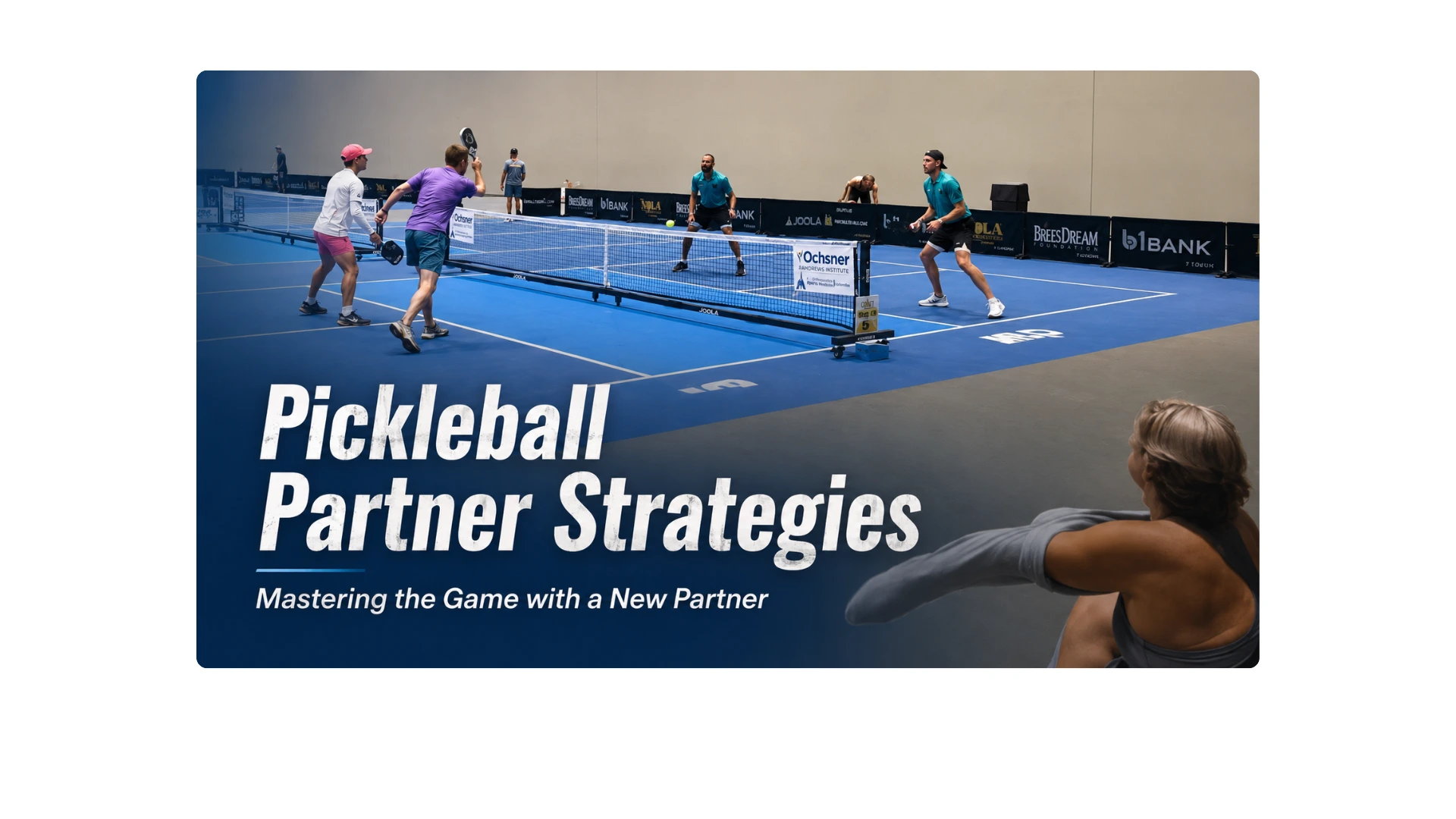
Playing Pickleball With a New Partner: Build a Plan Fast
When you play pickleball with a new partner, do not try to build perfect chemistry before the first point. Build a simple game plan. Agree on preferred sides, middle responsibility, third-shot tendencies, poaching comfort, and what each player should do when the rally becomes uncertain.
The goal is not to learn everything about each other immediately. It is to remove the surprises that create the easiest mistakes. A new team can compete well before the partners develop instinctive chemistry, but both players need to know what the first plan is and how they will adjust it.
I saw this clearly when my son AJ entered the Drew Brees NOLA Pickle Fest at the 4.5 level with a new partner, Evan. Both players had enough individual skill to compete. They could both play. They just were not expecting the same thing to happen next.
One player expected movement that the other did not anticipate. A ball that seemed obvious to one partner looked uncertain to the other. The shots were there. The problem was that one player’s drive, drop, or movement did not always mean the same thing to the other player.
With a new partner, simplify before you specialize. Establish a few dependable responsibilities before adding stacking, aggressive poaching, complicated signals, or rehearsed plays.
The FAST Plan for Playing With a New Partner
- F — Find your starting roles. Decide preferred sides, return positions, middle defaults, and who is most comfortable creating offense.
- A — Agree on the first responsibilities. Decide who takes the middle, how you will handle switches and lobs, and what movement either partner can call during the match.
- S — Simplify the first game plan. Use high-percentage patterns that both players understand before adding complicated tactics.
- T — Test one adjustment at a time. When something breaks down, change one responsibility or pattern and give it enough points to learn whether it works.
FAST is not a shortcut to long-term chemistry. It is a way to compete before that chemistry exists. It will not fix every partnership. A simple plan cannot erase a major skill gap, calm a partner who panics after every mistake, or make two completely different playing styles fit overnight. What FAST can do is show you whether the team has a real compatibility problem or is simply losing points to preventable confusion.
Start Simple, Then Build From There
Get through the first match with a simple plan both players understand. Once that foundation feels steady, build stronger team patterns with these pickleball doubles strategies, add dependable calls and hand signals, and keep developing the trust that creates better pickleball team chemistry.
What to Discuss Before the First Game
You do not need a thirty-minute strategy meeting. You need enough information to prevent both players from making different assumptions about the same ball.
Before the match, answer these questions:
- Which side does each player prefer?
- Who normally takes middle balls?
- Does either player prefer to drive most third shots?
- Does either player want the partner to crash after a drive?
- How comfortable is each player with poaching?
- Will the team stack, partially stack, or stay traditional?
- Who handles lobs through the middle?
- What simple change can either partner call during the match?
You can change every one of those answers later. For now, two imperfect players following the same plan beat two players following different good plans.
At the 3.0 or 3.5 level, preferred sides, middle responsibility, and moving forward together will solve most of the immediate confusion. Higher-level teams can add planned poaches, stacking, and more detailed third-shot patterns once those first responsibilities are clear.
Choose Preferred Sides Without Turning Them Into Permanent Property
Preferred sides matter because they affect middle coverage, forehand opportunities, return movement, stacking, and which player is most comfortable creating offense.
A typical right-handed team may place the more aggressive forehand on the left side so that player can cover more middle balls. But that is not the only workable setup. Mobility, backhand quality, return consistency, handedness, and defensive comfort can all matter more than a simple forehand-middle rule.
Ask each other:
- Where do you normally play?
- Which side gives you the better return?
- Who is more comfortable taking forehands through the middle?
- Who handles pressure better on the backhand side?
- Would switching sides improve the matchup against these opponents?
A preferred side is the starting plan, not permission to guard a permanent half of the court. Both players still have to shift with the ball and protect the openings created by the rally. When those shifts still feel awkward, these pickleball court coverage principles will help both partners move together instead of protecting separate boxes.
Agree on the Middle Before It Becomes a Problem
New partners often lose middle balls in two opposite ways. Either both players hesitate because neither knows who should take it, or both players attack the same ball and collide paddles.
Choose a default:
- Forehand usually takes the middle.
- The player in the stronger position takes it.
- An early call overrides the default.
- After a switch, the new court positions determine responsibility.
The default should reduce hesitation, not encourage one player to reach across bad balance. Lefty-righty teams and balls moving across the X need a little more judgment than “forehand takes middle.” I break those exceptions down in the pickleball middle shot strategy guide.
The worst middle strategy is two players silently assuming the other person sees the ball the same way.
Tell Your Partner What Your Third Shot Usually Means
A new partner does not automatically know what you plan to do after a third-shot drive, drop, or hybrid.
One player may drive expecting the partner to crash. The partner may stay back because the drive was low and hard. One player may hit a drop and advance. The partner may judge the same ball as too high and stop. That difference creates the one-up, one-back gap before the opponents even contact the ball.
Before the match, explain your normal tendencies:
- “I usually drive a short return.”
- “When I drive, look for a weak block but do not crash automatically.”
- “I prefer to drop deep returns and work forward in stages.”
- “If my drop sits high, I will call us off.”
- “If the returner is late moving forward, I may drive at the feet.”
The team still has to read the actual return. These are tendencies, not promises. When the return makes the choice less obvious, this third-shot strategy will help you decide when to drive, drop, or use a hybrid without leaving your partner guessing.
Add Poaching or Stacking Only When It Solves a Real Problem
Poaching and stacking can both help a new team, but they also ask the partner to process more movement before the partnership has developed automatic habits.
Poaching and stacking are fine when they solve a problem. They are not worth much when all they do is give a new partner more places to get lost. Maybe stacking keeps the stronger forehand in the middle. Maybe one planned poach takes away an opponent’s predictable return. Those are useful reasons. “This is how I normally play” is not always enough when the person beside you is still learning where you will be.
Before adding either tactic, make sure both players know:
- what movement is expected,
- which part of the court opens when one player moves,
- whether the partners switch or recover to their original sides,
- and what happens when the expected ball never arrives.
If a poach surprises the partner or stacking makes the returner late, go back to normal positions. A simpler formation that both players understand is better than an advanced pattern that leaves one player guessing.
Added complexity has to create a real advantage. When a predictable return gives you a poaching opportunity, these pickleball doubles plays will help both partners cover the movement. When stacking actually gives your team an advantage, these stacking positions and signals will help you do it without spending half the game asking where everybody belongs.
Use the First Game to Compete and Learn
A new team should not enter the first game with eleven different plans. Start with a few high-percentage priorities, then pay attention to how your partner actually plays when the point speeds up.
Serving Team
- Serve with safe depth.
- Let the return determine the third shot.
- Advance on the same read.
- Do not force the first attack.
Returning Team
- Return deep and move forward.
- Protect the early kitchen advantage.
- Let good drops bounce when reaching would break balance.
- Keep middle responsibility clear.
While you play those simple patterns, notice the details that affect the next decision. Does your partner usually drive a short return? Do they move immediately after a drop, or wait to see the opponent’s contact? Do they counter pace or prefer to reset? Which middle balls make them hesitate? How do they recover after being pulled wide?
You are not collecting faults for a postgame argument. You are learning what the partnership needs. The first game should help you spot the clearest team pattern to address next, not give you eleven reasons to rebuild the entire strategy.
Once these first-game priorities feel settled, the pickleball doubles strategy guide will help you turn them into a fuller plan for serving, returning, transitioning, and attacking together.
Make One Adjustment at a Time
New partners often overreact after losing a few points. They change sides, alter the third-shot plan, increase poaching, start stacking, and give each other technical advice—all before determining which problem actually caused the loss.
Instead, diagnose one repeatable pattern:
| What keeps happening? | Likely team problem | First adjustment |
|---|---|---|
| Middle balls keep dropping untouched | No agreed default or calls are too late | Choose one middle rule and call exceptions early. |
| One player reaches the kitchen alone | Partners are judging the third shot differently | Let the opponent’s contact decide whether both players advance. |
| Partner gets surprised by counters | Attacks are not predictable to both players | Identify the intended target and likely reply before speeding up. |
| Poaches open the sideline | The movement is not planned or the partner is not covering behind it | Limit poaching to one clear pattern. |
| Stacking creates late movement | The formation is adding more complexity than value | Return to normal positions temporarily. |
| Both players keep changing the plan | Too many corrections are being discussed | Choose one tactical adjustment and test it for several points. |
A new partnership does not need more information after every point. It needs one useful adjustment that both players can execute.
Keep Between-Point Communication Tactical
During the match, keep feedback short enough that the next point still has a clear plan.
- “I will take middle when the ball goes crosscourt.”
- “Let us both hold when that drop sits high.”
- “I am driving the short return. Look for the weak block.”
- “Stay on your side after the poach.”
- “Let us stop stacking on the return.”
- “Give me the next two lobs through the middle.”
Avoid speeches, mechanical lessons, or vague statements such as “play smarter.” The call should tell both players what changes on the next point.
When short verbal calls are not enough, these pickleball doubles communication examples will help you add clear rally language, hand signals, and switching calls.
What to Do When Your Partner Is Being Targeted
Opponents may immediately test the player they believe is less comfortable. Do not assume the answer is for the stronger player to cover more and more court.
First identify the exact ball causing the pressure:
- A short return
- A backhand dink that sits high
- A body speedup
- A transition reset made while moving
- Unclear lob responsibility
- An impatient attack after several neutral balls
Then respond as a team. Change the return target, protect a specific lane, alter middle responsibility, reduce exposure to the weak pattern, or simplify the next tactical job.
Do not erase the partner from the court. A player who no longer knows which balls are theirs becomes even harder to play beside. These pickleball doubles defense strategies show how to protect a pressured partner without trying to play the entire court for them.
What Happened With AJ and Evan
I could tell during the first match that AJ and Evan did not yet know how to play together. They had played against each other plenty of times, but playing beside someone is different from knowing what they like to do from the other side of the net.
One point made the problem obvious. A slightly high ball floated through the middle, and both players looked at each other before either one tried to hit it. By the time someone finally reacted, both paddles came forward and clashed. It was not a difficult ball. Neither player knew whose ball it was supposed to be.
Watching from the sideline, the problem looked less like shot quality and more like two players reading the same rally differently.
AJ and Evan lost their first two matches. Before the third match, they talked with coach Terri Lamperez about what kept breaking down. Her advice was simple: let the forehand take the middle. They did not need a complicated system. They needed one clear rule that removed the hesitation.
That agreement also clarified the responsibilities on each side. When either player was on the left, the left-side forehand had the first look at appropriate middle balls. The player on the right understood that his job was to give that forehand room while staying ready to protect the remaining court. They had both been comfortable with that arrangement; they simply had not agreed on it before the first two matches.
Those same middle balls looked completely different beginning with the third match. Instead of both players waiting or reaching at the last second, the left-side forehand stepped in and ate them up while the right-side player stayed balanced and protected the rest of the court.
AJ and Evan won their third and fourth matches decisively. In their fifth match, they played well but lost 11–8 to a strong team that made fewer errors.
One conversation did not give them instant chemistry. It gave them one less reason to hesitate. Once both players understood the middle responsibility and what was expected from each side, their individual skills finally had room to work together.
The ball did not change. The players finally agreed on whose ball it was.
What to Review After the Match
Do not replay every missed shot. Review the few partnership patterns that kept showing up:
- Which starting positions felt most natural?
- Where did middle or third-shot movement become uncertain?
- Did poaching or stacking create enough value to keep using?
- Which agreement should carry into the next match?
That is enough for the review. As you play more matches together, trust, film study, emotional support, and learning how your partner responds under pressure will build better pickleball team chemistry.
Three Drills That Build Shared Decisions
1. Third-Shot Read Drill
Play the serve, return, and third shot from normal positions.
Both partners call “move,” “hold,” or “reset” according to what the third shot produced.
The goal is for both players to make the same movement decision before the opponent contacts the ball.
2. Middle Responsibility Drill
Feed balls through the middle from different angles and depths.
Use the agreed default unless an early call changes responsibility.
The goal is no untouched middle balls, paddle collisions, or late debates about ownership.
3. One-Adjustment Game
Play a short game to seven.
The team may choose only one tactical adjustment during the game.
Decide whether that adjustment changed the targeted pattern before introducing another one.
Once these shared-decision drills become comfortable, use these additional pickleball drills to sharpen the individual shots behind the team patterns.
New Pickleball Partner Checklist
- Preferred left and right sides
- Default middle responsibility
- Third-shot drive, drop, and crash tendencies
- Poaching comfort and recovery responsibility
- Stacking plan, if any
- Lob and overhead responsibility
- Simple rally calls
- A simple change either partner can call
- The main pattern to review after the match
Questions About Playing With a New Pickleball Partner
The left-side player is often the person with the stronger middle forehand or more aggressive offensive role, but mobility, return quality, backhand strength, handedness, and defensive comfort also matter. Treat preferred sides as a starting plan rather than permanent court ownership.
Stack when both players understand the movement and preferred sides create a clear advantage. Avoid stacking when it causes late returns, open court, confusion, or more stress than the original formation.
Identify the repeatable breakdown, agree on a specific response, and keep it in place long enough to judge the result. Changing sides, stacking, poaching, shot selection, and communication all at once makes it difficult to know what actually helped.
Talk about the repeatable ball or decision, not the person. Instead of saying, ‘You keep missing your backhand,’ agree on something useful for the next point, such as changing the return target, protecting that lane together, or letting a difficult ball bounce. A new partner needs a clear job, not a running list of mistakes.
Discuss preferred sides, middle responsibility, third-shot tendencies, poaching comfort, stacking, lob responsibility, and the simple adjustment either partner can call. The goal is to remove the biggest tactical surprises before the first point.
Build the First Plan Before You Expect Instincts
A new partner does not need to play exactly like your regular teammate. The partnership needs a shared starting plan, clear responsibilities, and enough patience to test one adjustment at a time.
Give the partnership one clear place to begin. You can learn the rest while the points are being played.
You may not trust each other’s instincts yet. You can still agree on the first plan.

You spelled Drew Brees wrong! It’s not Breese.