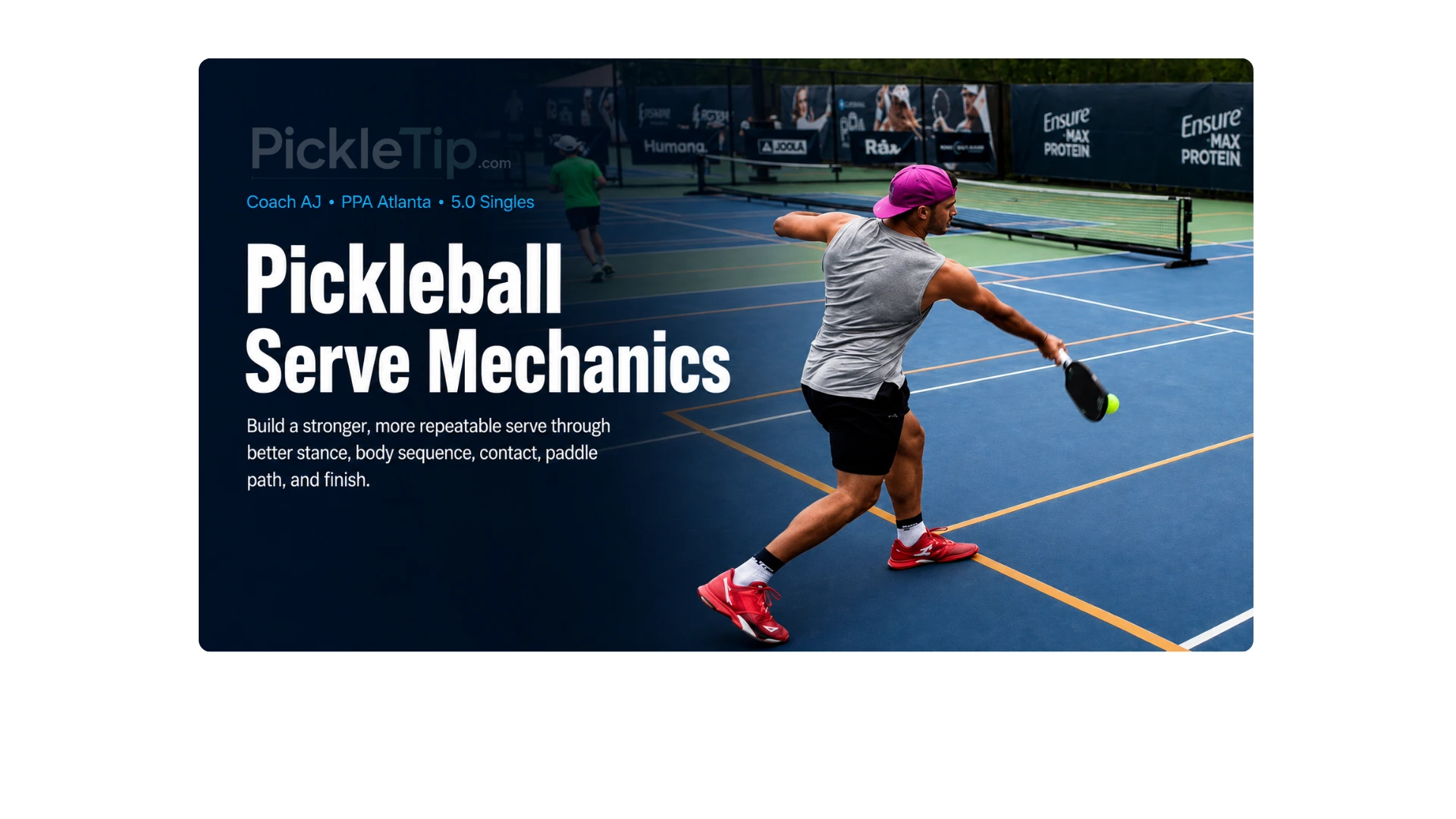
Pickleball Serve Mechanics: Build a Repeatable, Powerful Serve
I learned the hard way that swinging harder is not the same thing as serving harder.
I had a serve that looked aggressive, but the ball kept telling a different story. Some landed short. Others sailed long. When I tried to create more pace with my arm, the rest of the motion became less predictable.
The useful breakthrough was not a secret technique. It was understanding that a good pickleball serve is a coordinated motion: stable setup, repeatable contact, enough body contribution to keep the arm from doing everything, and a swing that sends the ball where you intended.
Quick take: Build your serve around five jobs: set a repeatable base, move through the ball without losing balance, create a dependable contact window, control the paddle path through contact, and finish in a position that leaves you ready for the return. Measure whether those mechanics actually produce legal serves and useful depth before chasing more pace or spin.
A powerful serve is not the one that feels violent. It is the one where more of your motion reaches the ball without making contact less predictable.
This is where I want to stay focused on the motion itself: stance, body sequence, contact, paddle path, follow-through and how to practice all of it.
- New to serving? Start with Pickleball Serves for Beginners.
- Unsure whether your serve is legal? Use Pickleball Serving Rules.
- Trying to fix a recurring miss? Use Pickleball Serving Mistakes.
- Deciding where to aim? Use Where to Serve in Pickleball.
- Already reliable and ready for more pace, spin or disguise? Use Advanced Pickleball Serve.
- Serve changes when the score gets tight? Use the SERVE pre-serve routine.
The Five Jobs Every Repeatable Pickleball Serve Has to Solve
I find it more useful to think in jobs than in body-part instructions. Two players can look different and still solve the same mechanical problems.
| Job | What you are trying to create | What failure often looks like |
|---|---|---|
| Base | Stable feet and posture before the motion begins | Body position changes every rep |
| Move | Coordinated weight transfer and rotation without unnecessary jumping or drifting | Arm dominates or balance disappears |
| Contact | A strike point you can reproduce | Launch angle and direction keep changing |
| Path | A paddle traveling predictably through the ball | Face and swing direction change at the last instant |
| Finish | A complete motion that leaves you balanced for the return | Deceleration, steering or falling through the shot |
Your serve does not need to look like someone else’s. It needs to solve the same jobs often enough that the ball stops surprising you.
Serve Stance: Build a Base Your Swing Can Repeat
Your stance does not need to match one exact template. It does need to give you balance, room to swing and a starting position you can recognize from one serve to the next.
If your feet, posture and distance from the ball change dramatically every rep, your upper body has to solve a slightly different swing every time.
- Stay athletic: enough knee and hip flexion that you can move naturally without squatting or standing rigid.
- Give the hitting arm room: do not crowd yourself so closely that the paddle has to escape around your hip.
- Use a repeatable foot relationship: open, semi-open and somewhat closed setups can all work. What matters is that your chosen setup supports the motion you can repeat.
- Protect your balance: body movement should support the serve rather than force your swing to rescue you at contact.
I like having a little space behind the baseline rather than crowding it. That gives me room to move naturally without making the line itself part of the swing thought. The exact foot-fault requirements belong in the serving rules guide.
If your setup changes every rep, your swing spends every rep solving a new problem.
Grip: Control the Paddle Without Choking the Swing
The grip is one of the easiest places to create unnecessary variation.
I want enough grip pressure that the paddle face does not feel loose or unpredictable, but not so much tension that the hand, forearm and shoulder become one rigid piece.
A neutral or continental-style starting grip works well for many players because it provides a straightforward paddle orientation and leaves room for different serve shapes later. It is not the only grip capable of producing a good serve.
- Pick a grip you can reproduce. Constantly changing hand position makes it harder to know whether the next ball changed because of your swing or your grip.
- Avoid unnecessary tension. If squeezing harder makes the swing shorter and more mechanical, back off.
- Let experimentation earn its way into your game. If you change the grip, compare the result against your normal serve instead of assuming different automatically means better.
The Kinetic Chain: Let the Body Contribute Without Forcing a Formula
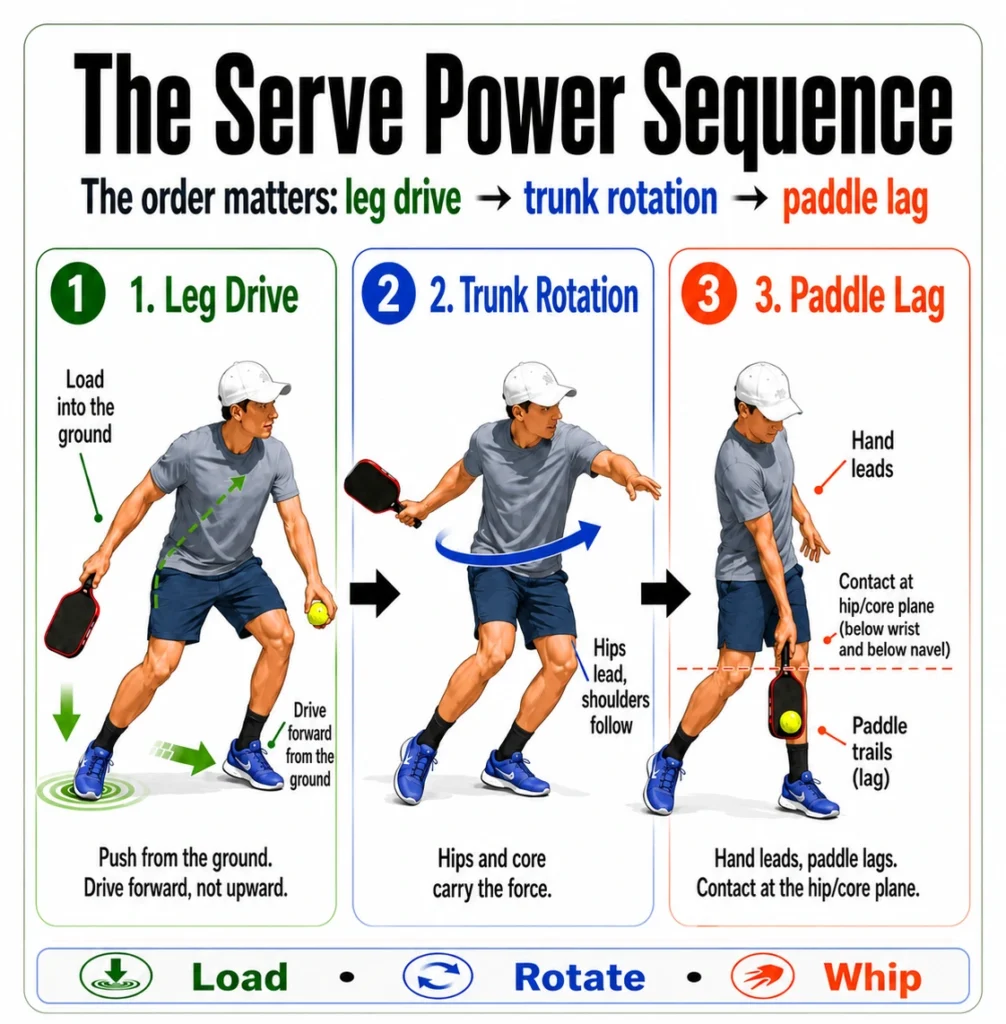
The phrase kinetic chain sounds technical, but the practical idea is simple: the paddle does not have to create all of its speed by itself.
Your interaction with the court, weight transfer, hips, trunk, shoulder, arm and paddle can contribute to one coordinated motion. The exact timing and appearance will vary from player to player.
What I do not want is a player trying to manufacture six separate body movements because somebody gave them a biomechanical checklist.
What coordinated power feels like
- You do not feel as if the arm has to suddenly rescue the serve.
- Your body moves toward the shot without carrying you out of balance.
- The paddle accelerates naturally through the hitting zone rather than being forced to max speed immediately.
- You can add a little pace without the entire motion changing shape.
That is the lesson I had to learn with my own arm-heavy serve. The harder I asked the arm to work, the less predictable the rest of the motion became. I was adding effort faster than I was adding useful ball speed.
For some players, you will see a clear back-to-front weight transfer. Others use less visible transfer and more rotation. Some show noticeable paddle lag. Others produce an efficient serve without an exaggerated lag position.
The kinetic chain is a coordination problem, not a choreography contest.
Weight Transfer Without the Lunge
If you begin with more pressure on the back side, allow that pressure to move naturally toward the front as the swing develops. I am looking for useful forward contribution, not a lunge.
If your torso keeps drifting after your hitting zone has already passed, contact can move with it. That is when a serve that felt normal can suddenly launch differently.
Rotation Without Flying Open
Rotation can help connect the lower body to the hitting arm, but more rotation is not automatically better.
If turning harder causes the shoulders to fly open early or pulls the contact point sideways, you have created motion without creating a better serve.
Paddle Lag: Let It Happen, Don’t Pose for It
Paddle lag describes the paddle head trailing the hand or arm during part of the acceleration before moving through contact.
It can be a visible result of a relaxed, sequenced swing. I do not teach players to force the paddle into a dramatic lag position.
If trying to “create lag” makes your wrist floppy, your contact late or your paddle face unstable, stop chasing the appearance and go back to a smooth swing.
Lag is useful when it emerges from the swing. It becomes a problem when you pose for it.
Contact Window: Make One Part of the Swing Boring
If I could make one part of every player’s serve boring, it would be contact.
When contact moves around, everything downstream becomes harder to interpret. A miss might look like a power problem when the ball was simply struck farther back, farther to the side or with a different paddle face.
- Give the ball space: contact should not feel jammed against your hip or body.
- Find a repeatable location relative to you: rather than chasing an exact inch measurement, look for a contact relationship you can reproduce.
- Let the swing continue through it: contact is not where the paddle should suddenly stop, steer or panic.
- Compare good and bad reps: if you film your serve, the location of the ball relative to your body is one of the first things worth comparing.
There is an important rules boundary here. A volley serve and a drop serve do not have identical contact restrictions under the current USA Pickleball rules. The legal contact details differ enough that I keep them separate from the mechanical cue. Use Pickleball Serving Rules for the maintained explanation or check the current USA Pickleball rulebook.
Paddle Path and Paddle Face: Direction Before Decoration
At contact, I am watching two things:
- where the paddle is traveling, and
- where the paddle face is pointing.
When either one changes at the last instant, the ball usually notices.
I do not try to freeze the wrist or make the paddle face literally motionless. The swing is dynamic. The useful goal is controlled change rather than last-second manipulation.
If your paddle repeatedly wraps across the ball before you have sent it toward the target, you may see wide misses. If the face opens unexpectedly, trajectory can climb. If you decelerate and guide the paddle, depth often suffers.
The ball only knows what the paddle was doing when they met. Make that meeting repeatable.
Follow-Through: A Result and a Diagnostic
I do not think of follow-through as something that magically controls the ball after contact. The ball is already gone.
What the finish does tell me is whether the motion continued naturally through contact or whether the player slowed down, steered, chopped or lost balance.
- Complete the motion: do not slam on the brakes at contact.
- Stay balanced: the finish should leave you able to organize for the next ball.
- Use the finish as evidence: when good and bad serves finish differently, investigate what changed earlier in the swing.
The follow-through does not fix the ball after contact. It tells you whether the swing was still committed when contact happened.
How Spin Changes the Basic Pickleball Serve
You do need to understand how spin changes the basic motion, but I would not start building specialty serves until the base swing behaves.
You can change the shape of the ball without rebuilding your whole serve. Most of that change comes from how the paddle travels into contact and what the face is doing when it gets there.
- Topspin: a more upward brushing component creates forward rotation.
- Lateral sidespin: more across-the-ball travel can create sideways rotation.
- Flatter contact: more of the available paddle speed is directed through the ball rather than around it.
The more aggressively you change the path or face, the more you need to verify that the serve is still repeatable.
For a dedicated lateral-sidespin changeup, use the pickleball slice serve guide. For building a broader portfolio of pace, shape and disguise after the base serve is reliable, use the advanced serve guide.
How to Build a Repeatable Pickleball Serve
Here is the progression I would use if the goal is not a flashy serve but a motion you can actually train.
Build a repeatable pickleball serve by stabilizing the setup, coordinating the body, reproducing contact and measuring the ball that comes out.
- Set a Repeatable Base
Choose a balanced stance that gives the hitting arm room and can be reproduced without unnecessary foot movement.
- Use a Smooth Body-Supported Motion
Allow weight transfer and rotation to contribute naturally instead of asking the hitting arm to create all of the speed by itself.
- Reproduce the Contact Window
Give the ball space and strike it in a location relative to your body that you can recognize and repeat.
- Send the Paddle Through the Ball
Use a predictable swing path and controllable paddle face rather than steering or changing direction at the last instant.
- Finish Balanced
Let the motion continue after contact and finish in a position that leaves you ready to respond to the return.
- Measure the Result
Track legal makes, useful depth and the repeated miss pattern. Let the ball tell you whether the mechanics are becoming more reliable.
Start With a 30-Serve Baseline
Before changing your serve, collect a small baseline.
Hit 30 normal serves. Do not try to perform for the test. Use the serve you would actually hit in a game.
| Track | What it tells you |
|---|---|
| Legal serves in | Your current reliability |
| Useful depth | Whether the serve is actually pushing the returner away from comfortable contact |
| Repeated miss | The pattern worth diagnosing instead of reacting to one bad ball |
| Balance after contact | Whether the motion is leaving you organized for the return |
I would define your depth target before the set. You might use the back third of the service box or another clearly marked zone. Do not move the definition halfway through because the numbers hurt your feelings.
For this drill, I call a serve usefully deep when it reaches the deep target you chose before the set, not merely when it lands in.
For the full strategic definition of the Deep Window and which lane to choose, use Where to Serve in Pickleball.
Before you fix a serve, learn what your serve actually does.
The One-Variable Serve Drill
Serve practice gets messy when you change your stance, grip, contact point, swing speed and target all at once.
Instead, choose one mechanical variable.
- stance stability
- amount of weight transfer
- contact location
- swing direction
- finish and balance
Hit 10 serves with your normal motion. Then make one small change and hit another 10. Compare what happened.
If the result improves, repeat the test. If the result gets worse, you learned something too.
Change one thing. Hit enough balls to see a pattern. Then decide whether the change earned another set.
The Three-Speed Mechanics Test
This is one of my favorite ways to see whether extra pace is exposing a mechanical limit.
- Hit 5 serves at an easy pace.
- Hit 5 at your normal match pace.
- Hit 5 slightly faster than normal.
Keep the target generous and do not intentionally change the rest of the motion.
If the easy and normal groups stay recognizable but the faster set causes contact, balance or direction to break down, you have found a current speed ceiling.
I have taught the same idea another way: find your usable limit. More speed is only useful while the serve still gives you something back for the risk. The Three-Speed Test gives that limit a mechanical check instead of asking you to guess from feel.
Your mechanics ceiling is the fastest serve speed you can use before contact, direction or balance starts changing shape. The fastest ball you can hit once is not the same thing as the fastest serve you own.
Train near the fastest speed where the motion still behaves, rather than repeatedly rehearsing the speed where it falls apart.
Film the Serve to Find What Changes First
Video is useful when you use it as a comparison tool rather than a beauty contest.
Film a small set without changing anything. Then compare a few good serves with the repeated miss.
| Camera view | Useful things to compare |
|---|---|
| Side | Body drift, contact location, balance, acceleration and finish |
| Behind / back corner | Swing direction, lateral contact movement, starting line and recovery position |
Do not try to diagnose fifteen joints. Find the first obvious difference between the serve that behaves and the one that does not.
I learned this long before I started coaching pickleball. After more than 30 years coaching basketball, baseball, football and now pickleball, the same problem keeps showing up: the visible mistake and the cause of the mistake are not always the same thing.
A ball going long tells me what happened. It does not tell me why. Two players can miss long for completely different reasons. One may drift through contact. Another may open the paddle face. The ball gives me a place to start looking, not permission to declare the cause before I check the swing.
If every serve looks different, rebuild the base motion. If the motion looks the same and one miss keeps showing up, diagnose the miss.
If you already have a recognizable motion and want symptom-specific diagnosis for net, long, wide, short or pressure misses, that is the job of Pickleball Serving Mistakes.
PickleTip Serve Mechanics Scorecard
I like numbers, but they need to be labeled correctly.
The targets below are PickleTip practice benchmarks, not official standards and not universal skill-rating requirements. Their purpose is to make improvement visible.
| Measure | What I want to see | Why I track it |
|---|---|---|
| Serve-in rate | Trend toward 9 of 10 or better in controlled practice | The motion has to start the point before added pace or variety matters |
| Useful-depth rate | Improve from your own baseline using one defined deep target | Separates merely legal serves from serves that make the returner respect depth |
| Repeatable miss | One recognizable pattern rather than several unrelated misses | A repeated problem is easier to diagnose than chaos |
| Balanced finish | Finish ready on most normal reps | Shows whether the motion is surviving contact without unnecessary recovery |
I would rather see a player move from 18/30 to 24/30 useful deep serves with the same recognizable motion than hit one spectacular serve surrounded by mechanical roulette.
Benchmarks are useful when they measure your progression. They become nonsense when we pretend the same number defines every player’s serve.
A 7-Day Plan to Make Your Pickleball Serve More Repeatable
If you want structure, use one week to work through the mechanical jobs instead of chasing a different YouTube cue every afternoon.
Seven days is enough to expose patterns and give your practice some direction. It is not a promise that a stubborn serve will be rebuilt in a week.
| Day | Primary job | Session |
|---|---|---|
| 1 | Baseline | 30 normal serves. Record in-rate, useful depth, repeated miss and balance. |
| 2 | Base | 30–40 serves using the same stance. Film a short sample and check whether setup drifts. |
| 3 | Contact | Use the One-Variable Drill. Compare normal contact with one small adjustment. |
| 4 | Body contribution | Three-Speed Test. Find the fastest pace where the same recognizable motion survives. |
| 5 | Paddle path | Use one generous target and compare the starting direction of good and bad serves. |
| 6 | Finish | Film from the side. Grade balance and whether the motion continues naturally through contact. |
| 7 | Retest | Repeat the Day 1 thirty-serve baseline with no special cue. Compare the numbers. |
The important part of Day 7 is no special cue. I want to know whether the work changed your default motion, not whether you can consciously perform the drill for one set.
What If the Serve Works in Practice but Breaks Under Pressure?
If the serve only falls apart when the score gets tight, I stop treating it like a mechanics problem.
If the same serve is mechanically stable in relaxed practice but your setup, pace or attention changes when the score matters, you may not need another swing rebuild.
I have watched players look completely comfortable serving from a basket, then tighten up once the score starts to matter. The tempo speeds up, the grip starts squeezing and the motion gets smaller and tighter. That is why I separate a serve that is mechanically unstable from one that only changes under pressure.
Use the SERVE Method to build the pre-serve routine and pressure process around mechanics you already trust.
If the motion is broken everywhere, train mechanics. If it only disappears when the score gets loud, train the process around the motion.
When Should You Add More Pace, Spin or Disguise?
Once you know what your normal serve looks like (and it stays in with useful depth) you finally have something worth adding variations to.
Do not ask only:
“Can I hit the harder serve?”
Ask:
- Does the same base motion survive?
- Does the serve-in rate remain acceptable?
- Does the new shape create a useful return?
- Can I return to my base serve immediately if the variation disappears?
Once you are ready for that progression, move into Advanced Pickleball Serve: How to Add Pace, Spin & Disguise.
Pickleball Serve Mechanics FAQ
Start by improving coordination rather than simply swinging the arm harder. Let weight transfer and body rotation contribute naturally, keep the hitting arm relaxed enough to accelerate, and test whether added pace preserves the same contact and balance. If the mechanics change dramatically when you swing faster, train just below that speed until the motion becomes more stable.
You may see paddle lag in an efficient serve, but I would not force the paddle into a dramatic lag position. Treat lag as a possible result of a relaxed, coordinated acceleration rather than a pose you have to manufacture. If chasing lag makes contact or paddle-face control worse, simplify the motion.
Mechanically, look for a repeatable contact relationship that gives the hitting arm room and allows the paddle to continue through the ball without getting jammed beside your body. The legal contact requirements differ between the volley serve and drop serve, so use the maintained PickleTip serving-rules guide for the current legality details.
If your stance, balance, contact and swing direction are changing dramatically from rep to rep, there may not be a stable base motion to troubleshoot yet. Rebuild the basic mechanical jobs first. If the motion is recognizable and one result keeps failing (net, long, wide, short or pressure misses) use the PickleTip serving-mistakes diagnostic guide to test the likely variable.
What to Work on Next
- Pickleball Serves for Beginners — build one legal, repeatable starter serve with fewer cues.
- Pickleball Serving Mistakes — diagnose repeated net, long, wide, short and pressure misses.
- Advanced Pickleball Serve — add pace, spin, shape and disguise without sacrificing your base serve.
- Pickleball Slice Serve — develop a controlled lateral-sidespin changeup.
- Where to Serve in Pickleball — choose deep, wide, T, body and short-angle targets based on the return you want.
- Pickleball Serving Rules — maintained legality, faults and current rule changes.
- Pickleball Serve Routine — use the SERVE method when the mechanics work but pressure changes the process.
Build a Serve That Keeps Looking Like Your Serve
The goal of pickleball serve mechanics is not to manufacture the prettiest swing on video.
Build a stable base. Let the body contribute without forcing choreography. Reproduce the contact window. Give the paddle a controllable path through the ball. Finish balanced. Then measure what comes out.
Once those pieces stay recognizable from rep to rep, you have something you can actually develop.
The best sign that your mechanics are improving is not one bigger serve. It is that your normal serve becomes harder to knock out of character.