
Who Takes the Middle in Pickleball Doubles? The SHARE Check
Who should take the middle shot in pickleball doubles? Use Coach Sid’s SHARE Check: favor the player who is set, can hit in front, is naturally connected to the incoming angle, can produce the better result, and leaves less exit space afterward. Forehand breaks a true tie. It should not override the cleaner ball.
“Forehand takes middle” is a useful default. Respect the X helps identify which player is naturally connected to the ball’s path. Neither rule should force a late reach across a balanced partner who already has clean contact in front.
I see middle-ball confusion at every level. Beginners both watch the ball bounce. Intermediate players both reach for it. Better players sometimes make a different mistake: they follow a rule so rigidly that one partner lunges across the body while the other stands balanced with the ball in front.
The centerline is painted on the court, but responsibility is not. The middle changes from ball to ball. One partner may be balanced while the other is recovering. One may have contact in front while the other is reaching. And sometimes the better shot still leaves the team in worse shape for the next ball.
Who Should Take the Middle in Pickleball Doubles?
I built the SHARE Check after seeing the same middle-ball argument over and over in lessons, rec games, and tournaments. Players remembered whose forehand it was. They often forgot who was balanced, who had the ball in front, and what happened to the court after contact.
Start with safety: avoid paddle collisions and do not cross through your partner. Then use the same five checks before somebody reaches across the middle.
Coach Sid’s SHARE Check
| Check | Question |
|---|---|
| S — Set | Who is balanced and ready instead of moving, falling, or recovering? |
| H — Hit in front | Who can meet the ball cleanly in front rather than reaching across the body? |
| A — Angle | Which player is naturally connected to the incoming ball path without crossing into the partner’s space? |
| R — Result | Who can produce the better attack, block, dink, reset, or defensive contact? |
| E — Exit space | Which choice leaves the smaller opening and the better team shape after contact? |
The middle is shared, but the contact should not be. Run the SHARE Check and let the cleaner player take the ball.
SHARE gives those disagreements a language. Most of the time, the video shows something simpler than “my forehand”: one player was set, one was late, or one choice opened the court. SHARE is not for proving who was right after the point. It is for making the same ball easier to recognize next time.
Forehand breaks the tie only after SHARE has failed to separate the two players. If one partner is late, moving, reaching, or opening more court, it was never a true tie.
Use this order: avoid the collision, run SHARE, follow your team default, and let forehand break a true tie. Call “Mine,” “Yours,” or “Switch” when the rally creates an exception.
Court Coverage Closes the Seam. SHARE Chooses the Paddle.
Court coverage gets both partners into position to protect dangerous space. SHARE answers the next question: when both paddles can reach the ball, which one should play it?
How SHARE Decides a Real Middle Ball
Picture the left-side player recovering from a wide dink while the right-side player is already square to the next ball. The ball lands near the seam, so both paddles can technically reach it. Here is why it belongs to the right-side player:
| SHARE check | Left-side player | Right-side player |
|---|---|---|
| Set | Still moving back toward the middle | Balanced and ready |
| Hit in front | Would contact beside or behind the hip | Paddle is already in front |
| Angle | Must cross back into the seam | Already connected to the incoming path |
| Result | Likely defensive reach | Compact block or controlled counter |
| Exit space | Reopens the wide lane | Keeps both partners connected |
The left-side player may still have the forehand. The right-side player has the ball. Result should not override Set, Hit in front, or safety. It matters most when both players have similarly clean contact.
When I review one of these points, I stop the video at contact and look for the first SHARE letter that clearly separates the two players. Nobody is spelling SHARE in their head during a hands battle. Use the checklist in practice, video review, and between-point conversations until both partners start recognizing the same ball earlier.
Is “Forehand Takes the Middle” Still a Good Rule?
Yes—as a starting rule, especially for a new partnership.
The forehand often reaches farther into the seam and gives you more attacking options when the ball sits up. That makes it a sensible default. It also removes hesitation, which matters more for a new partnership than having the perfect answer to every possible ball.
| Partnership | Useful starting rule | What to add next |
|---|---|---|
| New or unfamiliar partners | Forehand takes the routine middle ball | Call the obvious exceptions early. |
| Developing partners | Forehand plus Respect the X | Let balance and contact in front override a late reach. |
| Experienced partners | Pattern-specific responsibility | Pre-plan poaches, high-ball ownership, and transition exceptions. |
Trouble starts when “forehand takes middle” keeps winning after the forehand player has lost the ball. If that player is falling backward, recovering from a wide shot, screened, or reaching behind the body, a compact backhand in front is usually the better play. The longest reach does not automatically have the best claim.
A late reach leaves the player off balance and often opens the court after contact. Use the guide to pickleball positioning for where each player should stand and the pickleball footwork guide for movement and recovery. On this ball, ask which player is stopped, in front, and ready for the next shot.
The forehand has lost the ball when it must reach behind the body, cross the partner’s paddle path, or recover into the space it just opened.
I see this all the time in tournaments. One player gets pulled wide, and the partner is sitting right there with a calm backhand in front of the chest. But instead of letting that player handle it, the forehand player comes flying back toward the middle and reaches behind the body just to take the ball.
Yes, the team got a forehand on it. That does not mean they got the better shot.
When One Partner Gets Pulled Wide
When one player gets pulled outside the sideline, the inside partner should slide toward the newly opened seam. Once that player is established there, the old left-side or right-side ownership no longer matters. The wide player should recover into the team shape, not race back across a balanced partner to reclaim a theoretical forehand.
The new positions replace the old ones. Responsibility follows the paddle that can meet the ball in front and leave the smaller opening afterward.
Respect the X: Follow the Ball Path, Not Fixed Halves
Respect the X is not a rulebook rule. It is a way to give both partners a first answer before the ball reaches the seam. Instead of guarding two fixed halves, responsibility shifts with the direction the ball is traveling.
“Forehand takes the middle,” Respect the X, SHARE, and Hunter and Anchor are partnership strategies—not official rules assigning ownership of the ball. The current USA Pickleball rulebook governs legal play; your partnership still has to decide how to share the seam.
- The player directly in front of the ball protects the down-the-line lane.
- The crosscourt partner is naturally connected to more of the middle angle.

Imagine the opponents are hitting from their right side toward your right side. Your right-side player is connected to the line. Your left-side player is connected diagonally to more of the middle. That crossing relationship creates the “X.”
In the video below, watch the ball-side player protect the nearest line while the crosscourt partner moves with the diagonal path toward the middle. Do not memorize the picture. Recognize the angle before the ball arrives.
The X settles the first decision. Then the rally gets a vote.
Respect the X stops both partners from guarding two imaginary boxes. The line-side player protects the nearest lane while the crosscourt player closes toward the diagonal seam. It gives you the first read, but a scramble, planned poach, late recovery, body attack, or paddle already established in front can change the original geometry.
Slow middle balls give you time to compare balance, contact point, and shot quality. Fast middle balls are usually decided by which paddle is already in the path.
Who Takes Middle Dinks at the Kitchen?
Middle dinks are slow enough that both players feel they could take them. That is exactly why they create confusion.
On a routine middle dink, the crosscourt player often has the cleaner window. But look at the paddles, not just the diagram: the player already square to the ball should not surrender it to a partner reaching from the hip. If the dink floats, the cleaner downward attack can claim it. If the ball stays low, do not pull both players toward the seam just because both paddles can reach it.
Picture a soft dink drifting toward the center. One player is already square with the paddle out front. The partner would have to reach sideways and contact the ball near the hip. That is not really a forehand-versus-backhand debate. One player has a clean ball and the other has a rescue attempt.
At a recent Exchange NOLA tournament, I watched both partners hesitate over the same middle dink. By the time one player finally reached in with a forehand near the hip, the partner already had a paddle set in front. The late decision turned a routine dink into a pop-up, and the other team put the next ball away.
The biggest mistake is often not choosing the wrong player. It is waiting until the ball drops below net height before choosing anyone.
Who Takes Middle Drives and Speedups?
Nobody has time for a committee meeting on a hard drive through the seam. Fast balls need a clear default and separate paddle space.
| Middle ball | Useful default | What changes the decision |
|---|---|---|
| Hard drive through the seam | The player with the earlier compact block | A balanced backhand may beat a late forehand reach. |
| Speedup directly between both players | The player whose paddle is already connected to the ball path | The partner recovering from the previous ball should release it. |
| High middle floater | The player who can attack down cleanly | A better angle or earlier contact can override forehand priority. |
| Ball into one player’s body-side hip | The player whose body is being attacked | The partner should not reach into that player’s paddle path. |
| Low middle reset | The player with the softer, more stable contact | Do not force an attack merely because the ball is in the middle. |
A fast ball near the seam may still be attacking one player’s inside hip, dominant elbow, or paddle-side shoulder. Give that ball to the compact block already in its path. When the second paddle enters late, the first player hesitates or changes angle, the second player arrives without a normal block, and the return comes back softer than either intended. If both paddles are fighting for the same narrow window, one of them entered too late.
Who Takes the Middle in Transition?
The middle gets messy when one partner is already near the kitchen and the other is still climbing out of transition.
The player who normally owns the seam may be several feet behind, moving forward, recovering from the third shot, or defending a ball at the feet. The partner closest to the kitchen is not automatically in charge; sometimes the deeper player has the only contact that does not require somebody to reach backward or cross paddle paths.
That can mean the advanced player handles a middle volley while the deeper partner continues forward. It can also mean the deeper player takes the low ball near the feet while the advanced partner stays ready for the next attack. Sometimes both players should stop moving because the incoming ball is too dangerous for either one to reach across.
A common transition mistake looks like this: the deeper player has the ball in front, but the advanced partner reaches backward because that ball would normally belong to that side at the kitchen. The team is not at the kitchen yet. The kitchen-line rule does not get to pretend that it is.
I remember one point clearly from AJ and Diana’s gold medal match at The Picklr a few months ago. AJ was caught in midcourt when a ball floated past his comfortable contact point toward Diana, who was still deeper behind him. Instead of releasing it to her, he reached backward and stole it.
He got the ball back, but the awkward contact left him twisted and late resetting for the next shot. Diana had not yet moved forward, and for a split second a wide lane opened between them. The other team recognized it immediately and drove the next ball straight through the gap before either player could close it.
How Righties and Lefties Should Share the Middle
Two Right-Handed Partners
With two right-handed players in standard positions, the left-side player usually has the forehand in the middle. That makes the left-side player the default middle attacker on many balls, not the permanent owner of everything between the partners.
The right-side player should take the ball when that player has the earlier backhand contact, the left-side player has been pulled wide, the ball path belongs to the right side under Respect the X, or the left-side player would have to reach late and expose the court.
Over the course of a match, the left-side player may take more middle balls. The important word is more, not all.
Righty-Lefty Teams With Two Forehands
Two forehands in the middle sound perfect until both players swing at the same ball—or both try to be polite and leave it for the other.
I coached a righty-lefty team with two wicked forehand drives, and both players attacked the middle aggressively. The pairing struggled because neither one trusted the other to own a ball there. Two strong forehands did not create an advantage until the players agreed on who would take the high floater, who would follow the incoming angle, and when either player had to release the seam.
A right-handed player on the left and a left-handed player on the right can create a major attacking advantage, but only after the team decides how those two forehands will share the seam.
- Give high middle floaters to the stronger attacker when one player consistently creates better offense—but do not let that turn into ownership of low or defensive balls.
- Use Respect the X or ball-side priority on fast reactions when the ball path provides the clearest answer and there is not enough time for a large crossing movement.
- Let an early call settle true fifty-fifty balls. When both forehands are equally capable, “Mine” should come before either player begins the swing.
A mediocre rule both partners trust will usually beat a perfect rule they remember half a second late. Designating one high-ball attacker can work beautifully, but only if the other player still feels free to take the ball already sitting on that paddle.
Should the Stronger Player Take More Middle?
A stronger player can own a larger agreed window, especially on attackable floaters or predictable patterns. The stronger player can own more middle. They do not get to own their partner’s balance.
The stronger player still has to pass SHARE. Give that player more middle when the ball fits the agreement. Release it when the partner is already set, because repeated overreaching can do more than lose the point. It can teach the partner to hesitate on balls that should have felt automatic.
When Both Backhands Face the Middle
A right-handed player on the right and a left-handed player on the left put two backhands in the middle. The formation is workable, but the team usually loses some aggressive reach through the seam. Keep both paddles compact, use Respect the X, and give reaction balls to the backhand already in the path. If the partnership wants both forehands toward the middle, stacking may be the better answer.
For when to stack, switch sides, or keep both forehands toward the middle, see the full pickleball doubles strategy guide.
When Should a Player Poach the Middle?
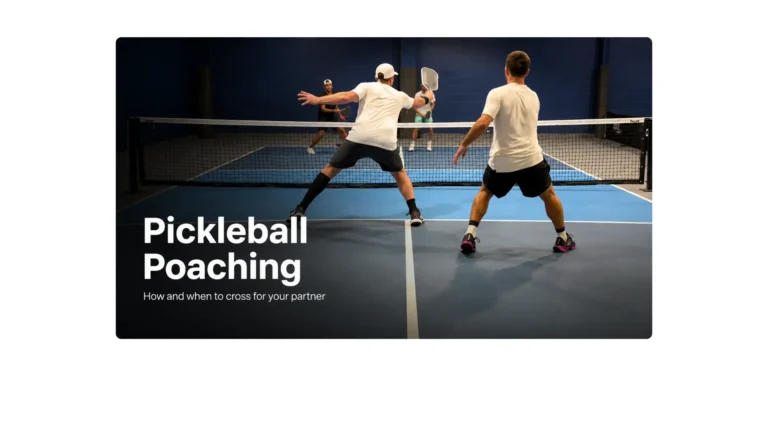
A real poach is planned. One player takes the ball, and the partner already knows which opening must be covered next.
A poach makes sense when the ball floats high enough to attack down, the poaching player is balanced, the partner is compromised or expects the move, the opponent’s pattern makes the reply predictable, and the team knows who protects the newly opened space.
Stealing a partner’s clean ball because you want more action is not a poach. It is just two players sharing one contact and leaving the next ball uncovered.
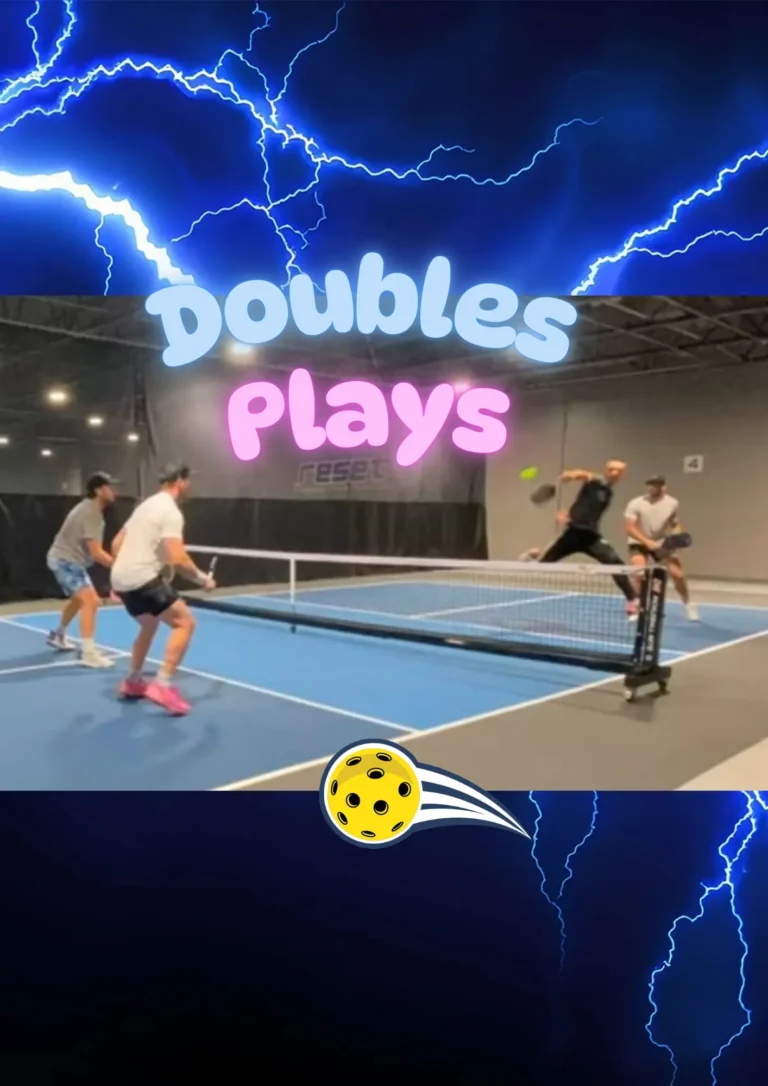
Poaching only works when the partner knows what is coming next. I break down the entry ball, partner movement, expected reply, and fallback in the pickleball doubles plays guide.
How Hunter and Anchor Change a Planned Poach
In my Hunter and Anchor framework, those names describe two temporary jobs during a planned attack. Hunter and Anchor does not replace SHARE. It only changes ownership during the poach both players agreed to run.
For example, the Hunter may cross for a predictable high return while the Anchor slides behind the move and protects the open lane. Once that pattern ends, so does the Hunter’s special claim. Routine dinks, defensive balls, and the Anchor’s paddle in front still go through SHARE.
Who Takes Middle Lobs and Overheads?
Middle lobs create a different problem because both players may turn, cross paths, and lose sight of each other.
The player who turns first, sees the ball clearly, and can reach it without crossing through the partner should take the overhead. If one player is looking into the sun, moving backward under the ball, or likely to collide with the partner, call the switch early and release the shot.
Do not wait until both players are underneath the lob to decide. “Mine,” “Yours,” or “Switch” should settle the ball while both partners still have room to move.
Five Middle-Ball Mistakes That Pull a Team Apart
| Mistake | What it causes | Better rule |
|---|---|---|
| One player claims every forehand or high middle ball | Late reaches, overreaching, and exposed court | Define which high balls are planned poaches and release the rest when the partner is already set. |
| Both players guard fixed halves | Both players protect the sideline and leave the diagonal seam untouched | Let responsibility shift with the ball path. |
| Both players wait for a verbal call | Late contact or a ball that bounces untouched | Use an agreed default, then call the exception. |
| Players use kitchen rules in transition | The moving player reaches across a balanced partner | Prioritize depth, balance, and contact point. |
| Partners debate ownership after every point | Confusion and shrinking confidence | Identify the repeated pattern and set one new default. |
What to Agree On Before the Game
Call the Exception, Not Every Ball
Your default and the SHARE Check should settle routine balls without a conversation. Use “Mine,” “Yours,” or “Switch” for a lob, scramble, planned poach, late recovery, or unusual path. For call timing and a simple vocabulary system, use the pickleball doubles communication guide.
When the same ball keeps creating confusion, stop arguing about whose side it landed on. Run the SHARE Check: who was set, who could hit in front, whose angle matched the ball, who could produce the better result, and which choice left less exit space? Then agree on one default for that pattern before the next game.
You do not need a five-minute strategy meeting. One clear sentence can solve most routine confusion:
“Forehand has the routine middle. If one of us is pulled wide, moving, or late, use SHARE and let the cleaner player take it. Call the exception early.”
Righty-lefty teams can add who owns the high middle floater. Teams using Hunter and Anchor language can name the specific poach pattern the Hunter owns. Keep the agreement short enough that both players actually remember it.
Three Drills That Stop the “I Thought You Had It” Problem
1. SHARE Freeze Drill
Both partners begin at the kitchen. A feeder sends balls through the seam at different heights and angles.
Rule: Forehand is the default only after both players run the SHARE Check. Freeze selected balls before contact and name the deciding letter: Set, Hit in front, Angle, Result, or Exit space.
Watch for: Separate paddle paths, contact in front, and immediate recovery. If partners disagree, ask, “Which SHARE letter decided it first?” instead of arguing about whose side the ball landed on.
Progression: Start with cooperative feeds, then randomize the height and angle. Finish with live points where the team earns one bonus point for every middle ball handled without hesitation or crossed paddles.
2. Respect the X Drill
A feeder alternates balls from the left and right side of the opposite kitchen.
Rule: The line-side player protects the nearest line while the crosscourt partner gets the first look at the middle.
Watch for: Partners should recognize the path before it reaches the seam. Use the cue, “Line player protects line; crosscourt player closes.” Add occasional floaters so they also practice calling the obvious exception.
Progression: Begin with predictable alternating feeds. Then let the feeder choose either side, add a high floater, or drive through the seam so the players must recognize when Respect the X gives way to SHARE.
3. Moving Player vs. Set Player Drill
Begin both partners near the baseline. Feed drops, drives, and middle attacks while the partners move through transition.
Rule: The stopped, balanced player has priority over the player still moving, even when that changes the normal kitchen-line responsibility.
Watch for: Players should stop before contact, release balls they cannot handle in front, and avoid reaching backward into a partner’s ball. Use the cue, “Moving paddle releases to the stopped paddle.”
Progression: Start with cooperative drops and resets. Then mix in drives and live fifth shots. Score the rally only when both players reach the kitchen without crossing paddle paths or reopening the seam.
Middle-Ball Questions Players Keep Asking
SHARE stands for Set, Hit in front, Angle, Result, and Exit space. Favor the player who is balanced, can contact in front, is naturally connected to the ball path, can produce the better shot, and leaves the smaller opening afterward.
No. It is a partnership strategy, not an official rule assigning ownership of the ball. Forehand is a useful default when both players have an equally clean play, but balance, contact point, ball path, shot quality, and the opening left afterward can change the decision.
Righty-lefty teams should agree on a default. They may use Respect the X, designate one player for high middle floaters, give reaction balls to the paddle already in the path, or use an early call for a true fifty-fifty ball. Both players should still pass the SHARE Check.
A stronger player may own a larger agreed window, especially on attackable floaters, but skill does not justify reaching late across a balanced partner. The stronger player should still pass the SHARE Check.
No. The team system should settle routine balls. Use “Mine,” “Yours,” or “Switch” when the rally creates an exception, such as a lob, scramble, planned poach, late recovery, or partner being pulled wide.
The player who turns first, tracks the ball clearly, and can reach it without crossing through the partner should take it. Call “Mine,” “Yours,” or “Switch” while both players still have room to move.
Reviewed and updated by Coach Sid on July 29, 2026.
Make the Seam Boring
Good partnerships do not eliminate every awkward middle ball. They eliminate the repeated hesitation that turns ordinary balls into awkward ones.
Pick one default before the game. When the rally creates an exception, use SHARE instead of renegotiating ownership in real time. Afterward, notice which pattern keeps causing trouble and adjust that one pattern together.
When both players trust the same default, the seam stops being an argument.