
Pickleball coach explaining DUPR ratings to players on court including overall, mixed, and age-based ratings

Which DUPR Rating Counts? Overall, Mixed, 50+ and Career High Explained

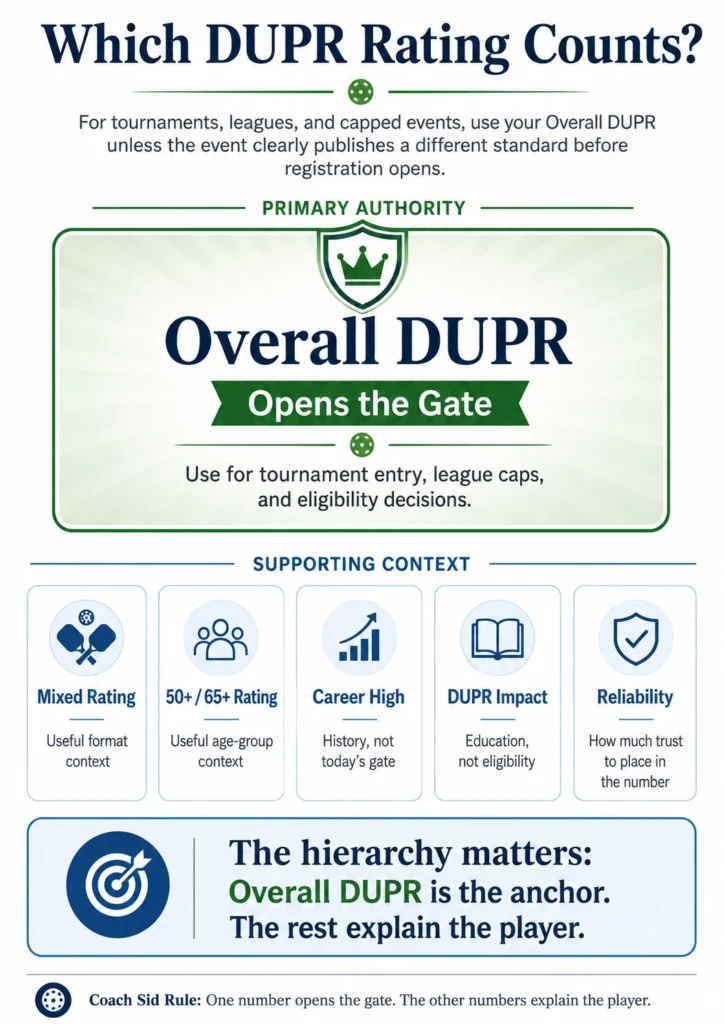
If you’re staring at your DUPR profile wondering which DUPR rating actually counts, start here: for tournaments, leagues, and capped events, use your overall DUPR unless the event clearly publishes a different standard before registration opens.

Mixed, 50+, 65+, Career High, and DUPR Impact are useful context. They can explain how you perform in specific situations, but they should not become a choose-your-own-rating shortcut when entry caps are involved.

Which DUPR rating counts?
Use your overall DUPR rating for tournaments, leagues, and capped events unless the event rules clearly publish a different standard before registration opens.

If this feels confusing, you are not wrong. The system didn’t break. The dashboard just got busier, and now players need a clean hierarchy before every bracket turns into a folding chair debate.

Coach Sid rule (The One Gate Rule): One number opens the gate. The other numbers explain the player.

Why this matters: the moment players can choose whichever rating helps them most, the system stops being a standard and becomes a negotiation.

Before You Scroll: The Whole Article in 30 Seconds

  • Overall DUPR is the anchor. Use it for entry caps unless event rules clearly say otherwise.
  • Mixed, 50+, 65+, Career High, and DUPR Impact are context. They explain patterns, not automatic eligibility.
  • Small samples deserve caution. A rating based on five matches should not carry the same trust as a deep match history.
  • Directors need one published standard. If players choose their best number, the bracket becomes a negotiation.
  • The clean fix is hierarchy. One number opens the gate. The rest explain the player.

Who This Helps

This article is for anyone looking at five different DUPR numbers and wondering which one opens the gate, which one explains the player, and which one is just standing there wearing sunglasses trying to look important.

  • Players entering capped events: start with overall DUPR unless the published rules say otherwise.
  • Players with a higher mixed rating: treat it as useful performance context, not automatic eligibility.
  • Senior players with 50+ or 65+ ratings: use those numbers to understand that environment, not to rewrite your universal skill number.
  • Players looking at Career High: be proud of the peak, but do not use yesterday’s best number as today’s gate.
  • Tournament directors: pick one rating standard before registration opens and publish it clearly.

The Real Problem: Too Many Numbers, Not Enough Hierarchy

Yesterday, a player asked me something that perfectly captures where pickleball ratings are right now:

“Do we use our mixed rating for the 6.5 cap?”

That question did not exist a week ago.

And that’s how you know something shifted.

Not necessarily broken. Not necessarily evil. Not even necessarily wrong.

Just easier to misunderstand.

I told him no. We use overall DUPR. Those bracketed ratings may help your sanity, but if we start letting every event pick whichever rating category feels best, things get chaotic fast.

Imagine a mixed doubles match against a 50+ mixed team. Which number counts? Overall DUPR? Mixed DUPR? 50+ DUPR? What if one player is 65+ and the other is not? What if the mixed rating is based on five matches and the overall rating is based on 80?

Here is the headache in real clothes: Player A is 3.90 overall but 4.30 in mixed. Player B is 4.00 overall with no mixed rating yet. In a 6.5 combined cap, do you let Player A argue from the lower number and Player B get punished for having fewer filtered matches? That is how a simple registration rule turns into a folding chair debate.

See the problem?

The more numbers players can choose from, the more tempting it becomes to choose the one that flatters them.

That is the heart of this article: one number should open the gate, while the other numbers help explain the player. Later, I’ll argue for the cleaner long-term fix: tag the match, not the player.

The Mistake That Will Break Events Fast

If events start allowing players to choose between overall, mixed, 50+, 65+, or Career High for entry caps, ratings stop being a system and become a negotiation.

This is the most expensive misunderstanding in this entire update: more numbers do not mean every number should have the same authority.

If players can choose their rating after seeing which one helps them most, the gate is no longer a gate. It is a sales pitch with sneakers on. That is how sandbagging accusations start. That is how brackets break. That is how directors stop trusting the rating system and start making judgment calls from the folding chair tribunal.

The more flexible the gate, the more political the bracket.

Everything else in this article builds from that, so the rest of the piece is not another version of the same answer. It is the practical guide for when the answer gets messy.

If Your DUPR Numbers Disagree

When your DUPR numbers disagree, do not ask which one you like more. Ask which one you trust more.

  • Mixed higher than overall? Useful pattern. Check sample size and partner dependency.
  • 50+ or 65+ higher? Environment advantage. Does it travel outside that bracket?
  • Career High higher? That was your peak, not your current gate.
  • Overall higher? The filtered number may be thin, local, or outdated.
  • Low match count anywhere? Treat it like a forecast, not a fact.

What DUPR Actually Added

In April 2026, DUPR introduced several new profile features designed to help players understand performance across formats, age groups, Career High, and rating movement:

  • Subscores, including Mixed Doubles Rating and Age-Based Doubles Ratings.
  • Mixed Doubles Rating, calculated from mixed doubles matches only.
  • Age-Based Doubles Ratings for 50+ and 65+ players.
  • Career High, showing the highest DUPR rating achieved after a player’s first 8 matches.
  • DUPR Impact, a Forecast tool that shows how different scorelines may affect rating movement.
  • Enhanced profile display, making these numbers easier to view directly inside the DUPR app.

DUPR’s stated goal is to help players better understand performance across formats and age groups. That part makes sense. Mixed doubles, senior play, open play, and local player pools can reward different skills.

But here is the decision point players and directors cannot miss:

DUPR added new ways to view performance. They did not make every number serve the same job.

That distinction matters, because if players and directors miss it, the system turns into a buffet.

And ratings should not be a buffet.

Coach Sid Translation: The engine did not change. The dashboard got a lot busier.

What Did Not Change

As currently presented, DUPR still treats your overall DUPR as the main rating on your profile.

That means:

  • Your main DUPR rating is still the primary number.
  • Subscores are additional metrics.
  • Mixed Doubles Rating does not automatically replace your overall rating in mixed events.
  • Age-Based Ratings do not automatically replace your overall rating in senior events.
  • Organizers decide how to use the new data.

So the practical rule is simple: treat overall DUPR as the anchor, and treat the new ratings as context unless the event says otherwise in writing before registration opens.

DUPR is still treating the main rating as the anchor, but the new tools give organizers more ways to interpret or structure events.

That is the pivot: one official rating, but several usable lenses.

And that is exactly where confusion starts crawling through the fence like a raccoon with a tournament waiver.

The addition of new ratings did not replace the original purpose of the main DUPR rating—it remains the most portable and broadly applicable measure of player skill.

Why This Feels Like a Shift From DUPR’s Original Philosophy

DUPR has historically been understood as a universal rating system. The idea was simple:

One player. One rating. One scale.

Not one rating for women, one for men, one for seniors, one for mixed, one for Tuesday nights when your knees feel good and your partner remembers the score.

The original appeal was portability. A 4.0 should mean something whether you are in Louisiana, Florida, Texas, Arizona, or standing on a court next to a guy who insists he was “basically a 5.0 before the shoulder thing.”

That universal idea is clean. Real pickleball is not.

Pickleball is played in:

  • men’s doubles
  • women’s doubles
  • mixed doubles
  • 50+ brackets
  • 60+ brackets
  • 65+ brackets
  • club leagues
  • rotating partner ladders
  • tournaments
  • private groups
  • local ecosystems where the same 30 people beat each other in circles for years

So DUPR is trying to solve a real problem.

But solving a real problem badly can create three more.

DUPR did not create this mess. Pickleball’s fragmented competitive structure did. DUPR just put the mess on the profile page.

My Position Has Not Changed

I have already written about this in Skill Rating vs Bracket Rating and Should Age and Gender Affect Pickleball Ratings?.

My framework is still the same:

ToolJobWhat Goes Wrong When Misused
RatingMeasures competitive skillStops being portable if it changes meaning by category
DivisionCreates fair participationTurns into fake measurement if treated like universal truth
SubscoreShows context-specific performanceBecomes self-curated branding if players choose only the flattering number

A rating should predict matches.

A division should organize competition.

A subscore should explain patterns.

Those are three different jobs.

When one number tries to measure skill, protect feelings, seed brackets, explain format differences, reduce anxiety, and market the app, something is going to wobble.

Subscores Are Lenses, Not Identities

Your DUPR rating is not your personality. It is not your résumé, your birth certificate, or a tattoo across your forehead that says, “I have arrived, please respect me.” It is a measurement, and measurements only help when you let them tell the truth.

A subscore is not a new universal truth. It is a filtered view. It can show where your game performs differently, but it should not become a second identity you pull out whenever it helps your argument.

Think of it like looking at your game through a smaller window:

  • Your overall DUPR looks at the broader picture.
  • Your mixed rating looks at mixed doubles only.
  • Your 50+ rating looks at age-based performance.
  • Your 65+ rating narrows that age-based lens even further.

That can be useful.

If your mixed rating is higher than your overall, maybe you communicate well, understand court roles, and build points better in mixed. If your age-based rating is higher, maybe your touch, patience, and placement thrive in that environment. If your overall is lower, maybe your game does not translate as well when pace, reach, athleticism, or open-field pressure increases.

That is information.

But information is not the same thing as replacement.

A subscore can tell you where your game shines. It should not become a mask you wear to hide where your game struggles.

Mixed Doubles Rating: Useful, But Easy to Misuse

DUPR’s Mixed Doubles Rating is calculated from mixed doubles matches only. As currently presented, a player needs at least 5 mixed doubles matches to receive one.

On one hand, I understand why players wanted this.

Mixed doubles is its own animal.

Court positioning changes. Shot selection changes. The way teams build points changes. Partner roles matter. Stacking matters. Targeting patterns matter. Some players are fantastic in mixed because they understand shape, patience, and role discipline. Others struggle because they try to play mixed like gender doubles with a different scoreboard.

So yes, a mixed rating can be useful.

But here is where directors need to be careful:

A mixed rating based on 5 matches is not the same strength of signal as an overall rating based on 80 quality matches.

That is not anti-DUPR. That is basic data hygiene.

If you run a mixed event and use mixed ratings only, you may get more format-specific accuracy for some players. But you may also create loopholes for others, especially if the mixed sample is tiny, old, local, or built against the same small group.

My recommendation:

  • Use overall DUPR for entry caps.
  • Use Mixed Doubles Rating as secondary seeding context.
  • Check reliability and match count before treating any subscore like gospel.

Director mistake to avoid: do not let a mixed rating become an automatic eligibility shortcut just because the event is mixed.

Coach Sid Translation: Mixed rating is seasoning. Don’t make it the whole gumbo.

Age-Based Ratings: 50+ and 65+ Explained

DUPR now gives eligible players access to age-based ratings:

  • Players ages 50 to 64 can access a 50+ rating.
  • Players ages 65 and older can access both 50+ and 65+ ratings.
  • Players must have an official DUPR rating.
  • DUPR Coach and AI ratings are not eligible for age-based ratings.

This is one of the most sensitive parts of the update because it touches the debate players have been arguing about for years. Here is where players can confuse a useful age-based lens with a universal skill claim:

Should age affect ratings?

My answer is still no, not inside the main number.

Age should affect brackets. Age should affect event options. Age can help players find the type of competition they enjoy. But once age changes what the number means, the number stops being universal.

That said, age-based subscores can still be useful if players understand what they are.

They are not proof that a 4.2 in 65+ equals a 4.2 in open play.

For example, a 4.2 65+ rating may be very accurate inside 65+ doubles. But that does not automatically mean the same player should be treated as a 4.2 in a 19+ open division where speed, reach, pace, and recovery demands may be different.

Age-based ratings are proof that a player has performed at a certain level inside a specific competitive environment.

Winning inside your bracket matters. But it does not automatically mean your number travels cleanly outside that bracket.

That is not disrespect. That is measurement.

Career High: The Feature Players Will Love and Directors Should Handle Carefully

Career High shows the highest DUPR rating a player has achieved after their first 8 matches.

I actually understand why this feature exists.

Ratings fluctuate. Players get injured. Partners change. Tournament conditions change. A player may peak, dip, recover, improve, or get exposed. Career High gives players a little emotional oxygen. It says, “You did reach that level once.”

That can reduce rating anxiety.

But it can also create another identity trap. Career High is useful history, not today’s entry pass.

Players are going to say:

  • “My current rating is 3.78, but my Career High is 4.12.”
  • “I’m really a 4.0. I just dipped.”
  • “Use my peak rating, not my current one.”

That may be emotionally understandable.

But current rating and Career High do different jobs.

MetricWhat It ShowsBest Use
Current DUPRRecent and ongoing competitive levelEntry caps, eligibility, competitive grouping
Career HighHighest level previously reachedContext, player history, confidence, possible seeding nuance

Career High is a memory. Current DUPR is the thermometer.

Don’t seed today’s bracket with yesterday’s best version of yourself.

DUPR Impact: The Most Useful and Most Dangerous New Tool

DUPR Impact is part of the Forecast experience. It lets players simulate matchups and see how different scores may affect rating movement. It can show expected scorelines, win probability, and rating impact.

That is genuinely useful. This is where the tool changes from profile decoration into player education.

For years, players have been confused by rating movement. Someone wins and drops. Someone loses and barely moves. Someone beats a weaker team 11-9 and wonders why the rating barely budged. DUPR Impact helps explain that margin matters, expectation matters, and not all wins carry the same rating weight.

Here is the plain-English version: if your team is expected to win comfortably but barely wins, the system may treat that as underperforming the expectation. You won the match, but you may not have beaten the prediction. That is one reason a win does not always produce the rating bump players expect.

Good.

Transparency is better than mystery.

But the same tool that educates honest players can also help strategic players reverse-engineer outcomes.

If players can preview rating movement by scoreline, some will start asking:

  • “What score do we need?”
  • “How close can we keep this without hurting our rating?”
  • “Can I manufacture a useful result?”
  • “Can this help me get into a gated open play?”

I am not saying every player will do that.

I am saying any rating system has to assume some players will.

Forecast tools explain the math. They also hand clever players a calculator.

This is why reliability, verified matches, director oversight, and match quality matter more than ever.

What Is Still Unclear

This is the part players and directors should not pretend is settled yet.

  • Whether most events will standardize around overall DUPR or start using format-specific subscores.
  • How platforms will display, filter, or enforce rating choices during registration.
  • How much directors will weigh reliability, match count, recency, and opponent pool when subscores disagree.
  • Whether players will understand these numbers as context or start treating them as alternate identities.

That uncertainty is exactly why the clean rule matters: set the rating standard before registration opens, then stick to it.

The API Rollout Is Where This Gets Bigger

One of the most important parts of DUPR’s update is not just what players see in the app. It is what event platforms may eventually see.

DUPR says Mixed, Age-Based, and Career High ratings will be made available to API partners. Once that happens, clubs, leagues, tournament platforms, and registration tools may be able to use these numbers directly.

That means this is not just a profile feature.

This is infrastructure. In real life, that means clubs, leagues, registration tools, and tournament platforms may eventually be able to pull mixed ratings, age-based ratings, and Career High directly into event setup.

That is where directors need to wake up.

If a platform lets organizers choose overall DUPR, mixed DUPR, 50+ DUPR, 65+ DUPR, or Career High for gates and brackets, every event needs clear rules before registration opens.

Otherwise, players will not just ask which number counts.

They will argue it.

The app can show five numbers. The event director still needs one standard.

DUPR Says Organizers Can Use These Ratings. Here’s Where I Agree and Where I Don’t.

DUPR’s update gives examples of how organizers might use the new data:

  • A mixed doubles event could use Mixed Ratings for seeding.
  • A 50+ league could use the 50+ Age-Based Rating to gate registration.
  • Clubs could use these numbers for clinics, ladders, draws, or event structure.

I agree with part of that.

I like using subscores for seeding context. I like using them to understand player tendencies. I like using them to make a director smarter.

But I would be very cautious using subscores as the primary gate for entry caps.

Why?

Because entry caps need consistency.

If one event uses overall DUPR, another uses mixed, another uses 50+, another uses Career High, and another lets the club decide case-by-case, then ratings become negotiable.

Entry rules need one gate. Seeding can use more windows.

My practical director stance:

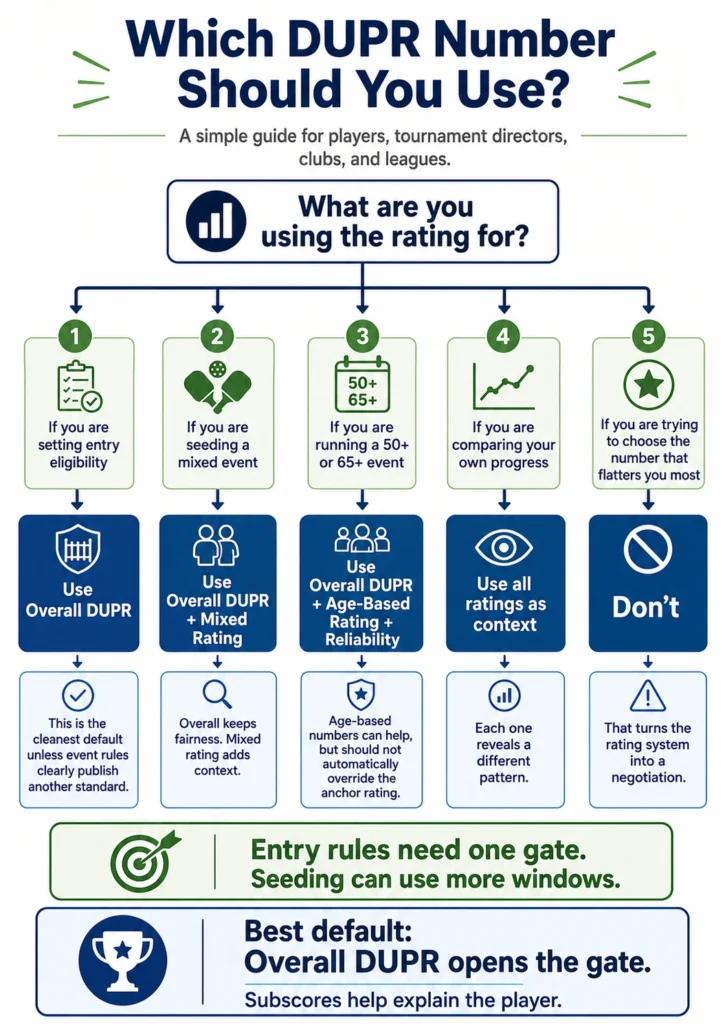
  • Entry eligibility: Overall DUPR is the cleanest default unless the event clearly publishes another standard.
  • Seeding: Use overall DUPR plus relevant subscores as context.
  • Senior-only programming: Age-based ratings can help, but should be paired with reliability, match count, and recent match history.
  • Mixed-only events: Mixed rating can help seed, but should not automatically override overall DUPR unless that rule is published before registration.
  • Clinics and ladders: Subscores are useful because the stakes are lower and the goal is grouping, not hard gatekeeping.

The Missing Piece: Reliability Score Still Matters

This is the part average players need to understand:

Reliability is basically DUPR’s confidence level in the number. A rating built from many recent matches against varied opponents should carry more trust than a rating built from five matches inside the same small group.

A rating without reliability is just a louder guess.

A mixed rating based on 5 matches may technically exist, but that does not mean it is as trustworthy as a rating built from dozens of recent, verified matches against diverse competition.

The community has been saying this for a while. The issue is not just whether a rating is mixed, age-based, gendered, or universal. The issue is whether the match history behind it is strong enough to trust.

A rating gets shaky when:

  • the sample size is small
  • the matches are old
  • the player pool is narrow
  • the results come mostly from one club
  • the matches are mostly self-reported
  • the player only competes inside one protected bracket
  • partners heavily distort outcomes
  • the player avoids cross-pool competition

This is why I keep coming back to the same principle:

The number is only as honest as the match history feeding it.

If you only play 50+ women’s doubles at one club, your rating may be very meaningful inside that world. But it may not travel cleanly into open play.

That does not make you bad.

It means your data is local.

Without reliability, a rating is not wrong—but it is incomplete.

What Players Are Already Arguing About

The reaction from players was predictable because this topic has been simmering for a long time.

Some players see subscores as overdue. They argue mixed doubles is different, senior play is different, and a single universal rating does not capture enough nuance.

Others see this as DUPR muddying the water. They argue that if a 4.0 means something different depending on age, gender, or format, then the number is no longer universal.

Both sides are reacting to the same wound:

Pickleball has segmented competition, but players still want one portable number.

The Pro-Subscore Argument

The strongest argument for subscores is this:

Mixed doubles, senior doubles, women’s doubles, men’s doubles, and open play can reward different skills. If the match environments are different, maybe players deserve more specific data.

That is fair.

A player might be excellent in mixed because they understand patterns and roles. Another player might dominate senior play with touch, patience, and anticipation. Another might struggle when exposed to younger open pace. A single number may not explain those differences clearly enough.

The Anti-Subscore Argument

The strongest argument against subscores is this:

Once players have multiple numbers, they will start using the one that benefits them.

That is also fair.

If someone says, “I’m a 4.3 in mixed,” but their overall is 3.8, what does that mean for a capped event? What if someone is 4.4 in 50+ but 3.9 overall? What if their Career High is 4.2, but their current rating is 3.7?

Now the number is not just a measurement.

It is a negotiation.

The danger is not more data. The danger is letting players decide which data is most convenient.

Why Two Players With the Same DUPR Can Still Look Different

This is where average players get frustrated: two players have the same DUPR, but one looks clearly better.

That can mean several different things. The rating might be wrong. The sample size might be thin. One player may have stronger match history. One may be inflated by a closed player pool. Or the flashy player may simply look better while the boring player wins more.

Sometimes it means the sample size is too small.

Sometimes it means one player’s rating is inflated by a closed player pool.

Sometimes it means the “better looking” player is flashy, but not actually more reliable at winning.

This is why visual impressions alone can mislead you.

A player with a pretty drive, a fast hand battle, and a tennis-looking forehand may look stronger than a boring player who resets, blocks, makes balls, and wins.

Ratings are not supposed to measure how impressive you look.

They are supposed to measure whether your results predict competitive matches.

Looking like a 4.0 and playing winning 4.0 pickleball are not always the same thing.

That is why I still believe in performance-based measurement. But the match context feeding that measurement has to be stronger.

The Better Fix: Tag the Match, Not the Player

This is where my position differs from both extremes.

I do not think the answer is pretending all matches are the same.

I also do not think the answer is creating a separate identity rating for every category.

The cleaner fix is:

Tag the match, not the player.

A match should carry context:

  • mixed doubles
  • men’s doubles
  • women’s doubles
  • open division
  • 50+ division
  • 65+ division
  • tournament
  • league
  • club ladder
  • self-reported
  • director-confirmed
  • video-verified
  • high-reliability opponent pool
  • low-reliability opponent pool

That would let the system understand the environment without turning every player into five different versions of themselves.

A 3.8 player could still be a 3.8 overall, while the system understands that many of the results came from 50+ mixed league play at one club.

That is useful.

That is honest.

That is better than letting players carry a pocketful of ratings and pull out whichever one gets them through the gate.

One player can have several useful data views. But the match history should explain the view, not create five different identities.

Director Guide: How I Would Use the New DUPR Data

If I were writing rules for an event today, here is how I would handle it: do not let players choose their rating. Set one standard before registration opens, publish it clearly, and use the other numbers as context.

For Capped Events

Use overall DUPR for eligibility.

If it is a 6.5 combined cap, use the two players’ overall DUPR ratings. Do not switch to mixed, 50+, 65+, or Career High unless your event rules clearly state that before registration opens.

For Mixed Doubles Events

Use overall DUPR for entry. Use Mixed Doubles Rating for seeding context only.

If two teams have similar combined overall ratings, the mixed rating can help you make a smarter draw. But I would not let mixed rating replace the main number unless the event is specifically built around that rule.

For 50+ or 65+ Events

Age-based ratings can be useful, especially if the event is fully inside that age category. But I would still check overall DUPR, match count, reliability, and recent play.

A 50+ rating with a thin sample should not outweigh a strong overall rating with a deep history.

For Clinics

Subscores are excellent for clinics.

The stakes are lower. The goal is better grouping, not hard eligibility. If someone has a stronger mixed rating, put them in a mixed strategy clinic that fits. If someone has an age-based profile, use that to group them with similar players.

For Ladders

Use the new data carefully.

Ladders can be chaotic because partners rotate, styles clash, and one player can get punished for being paired with weaker partners. Overall rating should remain the anchor. Subscores can help explain why someone overperforms or underperforms in certain formats.

For Open Play Gatekeeping

Be careful.

Open play gates already create enough drama. If clubs start letting players argue with overall, mixed, 50+, 65+, Career High, and “my coach says,” you will need a referee before anyone even warms up.

A clean gate beats a perfect argument.

Player Guide: How You Should Read Your New DUPR Profile

Here is how to look at your profile without losing your mind or falling in love with the number that flatters you most.

Start With Overall DUPR

That is still your anchor. It is the number most likely to travel across formats and events.

Use Mixed Rating as a Pattern Detector

If your mixed rating is higher, ask why. Do you communicate better? Do you play smarter when roles are clear? Are you benefiting from strong partners? Are you playing mostly inside a small mixed pool?

Use Age-Based Rating as Context, Not a Crown

If your 50+ or 65+ rating is higher, that tells you something about how your game performs in that environment. It does not automatically prove that same number will hold up in open play.

Use Career High for Confidence, Not Eligibility

Be proud of your peak. But do not pretend your peak is always your current level.

Use DUPR Impact to Learn, Not Scheme

Forecast tools can help you understand why scorelines matter. Use that knowledge to compete honestly, not to manufacture rating outcomes.

Check Reliability

Do not just ask, “What is the number?”

Ask:

  • How many matches?
  • How recent?
  • Against whom?
  • In what format?
  • Inside what player pool?
  • How reliable is the rating?

Your rating is not just a number. It is a story about who you played, when you played them, and whether that story is big enough to trust.

If you are…Use this ratingWhy
Entering a tournamentOverall DUPRSafest anchor unless the event rules clearly name another standard
Seeding a mixed eventOverall + Mixed RatingMixed adds context, but overall keeps fairness
Playing 50+ or 65+Overall + Age-BasedAge-based shows environment, not universal skill
Comparing your progressAll ratingsEach one shows a different pattern
Trying to “pick your best number”Don’tThat breaks the system and your development

What’s True, What’s Misunderstood, and What To Do

What’s True

  • Overall DUPR should remain the starting point for entry caps unless event rules clearly say otherwise.
  • Mixed, 50+, and 65+ ratings can reveal useful performance patterns.
  • Career High shows where a player has been, not necessarily where they are today.
  • DUPR Impact can help explain why scorelines matter, but it should not become a tool for gaming outcomes.
  • Reliability, match count, recency, and opponent pool still matter underneath every number.

What’s Misunderstood

  • A higher filtered rating is not automatically the “real” rating.
  • A mixed rating should not automatically replace overall DUPR in mixed events.
  • An age-based rating does not always travel cleanly into open play.
  • A Career High number should not be used as current eligibility.
  • A rating based on five matches should not be treated the same as a rating backed by deep, recent, varied match history.

What To Do

Everyone: do not pick the prettiest number. Read the number, then read the match history behind it.

Players: use overall DUPR as the anchor, then use subscores to study patterns.

Directors: publish the rating standard before registration opens.

Mixed events: use mixed rating as seeding context unless the event clearly says it controls eligibility.

Senior events: use age-based ratings carefully and check reliability before trusting them too much.

Final hierarchy: One number opens the gate. The rest explain the player. If players, directors, and clubs keep that order clear, DUPR’s new profile tools can add context without turning every bracket into a rating argument.

Coach Sid Locker Room Talk: Stop Dating Your Favorite Number

Let me say this the way I would say it leaning on the fence after league night:

Your DUPR rating is not your personality.

It is not your résumé. It is not your birth certificate. It is not a tattoo across your forehead that says, “I have arrived, please respect me.”

It is a measurement.

And measurements only help when you let them tell the truth.

If your mixed rating is higher, good. Learn from it. Maybe you communicate well with a steady partner. Maybe your reset game shines when the court roles are cleaner. Maybe you build points better than you realized.

If your 50+ rating is higher, fine. That tells you something too. Maybe your patience and shot tolerance play better when the game slows down half a beat. Maybe your hands are still filthy, but open-division pace exposes movement you used to get away with.

That is useful information.

But the minute you grab the prettiest number and say, “This is the real me,” you are not analyzing anymore.

You are decorating.

Coach Sid: Use the flattering number to study your strengths. Use the uncomfortable number to find your work.

What DUPR Got Right

Let’s be fair: DUPR did add useful tools.

More data can help players understand their game. Career High may reduce anxiety. Mixed rating may help explain why someone performs better in one format than another. Age-based ratings may help senior programming. DUPR Impact may make rating movement less mysterious.

Those are good things.

My issue is not that DUPR shared more data. More data is good when players understand the hierarchy.

My issue is that more data without a clear hierarchy creates confusion.

The problem is not the extra numbers. The problem is pretending every number should have the same job.

Where DUPR May Be Creating a Bigger Problem

DUPR is trying to reduce confusion by showing more context.

But for average players, more context often feels like more truth.

That is dangerous.

Players may not understand the difference between:

  • official rating
  • subscore
  • career high
  • forecasted impact
  • reliable rating
  • thin-sample estimate

They will see numbers.

And people love the number that loves them back.

DUPR gave players more mirrors. Now players have to be honest about which reflection is real.

Quick Definitions Before the Argument Starts

  • Overall DUPR: The main rating most players and events should start with.
  • Subscore: A filtered view of performance in a specific context, like mixed doubles or age-based play.
  • Career High: A historical peak, not a current eligibility number.
  • Reliability: A signal of how much trust the match history behind a rating deserves.
  • DUPR Impact: A Forecast tool for understanding possible rating movement, not a permission slip to engineer results.

The Debate: Which Number Should Count?

This is where I know the comments are going to get spicy, because there are smart players on both sides of this.

One side will say:

“If it is a mixed event, why wouldn’t we use mixed ratings?”

Fair question.

The other side will say:

“Because then every event becomes a negotiation over which rating helps who.”

Also fair.

That is the real pickle here. Not the cute kind you put on a sandwich. The messy kind that makes directors stare at registration lists like they are trying to decode a tax return.

So here are the questions:

  • Should a mixed doubles tournament use overall DUPR or mixed DUPR for entry caps?
  • Should a 50+ league use overall DUPR or 50+ rating to gate registration?
  • Should Career High ever matter for seeding?
  • Should a rating with 5 matches be treated the same as a rating with 80?
  • Should reliability score be shown more prominently before clubs use ratings for access?

That is why my vote remains simple: one number opens the gate, and the rest explain the player.

But I want to hear the other side.

Drop your take in the comments. Just don’t come in swinging a frying pan unless you brought receipts.

The Bottom Line

DUPR did not fully reverse its philosophy.

But it did soften the simplicity of that philosophy.

The old message was:

One rating. Universal scale.

The new reality is:

One official rating. Multiple profile lenses. Organizer discretion.

That means the responsibility shifts back to players, directors, and clubs. DUPR can show the numbers. We still have to decide which number is allowed to open the gate.

If one number does not open the gate, five numbers will not fix the argument.

That is not automatically bad.

But it does require discipline.

Players need to stop treating every new number as a new identity.

Directors need to define which number counts before registration opens.

Clubs need to stop pretending a rating is meaningful without match count, reliability, and context.

And DUPR needs to make the hierarchy painfully clear:

  • Overall DUPR is the anchor.
  • Subscores are context.
  • Career High is history.
  • DUPR Impact is education.
  • Reliability tells you how much trust to put in the number.

Coach Sid: A rating is not supposed to make you feel accurate. It is supposed to be accurate when the match starts.

FAQ: DUPR Subscores, Mixed Ratings, and Age Ratings

Did DUPR change my official rating?

No. Your overall DUPR remains the anchor rating. The new numbers are additional metrics that provide more context.

What is a DUPR Mixed Doubles Rating?

It is a rating based only on mixed doubles matches. DUPR requires at least 5 mixed doubles matches before a player receives one.

Should mixed doubles events use Mixed Rating for entry?

DUPR allows organizers to decide. My recommendation is to use overall DUPR for entry caps and Mixed Rating as secondary seeding context.

What are DUPR Age-Based Ratings?

They are ratings for eligible 50+ and 65+ players that reflect performance in age-based doubles contexts. Players 50 to 64 can access a 50+ rating. Players 65 and older can access both 50+ and 65+ ratings.

Should senior brackets use age-based ratings?

They can be useful, but directors should still consider overall DUPR, match count, reliability, and recent match history.

What is Career High?

Career High shows the highest DUPR rating a player has achieved after their first 8 matches. It gives historical context, but it should not replace current rating for eligibility.

What is DUPR Impact?

DUPR Impact is part of DUPR Forecast. It helps players see how different matchups and scorelines may affect rating movement.

Why can two players with the same DUPR look different?

Because ratings depend on match history, opponent quality, reliability, format, partner effects, and player pool diversity. Same number does not always mean identical skill expression.

What should players do with the new numbers?

Use them to understand patterns. Do not use them to cherry-pick your identity.

What should tournament directors do?

Publish clear rules. Choose one entry standard. Use subscores as context, not as a moving target.

Turn This Into Action

The next time someone asks:

“Which DUPR do we use?”

You already know the answer.

Use overall DUPR as the anchor unless the event has clearly published a different standard.

Use subscores to understand the story.

Use reliability to decide how much trust that story deserves.

And use common sense before letting every player walk into registration holding the number that makes them feel tallest.

One number should open the gate. The rest should explain the player.

Why This DUPR Breakdown Comes From Court Experience

Coach Sid Parfait is the founder of the New Orleans Pickleball Club, a local pickleball community with more than 1,000 members. He has hosted hundreds of DUPR rating sessions and has organized and submitted thousands of DUPR match results.

That firsthand experience working with players, ratings, brackets, and event formats is why this article focuses on the practical question players and directors are asking now: which DUPR rating should actually count?

Similar Posts

Leave a Reply

Your email address will not be published. Required fields are marked *