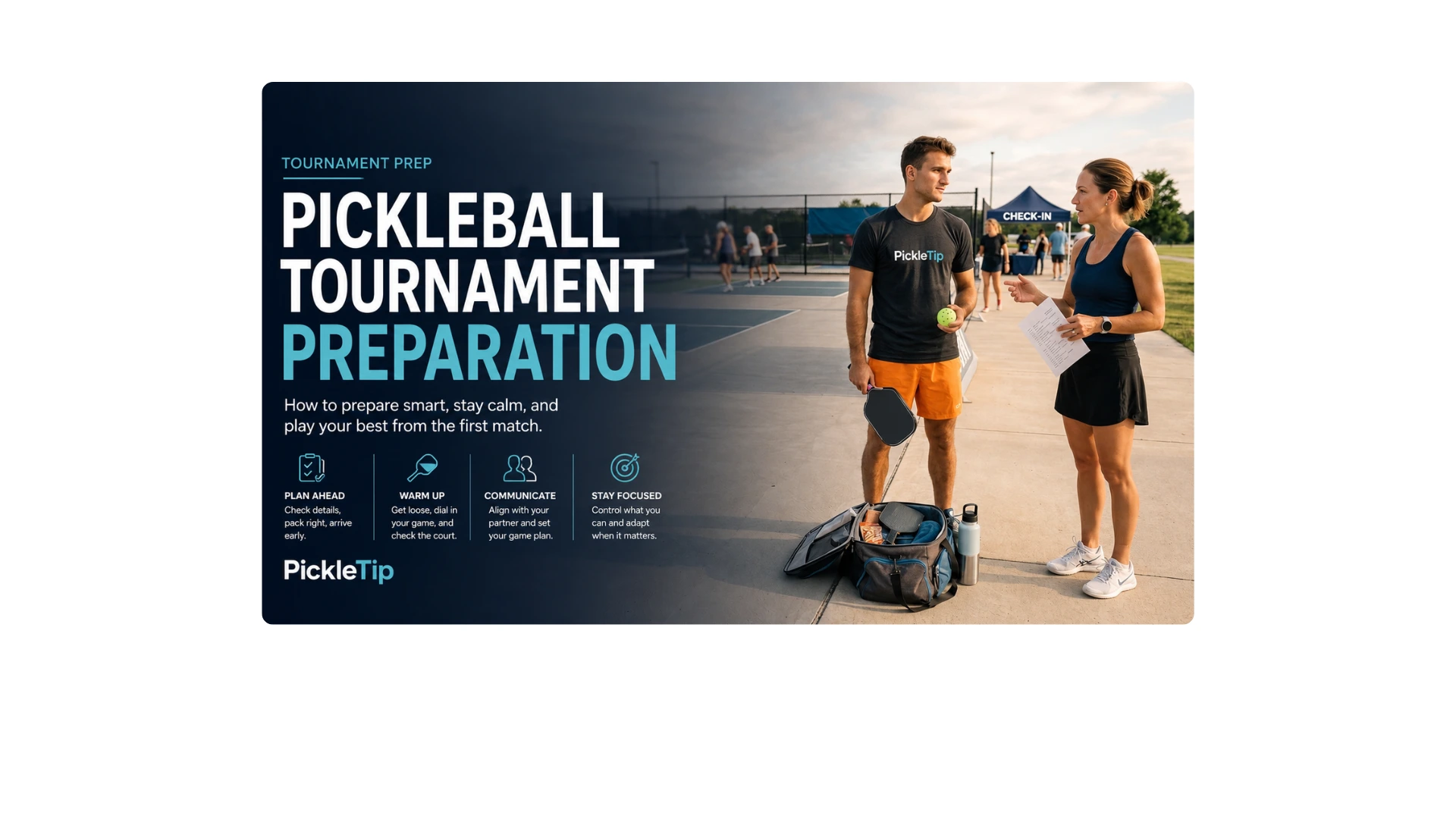
How to Prepare for a Pickleball Tournament Without Leaving the Important Stuff to Chance
Most players prepare for the shots they expect to hit. The tournament usually gets them with the parts they forgot to discuss: the ball, the wait, the middle, the short warm-up and what happens after two bad points.
I have watched teams spend weeks drilling third shots and still arrive unprepared. The event uses a different ball, the first match is moved up, neither partner knows who owns the middle, and the warm-up lasts four minutes. None of those problems required a better drop shot.
Tournament preparation is not cramming more pickleball into the final week. It is removing preventable surprises before the first score is called.
How to Prepare for a Pickleball Tournament
Confirm the division, format, scoring, official ball, venue, schedule, policies and rating implications. Get on the same page with your partner before the event. Practice the decisions and conditions the tournament is likely to create. Taper instead of rebuilding your game. Pack for delays and changing conditions. Use simple warm-up, timeout and between-match routines.
Preparation cannot guarantee your best pickleball. It can stop preventable confusion from stealing the pickleball you already have.
Last reviewed: July 2026.
The STAGE Tournament Preparation Plan
Most tournament advice arrives as a giant checklist. I built STAGE around the problems players tend to discover too late and put them in the order you will actually need them.
At a recent PICKLR tournament in Biloxi, I saw versions of the same problems I have watched at other local and regional amateur events: teams unfamiliar with the event ball, partners still negotiating the middle during warm-up and players returning cold after a long delay. None of those problems were fixed by hitting another hundred drops. STAGE grew from those tournament-day problems, where the event around the match can steal as much from a team as any missing shot.
| Step | Main question | What you should have |
|---|---|---|
| S — Study the Event | What conditions, rules and schedule are we entering? | A clear picture of the event |
| T — Talk Through the Team Plan | What will each partner expect and own? | A shared partner plan |
| A — Adapt Practice to the Tournament | What situations need to feel familiar? | Practice that resembles tournament conditions |
| G — Gear Up for Tournament Day | What can we settle before pressure makes small decisions feel harder? | A settled tournament-day routine |
| E — Expect and Adjust | How will we respond when the event stops following the plan? | One adjustment and one next-ball job |
S — Study the Event
Do not let tournament day be the first time you discover the format, ball, venue or partnership rules. For event-specific information, use the current registration page, player packet and organizer messages. For rules or paddle legality, check the current USA Pickleball rulebook or approved paddle list instead of trusting an old screenshot. Verify the event you actually entered instead of relying on what a similar tournament used last year.
| Event detail | What to confirm | Why it matters |
|---|---|---|
| Division | Skill, age, rating requirements and partner eligibility | You know whether both players belong in the division |
| Format | Round robin, pool play, single elimination, double elimination or another structure | You know how many games may be played and how quickly one result matters |
| Scoring | Game length, win-by rules and whether traditional or rally scoring is used | You can rehearse the actual urgency and end-game decisions |
| Official ball | Brand, model and indoor or outdoor type | Speed, bounce, feel and durability will not be a first-match surprise |
| Venue | Indoor or outdoor, surface, lighting, wind exposure and warm-up space | Practice can resemble the environment instead of an imaginary version of it |
| Schedule | Check-in, first-match window, court-assignment process and possible delays | You can plan travel, food, warm-up and rewarming |
| Results | Whether results affect DUPR or another rating system | You know what the event records and what it does not |
| Policies | Refunds, weather, substitutions, coaching, timeouts and paddle requirements | There is less to argue about or discover under pressure |
If division choice, rating level or the effect of recorded results is unclear, review the PickleTip guide to pickleball ratings before registering.
The PickleTip tournament finder can help you locate an event. Once you find one, treat the organizer’s current registration page, player packet and messages as the source of truth. Those instructions should beat your memory, a friend’s memory and whatever another tournament did last month.
Prepare for This Event, Not an Imaginary Tournament
A small local round robin may use informal court calls and short gaps between games. A larger regional event may require formal check-in, assigned courts, longer waits and stricter equipment or coaching rules. Round robins reward teams that can reset quickly because one flat game does not always end the day. Elimination brackets make the opening games less forgiving, so your warm-up and first-match plan carry more weight. Indoor and outdoor events can demand different balls, shoes, clothing, warm-ups and patience. One-day and multi-day events create different recovery problems. Prepare for the event in front of you, not the word tournament.
AJ once entered an outdoor tournament at Ochsner that had to move indoors because of the weather. The ball, lighting, sound, footing and pace all felt different from what he had prepared for. The useful response was not to keep arguing with the outdoor game he expected. It was to use the warm-up to find the indoor pace, shorten the list of decisions and accept that the tournament had already changed. Being angry about the change does not help you adjust to it.
Choose the Event That Fits the Goal
The right tournament depends on why you are playing. A first tournament may be about learning the rhythm of an event. It does not need to prove your rating, your partnership and your entire pickleball future in one Saturday. Another event may be about testing a partnership, chasing a medal, collecting rating evidence or facing stronger competition.
Use the SCORE goal-setting framework before registering if the goal is unclear. A team cannot prepare well when one partner wants a serious medal run and the other sees the event as a social experiment.
T — Talk Through the Team Plan
A compatible rating does not make someone a tournament partner. A tournament partner is someone who knows what the team will do when one player is targeted, the middle gets messy or the match starts slipping.
Before tournament day, settle these questions out loud:
- What would make this event successful? One partner should not be chasing a medal while the other treats the day as experience.
- Who starts on each side, and when will we stack? Pressure is a bad time to discover that the partners pictured different formations.
- Who owns the middle in our common patterns? There is no universal “forehand always takes it” answer. The right call depends on positioning, movement, handedness, stacking and which ball is actually playable.
- Who handles lobs, switches and timeout calls? Both players should know what language will be used.
- What feedback is useful during a match? Decide what helps, what annoys and what should wait until later.
- What happens if one player receives almost every ball? The targeted player and the quiet partner both need a job.
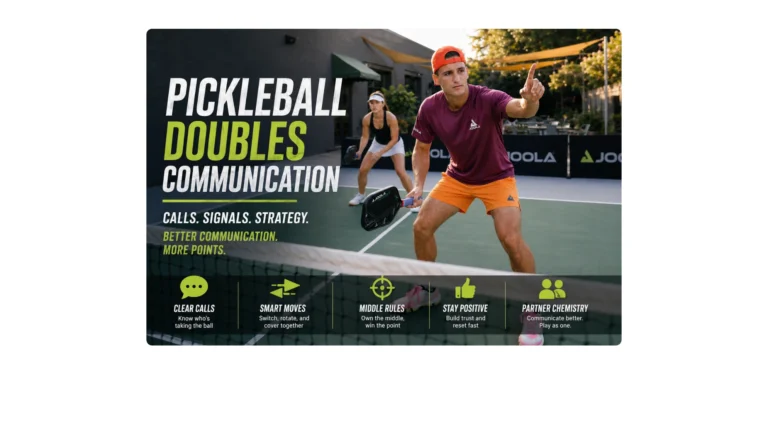
Use the Team Chemistry guide for trust, expectations and compatibility. Use the Doubles Communication guide for middle balls, switches, lobs and calls.
Tournament Preparation for Singles
Replace the partnership plan with a decision plan. Know your preferred serve targets, return position, approach pattern, passing-shot margin and what you will do when fatigue makes the court feel wider. Practice recovering after wide balls and returning to a position that protects the next angle instead of admiring the shot you just hit. Singles still needs a plan. You just have to settle the arguments with yourself before the match starts.
Prepare for Tournament Targeting
Recreational games often spread the ball around. Tournament opponents are more likely to isolate the player or pattern they believe gives them the best chance to win. The stronger player may receive fewer balls. The targeted player may receive too many.
The targeted player’s job is not to prove the opponent made a mistake. The job is to make repeatable balls. The other partner’s job is not to steal the match out of frustration. Both players still need a job.
| Situation | Targeted player’s job | Untargeted partner’s job |
|---|---|---|
| Returns repeatedly isolated | Give yourself margin, keep the return deep and recover to the same place | Stay engaged, communicate and prepare for the next ball |
| Dinks directed to one player | Build patience instead of trying to prove something | Maintain spacing and stay ready for the first ball that changes direction |
| Stronger player receives few balls | Trust the pattern and keep making playable balls | Avoid poaching from frustration; create planned involvement instead |
| Targeted player begins forcing | Simplify the target and decision | Calm the tempo and call a timeout before frustration spreads |
I see the same trap often: the targeted player starts forcing because being picked on feels personal, while the other partner starts poaching because being ignored feels useless. Now one player is trying to prove something and the other is trying to rescue the match. Neither one is playing the rally in front of them.
When that pattern shows up, I would rather give each partner one job than give the team a speech. The targeted player may get a deeper return target and one safer dink location. The quieter partner may get one planned poach instead of permission to hunt every ball. That does not solve the whole match. It usually makes the next few rallies look like pickleball again.
Use the full doubles defense guide for handling sustained pressure.
A — Adapt Practice to the Tournament
Players often tell me they practiced thirds, resets and counters. That tells me what shots they hit. It does not tell me whether they practiced the decisions, movement, score, waiting and partnership patterns the tournament will force.
Tournament practice should rehearse more than shots. Use the likely ball, scoring format and playing conditions. Practice short warm-ups, waiting between games, partner calls and what each player does when one person is targeted. A team can hit beautiful thirds and still be unprepared for the tournament around them.
| Preparation area | What to rehearse |
|---|---|
| Ball and environment | Use the event ball when practical and practice in similar indoor, outdoor, wind, heat, lighting or surface conditions |
| Scoring format | Play games using the event’s likely score and win conditions, including rally scoring when applicable |
| Serve and return pressure | Start drills at meaningful scores and track depth, margin and readiness for the next ball |
| Transition patterns | Practice third shots, fifth shots, resets and the team’s preferred path to the kitchen |
| Partner communication | Rehearse calls, stacking, switches, lobs, timeouts and between-rally language |
| Targeting | Let one player receive most of the balls while both partners practice their jobs |
| Short warm-up | Practice becoming ready without a full lesson or long game |
| Waiting and restarting | Pause between games, cool down, then rewarm and play again |
The official ball deserves more attention than players usually give it. A faster ball can steal reaction time. A softer ball can invite players to swing harder than they should. Indoor skid, outdoor wind, heat and cold can change what feels safe. You do not need to become obsessed with equipment, but the first match should not be your first honest contact with the ball.
The plan should reduce decisions before the event, not remove the ability to adjust during it.
The Final Week: Make the Familiar Dependable
The final week is for making the familiar dependable, not making the unfamiliar exciting.
| Time | Priority |
|---|---|
| 7–10 days out | Confirm event details and test the full match conditions |
| 4–6 days out | Rehearse partner patterns, targeting and likely pressure situations |
| 2–3 days out | Reduce volume while keeping timing, movement and familiar patterns sharp |
| Day before | Pack, hydrate normally, confirm travel and leave your mechanics alone |
| Tournament morning | Use familiar food, a familiar warm-up and simple cues; do not begin new experiments |
During tournament week, familiarity beats excitement. Keep the paddle, food, warm-up, partner calls and shots you already trust. Reduce volume, leave your mechanics alone and fix only what is unsafe or completely unusable.
If one situation still varies too widely, use the PickleTip consistency guide to find the cause. Tournament week is not the time to rebuild the entire motion.
G — Gear Up for Tournament Day
By tournament morning, parking, food, warm-up and spare gear should already be settled. You have enough decisions to make once the score starts, and good tournament days still contain delays, weather changes, schedule confusion and imperfect warm-ups.
What to Pack—and What Players Usually Forget
| Priority | What to pack |
|---|---|
| Must have | Primary paddle, a backup paddle permitted under the event’s current equipment rules, court shoes, water, familiar food, identification, event details, necessary medication and weather protection |
| Strongly recommended | Change of clothes, extra socks, towel, electrolytes, hat, sunscreen, eyewear, folding chair and basic first-aid supplies |
| Condition-dependent | Rain gear, warm layers, cooling towel, portable fan, hand warmers or indoor and outdoor balls for permitted warm-up use |
Pack for the tournament you registered for and the delays, weather and mistakes you did not.
Extra socks rarely feel important while packing. After a wet court, a spilled drink or a long, humid Louisiana morning, they can feel like the smartest thing in the bag.
Arrive Early Enough to Warm Up, Not Rush
Follow the event’s current arrival instructions, then add enough margin for parking, check-in, bathrooms and finding the courts. Confirm how court assignments are announced and locate water, shade, seating and warm-up space before you need them.
There is no universal arrival number that fits every event. A local round robin with easy parking is not the same as a regional tournament in a large complex. I have watched players turn one wrong entrance or a slow check-in into their entire warm-up. Do not assume the listed match time is the first moment you need to be ready.
A Tournament Warm-Up Should Wake Up Your Game
Four minutes is enough to wake up your feet and hands. It is not enough to repair your backhand, prove your fitness or win the warm-up. Help your body move, feel the ball and remind the partnership what normal looks like.
- Raise body temperature.
- Establish feet, balance and ready position.
- Feel soft contact through dinks and resets.
- Test drives, volleys and counters without chasing power.
- Hit serves and returns.
- Rehearse one partner pattern.
- Finish feeling ready, not tired.
The Four-Minute Emergency Warm-Up
Sometimes four minutes is all you get. This is not a universal clock; it is a fallback for a rushed court:
- Minute 1: Move your feet, establish balance and feel a few controlled dinks.
- Minute 2: Touch resets and volleys so the soft game does not begin cold.
- Minute 3: Hit a few drives, counters, serves and returns without turning the warm-up into a power contest.
- Minute 4: Rehearse one partnership pattern, stacking, middle ownership, return-and-crash or the first-ball call you expect to use.
A warm-up should wake up your game, not wear it out.
Food, Fluids and Tournament-Day Energy
- Bring food and fluids you already know you tolerate.
- Account for heat, humidity, long waits and multiple matches.
- Use practical foods you can eat in manageable amounts instead of turning tournament day into a nutrition experiment.
- Use the final days to reduce fatigue rather than prove fitness.
- Address pain appropriately instead of treating every physical problem as nerves.
What to Do During the Wait Between Matches
- Confirm the next match, court and reporting process.
- Cool down or stay warm based on the expected wait.
- Replace fluids and eat familiar food in manageable amounts.
- Review one useful pattern, not the entire match.
- Avoid watching the bracket so obsessively that the next opponent begins playing the match in your head.
- Begin rewarming before the next court call instead of after it.
I have watched players sit for 45 minutes, replay the previous match, study the bracket and begin moving only after their next court is called. The body cooled down while the mind kept playing a match that was already over. Start rewarming before the call and carry one useful observation forward, not the whole emotional history.
If the previous result is still affecting attention, use the next-ball reset. If pressure is changing breathing, tension, tempo or attention, use the PickleTip pressure routine.
E — Expect and Adjust
Expecting change does not mean expecting failure. Tournaments punish players who keep arguing with what already changed. The opponent changed the pattern. The wind changed the ball. The previous point changed your attention. Accept the ball that is actually coming and choose the next useful job.
Start with the game you trust. Do not abandon it because the first three rallies looked strange. Watch for a pattern, identify the first repeatable advantage or problem and change one thing.
When the original plan stops working, change one thing first: the target, tempo, position or sequence. Five simultaneous adjustments usually create five new problems.
| What happened? | Useful response |
|---|---|
| One mistake affects the next rallies | Use the PACE reset to return to one next-ball job |
| Fear makes you steer or frustration makes you force | Use the DRIVE commitment check |
| Opponent reputation changes your normal strategy | Use the Playing Not to Lose guide |
| One player is repeatedly targeted | Simplify that player’s decisions and give the partner a stabilizing job |
| Several adjustments are happening at once | Call a timeout and choose one change |
| The plan no longer fits the ball being played | Keep playing like yourselves; change one target, tempo or sequence, not the whole team |
Do not treat “target the middle,” “keep it in play” or “play your strengths” as universal commands. The useful target depends on opponent positioning, forehand ownership, stacking, available angles and the ball you received.
During a timeout, answer three questions: What pattern keeps repeating? What one thing are we changing? What does each partner do on the next ball? If the conversation needs a full match history, it is too long.
Use the timeout to choose the next job, not to review the entire match.
When the Problem Is Bigger Than Preparation
STAGE prepares you for the event. It cannot manufacture tournament experience, repair an injured body or make an unreliable shot dependable overnight. When the real problem is pressure, partnership or a skill that still breaks down, work on that problem directly instead of adding more items to the tournament checklist.
- Pressure or emotional carryover: Use the pressure guide, the next-ball reset or the guide to playing not to lose. Choose the one that matches what keeps showing up.
- Partnership or communication: Work through partner trust and expectations and the calls, switches and middle balls that keep creating confusion.
- An unreliable skill or repeated situation: Use the consistency guide to find what is actually varying before trying to rebuild everything during tournament week.
- Post-tournament learning: Use the post-match review process to separate repeated evidence from the one result that still bothers you.
The tournament is over when the last match ends. The learning part is not. Before one ugly loss takes over the whole story, write down what happened more than once. Those repeated patterns deserve the next practice session.
The PickleTip STAGE Tournament Checklist
Print this section from your browser, save a screenshot to your phone or walk through it with your partner before tournament week. The checklist is short on purpose. It should settle the day, not become another day to manage.
STUDY:
Do we know the division, format, scoring, ball, venue, schedule, rating implications and policies?
TALK:
Have we discussed goals, sides, stacking, middle responsibility, timeouts, feedback and targeting?
ADAPT:
Have we practiced the event’s likely ball, environment, scoring, pressure, short warm-up and partnership patterns?
GEAR UP:
Are travel, arrival, packing, warm-up, food, fluids, waiting and between-match routines settled?
EXPECT:
When the plan meets reality, what is our one adjustment and next-ball job?
Pickleball Tournament Preparation FAQs
Begin several weeks ahead by confirming the event format, ball, venue, partner plan and likely playing conditions. The exact timeline depends on how tournament-ready your current game already is. The final week should sharpen familiar patterns and reduce fatigue rather than introduce major changes.
Prioritize the event details, a simple warm-up, familiar equipment and food, and a clear plan for scoring, delays and nerves. Your first tournament is partly about learning the rhythm of an event, so do not judge the entire experience by whether you medal.
Practice the situations the event will create: its scoring format, likely ball and environment, serves and returns under pressure, transition patterns, partner communication, targeting, timeouts, short warm-ups and restarting after a wait.
Follow the event instructions, then allow enough additional time for parking, check-in, bathroom needs, finding the courts and a gradual warm-up. The right buffer depends on the size and location of the event, so do not assume the listed match time is the first moment you need to be ready.
Yes, when practical. The ball can change speed, bounce, skid, softness and reaction time. You do not need to obsess over equipment, but the first match should not be your first honest contact with the event ball.
Bring your primary paddle, a permitted backup paddle, court shoes, water, familiar food, identification, event information, extra clothing, towels and condition-specific items such as sunscreen, rain gear or warm layers.
Write down the situations that appeared more than once, identify the most useful practice priority and decide what should be tested before the next event. Separate one emotional result from the patterns that repeated across several games.
Remove the Preventable Surprises
You cannot control the draw, weather, opponents, schedule delays, bad bounces or whether your best game appears on command.
You can arrive knowing the event, trusting the partnership, recognizing the likely conditions, carrying what the day requires and understanding how the team will respond when the plan changes.
STAGE does not control the tournament. It makes sure the tournament has to beat the game you brought, not the confusion you brought with it.