
Should Age or Gender Affect Your DUPR Pickleball Rating?
Should age or gender change your pickleball rating? No, not the core skill rating. Age and gender can affect matchups, tournament eligibility, and the context around a result, but the rating itself should describe the competitive level your results support.
That distinction matters more in 2026 because DUPR now gives players additional age- and format-based subscores while continuing to use one universal main rating. In other words: keep the measurement universal, then add context around it.
If you’re really asking how a skill rating differs from an age or tournament division, I cover that separately in my skill rating vs. bracket rating guide. But that still leaves the harder question:
If older players, younger players, men, and women can experience very different competitive environments, should the rating itself be adjusted for those demographic differences?
What DUPR Actually Does With Age and Gender in 2026
First, here’s what DUPR actually does today. If you need the broader explanation of the system itself (what DUPR stands for, how the scale works, Reliability, and the different numbers on a player profile) start with my complete DUPR guide.
- DUPR’s main rating is universal. DUPR says its primary rating does not factor age, gender, or location into the core skill number.
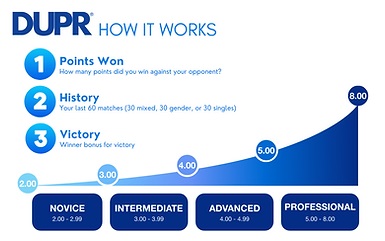
- The main scale runs from 2.000 to 8.000. Players have separate singles and doubles ratings.
- Result type already provides some context. DUPR distinguishes player-reported recreational results from club, league, and tournament results, with verified results carrying more weight.
- DUPR added subscores in 2026. Those include Mixed Doubles and age-based doubles views for 50+ and 65+ players.
- Those subscores do not replace the main rating. They give players another way to understand how their performance looks inside a particular slice of their match history.
DUPR explains its current rating model in What Is a DUPR Rating?, and its April 2026 announcement explains the newer profile subscores.
Coach Sid Translation: DUPR did not create a “senior 4.0” and an “open 4.0.” It kept the main number and added another window into the data. That is an important difference.
Age, Gender, Rating, Division, and Subscore Are Not the Same Thing
| Concept | Primary job | Should it redefine the core skill number? |
|---|---|---|
| Main skill rating | Estimate current competitive playing strength from results | No |
| Age division | Determine who is eligible for an age-based competitive field | No |
| Gender division | Organize women’s, men’s, mixed, or open competition | No |
| Age or format subscore | Show how part of a player’s recorded performance looks within a narrower context | No |
| Match history | Provide the evidence behind the rating | It should determine the rating through results |
USA Pickleball’s sanctioned tournament formats show the same separation from another direction. Events can combine age groups and skill levels (such as 50+ 3.5, 50+ 4.0, or 50+ 4.5) without requiring “4.0” to have a different definition for every age group. See the current USA Pickleball sanctioned tournament formats.
That is why I think demographic information belongs primarily in competition structure and performance context, not inside the definition of the underlying skill number.
The Best Argument for Age- or Gender-Adjusted Ratings
I disagree with demographic-adjusted core ratings, but there is a legitimate argument on the other side. It deserves to be stated fairly.
The strongest argument is not that older players or women deserve an easier number. It is that pickleball competition can develop in partially separated pools.
A player who records most of her matches in women’s divisions may have relatively few results connecting that match history to a broader open pool. A 65+ player may spend most of his competitive time against other 65+ players. A local club can create a similar effect even without age or gender divisions if the same players compete with one another over and over.
How confident should we be that two identical ratings drawn from weakly connected competitive pools represent exactly the same playing strength?
That is a much stronger version of the argument than saying, “A 60-year-old should automatically receive a different rating because of age.”
Age and gender can shape matchups, but the bigger rating problem is simpler: players often compete inside partially separated pools. When those pools rarely cross, the system has less direct match evidence connecting them.
Coach Sid Translation: The strongest case for demographic context is really a data-connectivity argument. Different groups may live in different competitive neighborhoods. That does not automatically mean they need different rulers.
Why I Still Would Not Put Age or Gender Into the Core Rating
The whole value of one universal scale is that the number is supposed to mean the same thing wherever you take it. If a 4.0 means one competitive level for one demographic and another level for someone else, we have changed the question the number answers.
1. Let Performance Move the Rating
If a player becomes slower, less mobile, less consistent, or less effective over time, the important thing is not the player’s birthday. It is whether those changes affect match performance.
If they do, results eventually provide evidence of the change.
A player should not lose rating points simply because they turned 65. They should lose rating points when their current results no longer support the old level.
2. Demographics Do Not Tell You How a Specific Player Wins
I have coached and played with older players who neutralize younger power players with anticipation, resets, positioning, touch, and patience. I have also watched younger athletes overwhelm experienced players whose movement or decision-making could not hold up to the pace.
Age matters to the matchup. Gender can matter to the matchup. Neither one tells you the result before the players actually compete.
3. A 4.0 Should Travel
A universal rating becomes useful when it travels. The player can move from one club to another, enter a different tournament, change partners, or play against a different demographic and still carry a number intended to mean the same thing.
If we redefine the underlying scale according to demographic category, the label becomes harder to interpret outside that category.
Coach Sid’s rule: Use demographics to organize competition when useful. Use results to measure competitive level.
What DUPR’s New Age-Based Subscores Get Right
This is the part of DUPR’s new setup I like.
DUPR added age-based doubles subscores for 50+ and 65+, while keeping the main rating universal. That gives a player more information without turning the main rating into a different scale for different people.
That’s pretty close to how I think this should work:
- Main rating: What competitive level does your overall result history support?
- Subscore: What does a particular slice of that performance history look like?
- Division: Which competitive field are you eligible to enter?
Those are three different questions. We create problems when we force one number to answer all three.
For the deeper explanation of why a rating and a tournament division perform different jobs, read Skill Rating vs. Bracket Rating.
The Real Weak Spot: Ratings Need Connected Evidence
The part of this debate I care about most is not demographics. It is evidence quality.
A rating backed by a large, recent, varied match history deserves more confidence than the same number built from a handful of matches against the same small group.
DUPR already acknowledges part of this problem through its Reliability Score. The rating estimates your competitive level; Reliability tells you how established and current that estimate is. DUPR says Reliability depends on factors including how many results are in the system, how recently you have played, and the variety of players you have faced. See DUPR’s Reliability Score explanation.
DUPR currently treats 60% or higher as a reliable rating. So if two players are both 4.0 but one has a 90% Reliability Score and the other is sitting at 25%, I would not treat those two numbers with the same confidence. Same rating. Very different amounts of evidence behind it.
Coach Sid’s reliability rule: Two players can have the same DUPR without having the same amount of evidence behind it. Look at the rating, then look at the Reliability Score and the match history supporting it.
That is true whether the narrow pool is:
- a women’s league,
- a 65+ tournament circuit,
- a men’s moneyball group,
- a private club, or
- the same twelve people playing every Tuesday night.
The demographic label is not the mathematical problem. The question is whether enough reliable match evidence connects that player to the wider player pool.
This is also why I would not treat one surprising cross-pool result as proof that an entire rating system is broken. A single match is evidence. It is not automatically enough evidence.
For the full distinction between the skill number and the evidence supporting it, see my DUPR explainer. For a deeper look at when a DUPR number deserves your trust, including match volume, recency, local player pools, and limited histories, read Are DUPR Ratings Accurate?
What I’ve Seen on the Court
I have watched this change happen without anybody touching a demographic adjustment.
There is an older player I have played with at Pontiff Park for years. Great hands. Smart resets. Excellent court awareness. At one point, everybody around him treated him as one of the stronger players in the group.
Over time, his movement changed. Hands battles he used to control became harder. Balls he used to reach comfortably started getting behind him.
His age explains part of why that happened.
But age should not be the input that changes the rating. The changed performance should.
The opposite can happen too. An older player can continue beating younger opponents because anticipation, placement, patience, and decision-making keep compensating for whatever physical advantage the younger player appears to have on paper.
Coach Sid Takeaway: Demographics can help explain a player. They should not replace the evidence produced by the player.
How Much Should You Trust Your Rating?
You do not need to obsess over demographic math to use your rating intelligently. You do need to understand the evidence behind it.
- Check your Reliability Score. DUPR treats 60% or higher as reliable. A lower score does not mean the rating is wrong; it means the system has less evidence behind it.
- Look at your match volume. A thin history deserves less confidence than a deep one.
- Look at recency. Old results may describe a player you no longer are.
- Notice how varied your opponents are. Playing the same small group repeatedly gives the system less cross-pool evidence than competing against a broader mix of players.
- Use subscores as context, not competing identities. A 50+ or mixed-doubles subscore can tell you something useful without replacing your main rating.
- Do not panic over one result. Look for a pattern across different kinds of opponents and settings.
- Test the number occasionally. Different partners, opponents, clubs, and competitive settings can reveal whether the level travels.
If you are trying to determine whether the rating itself has enough evidence behind it, use the framework in our DUPR rating accuracy analysis. If you are questioning whether your claimed level matches your actual repeatable game, that is a different problem covered in the PickleTip Rating Reality Check.
What I Still Want Rating Systems to Show Me
Everything below is what I’d like to see, not something I’m saying DUPR already does.
Show Me the Evidence Behind the Number
DUPR already gives us part of this through Reliability. What I still want is a player profile that makes both pieces hard to miss: how reliable the number is and where the underlying matches came from.
If most of a player’s history comes from one small group, age-restricted events, mixed doubles, tournaments, club play, or recreational matches, let me see that without digging. That does not mean those environments need different definitions of skill. It means I can understand what kind of evidence is sitting underneath the number.
A precise-looking rating is easy to overtrust when the evidence behind it is hard to see.
Keep Context Beside the Rating, Not Inside Its Meaning
This is why the subscore direction interests me. Give players more useful context without turning the main scale into several incompatible scales.
Coach Sid Translation: One ruler. Better evidence. More context.
What’s Fact, and Where I’m Giving You My Opinion
| Claim | Confidence | Basis |
|---|---|---|
| DUPR’s main rating does not adjust for age, gender, or location | High | DUPR’s current published explanation |
| DUPR added Mixed Doubles and 50+/65+ age-based doubles subscores in 2026 | High | DUPR’s April 2026 feature announcement |
| DUPR Reliability reflects factors including result volume, recency, and player variety; 60%+ is considered reliable | High | DUPR’s published Reliability guidance |
| USA Pickleball tournaments can combine age and skill divisions | High | USA Pickleball sanctioned tournament formats |
| Weakly connected player pools can make cross-pool comparisons less certain | Analytical inference | PickleTip interpretation of rating evidence and player-pool connectivity |
| Competitive context should be more visible beside the rating | Proposal | PickleTip recommendation |
Age and Gender Pickleball Ratings FAQ
No. DUPR says its main universal rating does not factor age, gender, or location into the core number. Your rating is based on match results and other algorithm inputs such as opponent strength and result type.
Yes. DUPR’s main rating is universal and does not use a different scale by gender. My caution is that two 4.0 ratings can have different amounts of evidence behind them, especially when match histories are narrow or weakly connected. That is why I also look at Reliability and match history.
DUPR introduced age-based doubles subscores for 50+ and 65+ players in 2026. These provide additional context on a player’s performance within those match groups but do not replace the player’s main universal DUPR rating.
The Reliability Score is separate from your skill rating. It shows how established and current the rating is based on factors such as result volume, recency, and player variety. DUPR currently describes 60% or higher as reliable.
No. Age can help explain changes in movement, recovery, reach, or other parts of performance, but the rating should change when match results show that the player’s competitive level has changed, not simply because the player reached a certain age.
The demographic division is not automatically the problem. Confidence can be lower when a player’s match history is small, old, or concentrated inside a narrow player pool. Check the DUPR Reliability Score, then look at how recent and varied the supporting match history is.
An age division determines who is eligible for a particular competitive group. A skill rating estimates playing strength. USA Pickleball tournaments can combine both, such as a 50+ 4.0 division. For the full distinction, see PickleTip’s Skill Rating vs. Bracket Rating guide.
They could describe performance inside isolated groups, but they would sacrifice some of the portability of one universal scale. My preference is one main skill rating supported by Reliability, transparent match history, divisions, and contextual subscores.
Coach Sid’s Bottom Line
Age and gender matter in pickleball. They can affect matchups. They can determine tournament eligibility. They can help explain why one competitive environment feels different from another.
But none of that requires us to make the core skill number mean something different depending on who is holding the paddle.
The principle worth keeping: Let the rating describe demonstrated competitive strength. Let divisions organize competition. Let subscores and match history provide context. Do not ask one number to do all three jobs.
If your real question is whether your current number deserves your trust, continue to Are DUPR Ratings Accurate?. If you need to understand how a skill number interacts with age, gender, and tournament eligibility, read Skill Rating vs. Bracket Rating.
Updated August 2026 to reflect DUPR’s current universal-rating model, result-type weighting, Reliability Score guidance, 50+/65+ age-based doubles subscores, and current USA Pickleball age/skill tournament formats.