
How to Choose a Pickleball Paddle That Fits Your Game
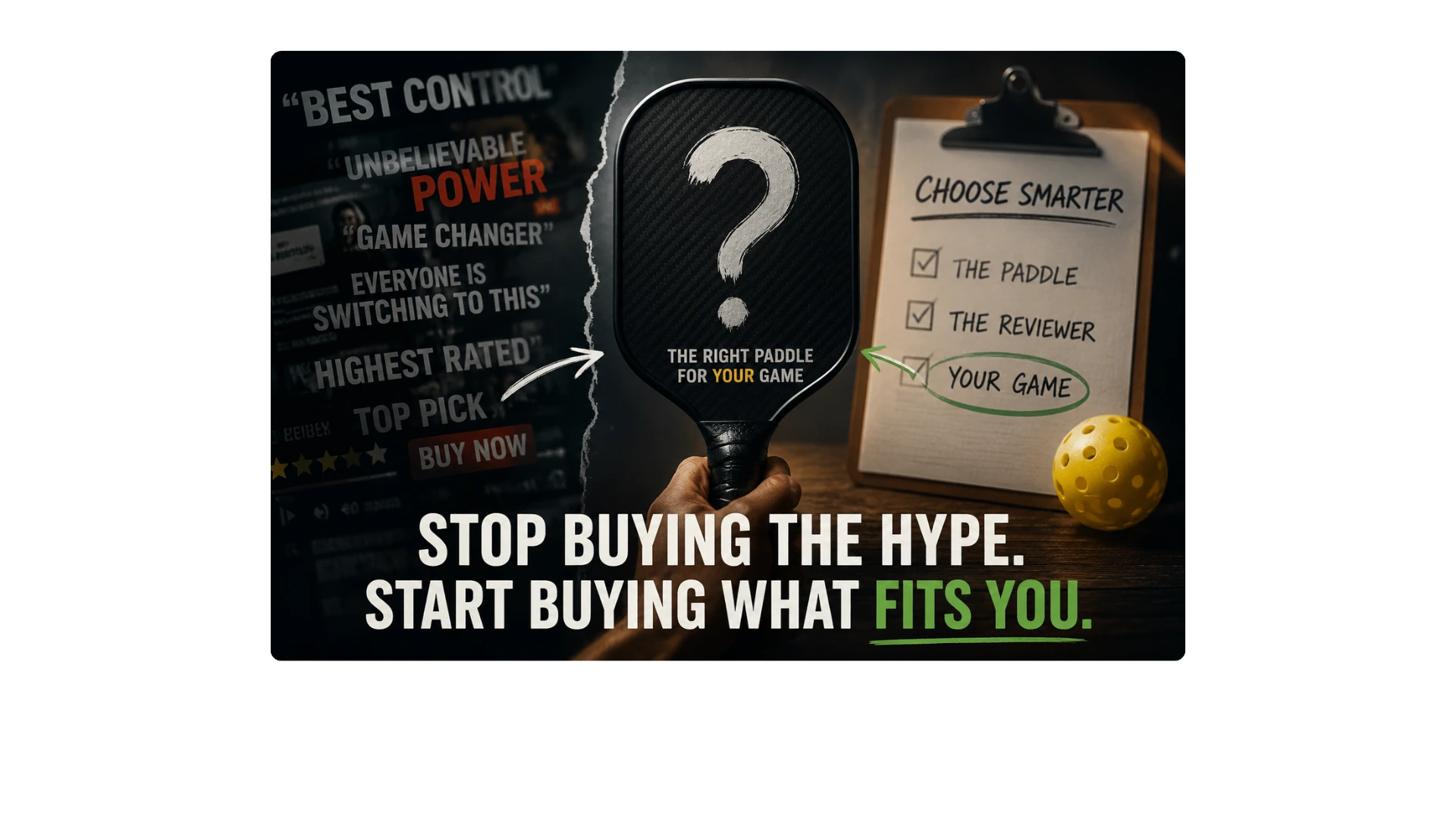
If you are trying to choose a pickleball paddle, do not start with a brand, a price tag, or somebody else’s “best paddle” ranking. Start with the shot or situation that keeps costing you points.
The Short Answer
Choose the paddle that makes your most common mistake less expensive without creating a worse problem somewhere else.
If balls keep sailing long, you probably do not need more pop. If your blocks die short, you may need more stability or easier depth. If your hands feel late, pay attention to swing weight and balance. If mishits twist badly, prioritize forgiveness and twist stability.
Jump to your question: quick decision guide • the PADDLE Method • do paddles make a difference? • choose by your miss • what paddle specifications mean • power vs control vs all-court • foam vs honeycomb • how much to spend • how to test a paddle • how to use reviews • paddle-buying questions
Start With the Point You Keep Losing
| Your Main Problem | What to Prioritize | What to Be Careful With |
|---|---|---|
| Balls keep sailing long | Predictable launch, lower pop, usable dwell, controlled rebound | Very hot faces and fast rebound on short swings |
| Drops and resets float high | Soft-game confidence, predictable face response, manageable pop | Paddles that feel exciting on drives but vague on touch shots |
| Blocks die short | Stability, plow-through, easier depth, forgiving off-center response | Very light or hollow-feeling builds that lose energy on imperfect contact |
| Paddle twists on mishits | Higher twist stability, larger usable sweet spot, stable shape | Fast but unforgiving paddles with weak edge response |
| Hands feel late | Manageable swing weight, balanced feel, quick reload speed | Head-heavy paddles that feel powerful but slow in exchanges |
| You cannot pressure opponents | Usable power, depth, spin, confident acceleration | Buying raw pop when timing, footwork, or shot choice is the real issue |
| Your elbow, wrist, or shoulder gets tired | Comfortable swing demand, balance, grip fit, dampened feedback | Choosing only by listed static weight |
The PickleTip PADDLE Method
When a player asks me what paddle to buy, I do not want to start with a brand. I want to know which point or shot keeps going wrong. Then I run the problem through PADDLE:
- P — Pinpoint the miss: Name the shot or situation that keeps costing you points.
- A — Assess the cause: Decide whether the paddle is contributing or whether timing, footwork, preparation, grip pressure, or shot choice is the bigger problem.
- D — Decide the trait: Identify the paddle characteristic most likely to make that miss less expensive.
- D — Demo under pressure: Test the paddle when you are late, jammed, stretched, off-center, blocking pace, or resetting under pressure.
- L — Look for the tradeoff: Notice whether solving one problem creates another, such as easier power but worse resets or more stability but slower hands.
- E — Evaluate the whole fit: Consider performance, comfort, grip, approval, price, durability, and whether you trust the paddle when the point gets messy.
If you cannot pinpoint the problem clearly, you are probably shopping from hype instead of need. And whatever trait you think you need, test it on ugly contact, not five perfect warmup balls.
One honest limitation: sometimes you will not know which paddle trait is causing the problem until you try a few very different paddles. That is fine. The method is not supposed to make the answer obvious before you test. It is supposed to make the test useful.
🎧 Prefer listening? Hear Coach AJ summarize Coach Sid’s approach to choosing a pickleball paddle:
Do Pickleball Paddles Really Make a Difference?
Yes, paddles matter. The harder question is whether the difference a paddle makes is the difference your game needs.
A paddle can send the ball off the face faster, stay steadier near the edge, give you easier depth, or make your hand work harder than it should. You usually notice the difference first on drops, resets, blocks, and counters, not on the perfect drive you hit during warmup.
A better match can make a rushed reset easier to trust or keep a compact block from dying short. The wrong match can make a good player feel late, launch counters long, or start steering the face because the rebound never feels predictable.
What a Paddle Can and Cannot Do
A paddle can change the cost of your mistakes. It cannot remove the mistakes for you.
If the same miss follows you from paddle to paddle (especially when you are late, off balance, reaching, or choosing the wrong ball to attack) the equipment may not be the main problem. A paddle can give you more margin. It cannot make the decision or move your feet.
That is why price alone tells you almost nothing. A $250 paddle that makes your hands late is a worse purchase than a $90 paddle that gives you more playable resets and keeps your counters in the court.
The Miss Is Only the First Clue
Most players shop by labels: power, control, all-court, foam, carbon, elongated, 16mm. Those labels can help, but they should come after the diagnosis.
Diagnose More Than the Final Result
- What happened? Did the ball fly long, die short, float high, twist the paddle, or arrive before your hands recovered?
- When did it happen? Was the contact clean, rushed, late, off-center, under pace, on the move, or after fatigue set in?
- What changed it? Did a different rebound, better stability, quicker handling, more forgiveness, a grip adjustment, or better preparation improve the result?
A Reset Problem That Wasn’t Just About Control
The miss tells you where to look. The situation tells you why. I saw that clearly while working with a 3.5 player who was convinced he needed a softer control paddle because his transition resets kept popping up. I recorded one of his local matches at Miley, and we watched it back together.
When he was balanced and caught the ball near the middle, his resets were fine. The trouble showed up when he was jammed, reaching, or a little late. His grip tightened, contact moved toward the edge, and the paddle twisted just enough to send the ball higher than he intended.
We tried a few different paddle profiles, but the useful difference was not simply “more control.” He did better with a paddle that stayed steadier on imperfect contact and gave him a larger playable hitting area. We also worked on preparing the paddle earlier and relaxing his grip under pressure.
The extra forgiveness helped, but the lesson was not that he needed one particular paddle. He had diagnosed the result without identifying the full cause. Softness alone was not the answer. Stability, forgiveness, preparation, and grip pressure were all part of it.
Before You Trust a Paddle Review
| Evaluate This | Question to Ask | Why It Matters |
|---|---|---|
| The paddle | What does it clearly do well, and what are the tradeoffs? | This identifies the actual performance profile. |
| The reviewer | Does this person play enough like me for their experience to transfer? | Swing speed, timing, level, style, and preferred shots change how a paddle feels. |
| Yourself | What problem am I trying to solve? | This keeps you from chasing somebody else’s solution. |
What Pickleball Paddle Specifications Actually Mean
Treat paddle specifications as clues, not promises. A light paddle can still feel slow, a thick paddle can still be poppy, and a carbon face can still disappoint you on spin. Use the numbers to decide what you need to test, not what you are supposed to feel.
| Specification | What It Tells You | Where You Feel It |
|---|---|---|
| Static weight | How much the paddle weighs on a scale | Overall load, but not necessarily how fast or slow it feels in motion |
| Swing weight | How demanding the paddle feels while swinging | Hand speed, reload speed, fatigue, and plow-through |
| Twist weight | How strongly the paddle resists twisting on off-center contact | Blocks, counters, and mishits near the edge |
| Core thickness | One part of the paddle’s stiffness and rebound profile | Pop, dwell, touch, launch, and feel |
| Shape | How face area, reach, sweet spot, and swing demand are distributed | Reach, forgiveness, maneuverability, and leverage |
| Handle length | Available grip space and leverage | Two-handed backhands, wrist freedom, reach, and balance |
| Grip circumference | How thick the handle feels in your hand | Comfort, wrist freedom, grip pressure, and control |
| Face material | One part of friction, stiffness, feedback, and durability | Spin potential, rebound, feel, and wear |
| Balance | Where the paddle’s mass is concentrated | Head speed, stability, fatigue, and perceived heaviness |
Paddle Weight: Do Not Choose by Ounces Alone
A head-heavy paddle can make a modest listed weight feel slow when the ball speeds up. A slightly heavier paddle can feel easier to manage when the balance is neutral or handle-biased. Pay attention to static weight, swing weight, balance, and how quickly the paddle changes direction, not just the number printed on a product page.
Signs that a paddle may be too demanding include counters arriving before the paddle reloads, the head continuing to pull after contact, your grip tightening as a game goes on, or your forearm, elbow, wrist, or shoulder tiring earlier than usual.
If you already own a paddle and want to change stability, balance, or plow-through, read the separate pickleball paddle weight placement guide. Added weight is useful for tuning stability or balance, but if you dislike the paddle’s basic shape or rebound, lead tape is not going to perform a personality transplant.
Paddle Shape, Handle Length, and Grip Fit
- Standard or widebody shapes: usually prioritize forgiveness, usable face area, and quick handling.
- Hybrid shapes: try to balance reach, sweet spot, and maneuverability.
- Elongated shapes: usually add reach and leverage, but may increase swing demand or reduce forgiveness near the sides.
- Longer handles: help two-handed backhands and players who want more leverage, but reduce available face area within legal size limits.
- Grip circumference: should let you hold the paddle securely without squeezing it like it owes you money. A grip that feels too large can limit wrist freedom. A grip that feels too small may encourage excess hand tension, though an overgrip can usually add size.
Former tennis players often prefer longer handles and elongated or hybrid shapes. See the dedicated best pickleball paddles for tennis players guide for current recommendations.
Core Thickness and Face Material
Thicker cores are often associated with a softer response, while thinner cores are often associated with quicker rebound. Then the rest of the construction barges into the conversation. Layup, perimeter weighting, face stiffness, core type, and balance can override the easy generalization.
Carbon fiber, fiberglass, graphite, Kevlar, and blended faces can all play differently depending on the complete build. Do not assume carbon automatically means spin or fiberglass automatically means power. Watch what the ball actually does: how quickly it leaves, how high it launches, how much the face moves on edge contact, and whether your touch survives when your contact gets rushed.
I saw this clearly when I tested the CRBN 3 TruFoam Genesis and KBS TruFoam Aurora, two full-foam T700 paddles. The KBS felt softer, but the CRBN stayed much more consistent when contact moved away from center. Soft is not the same thing as forgiving.
Check Tournament Approval Before You Buy
Tournament players should verify the exact brand and model against the equipment list used by the event they plan to play. Approval systems and model status can change, so do not assume a similar name, another generation, or a previously approved version has the same status.
For the full legality and approval process, see Pickleball Paddle Rules, Testing, Approval & Legality.
Check durability and warranty too. A paddle can feel excellent during a short demo and still be a poor long-term purchase if the surface wears quickly, the response changes, or the warranty offers little protection. Look for a clear warranty, realistic coverage, and evidence that the paddle remains consistent after regular play.
Should You Buy a Power, Control, or All-Court Paddle?
| Paddle Profile | Best Fit | Main Risk |
|---|---|---|
| Power | Players who need easier pace, depth, and pressure | Extra pop can make counters, drops, and resets harder to control |
| Control | Players who already create pace and want predictable touch | May feel passive if the player needs help creating offense |
| All-court | Players who want balanced offense, touch, forgiveness, and speed | May not be exceptional in the one category the player needs most |
Use power, control, and all-court as rough directions, not final answers. Two control paddles can produce completely different results when you are countering pace or trying to reset from the transition zone.
A player who already creates plenty of speed may love a control paddle because it calms the counter and gives the soft game more room. A player who struggles to create depth may find that same paddle passive and exhausting.
One comparison from my own bag: in my 11SIX24 Vapor Power 2 testing, the Vapor felt more chaos-capable: quicker hands, more bite, and more pop when I was early. My Ronbus Quanta R4 was calmer and more forgiving when I was late. Neither description makes one paddle universally better. It tells you which mistake each paddle is more likely to forgive.
Do not shop for the category you like saying. Shop for the ball behavior you need.
If predictable touch, resets, blocks, and controlled response under pace are the problem you have identified, use the best control pickleball paddles guide for current recommendations.
Full Foam, Perimeter Foam, or Honeycomb?
Foam or honeycomb gives me an idea what to look for. The court gets the final vote.
| Construction | Potential Benefit | Potential Tradeoff |
|---|---|---|
| Full foam | Stable, dampened, continuous response and a larger usable contact zone | Can feel muted, demanding, expensive, or slower than expected |
| Perimeter foam plus honeycomb | Familiar honeycomb response with added edge stability and forgiveness | May not feel as dampened or structurally different as full foam |
| Traditional honeycomb | Familiar feedback, broad price range, and proven performance | Some builds punish edge contact or feel less stable under pace |
With foam, pay attention to whether the extra stability produces more playable blocks and resets or simply makes the paddle feel muted and slow. With honeycomb, pay attention to edge response, vibration, and whether compact contact loses too much depth. The construction name is only the start of the test.
I have seen that inside the same paddle family. In my Enhance Turbo EPP vs. MPP test, the EPP version was easier for me to repeat on resets, while the MPP version exposed late contact faster. Same family, different foam architecture, different miss. That is why I do not buy a core label and assume I already know the answer.
If you already know you want foam, use the dedicated best foam-core pickleball paddles guide for current recommendations by player fit.
How Much Should You Spend on a Pickleball Paddle?
Spend enough to solve a problem you can identify, not enough to feel like you bought the newest technology.
- New players: prioritize forgiveness, comfort, predictable response, grip fit, and a reasonable price. You do not need the most advanced construction to learn.
- Improving players: spend more when you understand which performance trait you need to change and can test whether the new paddle actually changes it.
- Competitive players: durability, approval status, warranty, consistency between paddles, and exact fit may justify a higher price.
A premium paddle may be worth it when the extra cost buys a useful improvement in stability, consistency, comfort, durability, or fit. It is a poor value when the technology is impressive but the paddle still launches your common miss into the fence.
For current value recommendations and price ceilings, see the best budget pickleball paddles guide.
How to Test a Pickleball Paddle Before Buying
Five cooperative dinks are not a paddle test. Use your current paddle as the control, hit the same problem shots with the demo paddle, and track what changes. Otherwise, you are comparing today’s memory of one paddle with today’s excitement about another.
When we test paddles at PickleTip, we repeat the same shots, add pace, compare against a familiar paddle, and pay attention to what happens when contact is less than perfect, not just on serves, drives, and clean kitchen warmups. Read more about the process in How PickleTip Tests Pickleball Paddles.
This is the part of a demo I trust most.
Coach Sid’s Ugly-Contact Test
- Third-shot drops: Does the ball launch predictably, or do you begin steering the face?
- Transition resets: Do rushed resets land deeper, float higher, or die short?
- Body blocks: Does the paddle stay stable when contact is compact and late?
- Hip counters: Can you reload quickly, or does the paddle make your hands late?
- Off-center dinks: Does the face twist, feel harsh, or keep the ball playable?
- Baseline drives: Can you create pressure while still controlling height and depth?
Do not judge only by makes and misses. Track the miss type: short, long, pop-up, twist, or late reaction. A miss that changes from long to short is information. So is a paddle that improves clean contact but gets unstable when you are late.
Try demos from local players, coaches, ambassadors, stores, or brands with legitimate trial programs. Compare the demo against your own paddle in the same session. When possible, test it more than once so the first-session novelty wears off and your timing has a chance to settle.
A short demo can expose obvious fit problems. It cannot reliably tell you everything about durability, break-in changes, long-term comfort, or how your timing will adapt after several weeks. That is one reason a legitimate trial period and a useful warranty matter.
Clean Contact Lies a Little
A paddle can feel perfect when you are balanced and hitting the middle. Judge it when you are late, jammed, stretched, blocking pace, or resetting while moving backward. That is where trust shows up.
How to Use Pickleball Paddle Reviews Without Chasing Hype
Two honest reviewers can disagree because the paddle is reacting to two different players. Swing speed, timing, court position, skill level, habits, preferred shots, and risk tolerance all change what the reviewer feels.
| Your Playstyle | Reviewer to Trust Most | Reviewer to Be Careful With |
|---|---|---|
| Former tennis player with natural power | Someone who discusses launch, control under pace, long handles, and missed-long balls | Someone who only praises easy power |
| Soft-game doubles player | Someone who tests drops, resets, blocks, and kitchen exchanges | Someone focused mostly on serves and drives |
| Fast-hands counter player | Someone who discusses swing weight, reload speed, and stability | Someone who judges mostly from the baseline |
| Improving intermediate player | Someone who explains forgiveness, adjustment period, and confidence | Someone who tests only from an advanced attack-first perspective |
Before trusting a review, make sure it tells you five things:
- what the paddle clearly does well,
- which shots become easier,
- which shots require adjustment,
- which player type benefits most,
- and who should probably avoid it.
Also ask how the paddle was tested. A review based mostly on clean baseline drives cannot tell a soft-game doubles player much about rushed resets, compact blocks, or kitchen counters. The test has to resemble the part of pickleball you actually play.
If a review makes every paddle sound perfect for every player, it is probably not helping you make a real decision.
Match the Guide to the Problem
Once you know what you are trying to fix, you can stop wandering through everybody’s top-ten list. Use the guide that matches the job:
- Best Pickleball Paddles — broad current recommendations
- Best Pickleball Paddles for Beginners — first-paddle recommendations
- Best Pickleball Paddles for Spin — spin-led recommendations
- Best Control Pickleball Paddles — control-led recommendations for predictable touch, resets, blocks, and response under pace
- Best Pickleball Paddles for Tennis Players — tennis-transition fit
- Best Foam-Core Pickleball Paddles — foam education and recommendations
- Best Budget Pickleball Paddles — affordable and price-ceiling picks
- Player-Tested Pickleball Paddle Reviews — individual model testing
- How PickleTip Tests Pickleball Paddles — testing standards and methodology
Paddle-Buying Questions I Hear Most
Use the PickleTip PADDLE Method: Pinpoint the miss, Assess the cause, Decide the trait, Demo under pressure, Look for the tradeoff, and Evaluate the whole fit. The goal is to solve the problem that costs you points without creating a worse one somewhere else.
You may need a different paddle if your current one consistently makes a specific problem worse, such as balls sailing long, blocks dying short, mishits twisting badly, or hand battles feeling late. You may need a replacement if the paddle’s performance, surface condition, or consistency has noticeably changed. If the same issue follows you across paddles, equipment may not be the main problem.
Usually not. Beginners should prioritize forgiveness, comfort, grip fit, predictable response, and a reasonable price while they learn which traits matter to their game. Upgrade when you can identify the performance problem you want a new paddle to solve.
Compare it with your current paddle in the same session and test the same problem shots under pace and imperfect contact. When possible, use it in more than one session so first-day excitement fades and your timing has a chance to settle. A short demo still cannot prove long-term durability or break-in behavior.
Approval matters most for tournament play. Verify the exact brand and model against the equipment list used by your event because approval status can change and similar names or different generations may not share the same status.
Choose a power paddle if you need help creating pace and depth without making your common misses worse. Choose a control paddle if you already generate pace but need more predictable drops, resets, blocks, and counters. Choose an all-court paddle when you need a balanced mix and no single weakness demands an extreme solution.
Final Take
The best pickleball paddle is not the one everybody loves. It is the one that helps you play your game with fewer expensive mistakes.
That is the PADDLE Method in plain English: pinpoint the miss, test what might help, and make sure the cure is not worse than the problem.


