FLiK F3 Review: Two Months Later, Which Shape Is Best?
Hands-On Review • Three Shapes Tested • Two-Month Follow-Up
Updated August 20, 2026: Two-month follow-up added after continued regular play.
Should you buy the FLiK F3? Yes, if your game gets better when slightly imperfect contact stays playable. I started with roughly twelve hours of side-by-side testing across the Hybrid, Standard, and Elongated shapes, then kept playing the F3 for about two months. It is still in my everyday paddle bag and is competing for the top spot as my main.
The tradeoff: The F3 does not give you the sharpest feedback, the hardest baseline ball, or record-chasing spin. Its quieter response can also hide how much rebound is available around the kitchen until you adjust. What you get in return is a larger useful hitting area, predictable ball behavior, and more trust when contact is rushed.
Best For: Control-First Doubles
Biggest Surprise: Feels Softer Than It Plays
Biggest Tradeoff: Quiet Feedback, Lively Kitchen Pop
Hidden Strength: Confidence on Imperfect Contact
Follow-Up: Still in My Everyday Bag
🎧 Prefer listening? Hear a summary of Coach Sid’s take on the FLiK F3 paddles:
FLiK F3 in 30 Seconds
| Question | Coach Sid Answer |
|---|---|
| What is it? | A control-first all-court foam paddle family offered in Hybrid, Standard, and Elongated shapes. |
| Best overall shape | Hybrid. It gives the cleanest blend of hand speed, reach, reset confidence, usable offense, and mistake coverage. |
| Best forgiveness shape | Standard. Start here if small mishits, rushed blocks, or transition errors cost you too many rallies. |
| Best offensive shape | Elongated. Pick it if you already create pace and want more reach, leverage, and drive pressure. |
| Main strength | Imperfect contact often stays useful. In doubles, that can save more points than one perfect highlight ball. |
| Main tradeoff | The cushioned feel gives less tactile information, while the face can rebound more around the kitchen than your hand expects at first. |
| Who should skip it? | Players who want maximum power, very crisp feedback, or a truly dead reset paddle. |
Disclosure: If you buy through my FLiK links or use code PICKLETIP, I may earn a commission at no extra cost to you. That does not affect my testing or recommendations.
Who Should Buy the FLiK F3?
Buy the F3 if your game improves when the paddle gives you margin on the ordinary ugly balls: late blocks, stretched volleys, rushed resets, and counters that do not quite find center. It makes the most sense for doubles players who build points through placement, patience, and controlled aggression.
Skip it if your first priority is maximum baseline speed or sharp, immediate feedback. The expensive mistake would be buying the F3 because “all-court” sounds like maximum power with no penalty. That is not the job this paddle is trying to do.
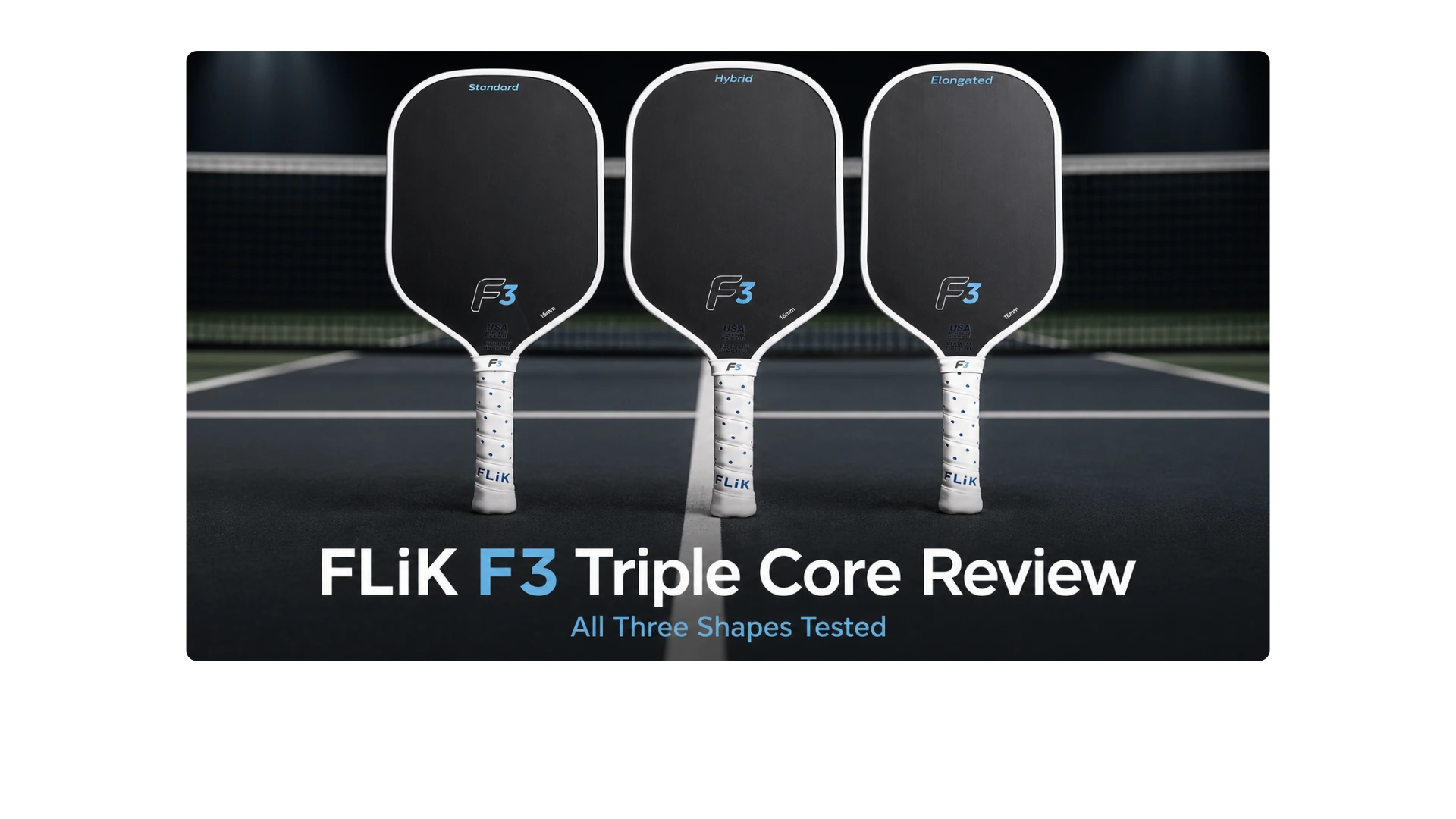
FLiK F3 Hybrid vs Standard vs Elongated
The three F3 shapes share the same basic personality, but geometry changes reach, maneuverability, leverage, and how much lateral room you have when contact drifts away from center.
I would not choose by rating alone. Choose by the problem you want the paddle to solve. The pressure tests made those differences pretty obvious.
How I Tested the FLiK F3
- Paddles tested: FLiK F3 Hybrid, Standard, and Elongated.
- Original comparison testing: Roughly twelve hours across drilling, warm-ups, direct shape comparisons, and open play.
- Pressure situations: Serve returns, third-shot drops, transition resets, stretched blocks, speed-up counters, baseline drives, and overhead put-aways.
- Primary setting: Real doubles play, because that is where late contact, body jams, movement errors, and awkward balls expose a paddle faster than clean warm-up swings.
- Main finding: The F3 feels calmer in the hand than the ball coming off the face suggests. Once I adjusted to that mismatch, the paddle became much easier to trust.
- Continued use: I kept the F3 in regular rotation for the two-month follow-up instead of ending the test after the original comparison sessions.
I did not want to give the F3 a two-session handshake and pretend I knew it. I rotated through all three shapes in the same kinds of doubles situations, took court notes, and kept coming back to the same pressure checks. That is also how I test paddles across PickleTip; if you want the full process, see how PickleTip tests pickleball paddles.
Two Months Later: What Changed?
I kept playing the F3 after the original testing was finished, and that may be the more useful test. It is still in my everyday bag and is competing for the top spot as my main paddle. What I liked during the first twelve hours is still what I like about it now.
The face grit has begun to wear a little. I have not noticed the corresponding drop in spin I would normally worry about, though. The paddle still gives me enough dwell time to shape the ball, and I have not noticed a meaningful drop in the spin I can produce.
What I can say now: this follow-up gives me more confidence in the original performance verdict and lets me comment on early surface wear. The sample is still not long enough for me to make a six-month or one-year claim about the foam core or overall construction.
Where My Notes Matched Other Testers
After I finished my own notes, I checked detailed F3 reviews from Pickleheads*, MyPickleList*, and Pickleball Playbook* to see whether other testers were running into the same things I did. I was not counting votes; I wanted to see whether the same traits kept showing up for other players.
| Trait | My Testing | What Kept Showing Up Elsewhere |
|---|---|---|
| Useful hitting area | Excellent; small misses stayed playable unusually often. | Forgiveness and a broad usable contact area were recurring themes. |
| Impact feel | Quiet and cushioned. | Other testers also described a softer or muted feel. |
| All-court identity | Control first, with enough offense to finish. | The F3 was generally treated as an all-court paddle rather than a pure power paddle. |
| Kitchen rebound | More lively than the feel suggests; I needed a short adjustment. | This was the biggest preference split: some testers liked the pop, while others needed more calibration on soft shots. |
What surprised me was how often the same traits showed up in other reviews. The disagreement was more about whether a player liked the way those traits felt.
Does the Triple Core Actually Matter on Court?
FLiK lists the F3 as a 16 mm paddle built with a TerraCore Triple Foam Core, three layers of T700 Raw Toray Carbon, and a solid PU handle. I expected that construction to send me down a foam-density rabbit hole. It did not. I only cared about the technology when I could connect it to a repeatable ball outcome.
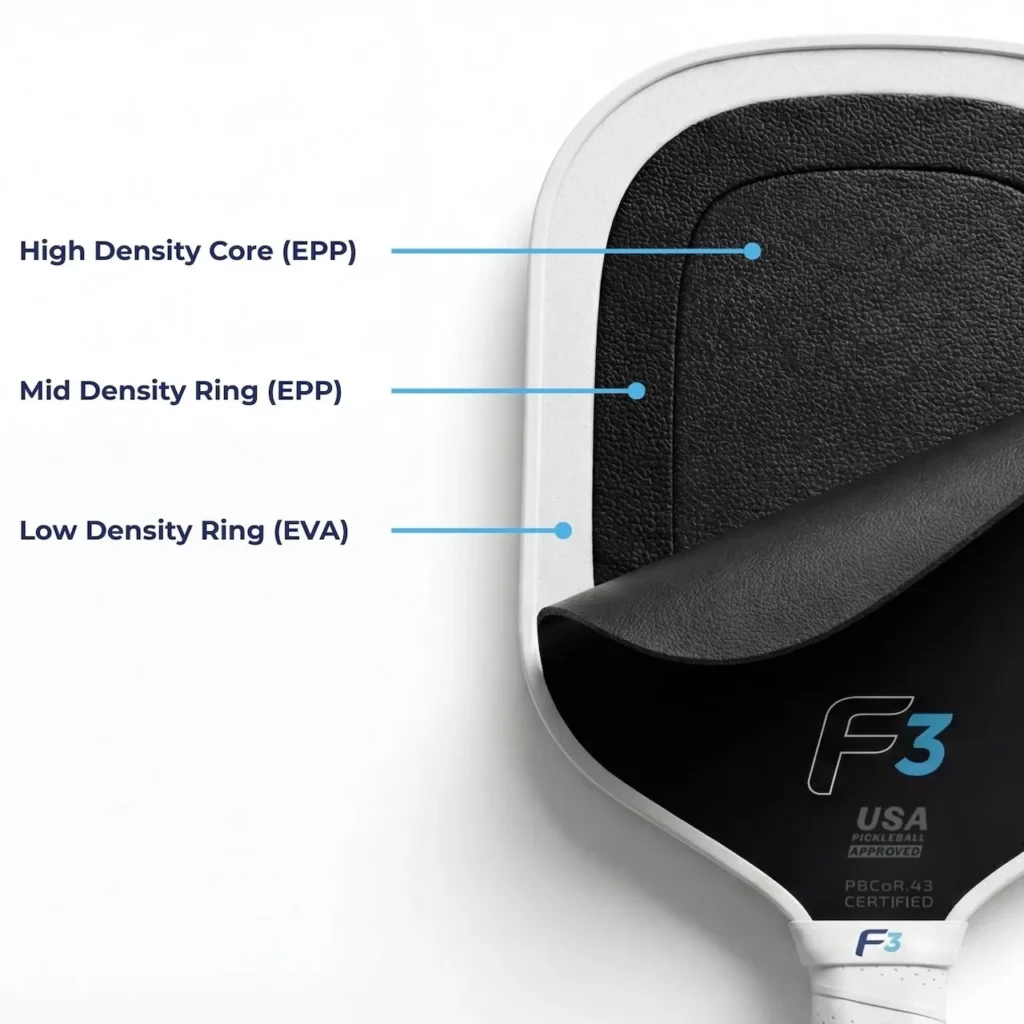
The repeatable outcome was simple: performance fell off gradually as contact moved away from center. I still knew when I missed the middle, but more of those misses retained enough pace, direction, and height control to keep the rally alive.
“That ball should have been worse.”
That became the most useful description in my notebook. The F3 did not turn bad swings into winners. It made a lot of slightly imperfect swings less expensive.
That is the only Triple Core explanation I think a buyer really needs. The technology matters because of the size and consistency of the usable contact zone, not because the center strike suddenly feels magical.
What Is the FLiK F3’s Biggest Tradeoff?
The F3 gives you stability, a broad usable contact zone, and a calmer all-court game. The price you pay is feedback. Impact is less sharp and less informative than it is on crisper paddles, even though the ball can still leave the face with useful speed.
| What You Gain | What You Give Up |
|---|---|
| More margin when contact drifts away from center. | Less tactile information about exactly where you struck the ball. |
| More confidence on blocks, resets, and awkward defensive balls. | Less of the sharp, connected sensation some players use to judge touch. |
| Enough short-swing rebound to counter without overswinging. | A short adjustment period because the hand can perceive less energy than the face actually returns. |
Biggest tradeoff: the same hidden pop that helps counters can make early soft-game attempts travel deeper than expected. For the right player, that is manageable. For someone who wants every contact to feel crisp and obvious, it may be the reason to pass.
Is the F3 Just a Softer FLiK F1?
No. The FLiK F1 built its identity around offense. The F3 feels like a different answer to a different question: how many quality balls can you keep in play without feeling like you surrendered the ability to attack?
That difference becomes obvious when the point gets messy. The F3 is not trying to win the demo with one spectacular strike. It is trying to make your next hundred pressured contacts a little more predictable.
What Does the F3 Do in Real Match Situations?
I care less about isolated category scores than what happens when a normal doubles point puts you under pressure. These five situations are where the F3’s personality became clearest.
| Match Situation | What I Felt | What the Ball Did | Buyer Takeaway |
|---|---|---|---|
| Serve return under pressure | Stable enough that I did not feel forced to guide the face. | Deep returns stayed controllable even when contact was not perfect. | Useful for players whose return miss comes from rushed or slightly off-center contact. |
| Third-shot drop | Calm impact with more rebound than the sound suggests. | Once adjusted, drops became repeatable without excessive lift. | Good fit if you want margin without a completely dead response. |
| Transition reset | Stable on awkward contact, but early attempts could travel deeper than expected. | Compact hands produced low, neutralizing balls. | Strong reset potential after a short calibration period. |
| Speed-up counter | Short swings produced surprising life. | Counters carried enough pace without a large motion. | One of the clearest reasons I preferred the Hybrid for most doubles players. |
| Overhead put-away | Enough mass and response to finish without overswinging. | Clean overheads ended points, but never felt like uncontrolled rockets. | Plenty of finishing power for an all-court player; not a max-power specialist. |
That confidence changed what I did with the next ball. Once I trusted a late block or slightly off-center volley to stay playable, I quit steering it and started picking a target.
That is also how I coach pickleball strategy. You do not need to force offense from every ball. Make the highest-percentage decision the situation allows, then be ready for the next one. The F3 helped because a small contact mistake was less likely to turn a reasonable decision into a disaster.
How Does the F3 Handle Imperfect Contact?
This is where the F3 separated itself for me. Perfect contact looks good with almost any modern paddle. The useful test is what happens when you are half a beat late, stretched outside your body, or defending a ball your partner accidentally left you.
On rushed backhand blocks and stretched volleys, I repeatedly felt contact that seemed mediocre in the hand, then watched the ball clear the net with enough depth and direction to keep the rally neutral. That is not a miracle shot. It is simply a cheaper miss.
The Standard protected those contacts best. The Hybrid stayed close while feeling quicker in rapid exchanges. The Elongated still offered good mistake coverage for a longer shape, but it rewarded cleaner timing more than its siblings.
Does the FLiK F3 Have Enough Power?
Yes for an all-court player; no if your shopping list starts with maximum drive speed. The F3 gives you offense with a seatbelt on.
On full baseline drives, the face felt composed rather than explosive, but the ball still carried enough pace to push opponents backward. The Elongated produced the heaviest drive of the three, the Hybrid stayed close enough that I never felt underpowered, and the Standard traded some leverage for an easier contact window.
On overhead put-aways, I did not need to manufacture extra swing speed. Clean contact finished the point. What the F3 does not give you is the sensation that every overhead wants to leave the facility. That restraint is part of the appeal for players who already create enough pace.
FLiK F3 Drops and Resets: The Quiet Face Takes Adjustment
This was the part that initially confused me. The contact sounds and feels restrained, so my hands expected the ball to die more than it actually did. My first few transition resets floated deeper than intended.
Once I stopped treating the F3 like an ultra-dead control paddle, the pattern changed. Relax the hands, keep the path compact, and trust the face. From there, third-shot drops became repeatable and I could shape them without feeling like I had to manufacture lift.
Transition resets were even more revealing because they combined movement, incoming pace, and imperfect contact. The F3 absorbed enough chaos to keep the ball low, but I still had to respect the rebound. If resets are a leak in your game, my how to reset in pickleball guide explains the mechanics that matter regardless of paddle.
Coach Sid’s adjustment: The F3 sounds deader than it plays. My resets improved when I stopped babying the ball, kept the swing compact, and trusted the face.
How Does the F3 Handle Speed-Ups and Counters?
The first hard speed-up I countered with the Hybrid taught me more than several minutes of dinking. I expected the paddle to absorb most of the pace. Instead, a compact counter came off with enough energy that I did not need to add much swing.
The Standard was the easiest shape to trust on defensive blocks and body jams. The Hybrid gave me the best balance between quick recovery and stable contact. The Elongated produced the fastest counter when I found the middle, but the extra length made timing a little more important.
That is the F3 kitchen lesson in one sentence: short swings work better than helping the paddle. Once I stopped adding unnecessary hand speed, counters became one of the family’s strongest shots.
How Much Spin Does the FLiK F3 Produce?
Enough for the way I use this paddle. I can shape topspin serves, drives, rolls, and passing shots without thinking of spin as the defining reason to buy the F3.
During the follow-up period, the face grit has begun to wear a little, but I have not felt the spin fall off with it. The dwell time is still giving me enough time on the ball to create the shapes I want. That does not mean the surface is unworn; it means the visible wear has not translated into a meaningful loss of spin for me yet.
If your entire paddle search revolves around maximum RPM, there are better places to look. If placement, margin, and repeatable ball shape matter more than chasing a spin leaderboard, the F3 still gives me what I need after continued use.
When Did the F3 Start Feeling Natural?
There was no magical shot. The realization came during an ordinary doubles game when I noticed I had stopped trying to help the paddle.
I was not steering blocks, babying resets, or swinging harder than necessary. I was choosing targets and preparing for the next ball.
That was the moment the F3 made sense. It was not asking me to play differently. It was quietly rewarding cleaner decisions.
Which FLiK F3 Specs Actually Matter?
The numbers matter only when they explain something you can feel on court. FLiK publishes the construction and shape details on the F3 Triple Core product page. The useful trend here is that as the shape gets shorter and wider, swing weight drops while twist weight rises. In plain English, the Standard gives up some reach and leverage to become easier to move and harder to twist on imperfect contact.
| Feature | Elongated | Hybrid | Standard |
|---|---|---|---|
| Overall Length | 16.5 in | 16.3 in | 16 in |
| Width | 7.5 in | 7.7 in | 8 in |
| Static Weight | 8.0 oz | 8.0 oz | 8.0 oz |
| Swing Weight | 116.5 | 116 | 114 |
| Twist Weight | 5.85 | 6.4 | 6.6 |
| Balance Point | 245 mm | 243 mm | 241 mm |
On-court implication: The shape trend matched what I felt. Shorter and wider moved a little easier and resisted twisting better on imperfect contact; more length bought reach and drive leverage at the cost of some lateral margin. Those same geometry tradeoffs apply well beyond the F3, which is why I go deeper on them in my guide to choosing a pickleball paddle.
All three F3 shapes are also listed as approved. The F3 Hybrid was listed as passing on 11/01/2025, the FLiK F3 Elongated on 12/15/2025, and the FLiK F3 Standard on 12/17/2025. If approval matters for an event, confirm the exact model on the official USA Pickleball approved paddle list before competing.
Which F3 Shape Should You Choose?
Do not choose the F3 shape by skill rating. A 3.5 who loses rallies to rushed blocks may need a different shape than another 3.5 who already defends well and wants more reach. Choose by the mistake you want to make cheaper. All three share the same core identity; shape changes reach, maneuverability, leverage, and how much room you have when contact drifts.
The FLiK F3 Shape Decision Tree
- Are mishits, rushed blocks, and defensive volleys your biggest problem? Choose the Standard.
- Do you want one paddle that creates the fewest compromises? Choose the Hybrid.
- Do you already create offense comfortably and want more reach and leverage? Choose the Elongated.
If you are deciding between paddle shapes beyond the F3 family, my pickleball paddle selection guide explains how standard, hybrid, and elongated geometry changes reach, face area, maneuverability, and forgiveness.
The Player Who Simply Wants to Miss Less
Buy the Standard.
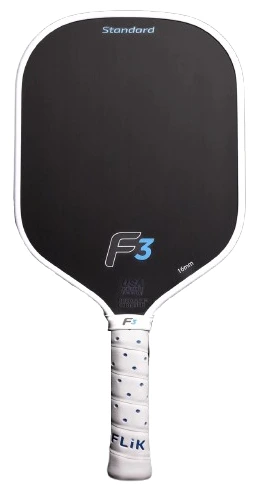
Every group has this player. They do not lose because they are underpowered. They lose because one or two unnecessary errors sneak into almost every game: an edge-heavy block, a rushed reset into the tape, a transition ball that drifts wide.
That is exactly where the Standard earns its place. Of the three shapes, it gave me the largest usable contact window and demanded the least perfection when I was late or stretched.
Instead of encouraging me to manufacture offense, it encouraged me to stay in the rally one more ball. That does not sound exciting. It wins a surprising number of games.
If you keep walking off court thinking, “I beat myself more than they beat me,” start with the Standard.
Choose the FLiK F3 Standard → Current GASMEUP + PICKLETIP codes are included in the cart link while both remain valid.
The Player Who Wants One Paddle for Everything
Buy the Hybrid.
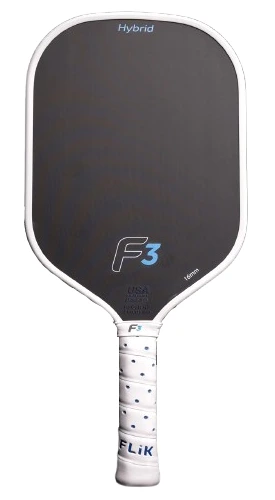
This became my default recommendation because it never created an obvious weakness. I had enough reach to attack, enough stability to defend, enough maneuverability for fast kitchen exchanges, and enough pop to finish without constantly flirting with the baseline.
Most players do not need the most power or the widest possible face. They need the fewest compromises. After continued use, the Hybrid is still the F3 shape I prefer.
If a player tells me they do not want three paddles and just want to know which F3 to buy, I do not need much time: Hybrid.
Choose the FLiK F3 Hybrid → Current GASMEUP + PICKLETIP codes are included in the cart link while both remain valid.
The Player Who Creates Their Own Offense
Buy the Elongated.
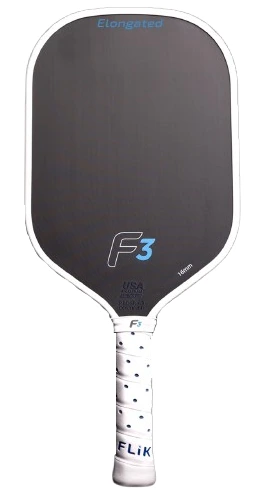
Some players do not wait for opportunities. They manufacture them. They attack high thirds, create angles, and use leverage to turn neutral balls into pressure.
Those players will naturally gravitate toward the Elongated. The additional length showed up most clearly on baseline drives, reaching volleys, and attacking contact above the net. When I found the middle, it produced the most penetrating ball of the three shapes.
But leverage always has a cost. The longer geometry asks for cleaner timing and gives you less lateral room than the Standard or Hybrid. It remained more manageable on slight mishits than many elongated paddles I have tested, but it was still the least protective F3 shape when contact wandered.
If your game already creates offense comfortably, that trade is worth considering. If consistency is still the larger problem, I would steer you toward the Hybrid or Standard instead.
Choose the FLiK F3 Elongated → Current GASMEUP + PICKLETIP codes are included in the cart link while both remain valid.
Current FLiK F3 Price and Discount Codes
Current deal: When I verified the offer on August 20, 2026, FLiK’s GASMEUP promotion stacked with my reader code PICKLETIP. On the $190 F3 Hybrid, GASMEUP removed $50 first and PICKLETIP then took another 10% off the discounted price, bringing it to $126 before shipping — $64 total savings.
If you already know which F3 fits your game, the model-specific links on this page are set to add that exact paddle to the cart and apply GASMEUP + PICKLETIP automatically while both discounts remain valid. GASMEUP is a FLiK promotion and can end or change; PICKLETIP normally provides 10% off.
Where Does the F3 Sit Among Other Foam Paddles?
The F3 is a control-first all-court foam paddle, but it is not dead. That distinction matters most at the kitchen, where the quiet feel can fool your hand into expecting less rebound than the face actually returns. The better comparison is not “foam versus carbon.” It is which problem each paddle solves when a point gets messy.
| Paddle | What Stood Out in My Testing | Choose It Over the F3 If… | Stay With the F3 If… |
|---|---|---|---|
| FLiK F1 | Speed-first offense and fast acceleration through hands battles. | You want the more offensive FLiK personality and prioritize quick acceleration. | You would rather trade some top-end offense for broader mistake coverage and a calmer all-court response. |
| 11SIX24 Pegasus Power 2 | A lively, very quick widebody that protects average contact well when doubles gets crowded. | You specifically want a fast widebody and a livelier foam response. | You prefer the F3’s quieter feel, three-shape choice, and more control-first personality. |
| Six Zero Coral Pro | More spin-driven and slightly crisper, with extra help when I wanted to attack. | Spin and a more direct offensive response are higher on your list. | You care more about mistake coverage, predictable ball behavior, and the F3’s calmer impact. |
| KBS TruFoam Aurora | A budget-friendly way to try soft full-foam feel, but off-center misses exposed the difference in forgiveness. | You mainly want an inexpensive way to experiment with softer foam feel. | You are paying for the broader useful contact area and better protection when contact gets ugly. |
What Should You Compare the F3 Against?
If you are shopping foam or all-court paddles, start with the miss you are trying to protect rather than the biggest headline number. My foam-core paddle pressure guide explains why these paddles can behave differently once points speed up, and my best pickleball paddles guide shows where current alternatives fit by player need.
What Is Your Current Paddle Costing You?
Before you buy one, ask what your current paddle keeps costing you.
- Your aggressive drives keep sailing long: the F3 can give you a calmer launch window without turning offense off.
- Off-center blocks die or spray: the broader usable contact zone can make those misses less expensive.
- Your resets work only when you are perfectly balanced: the face gives you useful stability when transition contact gets messy.
- Your control paddle feels too dead around the kitchen: the F3 adds short-swing rebound without becoming a pure power paddle.
- You want to play cleaner doubles: the F3 rewards blocks, counters, drops, resets, placement, and patient offense more than highlight hunting.
If none of those describe a real problem in your game, do not manufacture a reason to switch. Sometimes a new paddle is just a new way to blame yourself.
What Would I Improve in a Future F3?
I would ask for slightly clearer tactile feedback without changing the basic rebound profile.
The quiet impact is part of the F3’s appeal, but it also creates the biggest learning curve. Early in testing, the paddle sometimes returned more energy than my hands expected because the contact itself felt so restrained.
Once I adapted, that stopped being a problem. A future version that preserved the same mistake coverage and predictable ball flight while telling the hand a little more about the strike would shorten the adjustment period for players coming from crisper carbon paddles.
Who Should Cross the FLiK F3 Off Their List?
The F3 is easy for me to recommend to the right player, but there are four groups I would steer elsewhere.
- Power-first players who want the hardest-hitting paddle possible.
- Feedback-first players who depend on a sharp, connected impact sensation to judge every touch shot.
- Spin-first players who want maximum RPM to be the defining feature of the purchase.
- Players who already love their current paddle and cannot identify a specific problem the F3 would solve.
The F3 earns its value when your current paddle makes small mistakes too expensive. If that is not your problem, this may not be your upgrade.
FLiK F3 FAQ
Yes, if you value consistency, mistake coverage, and all-court play more than maximum power. After continued use, the F3 is still in my everyday paddle bag and my original performance verdict has held up. The Hybrid remains my best overall recommendation, while the Standard makes more sense if maximum forgiveness is your priority and the Elongated if you want more reach and leverage.
The FLiK F3 Hybrid is my best overall recommendation because it keeps most of the Standard’s stability while adding reach and quicker handling. After continued use, it is still the F3 shape I prefer. Choose the Standard if mishits and rushed defensive contact are the bigger problem. Choose the Elongated if you already create offense and want more reach and leverage.
I would not choose an F3 by rating alone. Two players with the same rating can need different things from a paddle. If rushed blocks, mishits, and transition contact are costing you rallies, the Standard gives you the most margin. If you want the fewest compromises, I prefer the Hybrid. If you already create offense comfortably and want more reach and leverage, look at the Elongated.
I would call it a large useful hitting area rather than one oversized sweet spot. The center is still the best contact, but performance fell off gradually as I moved away from it instead of dropping sharply.
It has held up well in regular play. The face grit has begun to wear a little, but I have not noticed a meaningful loss of spin, and the F3 still gives me enough dwell time to shape the ball. Two months is enough for me to comment on early surface wear, but not enough to make a six-month or one-year durability claim about the foam core or overall construction.
Yes. All three F3 shapes are listed on the USA Pickleball approved paddle list. Approval status can change, so confirm the exact model on the official USA Pickleball equipment list before a sanctioned event.
Other F3 Reviews I Checked
Independent F3 reviews I checked after finishing my own notes:
* Pickleheads FLiK F3 review
* MyPickleList FLiK F3 review
* Pickleball Playbook FLiK F3 review
Would I Miss the F3 Hybrid Tomorrow?
When I originally finished testing the F3, I asked myself the same question I ask after every paddle review.
If I left this paddle on a bench, would I actually miss it tomorrow?
Two months later, I do not have to guess. The review ended. The F3 never left my bag.
It is still in my everyday rotation and competing for the top spot as my main paddle. I test enough paddles that something has to keep earning court time after the notes are written. The F3 has.
The best paddles eventually get quiet in your decision-making. I am not steering blocks, babying resets, or wondering what the face is going to do. I can present the paddle, choose the target, and prepare for the next contact.
I still enjoy playing with this paddle. That sounds simple. After a lot more court time and a lot of other paddles competing for space in my bag, it is probably the strongest endorsement in this review.
Final Recommendation: Which FLiK F3 Would I Buy?
I started this review expecting to write about Triple Core engineering. I finished the follow-up still thinking about confidence.
The F3 is not the paddle I would buy for maximum power, the sharpest feedback, or a completely dead reset face. I would buy it because ordinary mistakes stayed playable often enough that I stopped managing the paddle and started managing the point. Continued use tells me that was not just a good first impression.
If it were my money, I would still buy the Hybrid. Choose the Standard if your biggest problem is mishits and rushed defensive contact. Choose the Elongated if you already create offense and want more reach and leverage.
Choose your model:
FLiK F3 Standard →
FLiK F3 Hybrid →
FLiK F3 Elongated →
Those model-specific links are set to add the exact shape you chose and apply the current GASMEUP + PICKLETIP discounts automatically while both remain valid. When I verified the stack on August 20, 2026, the $190 F3 Hybrid came to $126 before shipping. Promotional codes can change.
The review ended. The F3 never left my bag. That is the compliment that lasts.