How Pickleball Paddles Are Tested: USAP vs. UPA-A Explained
Pickleball paddle testing answers three different questions: did the submitted model pass, do production paddles still match it, and has the individual paddle in your bag remained compliant? USA Pickleball and UPA-A use overlapping but different laboratory and onsite procedures, so one approval logo cannot answer every tournament-eligibility question.
Last fully reviewed: · Testing rules change, and USAP and UPA-A do not always update every public page at the same time. When published numbers conflict, use the newest official rules document.
Coach Sid’s Short Answer
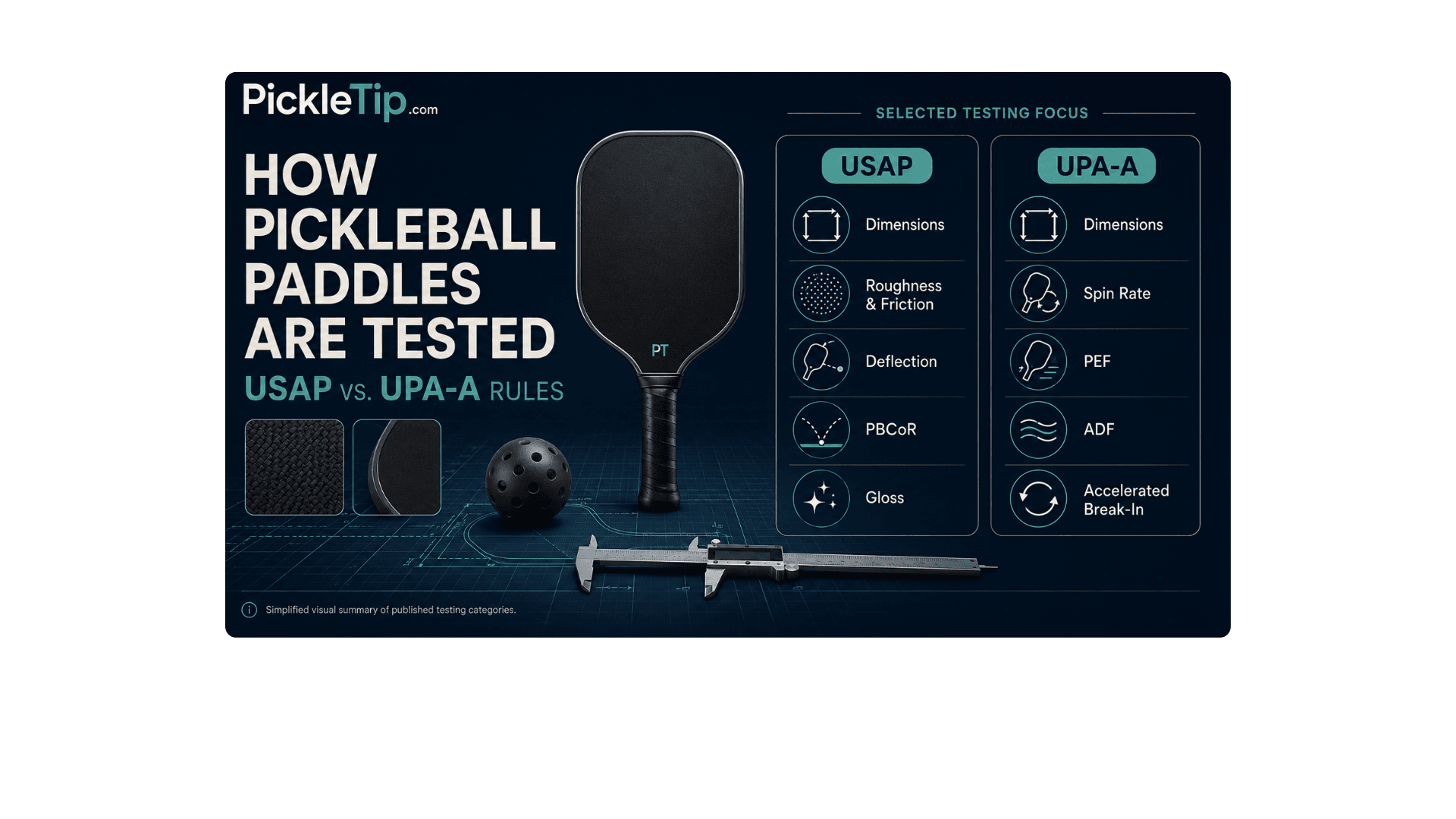
USA Pickleball and UPA-A do not certify paddles with one identical test package. USA Pickleball measures dimensions, surface characteristics, deflection, gloss, and paddle-ball rebound through PBCoR. UPA-A measures dimensions, direct power through PEF, direct spin, Average Deflection Force, and performance after Accelerated Break-In. Both systems also depend on production paddles continuing to match the certified model.
The Three Questions One Approval Logo Cannot Answer
Model, Production, and Individual Paddle
| Question | What It Applies To | Where the Answer Comes From |
|---|---|---|
| Did the model pass? | The submitted certification samples. | The laboratory result and current approved-model list. |
| Do production paddles still match? | The paddles the brand actually manufactures and sells under that approval. | Checks of the paddles the brand actually sells, production audits, and follow-up testing. |
| Has this paddle changed? | The individual paddle sitting in a player’s bag today. | Inspection, onsite screening, or additional laboratory review. |
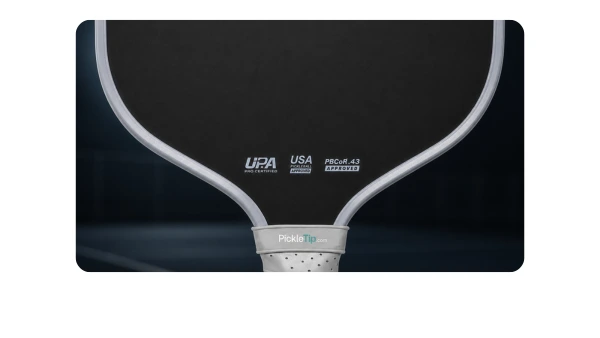
What an approval logo actually proves: Submitted samples of a defined paddle model passed one organization’s certification process. The logo does not prove every production paddle still matches those samples, that your paddle has not changed, or that the same approval system governs every event.
What I can tell from the court: I have played with paddles that changed enough for me to hear or feel the difference in sound, softness, rebound, or consistency. That tells me a paddle deserves a closer look. It does not tell me its PEF, PBCoR, spin rate, deflection result, or official tournament eligibility.
The OWL paddle approval case shows why certification pathway, event eligibility, and the condition of one physical paddle must be analyzed separately. The full controversy belongs in that dedicated case study; this guide focuses on the testing systems themselves.
How USAP and UPA-A Test Paddles Differently
| Test or Process | USAP | UPA-A |
|---|---|---|
| Dimensions | Measures paddle length and combined length plus width. | Measures length, combined length plus width, thickness, thickness variation, and total weight. |
| Surface evaluation | Uses surface roughness and coefficient-of-friction measurements. | Uses roughness measurements and directly measures generated spin during certification. |
| Power or rebound | Uses PBCoR to evaluate paddle-and-ball rebound behavior. | Uses Paddle Efficiency Factor to measure performance with a launched ball. |
| Deflection | Measures how much the paddle face moves under a controlled load. | Uses Average Deflection Force during certification and as an onsite screening measurement. |
| Break-in | Does not use UPA-A’s published ABI process. USAP instead uses its own certification and continuing-compliance procedures to evaluate whether rebound performance remains within applicable PBCoR requirements. | Uses Accelerated Break-In to evaluate performance change before certification is completed. |
| Spin control | Controls surface characteristics through roughness and coefficient-of-friction standards. | Measures generated spin directly in RPM. UPA-A public materials showed different ceilings when this page was reviewed, so the current paddle-rules document controls the applicable limit. |
| Gloss and reflection | Measures gloss and reflective characteristics. | Measures gloss and regulates colors or designs that may interfere with ball tracking. |
| Production consistency | Production paddles must match the approved model and remain compliant. | Key production metrics are expected to remain within a defined range of certification samples. |
| Onsite testing | Field-testing programs may measure friction, deflection, weight, and other compliance indicators. | Uses onsite grit and ADF screening, with laboratory follow-up when additional review is required. |
Coach Sid translation: USAP measures several properties that contribute to paddle performance and uses PBCoR to test rebound behavior. UPA-A directly measures power and spin, then stresses and retests the paddle through Accelerated Break-In. The systems overlap, but they do not certify the same thing in the same way.
Checking whether your paddle is legal for an event? First identify which organization’s rules apply in Who Governs Pickleball?. Then verify the exact brand, model, shape, and thickness on the current USA Pickleball approved paddle list or UPA-A certified paddle list. For models that were removed, restricted, or placed under review, use the paddle status and delisting guide.
How a Paddle Actually Earns Approval
A manufacturer does not earn approval by sending in a product description, a CAD drawing, or a marketing paddle and saying, “Trust us, this one is legal.” Physical paddles are submitted for laboratory testing. The samples are identified by model, measured under controlled conditions, and compared with that certification program’s limits.
Approval belongs to the exact paddle the lab tested, not every paddle that shares a family name printed on the face. Thickness, shape, handle length, edge design, internal construction, face material, and other structural details may create a separate model even when two paddles look like close relatives.
One version can be approved while another thickness, shape, generation, or power version still needs separate confirmation. The name may look almost identical on the shelf. The construction the lab approved may not be.
What Paddle Testing Can (and Cannot) Tell a Player
You do not need to know how to operate a gloss meter, profilometer, compression frame, or laboratory ball launcher. You do need to stop treating paddle feel, measured performance, and tournament eligibility as the same thing.
“This paddle feels powerful,” “this face feels gritty,” and “this model passed certification” are three different statements. Player feel is subjective. Surface texture is one measurable characteristic. Certification means the submitted model passed one organization’s test package. It does not mean every player will experience the paddle the same way.
Neither certification is a paddle review score. Approval does not tell you whether a paddle has a large sweet spot, fits your game, offers good value, or will remain durable for years. It tells you that submitted samples of a defined model met that certification program’s requirements when tested. For those player-performance questions, see how PickleTip tests pickleball paddles on court.
How USA Pickleball Tests a Paddle
USAP does not rely on one catch-all legality test. It checks different parts of the paddle separately because size, roughness, glare, stiffness, and rebound are different problems. Each test answers a different question.
Paddle Dimensions
The paddle is placed on a flat surface and measured with the edge guard and butt cap included. The published USA Pickleball Equipment Standards Manual limits overall length to 17 inches and combined length plus width to 24 inches.
That 24-inch combined limit is why manufacturers cannot make a paddle longer and wider without giving something back. An elongated paddle gains reach but has to surrender width. A widebody paddle gives you more face from side to side but cannot stretch as far toward the baseline. Everybody is working inside the same geometry box.
Surface Roughness
A surface roughness tester traces the paddle face and records microscopic peak-to-valley measurements. USAP’s published standard uses readings in multiple directions on both faces. The point is to measure the texture instead of having somebody rub a thumb across the face and make a judgment call.
A gritty face does not automatically make a paddle a spin monster. Roughness is one piece of the answer. Resin, weave, coating, face movement, dwell time, and wear can all change how the ball actually leaves the paddle.
Coefficient of Friction: How Much the Face Resists Sliding
Coefficient of friction measures resistance as a controlled sled moves across the paddle face. In normal language, the test asks how strongly the surface resists sliding instead of relying on how sticky or grabby the face feels in somebody’s hand.
Think of roughness as the shape of the little hills and valleys on the face. Friction asks how much that face resists movement across it. The tests are related, but they are measuring different parts of the surface story.
Deflection: How Much the Paddle Face Moves
Deflection measures how much the paddle face moves when the lab presses on it with a controlled load. The paddle is supported on fixtures while a test head presses into selected locations.
Think of this as a stiffness check. It shows how the face and core respond under load. Ball-impact testing is what measures what happens when the ball actually strikes the paddle. That is where players often mix up deflection with power.
Gloss and Reflection
A paddle can create a problem without being too powerful or too gritty. A shiny face or edge guard can throw glare into an opponent’s eyes and make the ball harder to track under sunlight or strong court lighting.
USAP uses a gloss meter at a controlled angle and places a limit on the measured gloss units. This is not about whether the graphic looks expensive. It is about whether the finish creates a visual distraction during play.
PBCoR Rebound Testing
PBCoR stands for Paddle/Ball Coefficient of Restitution. In plain English, it measures how efficiently the paddle-and-ball collision returns energy to the ball.
A higher PBCoR result generally means the paddle-and-ball collision returned more energy to the ball under that test setup. USAP introduced PBCoR as a more direct way to address excessive trampoline effect than trying to guess at power from stiffness or deflection alone.
The ball is part of the PBCoR result. The face, core, ball, impact setup, and speed all shape the collision being measured.
Checking a specific model? The standards explain how approval works. The current USA Pickleball Approved Paddle List tells you whether the exact brand, model, shape, and thickness are approved today.
How UPA-A Tests a Paddle
UPA-A checks some of the same physical basics as USAP, then takes a different path by directly measuring power and spin, stressing the paddle through Accelerated Break-In, and checking whether production paddles still resemble the samples that earned certification.
The Physical Limits UPA-A Checks
The current UPA-A Paddle Rules include:
- Maximum paddle length of 17 inches.
- Maximum combined length plus width of 24 inches.
- A defined paddle-thickness range and limit on face-thickness variation.
- Maximum total weight of 10 ounces, including the grip and permitted onsite modifications.
UPA-A also treats changes in thickness, shape, handle length, edge design, and other structural characteristics as meaningful model variations. In other words, changing the guts or geometry of the paddle is not the same thing as changing the paint job.
Paddle Efficiency Factor (PEF)
Paddle Efficiency Factor, or PEF, is UPA-A’s published power metric. Instead of estimating power only from how stiff the paddle is, the laboratory launches a ball into the paddle under controlled conditions and measures the resulting performance.
Under the 2026 UPA-A Paddle Rules, a new paddle must begin at or below the published new-paddle PEF limit. After laboratory break-in, the number may rise within a separate ceiling, but it cannot keep climbing past that limit during the paddle’s useful life.
UPA-A Published PEF Limits
- New paddle: PEF at or below 0.385.
- After break-in: performance may rise, but must remain at or below 0.405.
Verified: against the published UPA-A Paddle Rules.
The separate limits account for a simple reality: some paddles get livelier after the face and core have taken repeated impact. Fresh out of the wrapper is not always how a paddle will play after several hard sessions.
Direct Spin Testing
UPA-A measures generated spin directly in revolutions per minute rather than using roughness or friction alone as a proxy. UPA-A’s public materials showed different spin ceilings when I reviewed them on August 6, 2026. Rather than repeat a number that may already be outdated, use the current UPA-A Paddle Rules for the controlling limit.
Instead of inferring spin from how the face is built or feels, the test measures how much rotation the paddle puts on the ball under a repeatable laboratory setup. That answers the performance question directly: what happened to the ball?
Surface roughness still matters, and UPA-A may use grit measurements onsite. Roughness describes part of the surface. Direct spin testing records what the ball actually did.
Average Deflection Force (ADF)
ADF stands for Average Deflection Force. It measures how the paddle responds as it is compressed under a defined setup. UPA-A uses ADF during certification and as part of onsite eligibility screening.
ADF presses on the paddle. PEF launches a ball into it and measures the result. Those measurements may be related, but they are not interchangeable.
PBCoR, PEF, and Deflection Are Not the Same Test
| Metric | What It Measures | What It Helps Explain | What It Does Not Prove by Itself |
|---|---|---|---|
| PBCoR | The rebound relationship between a specified ball and paddle during impact. | How efficiently the collision returns energy to the ball. | Overall paddle quality, player fit, or eligibility under another testing system. |
| PEF | UPA-A’s direct ball-launch performance metric. | Whether measured power remains inside UPA-A limits. | A comparable USAP score or a complete review of the paddle. |
| Deflection or ADF | How the paddle mechanically responds when compressed under load. | Stiffness, structural change, and a screening signal for altered or broken-in behavior. | Exact ball speed, spin, or rebound performance. |
Also, do not compare a PEF number with a PBCoR number as though they live on one shared scale. They are separate test systems with different procedures, equipment, calculations, and limits.
Plain-English version: Deflection presses on the paddle. PBCoR and PEF study what happens when the ball hits it. A paddle can bend similarly to another paddle and still return the ball differently, which is why the numbers do not belong on one shared scale.
How Accelerated Break-In Tests Performance Change
UPA-A uses an Accelerated Break-In process, usually shortened to ABI, to see how paddle performance may change as the structure loosens, settles, softens, or otherwise moves away from its brand-new state.
ABI cannot reproduce every way a paddle gets used. A hard-hitting pro, a twice-a-week recreational player, summer heat, and a paddle left in a cold trunk will not age a paddle identically. Its value is repeatability: every sample gets the same laboratory punishment before the before-and-after measurements are compared.
After that stress, the paddle can be checked again for power, spin, deflection, and other characteristics. A paddle that starts comfortably inside a limit may move closer to (or beyond) that limit after the face and core settle.
Why Modern Paddle Construction Makes Break-In Harder to Predict
Modern paddles give designers more pieces to tune: perimeter foam, layered faces, adhesives, reinforced edges, solid foam, and increasingly complicated internal builds. Every extra interface is another place the paddle can settle, soften, separate, or fail.
- Thermoformed and unibody builds use heat, pressure, adhesives, edge reinforcement, and continuous structural layers that can settle differently over time.
- Foam-enhanced honeycomb paddles combine perimeter foam, polymer cells, face layers, and adhesive systems that may not age at the same rate.
- Full-foam paddles replace traditional honeycomb with a solid or layered foam structure whose compression and rebound behavior may change with repeated impact.
- Thin power paddles begin with less material between the face and the ball, which makes stiffness and internal change especially important.
- Raw and coated faces can lose texture, polish, chip, or wear unevenly even while the internal core becomes livelier.
The labels “Gen 3,” “Gen 3.5,” and “Gen 4” are industry shorthand, not universal certification categories. The testing body is approving a defined model and its measured performance, not whatever generation name happens to be popular that month.
Why a Paddle Can Change After Certification
The samples sent to the laboratory represent the model at certification. After that, real paddles go through mass production, shipping, storage, temperature changes, thousands of impacts, edge hits, drops, and whatever players decide to add, remove, tape, sand, or repair.
Production Paddles Still Have to Match the Samples
Certification would not mean much if a brand could submit one carefully built paddle and then sell something structurally different under the same model name. UPA-A’s current rules require production paddles to remain consistent with the certification samples across published metrics that include moment of inertia, ADF, spin rate, surface roughness, and PEF.
If production drifts from the certified specification, approval can be reviewed or withdrawn. The logo means something only while the paddles being sold still match what passed.
What Can Change Inside a Used Paddle
A correctly manufactured paddle can still drift away from its original condition in several different ways:
- Core softening: repeated compression can change how the core absorbs and returns energy.
- Cell collapse or crushing: honeycomb cells may deform or lose structural uniformity.
- Delamination or disbonding: face layers can separate from the core or surrounding structure.
- Foam compression: solid or injected foam may settle or develop localized soft spots.
- Adhesive change: heat, cold, repeated flexing, or manufacturing variation can affect bond strength.
- Surface wear: grit, resin texture, peel-ply texture, and coatings can smooth or wear unevenly.
- Edge or throat damage: cracks, loose edge guards, dents, and deformation may signal a deeper structural problem.
A damaged paddle does not always get weaker. Some failures can create extra rebound or a localized hot spot, moving the paddle farther outside its original performance window instead of simply making it feel dead.
Can an Approved Paddle Fail Onsite Testing?
Yes. Certification evaluates submitted samples of a defined model. Onsite screening looks at the individual paddle a player presents for competition.
Portable event equipment does not recreate the entire certification laboratory beside the court. Instead, onsite measurements look for unusual grit, deflection, weight, damage, structural change, or another result that falls outside the expected range.
USAP field-testing programs have included measurements such as coefficient of friction, deflection, and weight-related checks. UPA-A’s published testing process includes onsite grit measurements and Average Deflection Force screening, with some paddles compared against model-specific post-ABI certification values.
What onsite testing means: An onsite test is a screen, not the entire laboratory certification process squeezed onto a folding table. A questionable result may remove a paddle from play or send it for further review without answering every technical question beside the court.
Five Checks Before You Bring a Paddle to a Tournament
- Identify the rules that govern the event. A USAP sanction, a PPA or MLP event, an independent tournament, and local recreational play may not use the same approval requirement.
- Check the exact paddle. Match the brand, model, shape, thickness, and other listed identifiers, not just the family name or logo.
- Inspect the paddle you are bringing. Look and listen for cracks, loose edge sections, bulges, soft spots, clicking, crunching, or a sudden hot area on the face.
- Leave the hitting surface and internal structure alone. Do not sand, coat, heat, drill, open, crush, inject, or internally repair the paddle.
- Ask before you play when something is unclear. A tournament desk or equipment official can tell you which list and inspection procedure the event is using. Guessing after a paddle challenge is the expensive way to learn.
When a Paddle Modification Changes What Was Tested
Certification applies to a defined construction. A permitted grip, edge-protection, or weight adjustment is different from changing the hitting surface or internal structure. The event rules decide what is allowed. The practical line is simpler: once you change how the face grips, flexes, or returns energy, the original test may no longer describe the paddle in your hand.
A small change can still matter: Sanding, added grit, coatings, internal repairs, crushing, heating, or injected material can change how the face grips, flexes, or returns energy. Once that happens, the original certification test may no longer describe the paddle in your hand.
Normal Setup or Paddle Alteration?
Because equipment rules can change, verify the current requirements in the USA Pickleball Equipment Standards Manual or the UPA-A Paddle Rules used by your event.
- Usually allowed when applied within the current rules: replacement grips, overgrips, edge protection, and securely attached flat lead or tungsten tape.
- Requires current rule verification: replacement edge guards, grip inserts, butt-cap weight, identification markings, and repairs that could affect the original structure.
- Not allowed: sanding the face, adding grit, applying resin, paint, adhesive, tacky coatings, or another treatment intended to change spin or ball contact.
- Do not alter the internal structure: drilling, cutting, crushing, heating, opening the paddle, injecting material, or attempting an internal core repair can invalidate what was originally tested.
Pickleball Paddle Testing Terms in Plain English
- PBCoR: USAP’s paddle-and-ball rebound metric used to evaluate energy return and excessive trampoline effect.
- PEF: UPA-A’s Paddle Efficiency Factor, a direct measurement of ball-impact performance.
- Deflection: How far the paddle moves when a controlled force is applied.
- ADF: Average Deflection Force, used by UPA-A to measure structural response and support onsite screening.
- Coefficient of friction: A measurement of resistance as a controlled object slides across the paddle face.
- Surface roughness: Microscopic peak-to-valley measurements across the hitting surface.
- Spin rate: The measured revolutions per minute produced by a paddle under controlled impact conditions.
- ABI: Accelerated Break-In, a repeatable laboratory process used by UPA-A to stress a paddle before retesting it.
- MOI: Moment of inertia, a measurement related to how mass is distributed and how resistant the paddle is to rotation.
- Delamination or disbonding: Separation between the paddle face and the internal structure.
Signs Your Paddle Has Changed Internally
You cannot reproduce laboratory testing at home, but you can notice when a paddle stops acting like the paddle you bought.
- New soft spots, crunching, clicking, or movement inside the face.
- Bulges, depressions, bubbles, warping, or two faces that no longer feel or sound alike.
- Cracks, loose edge-guard sections, dents, or separation around the paddle perimeter.
- A sudden change in rebound, sound, vibration, or one area of the face that plays noticeably hotter than the rest.
| What You May Notice | What You Still Cannot Confirm at Home |
|---|---|
| Clicking, crunching, bulging, or a new soft spot | The paddle’s exact PEF, PBCoR, or deflection result |
| A sudden hot spot or change in rebound | Whether the paddle officially exceeds a laboratory limit |
| Uneven sound or response across the face | Whether the issue is core damage, adhesive failure, or another internal change |
| Visible wear, cracks, or edge separation | Whether the paddle would pass the full certification procedure |
What a Changing JOOLA Perseus 3 Felt Like
One of the clearest examples for me was a JOOLA Perseus 3 I had been playing with. This was my experience with one physical paddle, not a claim that every Perseus 3 changes the same way or that the model’s official status can be determined from my experience.
When I first started playing with it, the response across the face felt consistent. Blocks came off predictably, resets behaved the way I expected, and mishits lost enough energy that I could usually tell when I had missed the center.
After roughly three months of use, something changed.
The first clue was not a crack or a loose edge guard. A small area in the upper third of the face began returning the ball differently. A block that normally would have landed in the kitchen started carrying deeper. On counters, the ball left that area with less effort than it had when the paddle was new.
Then the sound changed.
Hits from that area developed a sharper note than contact on the rest of the face. When I tapped and pressed around the paddle, the response no longer felt uniform. I could not determine whether the cause was core crushing, disbonding, or another internal change.
I knew something had changed because I had played enough games with that particular paddle to know how it normally responded. I did not know its PEF, PBCoR, ADF, or whether it would fail an official test.
Court experience gave me a reason to stop trusting the paddle, so I stopped treating it as a reliable reference for normal play. It did not give me a laboratory result.
That is the line players need to understand: noticing that a paddle changed and proving what caused the change are two different jobs.
I did not need a laboratory to know it was no longer the same paddle. I would have needed a laboratory to prove why.
What a player can notice: A new hot spot, soft area, clicking, crunching, uneven sound, or sudden change in rebound can tell you the paddle deserves a closer look. Those clues cannot produce a PEF, PBCoR, or official legality result. Your job is to notice that the paddle changed, not pretend your kitchen counter became a lab.
Official Paddle Testing Sources
I used the current USAP and UPA-A testing documents for the technical details in this guide. I have not performed these certification tests myself. My part is translating what the tests measure, connecting them to what players notice, and being honest when two official pages do not agree.
Update history: · Rechecked current USAP and UPA-A testing documents, added the published UPA-A PEF limits, documented conflicting spin ceilings in UPA-A’s public materials, and added a firsthand JOOLA Perseus 3 paddle-change case.
- USA Pickleball Equipment Standards Manual
- USA Pickleball Manufacturer Paddle Test Plan
- USA Pickleball PBCoR Certification Update
- Current UPA-A Paddle Rules
- UPA-A Paddle Testing and Certification Information
- UPA-A Certification Submission Checklist
Standards note: The current official equipment manual, paddle-rules document, certification procedure, and event instructions control. When two public pages disagree, this guide identifies the conflict rather than silently choosing the cleaner number.
A model can also remain physically unchanged while its official status changes. Check the banned, removed, and delisted paddle guide for removed, restricted, or under-review models.
Pickleball Paddle Testing FAQ
Certification laboratories measure submitted paddle samples instead of relying on somebody to squeeze the paddle, rub the face, and make a judgment call. Depending on the organization, testing can include dimensions, roughness, friction, deflection, rebound, spin, gloss, break-in, and production consistency.
USAP combines dimensions, surface roughness, coefficient of friction, deflection, gloss, and PBCoR rebound testing. UPA-A uses dimensions, Paddle Efficiency Factor, direct spin testing, Average Deflection Force, Accelerated Break-In, production consistency, and onsite measurements. The systems overlap, but they do not use one identical testing package.
No. PBCoR and PEF use different procedures, calculations, equipment, and limits. Both study paddle-and-ball performance, but the numbers do not live on one shared scale.
No. You can notice warning signs such as clicking, crunching, soft spots, uneven sound, visible damage, or a sudden hot area. Those clues can tell you the paddle changed, but they cannot produce an official PEF, PBCoR, deflection, or tournament-eligibility result.
Yes. Approval applies to a defined model, but an individual paddle can change through core softening, crushing, delamination, damage, surface alteration, repair, or another structural change. A logo does not freeze the paddle in its original condition.
They may. Certification applies to an exact model specification, and thickness, shape, handle length, edge design, or construction can separate one approved version from another. Check the exact model, shape, and thickness rather than relying on the family name.
No. USA Pickleball and UPA-A maintain separate testing systems and paddle lists. Event eligibility depends on the rules and equipment policy used by that tournament or league.
Current event rules control, so check the USAP or UPA-A rules used by the event. Replacement grips, overgrips, edge protection, and permitted flat weight tape may be allowed. Sanding, added grit, tacky coatings, internal repairs, drilling, crushing, heating, or another change to the hitting surface or internal structure can make the original certification result stop describing the paddle.
The procedure depends on the event. A questionable result may remove the paddle from play, trigger comparison with model-specific certification values, or lead to additional review. Onsite screening examines the individual paddle; it does not always reproduce the full certification laboratory process.
Related Paddle Rules and Approval Guides
- Paddle Rules & Approvals: choose the approval, certification, status, governance, or testing guide that matches your question.
- USA Pickleball Approved Paddle List: check whether an exact model is currently USAP approved.
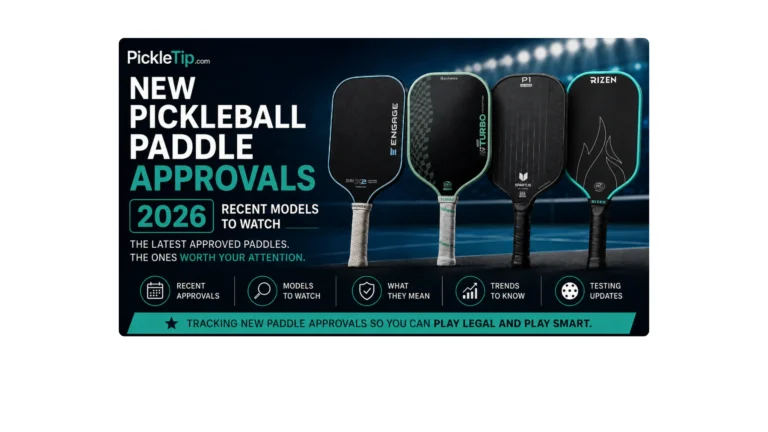
- New Pickleball Paddles to Watch in 2026: see which recent approvals are editorially noteworthy and which models PickleTip has actually tested.
- UPA-A Approved Pickleball Paddles: check the separate UPA-A certification list.
- Banned, Removed, and Delisted Pickleball Paddles: review models that were removed, restricted, or lost approval.
- Who Governs Pickleball?: understand which organization, rulebook, or tournament authority applies.
- Are Paddle Brands Prioritizing UPA-A Approval?: read the separate, dated analysis of manufacturer certification strategy.
Coach Sid’s bottom line: Keep the model, the production run, and the paddle in your bag separate. The model must earn approval, production paddles must continue to match it, and your paddle must remain inside the rules after break-in, wear, damage, repair, and modification. The logo answers the model question. It does not answer all three.