Who Governs Pickleball? USA Pickleball, UPA-A, and Event Authority
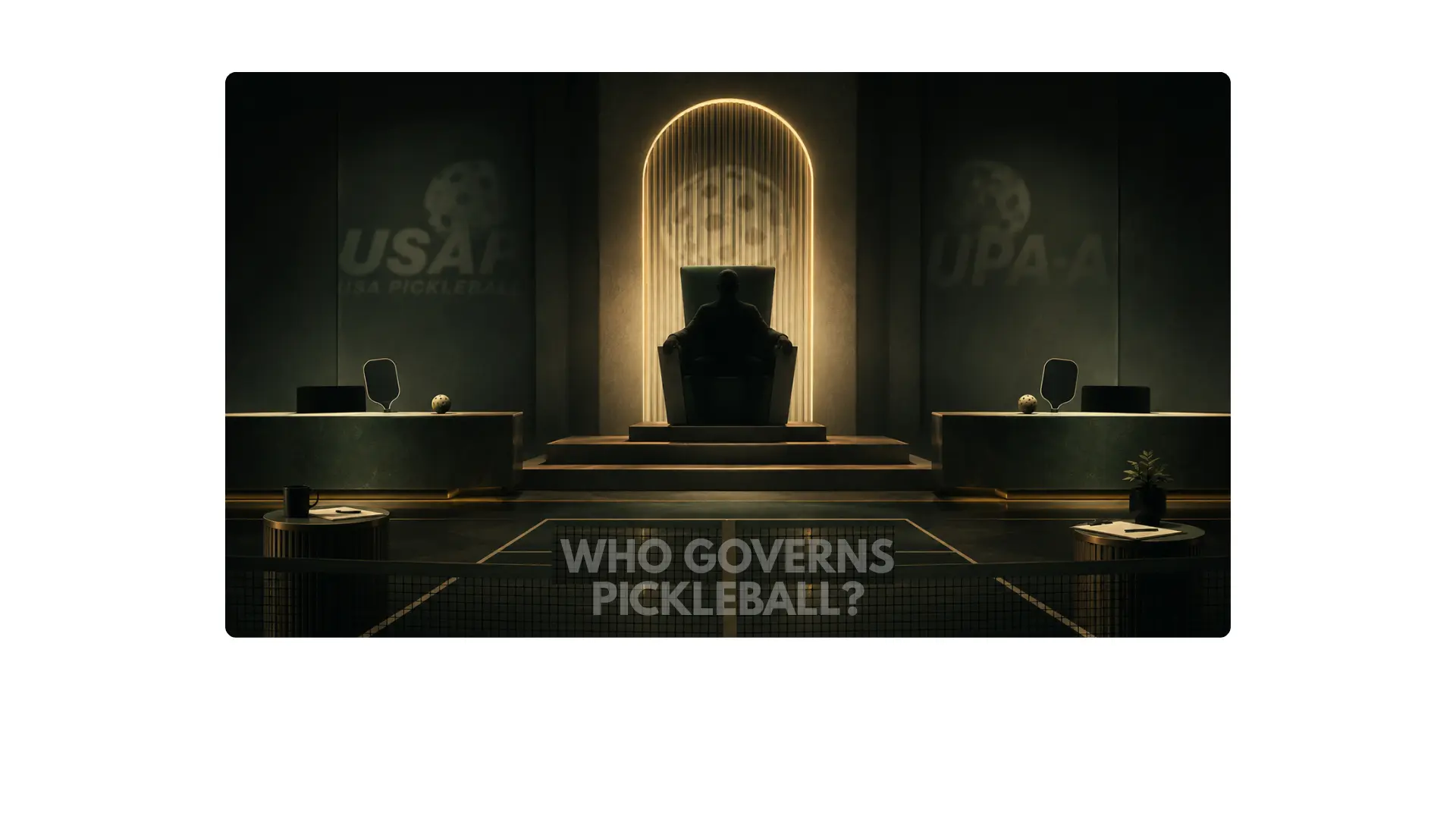
For players, the rulebook that usually matters is the one the event adopted and published. USA Pickleball supplies the common U.S. rulebook, sanctioned-event structure, referee system, and equipment approvals used across much of the sport. UPA-A publishes the professional framework and paddle requirements used across the PPA Tour and Major League Pickleball, while tour-specific guides such as the MLPlay Rules Guide can add or modify competition procedures. At an independent tournament, league, club, or local facility, the organizer decides which rulebook, scoring format, equipment list, and onsite authority apply, subject to any sanctioning requirements or higher-level policies the event agreed to follow.
Reviewed August 6, 2026: Checked against the current USA Pickleball and UPA-A rulebooks, paddle policies, governance pages, and event guidance.
| Where You Are Playing | Rules or Standards That Usually Control | What You Should Check |
|---|---|---|
| Recreational or social play | Usually based on USA Pickleball rules, sometimes mixed with local customs | Written facility or group rules when players disagree |
| USA Pickleball-sanctioned event | USA Pickleball rulebook, sanctioning requirements, and equipment standards | Event information and current USA Pickleball equipment lists |
| PPA professional competition | General UPA-A professional rulebook, equipment standards, and PPA event procedures | UPA-A rules, approved-paddle status, and the event documents for that competition |
| Major League Pickleball | UPA-A professional framework plus the current MLPlay Rules Guide | MLPlay rules, equipment eligibility, and MLP event procedures |
| PPA amateur competition | Published event rules; current UPA-A guidance generally accepts active USA Pickleball-approved paddles | Your specific division and event notice |
| Independent tournament or moneyball | The rulebook and modifications adopted by the organizer | Published scoring, equipment, challenge, and dispute procedures |
| Club, league, or DUPR session | The facility, league, or organizer | Scoring, rating, paddle, and local-rule policies |
| International competition | The federation, tour, or organizer running the event | The event’s published governing documents |
The simple framework: The organization writes the system. The event adopts it. The onsite official applies it.
What I have seen at local events: Independent tournaments sometimes mix systems. A moneyball at Category 5 in Mandeville used rally scoring with USA Pickleball fault rules, while an event at Stacks in Baton Rouge accepted paddles from both equipment lists. The hybrid was not the problem. Making players discover it at check-in would have been.
International rules vary by federation and event. Players outside the United States should rely on the governing documents published for their competition.
Checking a paddle instead of the rulebook? For laboratory standards and compliance levels, read how USA Pickleball and UPA-A test paddles. For an exact model, use the USA Pickleball Approved Paddle List or UPA-A Certified Paddle List. For the full cluster, visit Paddle Rules & Approvals.
Why Pickleball Has More Than One Authority
For most of pickleball’s history, USA Pickleball, formerly called the USAPA, was the organization players looked to first. Its rulebook supplied the common language of the game. Its equipment program defined approved paddles and balls. Its referee, tournament, ambassador, and club programs gave the sport national structure.
That foundation still matters. USA Pickleball describes itself as the national governing body for pickleball in the United States and calls its Official Rulebook the definitive rules authority for standard pickleball play.
Professional pickleball later developed needs that ordinary open play does not have: broadcast timing, team competition, player contracts, substitutions, paddle challenges, medical procedures, professional officiating, and tour-specific enforcement. UPA-A now publishes a separate professional competition rulebook that supplies the baseline for the PPA and MLP environment, while tour-specific documents can add or modify rules for a particular competition.
Pickleball did not replace one universal boss with another. It split authority across rulebooks, tours, equipment systems, and events.
Four Different Questions Hiding Inside “Who Governs Pickleball?”
Most arguments about who governs pickleball are really four arguments piled on top of each other. Who writes the common rules? Who runs the pro game? Who certifies the paddle? Who gets the final say on the court today?
1. Who Writes the Common Rules?
USA Pickleball writes and maintains the rulebook that became the common foundation for standard play in the United States.
Answer: USA Pickleball
2. Who Sanctions Events and Trains Officials?
USA Pickleball operates sanctioned-event pathways, referee education, and many of the grassroots programs used by clubs and local organizers.
Answer: USA Pickleball
3. Who Controls Professional Competition?
Inside PPA and MLP professional competition, UPA-A publishes the core professional framework and paddle requirements. Tour-specific guides can add or modify procedures for a particular competition.
Answer: UPA-A within PPA and MLP competition
4. Who Decides What Applies Today?
This is the authority that decides what happens on a specific court. The organizer adopts the documents. The designated official applies them onsite.
Answer: The organizer and its designated onsite official
Where USA Pickleball Has Authority
USA Pickleball’s influence is easiest to see outside the pro tours. Its system supplies the broad rules foundation used across recreational, social, amateur, and sanctioned play in the United States.
- The Official USA Pickleball Rulebook and annual rule-change process
- USA Pickleball-sanctioned tournaments, national championships, and qualification pathways
- Referee education, resources, and certification
- Equipment standards and approved paddle and ball lists
- Grassroots programs involving clubs, ambassadors, educators, and community development
- The shared rules language used by many independent facilities and organizers even when an event is not formally sanctioned
Most new players learn a version of pickleball that traces back to this system: the non-volley zone, the two-bounce rule, serving requirements, faults, scoring, line calls, and ordinary match procedures. They may never open the rulebook, but the rules being taught usually came through it.
Its rules are also widely used at independent clubs and facilities, but widespread use is not the same as direct operational control.
Where UPA-A Has Authority
Inside PPA and MLP professional competition, UPA-A publishes the core rules and sets the paddle requirements. Its 2026 rulebook creates a common baseline across the PPA Tour and Major League Pickleball, while tour-specific guides can add or modify competition procedures. Its professional paddle rules apply to PPA main draws, qualifiers, MLP, Challenger professional divisions, and related professional UPA competitions.
- Professional competition rules for PPA and MLP play
- Professional paddle eligibility, certification, challenges, and onsite equipment procedures
- Professional officiating, referee development, conduct, and medical procedures. For the current PPA-specific system for Line Reviews, Video Challenges, PlayReplay, review penalties, and overturned calls, see PPA Line Call Rules 2026.
- MLPlay and tour administration, including team formats, substitutions, service lets, and other competition-specific procedures
UPA-A does not need to govern every Tuesday-night open play session to influence the sport. By controlling the professional stage, it influences what viewers see, what aspiring professionals prepare for, which paddle technologies receive attention, and which certifications manufacturers pursue.
As of August 6, 2026, current UPA-A certification guidance requires UPA-A certification for professional PPA and MLP competition. Amateur competition in that ecosystem generally accepts paddles with active USA Pickleball certification even when they do not carry separate UPA-A certification. Players should still verify the event notice for their exact division.
Checking an exact paddle? Use the USA Pickleball Approved Paddle List for current USA Pickleball status and the UPA-A Certified Paddle List for current professional certification status.
Is USA Pickleball the Governing Body of Pickleball in the United States?
USA Pickleball has the strongest broad national claim within the United States. It publishes the rulebook used across most standard recreational and sanctioned amateur play, operates national sanctioning and officiating programs, maintains its own equipment system, and supports the sport’s grassroots structure.
“National governing body” describes USA Pickleball’s broad role and its own public position. It should not be read as legal or operational ownership of every tournament, tour, facility, or rules decision in the country. USA Pickleball does not control the PPA Tour, Major League Pickleball, every independent event, every facility, or international competition. UPA-A runs a separate professional rule and equipment system inside the PPA and MLP ecosystem.
Why USA Pickleball and UPA-A Publish Separate Rulebooks
The second rulebook did not appear because recreational players demanded a different kitchen rule. It grew from the different operating needs of professional pickleball and from the organizations controlling those tours.
Broadcast replay, team substitutions, paddle challenges, contracted players, medical procedures, professional referee assignments, and tour administration create problems Tuesday-night open play does not have. MLPlay team formats and substitutions are a clear example: they belong in a professional team rulebook, not in the rules used for an ordinary doubles game at the park.
The Net-Let Rule My Students Still Argue About
One serve rule consistently causes confusion when my students move between recreational play, tournaments, and the professional matches they watch on television: what happens when the serve clips the net and still lands legally?
Under both the current USA Pickleball rulebook and the general UPA-A rulebook, the ball remains live. If the serve touches the net, clears the non-volley zone, and lands in the correct cross-court service area, players continue the point. The net contact alone does not create an automatic replay.
Major League Pickleball is the important exception. Although MLP operates within the broader UPA professional system, it uses the separate MLPlay Rules Guide. Under that event-specific guide, a serve that touches the net and lands in the proper service area is treated as a let and served again.
This is the jurisdiction framework in practice: the general UPA-A rulebook supplies the professional baseline, MLP adopts a competition-specific supplement, and officials enforce the MLPlay version during that event.
That is why players arrive with different expectations. Someone following USA Pickleball or the standard UPA-A rulebook keeps playing. Someone who regularly watches MLP may stop the point and expect a re-serve.
The disagreement is not really USA Pickleball versus UPA-A. It is the general rulebooks versus an MLP-specific competition rule.
Coach Sid’s practical ruling: Under ordinary USA Pickleball or standard UPA-A rules, keep playing when a net-clipping serve lands legally. In an MLP or MLPlay event, replay it. At any other event, check whether the organizer adopted a special service-let rule.
Two rulebooks are not automatically a disaster. The trouble starts when players are not told which differences matter, when one approval badge is mistaken for universal eligibility, or when an event applies a modification it never published.
The business side of UPA-A is a separate question from who governs an event. For current certification costs, professional licensing, and why some paddle brands may choose USAP, UPA-A, or both, read Are Paddle Brands Moving From USAP to UPA-A?
Who Has Final Authority at a Pickleball Tournament?
At an organized event, the published event documents are normally the first place to look. A sanctioned event may also be required to follow the sanctioning organization’s rulebook, equipment standards, and event conditions. A fully independent event has more freedom to choose a rulebook, publish modifications, establish scoring and equipment policies, and identify the official who makes final onsite rulings.
Choosing the rules before an event is different from changing them after play begins. Weather, safety, court loss, or another genuine disruption may force a tournament director to adjust the plan. But changing the scoring format, playoff structure, earned byes, tournament ball, or advancement rules should be a last resort, not a convenient fix for a foreseeable scheduling problem. Read why pickleball tournaments should not change rules or formats mid-event.
PickleTip’s seven things every tournament should publish before registration closes:
- The governing rulebook
- Any local or event-specific modifications
- The scoring format
- The accepted paddle and ball standards
- The date used to determine equipment status
- The challenge or inspection procedure
- The official with final decision-making authority
Eventually somebody has to make the call on the court. At an event, that person is whoever the published rules designate. That practical authority creates an equal obligation to tell players the rules before they spend money, travel, practice, or buy equipment for the event. When the registration page, player email, and rulebook conflict, ask the event to identify the controlling document in writing before play. Do not assume the newest-looking page is the one officials will enforce.
Why the Same Paddle Can Be Eligible in One Event and Ineligible in Another
Most players do not think about governing bodies until somebody questions a paddle. A model can appear on one organization’s approved list without appearing on the other. A tournament can accept one list, both lists, or a narrower policy. The same paddle can therefore be eligible in one event and unavailable in another without either database being wrong.
A paddle logo is not a universal passport. It tells you the model entered one organization’s equipment system. It does not tell you every tournament must accept it, that its status is still active, or that the individual paddle cannot be inspected onsite.
A player can show an active USA Pickleball approval page while an event requires UPA-A certification for that division. The database is not necessarily wrong, and neither is the player. The event adopted a different eligibility system.
When a paddle is questioned, ask:
- Which organization’s equipment standard did the event adopt?
- Was that choice published before play?
- Did the exact model appear on the required list?
- What status date did the event use?
- Did the event reserve the right to conduct additional inspection?
- Who makes the final ruling when a paddle is challenged?
For the difference between certification samples, production paddles, and the individual paddle presented at an event, see the three levels of paddle compliance.
If a model was once approved but later removed, restricted, or placed under review, check the banned and decertified pickleball paddle list.
Which Rulebook Should Recreational Players Follow?
Most recreational pickleball in the United States follows the USA Pickleball rules foundation, even when nobody at the facility has formally announced that choice. Players learn the kitchen, serve, scoring, faults, and two-bounce rule through coaches, friends, clinics, and local organizers who are usually teaching that system.
Local customs still creep in. That is how imaginary or outdated rules survive:
- “You cannot enter the kitchen until the ball bounces.”
- “A serve touching the net is always replayed.”
- “You cannot return the serve into the kitchen.”
- “An approval logo makes a paddle legal everywhere.”
- “The loudest player gets to interpret the rule.”
Most recreational players do not need to memorize two rulebooks. At ordinary U.S. open play, USA Pickleball rules are the most sensible default unless the facility has written something different. At a league, DUPR session, moneyball, or invitational, stop assuming and check the organizer’s scoring and equipment policies.
DUPR supplies a rating system. It does not automatically decide the rulebook for every session that reports results to DUPR. Local clubs can also adopt house rules, but those rules should be written down before they are used to settle an argument.
For court performance, fit, forgiveness, and value, use a paddle review, not a governing-body logo.
Are Two Rulebooks the Real Problem?
Not by themselves. Professional and recreational pickleball can need different procedures. A professional tour may need replay, paddle challenges, substitutions, team scoring, and contracted-player policies that ordinary open play does not.
The problem starts when nobody says which rules apply. Players should know the governing rulebook, scoring format, equipment policy, modifications, and final decision-maker before they register. Hybrid rules can work. Surprise rules do not.
Different Systems, Different Risks
PickleTip’s analysis: UPA-A’s close connection to the professional commercial ecosystem makes transparent procedures, consistent enforcement, and disclosed conflicts especially important. That connection does not prove unfairness, but it raises a reasonable oversight question.
USA Pickleball’s broader membership, responsibilities, and public rule-change process may reduce some commercial pressure. The tradeoff is speed: a larger organization may react more slowly when paddle technology or professional competition changes quickly.
The practical answer does not change: check the event documents before you pay, travel, or have a paddle challenged.
The PickleTip Jurisdiction Check
- Identify the organizer. Determine which organization, tour, facility, league, or tournament director operates the competition.
- Find the adopted rulebook. Do not assume the organizer uses every rule from the organization named in the event title.
- Find the published modifications. Scoring, team format, substitutions, equipment recognition, and challenge procedures may differ.
- Verify the exact equipment policy. Check the accepted list, model status, status date, and onsite inspection authority.
- Identify the final onsite decision-maker. Know who resolves disputes when the written documents do not answer the question.
- Resolve conflicts before play. Ask which document controls when the registration page, player email, and rulebook disagree.
- Save the published information. Rules pages change. Screenshots remember.
Official Governance and Rulebook Sources
These conclusions are based on the organizations’ current published rulebooks, tour-specific competition guides, governance pages, and equipment policies. The latest official rulebook, event notice, equipment document, or division policy controls whenever a requirement changes.
- 2026 USA Pickleball Official Rulebook and rules resources
- USA Pickleball national governing body information
- 2026 UPA-A Official Rulebook
- 2026 MLPlay Rules Guide: MLP-specific team, scoring, substitution, and service-let rules
- UPA-A governance and referee resources
- 2026 UPA-A professional paddle rules
- 2026 UPA-A professional and amateur certification guidance
How this page is kept current: PickleTip reviews new annual rulebooks, tour-specific guides including MLPlay, professional and amateur certification requirements, equipment recognition, paddle-challenge procedures, event policies, and changes in organizational control. The latest official rulebook, event notice, and division policy control.
Common Questions About Pickleball Rule Authority
Yes. A fully independent organizer can adopt USA Pickleball rules, UPA-A rules, another federation’s rules, or a hybrid with published modifications. A sanctioned event may have less freedom because it must also follow the sanctioning organization’s requirements.
As of August 6, 2026, current UPA-A guidance requires UPA-A certification for professional PPA and MLP competition. Amateur competition generally accepts paddles with active USA Pickleball certification, but players should verify the rules for their event and division.
No. USA Pickleball and UPA-A maintain separate equipment systems, and an organizer may publish another policy. Paddle eligibility depends on the approval list, status date, division policy, and onsite inspection rules adopted by the event.
Ask the tournament director or designated official to identify the controlling document in writing before play. Save the response and the published rules because registration pages, emails, and event policies can change.
Under the current 2026 USA Pickleball and general UPA-A rulebooks, no. If the serve touches the net, clears the non-volley zone, and lands in the correct service court, the ball remains live. Major League Pickleball is an important exception: its MLPlay Rules Guide treats a legal net-touching serve as a let and requires a re-serve. Other events may also publish their own modifications.
Keep Reading: Paddle Rules and Approvals
- Paddle Rules & Approvals: choose the current lookup, status, testing, strategy, watchlist, or governance guide that matches your question.
- How Pickleball Paddles Are Tested: understand the technical differences between USA Pickleball approval and UPA-A certification.
- USA Pickleball Approved Paddle List: check an exact model for current approval status.
- UPA-A Certified Paddle List: check current professional certification status.
- Banned and Decertified Pickleball Paddles: review removed, restricted, and under-investigation models.
- Are Paddle Brands Moving From USAP to UPA-A?: read the analysis of manufacturer certification strategy.
- Why UPA-A Was Created: review the launch history, structure, and original controversy.
Coach Sid’s Bottom Line
The player’s job is not to choose a winner between organizations. It is to identify the rulebook, equipment policy, scoring format, modifications, and final decision-maker before play begins.
The organizations do not have to agree on everything. They do have to make the boundaries clear enough that players are not punished for the confusion.