Are Paddle Brands Moving From USA Pickleball to UPA-A?
USA Pickleball approval and UPA-A certification no longer open the same doors for a paddle brand. USA Pickleball still reaches the broadest amateur and sanctioned-event market. UPA-A opens the professional PPA and MLP door. PickleTip’s June 6, 2026 data snapshot and original industry reporting suggest that some brands are now choosing a path one paddle at a time: USAP first, UPA-A first, both, or neither.
Analysis last reviewed: · Approval-data snapshot: June 6, 2026 · This is a dated market analysis, not a live approval database.
Coach Sid’s Short Answer
Some brands are reducing their reliance on USA Pickleball approval for selected future models, but this is not a brand-wide stampede away from USAP. What I am seeing is model-by-model strategy. A company may send a new performance paddle through UPA-A first, keep broader-market models on the USA Pickleball list, dual-certify a flagship, or choose a different path for each shape, thickness, or generation.
What the Data Confirms
- USA Pickleball still had substantially more 2026 approval records and participating brands.
- Seventeen brands showed 2026 activity on both lists.
- Fifteen brands showed UPA-A activity without matching 2026 USA Pickleball activity in the supplied data.
- UPA-A certification is required for professional PPA and MLP competition.
- Different models from the same brand were appearing on different approval paths.
What Remains Unknown
- The private reasoning of every brand represented in the snapshot
- Whether a specific missing model was pending, delayed, renamed, withdrawn, rejected, or never submitted
- Whether a company moving selected models will eventually move its full catalog
- Which combination of testing, cost, timing, professional access, or governance concerns drove each decision
- Whether UPA-A will replace USAP as the broad amateur standard
Use the right page for the question. This article explains brand strategy and market direction. For exact current status, use the USA Pickleball Approved Paddle List or UPA-A Certified Paddle List. For removed or disputed models, use the paddle status and delisting guide. For the full cluster, visit Paddle Rules & Approvals.
Are Paddle Brands Moving Away From USA Pickleball Approval?
I started looking more closely after several recognizable brands placed multiple new performance paddles on the UPA-A list without matching new 2026 USAP records in the supplied snapshot. In separate private conversations, one paddle-company founder and employees from several other brands described UPA-A-first approval decisions they were familiar with as intentional.
A repeated criticism from those sources was that USA Pickleball had dropped the ball on parts of paddle approval and compliance. Several viewed UPA-A as the more attractive first path for certain professional-facing or performance-focused launches. Because those conversations were private, I am not naming the companies or connecting their comments to any individual brand in the public watchlist.
The shift is easy to miss because it does not have to happen brand-wide. A company can send its newest professional paddle through UPA-A, leave older USA Pickleball-approved models in circulation, and still put a flagship through both systems. Judge only by the logo on the handle and the strategy disappears. Look at the exact model, generation, shape, and thickness and the split becomes much easier to see.
I would not call this a full industry exit from USA Pickleball. The better question is whether more influential manufacturers begin treating UPA-A as the first stop for new performance paddles while using USAP mainly when broad amateur access matters.
One Approval No Longer Gets a Paddle Everywhere
For years, the commercial logic was fairly simple: submit a paddle to USA Pickleball, earn broad tournament acceptance, and use the approval mark in product marketing.
UPA-A created a second meaningful path by tying certification to professional competition on the PPA Tour and in Major League Pickleball. Under current UPA-A guidance, professional PPA and MLP divisions require UPA-A certification. Active USA Pickleball-approved paddles are generally accepted in UPA amateur competition, but that approval alone does not make a paddle eligible for professional PPA or MLP play.
A brand no longer has one automatic approval path. It has choices:
- USA Pickleball first: protect the widest amateur and sanctioned-event acceptance.
- UPA-A first: get a performance model into professional PPA or MLP competition.
- Dual certification: keep both the professional and broad amateur markets open.
- Model-by-model certification: choose a different path for each paddle based on its audience and intended use.
- Delay or skip certification: sell mainly to recreational buyers who are unlikely to face formal equipment checks.
| Brand Priority | Most Logical Path | Main Tradeoff |
|---|---|---|
| Broad amateur and sanctioned-event access | USA Pickleball approval first | No automatic professional PPA or MLP eligibility |
| Professional PPA or MLP launch | UPA-A certification first | Narrower acceptance outside events using the UPA-A pathway |
| One flagship for both markets | Dual certification | More testing, fees, samples, timing, and compliance obligations |
| Different audiences across one catalog | Model-by-model strategy | More consumer confusion unless exact-model status is communicated clearly |
A paddle can pass its laboratory test and still face a market-access test. One approval opens the professional door. The other reaches more amateur tournaments. A brand still has to weigh timing, samples, fees, possible redesign, player contracts, retailer expectations, and which customers or events are shut out when a model appears on only one list.
That model-by-model approach also creates a communication problem. A retailer cannot safely say, “This brand is approved.” The useful answer has to identify the exact model, shape, thickness, and generation.
What We Found in the June 2026 Approval Lists
Snapshot Results
The supplied USAP data contained 182 paddle approvals dated in 2026 from approximately 120 brands or manufacturers. The supplied UPA-A data contained 95 approvals from approximately 32 brands. Seventeen brands appeared on both 2026 lists. Fifteen showed UPA-A activity without matching 2026 USA Pickleball activity in the supplied snapshot.
| June 6, 2026 Snapshot Metric | USAP | UPA-A |
|---|---|---|
| 2026 paddle approvals in supplied data | 182 | 95 |
| Approximate brands or manufacturers with 2026 activity | 120 | 32 |
| Brands with activity on both lists | 17 | 17 |
| Brands with UPA-A activity but no matching 2026 USA Pickleball activity | — | 15 |
| Approximate approval records per identified active brand | 1.5 | 3.0 |
PickleTip’s Main Finding
USA Pickleball still had the much larger 2026 approval footprint, but UPA-A activity was more concentrated. In the June 6 snapshot, UPA-A worked out to about three approval records per identified active brand, compared with roughly one and a half for USAP. The smaller list was being used heavily by a narrower group of manufacturers.
The numbers are not close on overall reach. USA Pickleball had nearly twice as many approval records and roughly four times as many participating brands in the reviewed period.
Of the 32 brands with UPA-A activity, 17 also showed 2026 USA Pickleball activity and 15 did not. That does not prove one coordinated move away from USAP. It does show a smaller group of companies putting multiple products through the system required for professional PPA and MLP play.
How PickleTip Compared the 2026 Approval Lists
PickleTip compared supplied USA Pickleball and UPA-A certification-list data from January 1, 2026 through the June 6, 2026 snapshot date. I then compared the public-record pattern with private reporting from one paddle-company founder and employees at several other brands. Those conversations informed the market-level interpretation, but they were not used to assign private motives to individual companies in the public tables.
The comparison looked at approval records dated in 2026, the approximate number of participating brands or manufacturers, brands appearing on both lists, brands with UPA-A activity but no matching 2026 USA Pickleball activity in the supplied files, prior USAP history, and the models attached to those records. An approval record can represent a specific model variation, shape, thickness, or generation rather than an entire product family.
Brand totals are approximate because the databases sometimes use a company name, manufacturer name, product line, or differently formatted version of the same name. The approval counts come directly from the supplied records. The approvals-per-brand comparisons are PickleTip calculations based on those normalized, approximate brand totals. Approval records may represent different shapes, thicknesses, or model variations, so records per brand measure activity concentration rather than completely distinct paddle families.
What the lists can prove: The databases show where an exact paddle appeared in this dated snapshot. They do not show why another record is missing. A model could have been pending, delayed, renamed, withdrawn, rejected, omitted, or never submitted. The list tells us where the paddle went, not the private motive behind the decision.
The PickleTip Strategy Evidence Ladder
- Public record: The exact model appears (or does not appear) in the dated supplied approval data.
- Pattern: Several models or generations point in the same direction across one brand or market segment.
- Reported intent: A founder or employee with direct knowledge of an approval decision tells PickleTip that the choice was intentional, even when the conversation is not authorized for public attribution.
- Named-company conclusion: PickleTip attributes motive to a specific company only when the statement is on the record or permission has been given.
Reporting boundary: The public records show which paddles appeared on each list. The private conversations help explain why at least some of that movement is happening. The companies represented in those conversations should not be inferred from the public watchlist below, which was built from approval records rather than confidential-source identities.
The Brands Showing the Strongest UPA-A-First Pattern
The clearest watchlist candidates had three things in common: prior USA Pickleball approval history, new 2026 UPA-A activity, and no matching new 2026 USA Pickleball activity visible in the supplied data as of June 6.
Source separation: The watchlist below comes only from the dated public approval records. It should not be used to infer which companies were represented in PickleTip’s private conversations.
| Brand | 2026 UPA-A Approvals in Snapshot | Latest Prior USAP Approval Found | Example UPA-A Models |
|---|---|---|---|
| JOOLA | 11 | March 4, 2025 | Agassi Pro V, Graf Pro V, Hyperion Pro V, Perseus Pro V, Scorpeus Pro V |
| Selkirk | 4 | June 3, 2025 | Omni and Project Boomstik shapes |
| CRBN | 4 | May 27, 2025 | TruFoam Barrage models |
| 11SIX24 | 4 | May 27, 2025 | Vapor Power 2, Hurache-X Power 2 Pro, Pegasus Power 2, Ultre Power 2 |
| Li-Ning | 4 | November 4, 2025 | Hyper Power models |
| Diadem | 3 | November 6, 2025 | Edge BluCore models |
| Warping Point | 3 | November 30, 2025 | Sophon, Sophon16, Phoenix 16 |
| RPM | 2 | December 31, 2025 | Friction Pro V2 14mm, Jade |
This is a dated pattern, not a list of companies proven to have rejected USA Pickleball. The table shows UPA-A activity without matching new 2026 USAP activity in the supplied snapshot. As explained in the evidence boundary above, a missing record does not reveal motive.
This would be easier to dismiss if the table were filled only with unknown startups. It is not. JOOLA, Selkirk, CRBN, 11SIX24, and Diadem help set expectations around power, foam construction, professional use, premium pricing, and the next wave of paddle technology. When brands like these place several new products on the UPA-A list, competitors, retailers, reviewers, and advanced players notice.
What the 11SIX24 Example Can (and Cannot) Show
11SIX24 made the model-level pattern easy to see. The supplied UPA-A data showed several Power 2 models, while the supplied USAP snapshot showed earlier brand history but no matching new 2026 approvals for those models.
The records establish the list difference, not 11SIX24’s private reason for it. The real test is whether players buy the Power 2 paddles anyway and whether retailers can sell them without matching day-one USAP approval. If that works, other manufacturers may decide that every new model does not need both approvals at the same time.
Why Many Brands Still Want Both Approvals
Seventeen brands recorded 2026 activity on both lists. That is why I would not describe this as an industry-wide exit from USAP. Many manufacturers still see value in keeping both markets open.
| Brand | 2026 UPA-A Activity | 2026 USAP Activity | Public-Record Pattern |
|---|---|---|---|
| Franklin | 3 | 6 | Activity on both lists, with more USAP records |
| Engage | 2 | 2 | Equal activity on both lists |
| Paddletek | 2 | 3 | Activity present on both lists |
| Six Zero | 5 | 1 | UPA-A-heavy, but USA Pickleball still present |
| Honolulu | 4 | 2 | More UPA-A records, with USAP still active |
| Kamito | 7 | 2 | Strong UPA-A activity with USA Pickleball still active |
| Friday | 2 | 6 | More USA Pickleball activity in the snapshot |
| Wilson | 1 | 3 | USAP remained active |
Dual-list activity does not erase the UPA-A-first pattern. It shows how uneven the change can be. For now, expect all three paths to keep showing up: USAP-first launches, UPA-A-first performance paddles, and dual-approved flagships.
Why certify one paddle twice? A flagship may need two doors open: UPA-A for professional PPA and MLP play, and USA Pickleball for the broader amateur tournament market. A smaller or specialized launch may decide one door is enough.
Why a Brand Might Choose UPA-A Certification First
When a new paddle is built around a sponsored pro or a PPA launch, UPA-A may be the first approval the brand actually needs.
- Sponsored professionals need the paddle. Professional PPA and MLP play requires UPA-A certification.
- The paddle is built for the performance market. A new power, foam-core, high-spin, or otherwise performance-focused paddle may get more immediate value from professional exposure than from reaching every amateur tournament on day one.
- Professional visibility can put the paddle in front of the right audience early. A paddle seen on the PPA Tour or in MLP can reach reviewers, retailers, and advanced players before broad amateur approval arrives.
- The brand prefers UPA-A’s published testing approach. UPA-A emphasizes direct performance measurements, break-in, and production monitoring.
- Launch timing matters. The preferred route may depend on contracted players, marketing dates, and expected certification timing.
- Most buyers may be recreational. Many customers never enter a sanctioned event that checks the USA Pickleball database.
Why USA Pickleball Approval Still Reaches More Players
UPA-A opens the professional door. USA Pickleball remains the approval most American players are likely to recognize and the one that reaches more amateur and sanctioned events.
- USA Pickleball-sanctioned events use the USA Pickleball equipment system.
- Many independent tournaments and clubs recognize the USA Pickleball list.
- Recreational buyers are more familiar with the USA Pickleball approval mark.
- Retailers may view current USA Pickleball approval as reducing customer uncertainty.
- UPA-A amateur events generally allow active USA Pickleball-approved paddles under current guidance.
- A USA Pickleball-approved model can serve a large customer base without professional UPA eligibility.
The numbers are not close: USA Pickleball had far more 2026 approvals from a much broader manufacturer base. UPA-A does not need to replace USAP to change how performance paddles are launched.
Testing Matters, but It Is Not the Whole Story
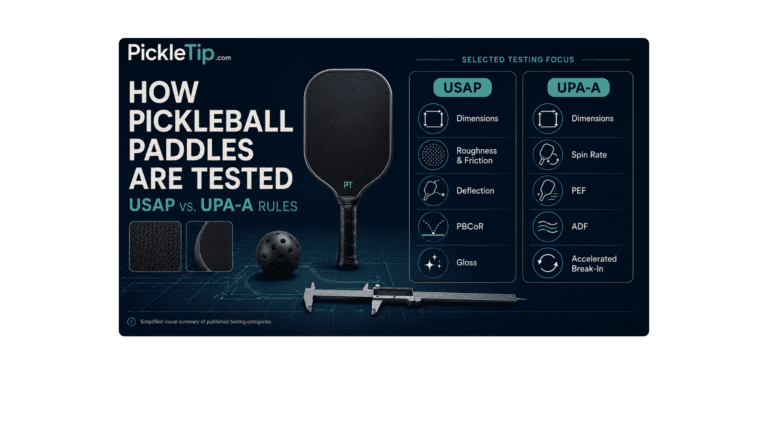
Manufacturers have good reasons to care about how certification systems measure rebound, spin, deflection, surface behavior, production variation, and break-in. UPA-A publicly promotes direct performance testing and Accelerated Break-In as advantages of its system. USA Pickleball uses its own certification and continuing-compliance procedures.
Testing philosophy is one reason brands talk about UPA-A, but it is not the only reason they may submit a paddle there first. The private reporting behind this article suggests that dissatisfaction with parts of USA Pickleball’s approval and compliance process is also influencing some decisions. Professional access, launch timing, contracts, governance, and cost can still matter just as much.
For the testing differences (PBCoR, PEF, spin, deflection, production compliance, and Accelerated Break-In) read: USA Pickleball vs. UPA-A paddle testing explained.
Why Brands May Not Put Every Paddle Through Both Systems
UPA-A publicly lists a 2026 annual certification fee of $10,000 per brand and $3,000 per paddle, with certification valid for 24 months. It also lists optional expedited services and a resubmission fee for a failed paddle.
| Published 2026 UPA-A Cost | Amount |
|---|---|
| Annual brand fee | $10,000 |
| Certification per paddle | $3,000 |
| Certification period | 24 months |
| Four-week expedited service | $2,500 |
| Two-week super-expedited service | $7,500 |
| Failed-paddle resubmission | $2,000 |
UPA-A also states that a branded paddle used by professionals on the PPA Tour or in Major League Pickleball requires a separate PPA/MLP Marketing and Broadcast License unless the brand meets the stated sponsorship exception. That commercial requirement is separate from laboratory certification.
USA Pickleball’s public submission FAQ says a paddle submission requires nine paddles shipped to multiple locations. Exact current USAP fees should be confirmed through the manufacturer submission process rather than pulled from an older fee schedule.
For a smaller paddle company, the math can get ugly quickly. Certification may involve annual program fees, per-model testing, samples, shipping, expedited service, failed resubmissions, redesign, and separate professional licensing or sponsorship expenses.
A large manufacturer can spread those costs across thousands of units. A smaller brand or low-volume model may not be able to. Selective certification can therefore be a financial decision even when the company has no philosophical objection to either organization.
Cost limitation: Certification expense does not pass dollar for dollar into a paddle’s retail price. A brand can absorb the cost, accept a smaller margin, certify fewer models, change its launch timing, seek sponsorship, or spread the expense across a larger catalog.
What Evidence Would Show the Shift Is Growing, or Stalling?
Signs the Shift Is Growing
- More brands publicly naming UPA-A as the preferred path for new performance models
- Repeated UPA-A-first launches across multiple product generations
- A growing share of influential brands with no matching new USA Pickleball activity
- Retailers successfully selling UPA-A-only premium models at scale
- Tournament directors accepting UPA-A more widely outside professional UPA events
- USA Pickleball approval becoming concentrated mainly in broader-market models
Signs the Shift Is Stalling
- Most watchlist models later receiving USA Pickleball approval
- Brands confirming that apparent gaps were only pending or delayed submissions
- UPA-A activity staying limited to a narrow group of professional-player models
- Retail resistance to paddles without USA Pickleball approval
- More brands returning to routine dual certification
- Event organizers declining to recognize UPA-A outside its professional ecosystem
Three Ways the Approval Split Could Play Out
| Possible Direction | What It Would Look Like |
|---|---|
| USAP remains the broad amateur standard | USAP keeps the largest list and widest grassroots recognition. UPA-A remains essential for professional competition without replacing USAP in the general market. |
| UPA-A becomes the pro-launch badge | Brands use UPA-A first for paddles tied to professionals, advanced players, and technology-focused launches, while USAP continues serving the wider amateur market. |
| Dual approval becomes the flagship default | Large brands certify premium models through both systems, while smaller brands and experimental paddles choose one path based on cost and audience. |
June gave us a signal, not an ending. USAP can remain the broad amateur standard while UPA-A gains influence over the newest professional and performance-focused launches.
Check the Exact Paddle Before You Buy or Compete
Before You Buy or Enter a Tournament
Do not shop by brand approval. Shop by exact-model approval. A company may have one paddle on both lists, another on USAP only, and a newer generation on UPA-A only. Approval can differ by model number, generation, thickness, shape, or release. Two paddles with nearly identical names may not have the same event eligibility.
- Check the exact model name, model number, thickness, and shape.
- Do not assume every paddle from one company carries the same approval.
- Use the current official database rather than relying only on a logo or product-page claim.
- Confirm which organization’s paddle list your event accepts.
- Do not assume UPA-A-only means illegal everywhere.
- Do not assume USA Pickleball approval provides professional PPA or MLP eligibility.
Most recreational players will never have a paddle checked against either database. The practical question is whether you may enter a tournament later. If that is even a possibility, verify the exact model before buying rather than assuming the logo on the paddle tells the whole story.
The pickleball governance guide explains which equipment system applies in different event environments. The USA Pickleball vs. UPA-A testing guide explains how model certification differs from production compliance and the legality of an individual paddle.
Sources, Methodology, and Analysis Limits
The approval counts and brand comparisons come from supplied list data preserved as a June 6, 2026 snapshot. Brand names were normalized where the records used company names, manufacturer names, product-line names, or formatting variations, so brand totals remain approximate. The approvals-per-brand figures are PickleTip calculations.
The market-level interpretation also draws on separate private conversations with one paddle-company founder and employees at several other brands. Those sources described at least some UPA-A-first decisions as intentional. A repeated criticism was that USA Pickleball had dropped the ball on parts of approval and compliance, while several sources regarded UPA-A as the more attractive first path for certain professional-facing or performance-focused launches. The companies represented in those conversations should not be inferred from the public watchlist.
UPA-A eligibility, fee, and licensing descriptions come from its published 2026 materials. USA Pickleball submission requirements should be checked against its current manufacturer FAQ and account portal.
- Current UPA-A Certified Paddle List
- 2026 UPA-A Certification Eligibility and Fees
- UPA-A Certification FAQ and Professional Licensing Information
- Current USA Pickleball Approved Paddle Database
- USA Pickleball Equipment Submission FAQ
Maintenance method: This article preserves the June 6, 2026 dataset as a dated market snapshot. PickleTip updates the analysis when later public records, on-record company statements, or additional firsthand reporting materially change the interpretation. Live approval status and event eligibility must always be checked on the current database and event rules.
Data availability: The counts in this article come from the supplied June 6 snapshot and PickleTip’s normalized brand matching. The underlying normalized worksheet is not linked from this article, so the totals should be read as a documented PickleTip analysis rather than a public live database.
Update History
- June 6, 2026: Approval-list data preserved for the market snapshot.
- August 6, 2026: Analysis, source-attribution language, methodology, and reader guidance reviewed.
Questions Players Keep Asking About the Two Lists
Some are. PickleTip’s private industry reporting indicates that at least some UPA-A-first approval decisions were intentional. The June 6, 2026 snapshot shows where that movement may be appearing, but the reporting is not attributed to any individual company in the public watchlist.
Not yet. USA Pickleball had the broader approval footprint and far more participating brands in PickleTip’s June 2026 snapshot. UPA-A can still gain influence over professional and performance-focused launches without replacing USAP as the broad amateur standard.
The two approvals open different doors. USA Pickleball approval reaches the broader amateur and sanctioned-event market, while UPA-A certification provides professional PPA and MLP eligibility. A flagship paddle may need both.
No. Approval follows the exact model and can differ by generation, shape, thickness, or model number. One paddle from a company may appear on both lists while another appears on only one. Check the exact model in the current official database.
Only after checking where it may be used. A UPA-A-only paddle is not automatically illegal everywhere, but it generally will not qualify for a USA Pickleball-sanctioned event that requires active USAP approval for the exact model.
Related Paddle Approval Guides
- Paddle Rules & Approvals: choose the current lookup, status, testing, governance, watchlist, or strategy guide that matches your question.
- USA Pickleball Approved Paddle List: check current approval by exact model.
- UPA-A Certified Paddle List: check current professional certification by exact model.
- How USA Pickleball and UPA-A Test Paddles: compare certification procedures and compliance levels.
- Who Governs Pickleball?: determine which rules and equipment system apply at an event.
- Who Governs Pickleball?: understand how USA Pickleball, UPA-A, tournaments, and event documents divide rule, equipment, and competition authority.
- Banned and Decertified Pickleball Paddles: review models that lost, changed, or faced questions about approval.
Coach Sid’s Bottom Line
USAP is still bigger. UPA-A is still changing launch strategy. The June 2026 snapshot showed the broader USA Pickleball market alongside a smaller, more concentrated group of brands putting multiple paddles through the professional system.
PickleTip’s private reporting indicates that at least some UPA-A-first decisions were intentional. The recurring criticism from the sources was that USA Pickleball had dropped the ball on parts of approval and compliance, while UPA-A was viewed as the more attractive first path for certain performance-focused launches.
Those conversations were private, and the companies represented in them should not be inferred from the public watchlist. But the consistency of what I heard matters: at least part of the split showing up in the approval records is strategy, not noise.
Watch the next generation of performance paddles. If more influential brands send those models to UPA-A first, the shift is spreading beyond a handful of private decisions. USA Pickleball does not have to disappear for the market to change.