
Pickleball Targeting Rule: What Changed and What Applies in 2026
The pickleball targeting rule was introduced as a provisional professional rule in 2025 to address intentional or reckless “head hunting.” It was a UPA professional-policy development, not a universal USA Pickleball rule for every recreational game.
And this is where older explanations can get you in trouble. UPA-A announced the provisional Targeting rule on February 18, 2025 and published an updated provisional Head Hunting rule on March 4. Since then, the governing framework has changed again: UPA-A now publishes its own rulebook for UPA-A-sanctioned competition.
So if you found an older article or video saying every shot above the shoulders automatically carries a specific $2,500 targeting fine, be careful. That describes an earlier provisional policy, not the current UPA-A rulebook.
What Was the Pickleball Targeting Rule?
On February 18, 2025, UPA-A announced a new provisional rule called Targeting. The stated purpose was player protection and competitive integrity in professional pickleball.
Less than three weeks later, UPA-A changed it. Targeting became an updated provisional rule labeled Head Hunting. The policy was clearly still evolving, not operating as a settled sport-wide rule that had existed for years.
You can still see both announcements in UPA-A’s official archive: the February 2025 Targeting announcement and the March 2025 Head Hunting update.
Who Did the Targeting Rule Apply To?
The 2025 targeting/head-hunting policy came from the professional UPA system. It was not a universal USA Pickleball rule for ordinary recreational games.
This is where a lot of online explanations go wrong. They take a professional-tour policy and rewrite it as:
“Pickleball has banned shots at an opponent’s head.”
That is too broad.
A recreational player using USA Pickleball rules, a player in a UPA-A-sanctioned event, and a player in another league or tournament may not be operating under the same governing document.
If you are unsure which organization or rulebook controls your match, see our guide to who governs pickleball and which rules apply.
Why Head Hunting Became a Problem for Pro Pickleball
At close range, hard speedups, counters, overheads, and firefights can put the ball into another player’s upper-body window before there is much time to react. That is normal aggressive pickleball right up until somebody has to decide whether a particular shot was simply hard play or something more.
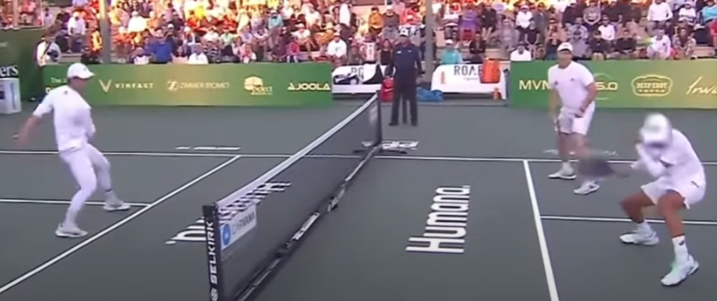
A highly discussed sequence involving Ben Johns and Quang Duong became part of the public conversation around head-level shots in professional play. It put a difficult officiating question right in the middle of the debate: how do you distinguish an ordinary hard shot that happens to travel high from conduct that crosses into intentional or reckless head hunting?
I would be careful about using that clip to declare what somebody intended. Video can show trajectory, player position, reaction, and context. It cannot let us climb inside a player’s head.
And that’s the officiating nightmare. The ball is easy to see. Intent isn’t. Once a rule asks an official to separate aggressive competition from reckless conduct, judgment becomes part of the call.
What Happened to the Original Targeting Penalties?
The original 2025 provisional policy was widely discussed in terms of technical penalties, fines, forfeitures, and discipline. But I would not use those original numbers as a current penalty chart today.
UPA-A revised the provisional policy and later moved to a formal rulebook. The current book has a general behavioral-sanction system built around Warnings, Marks, Fouls, escalation, behavioral game forfeits, and behavioral match forfeits.
Rule 12.3.3 defines a Foul as a sanction that awards one point to the opponent. It can be assessed when behavior is extreme, reckless, threatening, repeated after prior Warnings or Marks, or creates risk to persons, property, or competitive integrity. But the current rulebook does not say Rule 12.3.3 is simply the old Targeting rule under a new name.
Do not mix the 2025 provisional penalty schedule with the current rulebook. The old targeting/head-hunting policy is part of the history. Current sanctions have to come from the rules and event policies that are actually in force.
Does the Current UPA-A Rulebook Still Have a Rule Called “Targeting”?
No. The current 2026 UPA-A rulebook does not contain a standalone rule titled “Targeting” or “Head Hunting.”
It does contain broader behavioral-sanction rules, including Rule 12.3.3 on Fouls, but the book does not simply rename the old Targeting policy as a Foul. It also does not say every head-level shot or every in-rally body shot automatically becomes a behavioral sanction.
Coach Sid’s short version: The old Targeting rule did not simply become a permanent “no headshots” rule. The 2026 UPA-A rulebook has no standalone Targeting or Head Hunting provision. Ordinary ball contact and behavioral misconduct are addressed under different parts of the rules.
There is another wrinkle worth knowing. Rule 1.1 says the current UPA-A Rulebook governs UPA-A-sanctioned competition, while non-sanctioned competitions may choose to adopt it. Rules 1 through 15 provide the general framework for organized amateur and professional play under that rulebook, with additional appendices modifying designated professional competition.
You can verify the current framework on the official UPA-A Rulebook page.
Rules-status review: Rechecked August 17, 2026 against UPA-A’s February 2025 Targeting announcement, March 2025 Head Hunting update, and current 2026 UPA-A Rulebook.
Can You Still Hit the Ball at an Opponent in Professional Pickleball?
Yes. A normal in-rally body shot can still be legal pickleball.
Rule 8.4 of the current UPA-A rulebook is the Ball Contact Fault. After the serve, contact with a player’s body or anything worn or carried by that player results in a fault, except for contact with the paddle or hand below the wrist while that hand is in contact with the paddle handle.
In other words, hitting an opponent with a live ball can be how you win the rally. The fact that UPA-A also has behavioral sanctions does not turn every body shot into misconduct.
Both of these things can be true:
- A normal body shot can be a legal competitive shot, and the player hit may commit the ball-contact fault.
- Separate player behavior can still be sanctionable if it meets the standard of the behavioral rules that govern that match.
A Body Shot Is Not Automatically Head Hunting
One problem with calling this a simple “no headshots rule” is that ball flight in pickleball is messy.
A body shot tells you where the ball went. It does not automatically tell you why the player hit it there. That is the problem with turning every high body shot into a targeting call.
I’ve been on the receiving end of one of these moments. During a match, an opponent ripped a high-speed smash straight toward my face, and I barely got my paddle up in time. What bothered me afterward wasn’t that I could prove what he intended—I couldn’t. It was the combination of the shot and the dismissive laugh that followed instead of any acknowledgment. That experience is one reason I’m careful about both extremes here: I don’t want to call every high ball “head hunting,” but I also don’t think every dangerous-looking shot should be waved away just because hitting the opponent can be legal pickleball.
And there are plenty of less dramatic ways a legal shot can end up higher than the hitter expected. A player can:
- move into the ball’s path after the shot has been struck;
- get handcuffed by a ball intended for the upper torso;
- be struck by a deflection or mishit;
- or have an ordinary hard exchange produce a ball that finishes higher than anyone expected.
That is very different from having a rule that says the ball may never travel near a player’s head.
The better question for a professional behavioral ruling is not simply:
“Did the ball go near somebody’s face?”
The real rules question is whether the player’s conduct meets the standard for a sanction under the rulebook governing that match. Where the ball ended up may be part of the evidence. It is not the entire ruling by itself.
Legal Doesn’t Always Mean Smart Pickleball
Rules and strategy get mixed together here all the time. A rule can tell us whether conduct is sanctionable. It does not tell you whether aiming an attack at somebody’s paddle-side shoulder is smart pickleball. For that tactical question, see our guide to choosing body and jam targets on a drive.
Body shots are a normal tactical part of the game, and players can disagree about when aggressive play becomes bad sportsmanship. That is a different question from whether UPA-A has a standing rule that automatically penalizes every shot near the head.
If your question is about protecting yourself on court, see our pickleball safety guide. If you are trying to sort out ordinary gameplay rules, use our pickleball rules guide.
Pickleball Targeting Rule Timeline
| Date | What happened | Why it matters |
|---|---|---|
| February 18, 2025 | UPA-A announced a provisional rule called “Targeting.” | This was the professional policy that started much of the discussion about head-level shots and targeting penalties. |
| March 4, 2025 | UPA-A published an updated provisional rule labeled “Head Hunting.” | The policy changed in less than three weeks, showing that the professional enforcement approach was still evolving. |
| 2026 | UPA-A moved to its formal 2026 Rulebook framework. | The current rulebook contains no standalone Targeting or Head Hunting provision. Rule 8.4 addresses ball-contact faults, while Rule 12 separately establishes behavioral sanctions. |
What Changed After the Targeting Experiment
I think the most useful legacy of the targeting controversy is not a particular fine amount.
The harder issue was never really the dollar amount. It was this:
Hard pickleball and sanctionable conduct are not the same thing. The sport needs room for aggressive play, and officials still need authority when a player’s behavior crosses a line the rules actually define.
That is a much more useful way to understand the issue than memorizing the first penalty schedule attached to a provisional rule.
It is why I would not tell a recreational player, “You can’t body-bag someone because of the targeting rule.” I also would not tell a professional player that anything goes simply because hitting an opponent with the ball can normally win the rally.
First identify the rules authority. Then identify the conduct. Then apply the rule that actually governs that event.
Pickleball Targeting Rule FAQ
The pickleball targeting rule was introduced by UPA-A as a provisional professional policy in February 2025 to address intentional or reckless head hunting. UPA-A updated the policy in March 2025. The current 2026 UPA-A rulebook does not contain a standalone rule titled Targeting or Head Hunting.
Not as a universal recreational rule. The 2025 targeting and head-hunting policies were professional UPA policies. The current UPA-A rulebook governs UPA-A-sanctioned competition, and non-sanctioned competitions may choose to adopt it. Recreational players should identify the rulebook that actually governs their game.
There is no universal pickleball rule that makes every ball traveling near or contacting a player’s head automatically illegal. The current 2026 UPA-A rulebook has no standalone Targeting or Head Hunting rule. Rule 8.4 covers ordinary ball contact after the serve, while Rule 12 separately covers behavioral sanctions.
Yes, a normal in-rally body shot can be legal. Under Rule 8.4 of the current UPA-A rulebook, after the serve, contact with a player’s body or anything worn or carried by that player results in a fault, except for contact with the paddle or hand below the wrist while that hand is in contact with the paddle handle. That ball-contact rule is separate from UPA-A’s behavioral sanctions.
Do not use the old $2,500 targeting figure as a current UPA-A penalty rule. The 2025 targeting policy was provisional, was subsequently updated, and the current 2026 UPA-A rulebook has its own behavioral-sanction and escalation system. Current penalties should be checked against the rulebook and event policies that are actually in force.