Pickleball Players Are Already Roasting The Dink. They’ll Still Watch It.
Pickleball has officially reached its most dangerous stage of popularity.
Not Olympic recognition.
Not another paddle getting delisted.
Not a DUPR argument that starts with “I don’t care about ratings” and somehow ends with someone pulling up their entire match history.
No, we have reached the stage where Hollywood made a pickleball comedy, released a poster and trailer, and the internet immediately turned into a 3.5 open-play group chat with Wi-Fi.
Apple Original Films’ The Dink is scheduled to debut globally on July 24, 2026. The movie stars Jake Johnson as Dusty Boyd, a washed-up tennis pro who reluctantly turns to pickleball after an injury while trying to save a struggling club and earn his father’s respect.
I have not seen the full movie yet, so this is not a review of the final cut. This is a reaction to the premise, the poster, the trailer, and the very predictable way pickleball people responded once it started making the rounds.
So basically, Dodgeball, but with dinks.
Or Happy Gilmore, but with kitchen violations.
Or a Hallmark movie with fewer Christmas lights and more arguments about indoor balls.
Naturally, pickleball players responded with grace, patience, and open-minded perspective.
Just kidding.
They started roasting it before the trailer even had time to finish its follow-through.
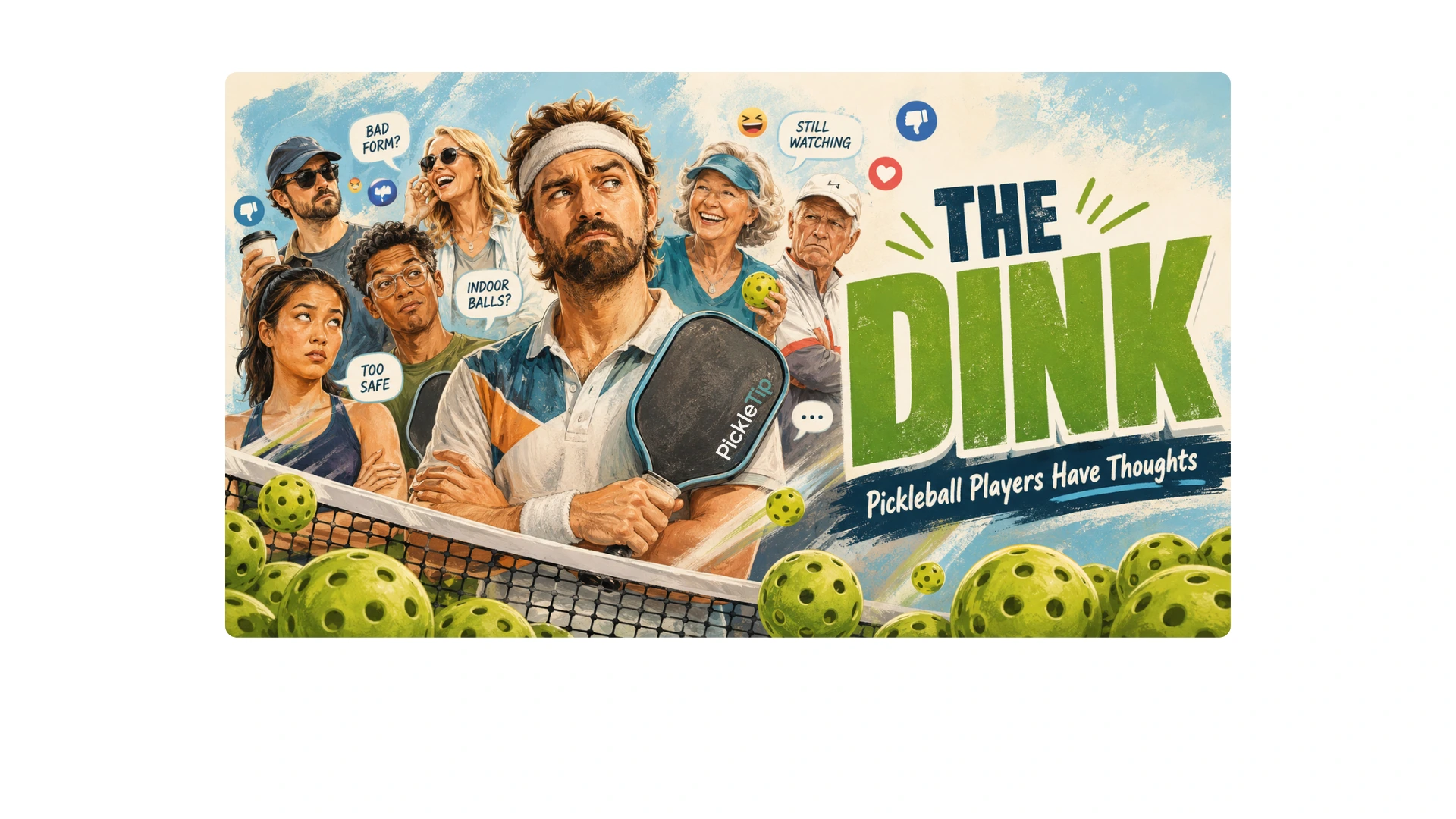
After the poster and trailer started making the rounds on YouTube and Reddit, the reaction settled into a few very pickleball-specific complaints: the tennis-rehab stereotype, the bad-form police, the missing real-player nods, the indoor-ball detectives, and the fear that Hollywood still thinks pickleball is funny only because it is supposedly lame.
That is the tension around The Dink: pickleball people do not mind being roasted. They mind being roasted lazily.
Quick read
Why pickleball players are roasting The Dink: the problem is not that the movie makes pickleball look funny. Pickleball is funny. The sport is already weird, competitive, social, petty, funny, and addictive. That is where the comedy should live. The problem is that the trailer appears to lean on the oldest outside joke about the sport: pickleball as the place tennis players go when tennis is done with them.
🎧 Prefer listening? Coach AJ summarizes this article about The Dink Movie:
What The Dink Understands About Pickleball — and What Might Miss
From a pickleball player’s view, The Dink gets one big thing right: the sport is absolutely ready for a comedy.
Pickleball has the ingredients. It has weird language, loud personalities, fragile egos, rating drama, paddle arguments, line-call tension, open-play politics, and enough “I’m just here for fun” competitors to fill a streaming series.
Where the trailer may go wrong is the angle. If the movie understands that pickleball culture is funny, it has a real shot. If it only treats pickleball as a goofy tennis replacement for injured or aging players, that joke is going to feel stale to people who actually play.
The better version laughs with pickleball players, not just at the idea that pickleball exists.
That is the tightrope the movie has to walk. The sport can handle a roast. Honestly, it deserves one. But the funniest roast comes from knowing the room.
Pickleball Players Saw the Setup and Already Knew the Movie
The funniest part is that pickleball players did not need the full trailer to start judging The Dink.
The poster and premise were enough.
The setup pickleball players spotted
- Aging tennis pro.
- Local club in trouble.
- Pickleball is treated like the ridiculous sport he never wanted to play.
- The club probably needs saving.
- There is probably a big final match.
- There is probably a prize or outcome that is exactly the amount needed to keep the doors open.
Pickleball players smelled the formula immediately.
Sports comedies have a pattern. The washed-up athlete is humbled. The sport he mocks teaches him a lesson. The misfit group becomes a family. The final point happens in slow motion. Someone learns that winning is not everything, right before winning anyway.
That does not mean the movie cannot be fun. Formula is not automatically a problem. Dodgeball, Happy Gilmore, Kicking & Screaming, and plenty of other sports comedies are built on obvious setups.
The real test is whether The Dink finds the weird pickleball stuff, not just the obvious tennis-guy-learns-humility stuff.
My read is simple: if The Dink makes fun of pickleball culture, it might work. If it only makes fun of pickleball as a fake little tennis substitute, players are going to shred it before the opening credits finish.
Did the Trailer Already Show Us the Whole Movie?
The other complaint is not even pickleball-specific.
A lot of viewers had the same reaction modern trailers often create: “Did I just watch the whole movie?”
The setup, the injury, the humiliation, the reluctant training arc, the club in trouble, the father-son tension, the big showdown, it all feels easy to map out from the trailer. That does not mean the movie cannot still be funny, but it does mean the comedy has to carry more weight than the plot.
Formula is forgivable. Predictability is forgivable. But if a trailer makes people feel like they already know every beat, the actual movie has to surprise them somewhere else.
The Trailer Did What Pickleball Always Does: Started an Argument
Pickleball players do not simply watch pickleball content.
They audit it.
The immediate audit
- Was that an indoor ball?
- Was that supposed to be good form?
- Why is the tennis pro swinging like that?
- Did that dink even make sense?
- Is this another “pickleball is for retirees and washed-up tennis players” joke?
- Why does every mainstream pickleball story act like the sport is something tennis players get sentenced to?
That last question is where the trailer stopped being just a trailer and became a referendum.
The problem is not that pickleball cannot be funny. Pickleball is hilarious. The people are hilarious. The arguments are hilarious. Spend one morning around open play and you can find more comedy in the paddle stack than most writers could invent in a room.
I have heard more ridiculous arguments waiting for a court at Mike Miley than most sports comedies could fit into a third act.
Coach Sid read
Pickleball can be roasted. It probably should be roasted. But the sport itself is not the joke. The lazy outside view of the sport is the joke.
The Tennis-Rehab Premise Steps Right on the Stereotype
The official setup does not step near the stereotype. It plants both feet on it.
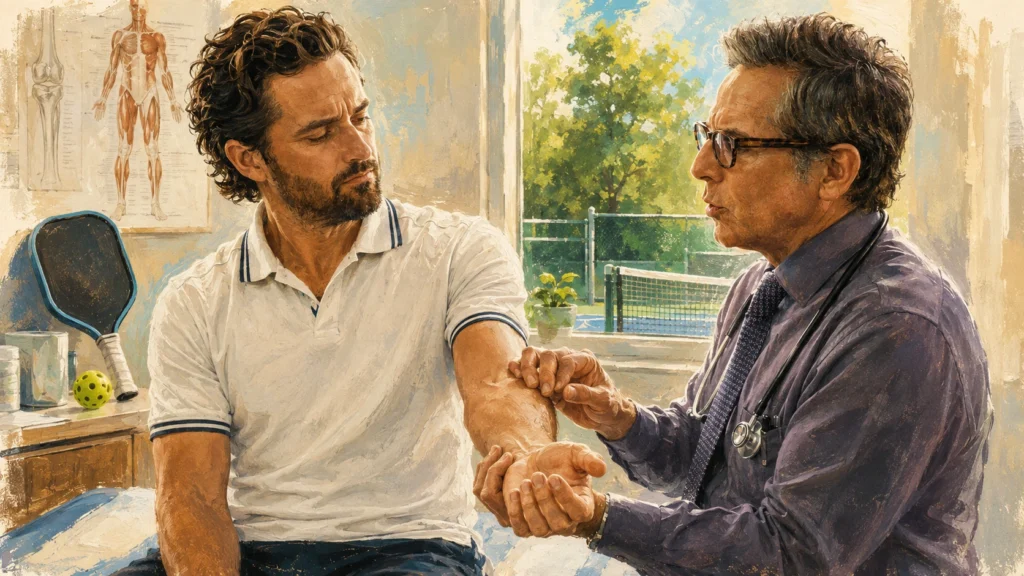
Dusty Boyd is not simply a tennis player who randomly discovers pickleball. He is a former tennis prodigy whose injury takes away his ability to play tennis, forcing him to pick up a pickleball paddle as part of his rehab.
That is probably meant to be funny.
The issue is not that an injured athlete tries pickleball. That happens in real life all the time.
The issue is the framing. If pickleball is presented as the consolation prize after tennis, players are going to hear the same insult they have been answering for years.
The stereotype players keep hearing
“You play pickleball? Isn’t that for old people?”
“You mean mini tennis?”
“You’re too young for that.”
Younger players hear that stuff every week from people who have never stood at the kitchen while a 60-something with a knee brace and soft hands makes them feel like they brought a frying pan to a chess match.
So yes, the tennis-rehab angle hits a nerve.
Pickleball has grown beyond the lazy setup. Former tennis players are part of the sport, but they are not the whole sport. Former baseball players, basketball players, racquetball players, table tennis players, golfers, weekend athletes, retired athletes, teenagers, grandparents, and people with no sports background at all are showing up.
Some come for competition. Some come for community. Some come because the court is smaller and the learning curve is friendly. Some stay because the kitchen turns into a chess match with hand speed.
Pickleball does not need tennis to validate it anymore. The sport has its own culture, its own stars, its own teaching language, its own equipment wars, its own rating system meltdowns, and its own highly specific nonsense.
That is why “injured tennis guy is forced to play pickleball” feels a few years late.
The Form Police and Ball Detectives Were Always Going to Show Up
One of the biggest complaints is not even about the plot.
It is about whether the pickleball and tennis look believable enough.
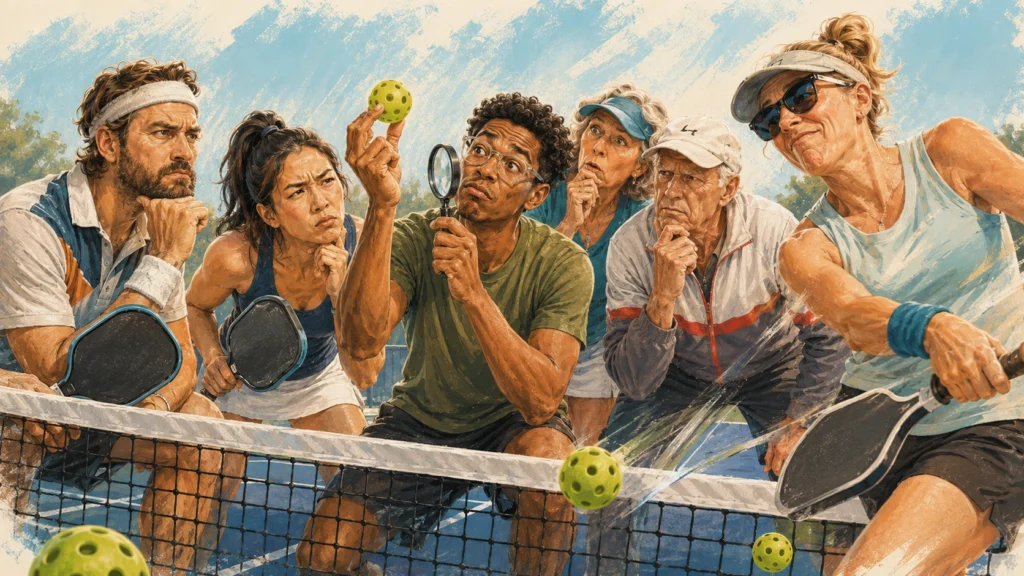
If the main character is supposed to be an aging tennis pro, pickleball players are going to expect him to at least look like someone who has played tennis before. A bad pickleball swing can be forgiven in a comedy. A bad tennis swing from a character whose backstory depends on tennis? That is harder to ignore.
This is the trap every sports movie steps in eventually.
Every sport has its movie problem
- Baseball fans notice fake swings.
- Golfers notice actors who cannot putt.
- Basketball players notice when somebody dribbles like they are angry at the floor.
- Pickleball players notice everything.
And pickleball players may be even worse because half the sport is actively learning technique while the other half is actively correcting them.
What players are pausing for
- A tennis-style backswing at the kitchen? People will notice.
- A dink that looks like a panic scoop? People will notice.
- A supposed tennis pro with awkward groundstrokes? People will definitely notice.
- A player standing in the wrong place for the shot they are hitting? Someone is already pausing the trailer.
Then there is the ball thing.
To normal viewers, a pickleball is a pickleball.
To pickleball players, that sentence alone can start a 37-comment argument.
The ball detective checklist
Indoor ball? Outdoor ball? Franklin? Dura? Selkirk? Vulcan? Too soft? Too hard? Cracking too fast? Flying weird? Playing slow? Playing fast? Was that ball even legal? Why are there so many indoor balls on the poster? Why are they practicing outside with what looks like indoor balls?
Indoor and outdoor balls do not just look different. They play different, bounce different, crack different, and change the pace of a point. So yes, players notice.
And once they notice, they cannot unsee it.
That is the beauty of the sport. We are all normal until someone uses the wrong ball. Then suddenly we become forensic analysts.
None of this means The Dink has to be a coaching video. It is a comedy, not a certification course. It does not have to explain stacking, show perfect transition resets, or teach the non-volley zone correctly.
But if Hollywood is going to build the whole premise around a tennis player entering pickleball, the tennis and pickleball should look believable enough that players are not pulled out of the story.
Where Are the Actual Pickleball People?
Roddick and McEnroe make sense for the tennis side of the story, but their presence also reinforces the issue pickleball players are reacting to: the movie still seems to be entering pickleball through tennis.
But pickleball players are still going to wonder whether the movie gives a nod to the actual pickleball world.
Actual pickleball-world nods players wanted
- Where is the Ben Johns cameo?
- Where is Anna Leigh Waters?
- Where is the random pro standing in the background, silently judging everyone’s split step?
- Where is the scene where someone says, “That paddle has been delisted,” and the entire tournament stops?
A real player cameo would not fix the whole movie, but it would signal that the filmmakers know the sport has its own universe now.
That matters because pickleball is not just “tennis, but smaller.” It has its own celebrities, arguments, products, inside jokes, etiquette rules, rating drama, and weird little language.
Pickleball already has its own language
- Dink.
- Kitchen.
- Erne.
- ATP.
- Shake and bake.
- Third-shot drop.
- Hands battle.
- Sandbagging.
- Open play politics.
Try explaining any of this to a normal person and tell me the sport does not sound like it was invented during a family reunion after three drinks.
That is why pickleball people get protective. The real sport is already strange enough. You do not have to flatten it into “old people tennis” to make it funny.
The Funnier Pickleball Movie Might Be About the Arguments
Hollywood may have walked right past the easiest comedy.
The best pickleball movie might not be about an aging tennis pro learning to respect the sport.
It might be about everything around pickleball.
The movie hiding in plain sight
- The DUPR arguments.
- The paddle-company drama.
- The ball debates.
- The private equity takeover of every empty warehouse in America.
- The guy who says he is a 4.0 but only plays with beginners.
- The person who refuses to play with a certain ball because it “doesn’t feel right.”
- The couple that plays mixed doubles together and somehow remains married.
- The beginner who buys a $280 paddle before learning how to keep score.
- The facility owner trying to convince neighbors that the sound is “not that bad.”
- The tournament director explaining why the 3.5 bracket has three former college tennis players in it.
You do not need a washed-up tennis savior. Put a camera near the paddle stack for one Saturday morning and half the script writes itself.
A truly accurate pickleball comedy would have at least one person arguing over DUPR, one person accusing someone of sandbagging, one person bringing their own ball, one person filming every rally for Instagram, and one person saying, “I’m just here for fun” right before questioning every line call.
That is where the comedy lives.
Not just in the idea that pickleball looks goofy to outsiders, but in the fact that the people who play it can turn a plastic ball, a paddle stack, and a disputed kitchen line into a courtroom drama.
Maybe The Dink Needed to Get Even Weirder
The trailer may have the opposite problem too: it might not be weird enough.
That is why movies like Dodgeball, Balls of Fury, Kicking & Screaming, and Semi-Pro worked for the people who loved them. They were not trying to politely wink at the sport. They committed to the absurdity.
With The Dink, the danger is that it lands in the middle: not accurate enough for pickleball players, but not ridiculous enough for comedy fans who wanted full sports-movie chaos.
That is why one of the best reactions was basically: this should have been a Dodgeball sequel where White Goodman makes his comeback by opening luxury pickleball facilities.
And honestly, that is a movie.
White Goodman with a fake 5.0 DUPR, a signature paddle, overpriced memberships, branded electrolyte drinks, and a proprietary rating system that somehow always ranks him first? A scrappy local club trying to stop him from buying every abandoned Bed Bath & Beyond in America?
Would it be dumb? Absolutely. Would pickleball players watch it? Immediately.
That is the strange thing about pickleball. The real world around the sport may already be too ridiculous for a normal sports comedy. You almost have to go bigger to keep up.
The pickleball complaints are one thing. The regular movie crowd seems to have a different problem: the trailer may look too safe for people who wanted bigger, stranger sports-comedy energy.
That is a rough bracket, because The Dink is not just competing with people’s feelings about pickleball. It is competing with people’s memory of comedies that swung harder, missed bigger, and did not mind looking ridiculous.
And once you put Ben Stiller near a sports comedy, people are going to expect some Dodgeball energy. Whether that is fair or not, it changes how the trailer gets judged.
From what is publicly listed, Stiller plays Dr. Stone, the doctor who pushes Dusty toward pickleball for rehab, which may make him important to the premise even if he is not the center of the movie.
The Hallmark Version Also Exists in Everyone’s Head
Of course, the other fake version writes itself too.
A big-city woman returns to her small hometown for Christmas. Her old high school flame runs the local pickleball club. They team up for the statewide indoor mixed doubles tournament, and the prize money will save the club, the church, or the beloved community center from developers.
Somewhere around the second act, someone says, “Maybe pickleball isn’t the only thing worth giving a second chance.”
That is painfully accurate.
And the worst part?
A lot of us would watch that too.
Pickleball players love to act above this stuff, but give us a cheesy movie with paddles, a tournament bracket, and one emotional kitchen-line moment, and suddenly we are “just checking it out.”
The Cast Is the Reason I’m Not Writing It Off Yet
This is not some no-name throwaway project.
The cast is stacked. Jake Johnson, Mary Steenburgen, Ed Harris, Ben Stiller, Chloe Fineman, Patton Oswalt, Aaron Chen, Chris Parnell, Christine Taylor, Andy Roddick, and John McEnroe give the movie more than enough talent to be better than the trailer reaction suggests.
The comedy team gives me one reason not to bury the movie from a two-minute trailer. Josh Greenbaum directed Barb and Star Go to Vista Del Mar, and Sean Clements wrote the script. Comedy trailers lie all the time. Sometimes the funniest rhythm does not fit inside the trailer cut.
So yes, the trailer gave pickleball players plenty to roast.
But there is still enough talent involved that the movie could end up being funnier, stranger, or more self-aware than the marketing makes it look.
The DINK Name Confusion May Be the Best Accidental Joke
One of the funniest reactions has nothing to do with pickleball technique.
A bunch of people thought The Dink was going to be about “DINKs” — double income, no kids.
Honestly, that is a completely different movie.
Maybe a couple buys a condo near pickleball courts, refuses to have kids, then slowly loses their mind because the plastic ball sound starts at 7 a.m. every Saturday.
Actually, that might be the horror version.
The title works for pickleball players because we know what a dink is. But outside the sport, “DINK” means something else entirely. That confusion is almost too perfect.
Pickleball has always had a naming problem.
Try explaining these to a normal person
- Pickleball.
- Kitchen.
- Dink.
- Erne.
- ATP.
- Shake and bake.
So if the title confuses people, that may be the most accurate part of the whole marketing campaign.
The Hate-Watch Potential Is Through the Roof
Some of the harshest reactions also sound like people who might watch it anyway.
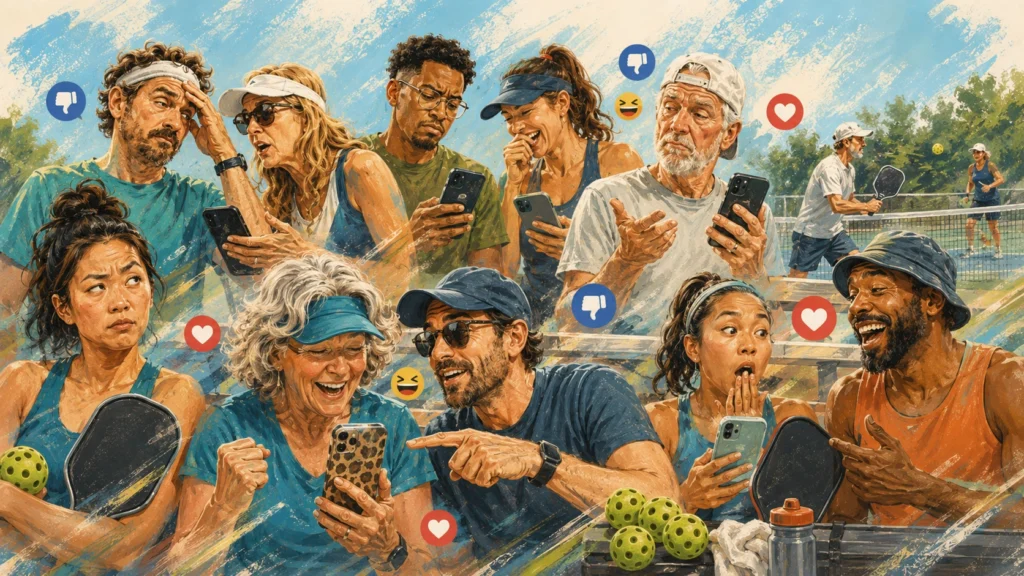
That is the magic zone.
The whole article in four lines
“This looks awful.”
“The form is terrible.”
“This looks like a trainwreck.”
“And I’m going to watch it nonetheless.”
A pickleball movie does not need universal approval. It just needs enough players muttering “this looks awful” while quietly checking the release date.
And pickleball players are absolutely going to press play.
Maybe not all of them. Maybe not proudly. But plenty will.
Why players will still press play
- Some will watch because they love pickleball.
- Some will watch because they hate how pickleball is portrayed.
- Some will watch because they want to count technical mistakes.
- Some will watch because they need fresh material for the group chat.
And a few will watch because they secretly hope it is better than the trailer makes it look.
The Dink Might Get the DUPR Treatment
The whole reaction reminds me of how pickleball players talk about DUPR.
Everyone says it is broken, inflated, deflated, unfair, misunderstood, and personally disrespectful.
Then the next week, those same players are signed up for another DUPR session.
That is pickleball. We complain because we care, then we participate because we care.
The Dink may get the same treatment.
The Movie Can Be Wrong and Still Be Worth Watching
A pickleball comedy does not need perfect form to be worth watching. It does not have to teach stacking, explain the non-volley zone, or make every rally look like a pro mixed doubles final.
Pickleball players should probably leave a little room for the movie to be a movie.
Bad footwork is forgivable. A goofy swing is forgivable. A ridiculous tournament setup is forgivable. Sports comedies are supposed to exaggerate things.
What is harder to laugh off is a lazy understanding of the sport.
That is the line for me. Pickleball can absolutely be the setting of the joke. It just does not need to be reduced to the same tired punchline.
The sport already brings its own circus: DUPR arguments, paddle drama, ball debates, kitchen-line trials, open-play politics, and people who say they are “just here for fun” while cross-examining every call like they are trying a federal case.
That is the movie.
The lazy version stops at “pickleball sounds silly.”
That joke is too easy.
The better version laughs with the people who play, not just at the idea that they play.
And if The Dink brings more attention to the sport, that is not automatically bad. Some people will watch it and laugh at pickleball. Fine. They were probably laughing already.
Some people will watch it and get curious. Even better.
Some people will watch it, search for courts nearby, show up to open play, and immediately discover that the “easy old-person sport” becomes very different when someone keeps rolling balls at their feet.
I have seen that exact face from new players. They show up thinking the court is small and the ball is plastic, then ten minutes later they are asking why every ball keeps landing on their shoelaces.
That would actually be a pretty accurate pickleball experience.
Pickleball Has Entered Its Roast Era
Maybe this is what mainstream attention looks like.
The mainstream pickleball cycle
- First they ignore the sport.
- Then they make fun of it.
- Then they try it.
- Then they get addicted.
- Then they start arguing about paddle grit, DUPR, court etiquette, and whether a 4.0 tournament bracket was secretly full of 4.7s.
A pickleball movie was always going to get roasted.
The poster started it. The trailer made sure of it.
Pickleball players are going to complain about the stereotypes. Movie fans are going to complain that it looks formulaic. Younger players are going to worry it makes the sport look lame. Tennis players are going to use it as evidence in their ongoing case against us. People who thought DINK meant double income no kids are going to be confused.
And the rest of us are going to sit there with popcorn, low expectations, and way too many opinions.
Because that is what pickleball does now.
It gets mainstream attention, immediately forms a group chat opinion, and somehow turns a movie trailer into a ratings debate.
And afterward, we will probably argue about whether the movie was actually a 3.25 or closer to a 4.0.
Final thought
So, who’s ready to watch this with me and pretend we’re not going to overanalyze every dink, swing, ball choice, and rating-level plot twist?