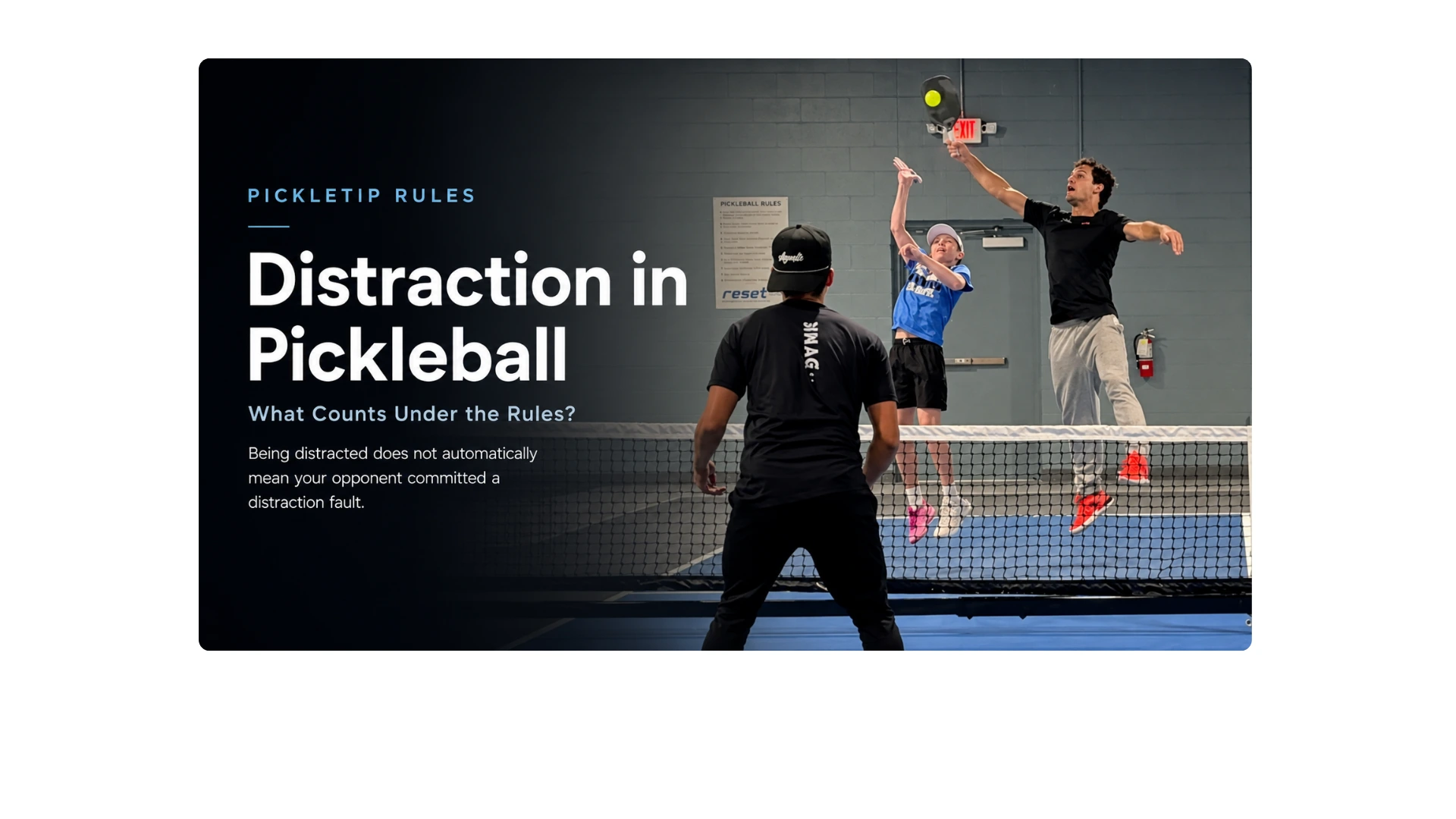
Distraction in Pickleball: What Counts Under the Rules?
A distraction in pickleball is not simply anything that breaks your concentration. Under the 2026 USA Pickleball rules, a distraction involves player actions that are not common to the game and interfere with an opponent’s ability or concentration to hit the ball. Rule 10.F says a player must not distract an opponent when that opponent is about to hit the ball. In an officiated match, the referee makes that judgment under Rules 20.I and 20.I.1.
That sounds straightforward until somebody talks during a rally, celebrates early, stomps, waves a paddle, shouts to a partner, or does something that one player considers normal and another considers distracting.
I’ve seen that gray area turn a routine recreational point into a full rules debate. The important distinction is this: being distracted does not automatically mean your opponent committed a distraction fault.

What Counts as a Distraction in Pickleball?
USA Pickleball defines a distraction in Section 2 of the 2026 rulebook as player actions that are not common to the game and interfere with an opponent’s ability or concentration to hit the ball. The examples include loud noises, stomping feet, and waving the paddle in an erratic manner. Rule 10.F then adds the timing piece: a player must not distract an opponent when that opponent is about to hit the ball.
The key is that the rule does not say, “If something bothered me, I win the rally.”
- Normal game activity matters. Pickleball naturally includes movement, paddle noise, communication, effort sounds, and reactions.
- Timing and context matter. A normal call to your partner while a point develops is a different situation from a sudden yell as an opponent starts a swing.
- The effect matters. The rules definition is concerned with conduct that interferes with an opponent’s ability or concentration to hit the ball.
- In an officiated match, the referee judges it. Rules 20.I and 20.I.1 give the referee responsibility for determining whether a distraction occurred and calling the resulting fault.
PickleTip rule of thumb: Separate two questions: Did that distract me? and Did my opponent actually commit a distraction under the rules? You can answer yes to the first and no to the second.
Distraction vs. Hinder in Pickleball: What’s the Difference?
The two terms get mixed together, but they describe different problems. A distraction comes from a player’s conduct. A hinder is a temporary element or occurrence not caused by a player that adversely affects play. USA Pickleball lists examples such as stray balls, flying insects, foreign material, or people from another court interfering with a play.
| Situation | Rules concept | Basic distinction |
|---|---|---|
| An opponent deliberately makes an unusual noise as you swing | Possible distraction | The alleged interference comes from a player |
| An opponent makes an unusual paddle motion as you prepare to hit | Possible distraction | The alleged interference comes from a player |
| A stray ball rolls onto the court | Hinder | The interruption was not caused by a player in your rally |
| An unexpected outside occurrence disrupts the rally | Possible hinder | The cause is external rather than opponent conduct |
The easiest way to separate the two is to ask what caused the interruption. If it came from an opponent’s conduct, distraction may be the issue. If it came from outside the rally, you’re probably dealing with a hinder instead. Under Rule 9.C, any player may call a hinder, and a called hinder results in a replay under Rule 9.C.2.
The Exchange NOLA Incident That Changed How I Think About This Rule
I ran into this exact gray area during a recreational game at the Exchange NOLA.
After a poor pop-up, someone shouted, “My bad.” The opposing player then missed the next shot and argued that the shout had distracted him. What had felt like completely ordinary partner communication to one side suddenly became a rules dispute on the other.
We ultimately replayed the point.
Looking back, the interesting part is not whether the replay kept the peace. It did. The rules question is whether saying “my bad” automatically creates a distraction fault.
No, not automatically. “My bad” can be ordinary communication between partners. But that does not give every spoken phrase a free pass just because somebody calls it partner communication.
In our Exchange game, nobody was really debating whether the opponent heard “my bad.” He obviously did, and he said it affected him. The harder question was whether the other player’s conduct crossed the rules boundary. Was the comment simply directed toward a partner? When was it said? How loud was it? Was it directed at the opponent? Did it have a normal game-related purpose? Those facts tell me a lot more than trying to build a magic list of words that are always legal or always illegal.

Is Partner Communication Allowed During a Pickleball Rally?
Yes. Partner communication is a normal part of doubles pickleball. Players call balls, warn each other, communicate switches, identify patterns, and react to shots throughout a rally. The 2026 rulebook recognizes this directly in the line-call context: Rule 8.F.4 says that communication between partners about whether a ball might land out is player communication, not a line call.
That is why I would not treat words such as “switch,” “out,” “watch,” “back,” “mine,” or “Erne” as automatic distraction faults merely because an opponent heard them.
But “partner communication is allowed” should not be stretched into “anything I yell is protected.” A normal tactical call made to your partner while the rally develops is one thing. A sudden scream timed to an opponent’s swing is another.
The Same “Erne” Call Can Be Normal—or a Problem
Here’s a good example because the word never changes. Only the situation does.
Imagine I read an opponent’s body position and paddle angle and call “Erne” to alert my partner that an Erne opportunity may be developing.
- Scenario A: I make the call while the rally is developing as normal tactical information for my partner.
- Scenario B: I suddenly scream the same word as an opponent is striking the ball, in a way that looks designed to break that player’s concentration.
The word itself has not changed. The context has.
A legitimate tactical purpose still tells me something important about the call, but it can’t settle the question by itself. Timing, behavior, whether the action is normal to the game, its effect on the opponent, and, in an officiated match, the referee’s judgment matter too.
If you’re trying to improve what partners should actually say during a rally—who takes the ball, switching, movement cues, and communication systems—see our pickleball doubles communication guide.
Common Examples: Normal Play or Possible Distraction?
| Example | Usually looks like | Why |
|---|---|---|
| Calling “mine” or “you” to your partner | Normal play | Ordinary doubles communication |
| Calling “switch” during a defensive rotation | Normal play | Legitimate tactical communication |
| Saying “my bad” after popping a ball up | Usually normal communication | The phrase by itself does not establish a distraction |
| Normal effort noise while striking the ball | Usually normal play | Ordinary physical play can make noise |
| Suddenly screaming as an opponent begins a swing | Possible distraction | The timing and behavior may fall outside normal game activity and interfere with the shot |
| Stomping as an opponent prepares to hit | Possible distraction | Stomping is one of the examples in USA Pickleball’s distraction definition |
| Waving a paddle erratically as an opponent prepares to hit | Possible distraction | Erratic paddle movement is one of the examples in USA Pickleball’s distraction definition |
| A stray ball rolling from another court | Hinder, not opponent distraction | The interruption was not caused by a player in your rally |
The table is a starting point, not a list of automatic faults. A normal action can become a problem depending on when and how it happens.
Does Intent Decide Whether Something Is a Distraction?
Intent can be relevant, but I would not use intent as the only test.
I used to think intent should settle it. I don’t anymore. None of us can climb inside another player’s head, and the USA Pickleball definition is written around the action and its interference with the opponent, not a requirement that somebody prove what another player was secretly thinking.
When I’m trying to sort one of these out, I look at a few things:
- Was the action common to normal pickleball?
- Did it have a legitimate game-related purpose?
- When did it happen relative to the opponent hitting the ball?
- Was the behavior unusually loud, exaggerated, directed, or unnecessary?
- Did it interfere with the opponent’s ability or concentration to hit the ball?
- If the match is officiated, what did the referee judge?
Coach Sid’s practical test: Don’t ask only, “Did that bother me?” Ask what the opponent actually did. Was it normal pickleball serving a legitimate game purpose, or did the conduct cross into something outside normal play that interfered with the shot?
What Happens When a Referee Calls a Distraction?
In an officiated USA Pickleball match, Rules 20.I and 20.I.1 put this decision in the referee’s hands. The referee determines whether a player distracted an opponent from hitting the ball. If the referee judges that a player distracted an opponent when the opponent was about to hit the ball, it is a fault against the offending player.
That’s why the word itself can’t answer the question. “Mine,” “switch,” “Erne,” or “my bad” could be ordinary communication in one situation and part of a very different situation in another.
What About Distraction in Recreational Play With No Referee?
This is the part I would handle differently today.
Under the 2026 USA Pickleball rules, players do not have blanket authority to impose every alleged fault on an opponent. Rule 9.B.3 says players may call non-volley zone faults and service foot faults on an opponent. Rule 9.B.4 addresses other alleged opponent faults: you may mention the specific fault after the rally, but you do not have authority to enforce it. The final decision belongs to the player who allegedly committed the fault.
That changes how I look at a claimed distraction in ordinary non-officiated play. If you think an opponent distracted you:
- Don’t automatically stop a live rally just because something bothered you. Rule 9.A.1 generally makes stopping a rally a fault unless one of the rulebook’s listed exceptions applies.
- Explain specifically what you believe happened. “You yelled as I started my swing” is much more useful than “You distracted me.”
- Point to the conduct, not just your reaction. Hearing something before you miss does not by itself settle whether the opponent violated the distraction rule.
- Don’t give yourself referee authority. In non-officiated play, your authority to call faults on an opponent is limited.
- If everybody agrees to replay a disputed recreational point to keep the game moving, understand what you are doing. You are choosing a practical group resolution; you have not proven that every claimed distraction automatically requires a replay.
That last distinction is exactly how I now view our Exchange NOLA point. Replaying it was a reasonable way for four recreational players to end an argument and move on. That doesn’t mean the rules automatically required a replay.
A Distraction Claim Should Not Become a Do-Over Button
This rule can become messy in open play because concentration is personal. One player barely notices talking on the next court; another hears everything.
But pickleball cannot work if every missed shot can be converted into, “Something distracted me, let’s replay it.”
Instead, point to what the opponent actually did. “You shouted as I started my swing” gives everyone something concrete to discuss. “I was distracted” only describes your reaction. You may have been genuinely distracted. That still does not answer the rules question.
Which Pickleball Rules Are You Actually Playing Under?
Everything above assumes you are playing under the USA Pickleball rules. A tournament, professional event, league, or other competition can use a different governing document or published modification, so check which rules actually control the event before treating a USA Pickleball ruling as universal.
For the broader jurisdiction question, see who governs pickleball and which rulebook applies. For a complete overview of ordinary gameplay rules, use our pickleball rules guide.
For the source itself, use the official USA Pickleball rules page. USA Pickleball updates its rulebook, so I would rather send you to the current source than hard-code an old annual PDF that eventually goes stale.
Rules review: Checked against the 2026 USA Pickleball Official Rulebook on August 17, 2026.
The Question I Ask Now
Not everything that distracts you is a distraction fault.
The Exchange NOLA argument taught me something useful. Asking whether somebody was genuinely distracted gets you only halfway there. Of course they may have been. The question that actually helps is: what did the opponent do, and did that conduct cross the rules boundary?
That’s the distinction I use now when this comes up on court: separate the reaction from the rule.
Frequently Asked Questions About Pickleball Distractions
Under the 2026 USA Pickleball rules, a distraction involves player actions that are not common to the game and interfere with an opponent’s ability or concentration to hit the ball. Rule 10.F says a player must not distract an opponent when that opponent is about to hit the ball.
Yes. Partner communication is a normal part of doubles pickleball. Calls such as mine, switch, back, or Erne are not automatically distractions merely because an opponent hears them. A problem can arise when the conduct falls outside normal play and interferes with an opponent’s ability or concentration to hit the ball.
No. Feeling distracted does not automatically establish a distraction fault. In an officiated USA Pickleball match, the referee determines whether a distraction occurred under Rules 20.I and 20.I.1. In non-officiated play, Rules 9.B.3 and 9.B.4 limit which alleged opponent faults players may enforce themselves.
A distraction comes from player conduct that falls outside normal game activity and interferes with an opponent’s ability or concentration to hit the ball. A hinder is a temporary outside element or occurrence not caused by a player that adversely affects play, such as a stray ball from another court.
Not automatically. ‘My bad’ can be ordinary partner communication. Look at what actually happened: when it was said, how it was said, who it was directed toward, whether it had a normal game-related purpose, and whether the conduct interfered with the opponent’s ability or concentration to hit the ball.



Please post your thoughts on this situation. In a tournament, we were given two balls for the match. When I changed from the ball we started with to the second ball, one of the opponents told me I couldn’t do that. She said we have to play with the same ball, unless the first ball cracked, then we could play with the second ball. She claimed it was in the rules. Thoughts?