Pickleball Video Analysis: How to Review Matches With the FILM Method
When you are in the middle of a pickleball match, everything feels faster and cleaner than it may actually be. You remember the missed return, the ball you popped up, or the winner that ended the rally. What you usually do not remember is the sequence that created it.
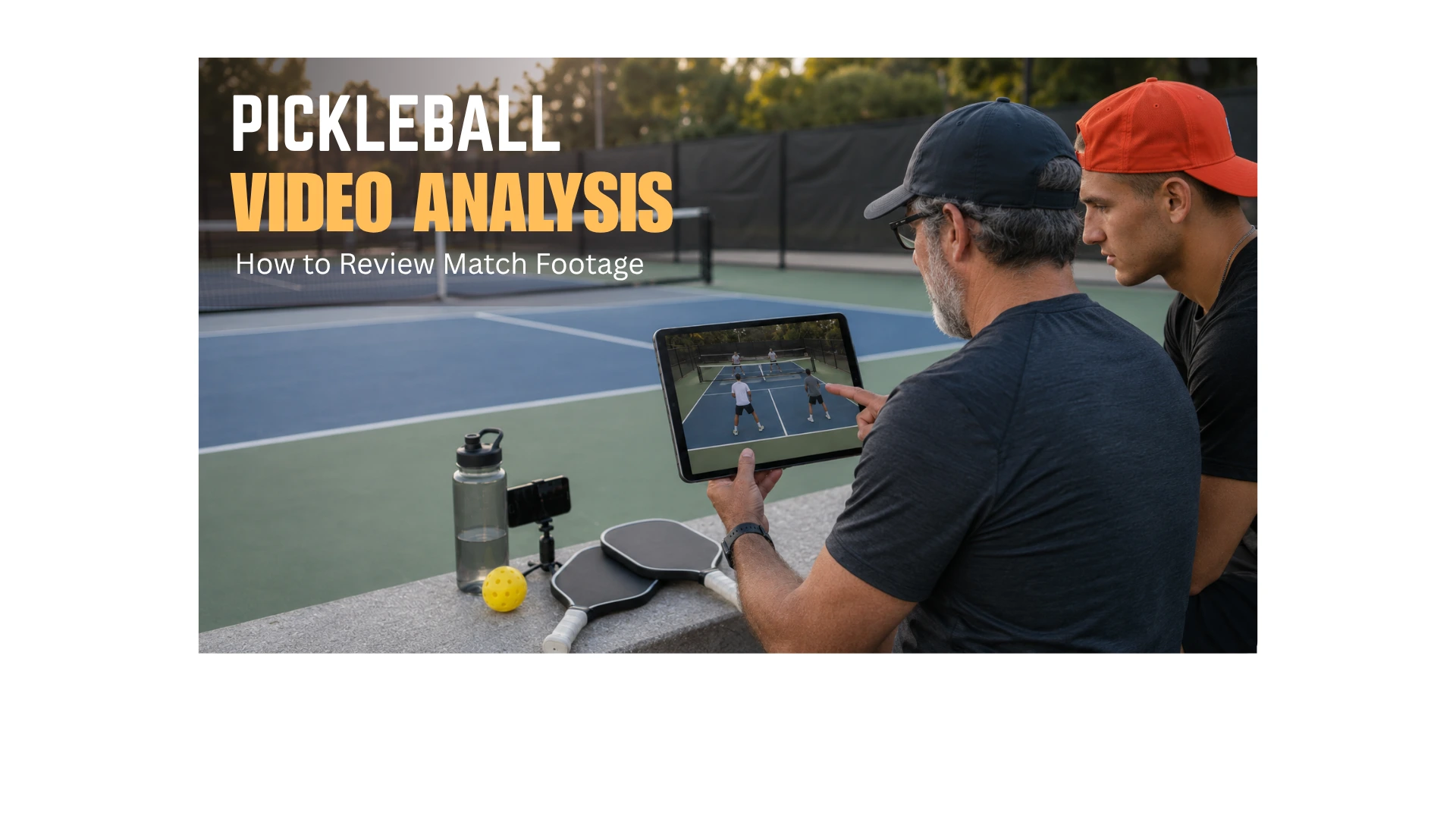
That is why recording pickleball matches has become such an important part of how AJ and I study the game. The camera does not care what we intended to do. It shows where we stood, how we moved, which ball started the trouble, and whether the mistake we blamed was really the first mistake in the rally.
Quick answer
To analyze pickleball match video, work backward from the final result to the earliest visible, controllable breakdown that meaningfully changed the rally, group similar breakdowns into repeated patterns, and choose one pattern worth addressing next. The final miss may end the point without explaining it. Review positioning, shot selection, partner movement, opponent tendencies, and what happened before the rally fell apart.
Once you have a clear view of the full court, the harder question begins: what are you actually supposed to look for? For camera placement, recording angles, mounts, frame rates, and keeping all four players visible, start with our guide to how to record pickleball games.
FILM starts once you have usable footage. From there, the job is figuring out what actually happened, what kept happening, how all the players shaped the rally, and which pattern deserves your attention first. For the broader post-match process (including notes, emotion, partner discussion, and evidence that may not come from video) use the REVIEW framework.
Why Memory Gets the Match Wrong
Players are not always reliable witnesses to their own matches. That is not a character flaw. It is simply difficult to track the ball, your partner, both opponents, court position, score, strategy, and your own mechanics at the same time.
Video gives you a second look after the speed and emotion are gone. It separates what you felt from what actually happened.
- You may feel as though you missed a third-shot drop when the real problem was a rushed, off-balance return from the previous exchange.
- You may blame your partner for leaving the middle open when your wide dink pulled both of you out of position.
- You may think an opponent is overpowering you when the footage shows that most attacks began with a ball you left too high.
- You may remember several spectacular winners while overlooking the same ordinary positioning mistake that cost six points.
PickleTip principle
The last mistake ends the rally. It does not always explain the rally. Good video review works backward until you find the earliest controllable moment that meaningfully changed the point against you.
The PickleTip FILM Method
Watching an entire match without a process often turns into entertainment. You notice a few ugly shots, admire a few good rallies, and finish without knowing what to practice.
AJ caught something in one of my own matches that I had completely misread. I thought my backhand dinks were breaking down because of my footwork. On film, he noticed that I was starting the paddle too far forward and never giving the stroke enough room to develop. My feet were not the main problem after all.
That is the kind of confident wrong answer video can expose. We needed a process that could do the same thing across an entire match, not just one stroke. AJ and I needed a way to stop watching matches like spectators, so we began sorting the review into four steps.
The FILM method
- F — Find the first breakdown: Trace each lost rally back to the earliest controllable shot, movement, or decision that created pressure.
- I — Identify repeated patterns: Group similar breakdowns instead of treating every missed ball as a separate problem.
- L — Look at all four players: Study yourself, your partner, and both opponents rather than watching only the ball you hit. Singles players can use the same method by studying both players and the space created by each shot.
- M — Make one priority: Choose the highest-value repeated pattern and state it clearly enough that you know what needs attention next.
F: Find the First Breakdown
Start with a point you lost. Watch the final mistake, then rewind several shots. Ask when your team first lost control of the rally.
What counts as the first breakdown?
The first breakdown is not automatically the first imperfect shot. It is the earliest controllable decision, movement, or contact visible in the footage that meaningfully changed the rally against your team. Sometimes the opponent simply hits a good ball. Not every lost point contains a hidden mistake three shots earlier.
FILM can show what happened and where the rally changed. It cannot always prove why. If the footage leaves two or three plausible causes, keep the uncertainty and use the ERROR framework for deeper diagnosis before rebuilding mechanics.
Here is a common example. The rally ends when you hit a transition-zone reset into the net. It is tempting to write down “work on resets.” But rewind the point:
- Your return lands short.
- The serving team drives the third shot at your partner.
- Your partner blocks the ball high.
- You are caught moving through the transition zone.
- You miss the reset.
The reset was the final error, but the short return may have been the first breakdown. The better improvement plan might be deeper returns and cleaner movement to the kitchen, not simply hitting one hundred resets.
How that rally fits FILM
- What looked wrong: The reset went into the net.
- What created the pressure: The short return gave the serving team an easy drive.
- What to track: Short returns followed by rushed transition movement.
- What to practice: Return deeper, move immediately, and get balanced before the opponent contacts the next ball.
I: Identify Repeated Patterns
One bad shot may be random. The same breakdown appearing throughout a match deserves attention.
Instead of creating a different diagnosis for every rally, use a few broad categories and place each lost point into the best-fitting one.
- Serve and return: missed serves, short returns, poor return placement, slow movement forward.
- Third- and fifth-shot decisions: forcing a drive, dropping from poor balance, attacking from below the net.
- Transition play: rushing forward, failing to split-step, swinging at balls that should be reset.
- Kitchen play: popping up dinks, reaching, attacking the wrong ball, losing patience.
- Positioning: leaving the middle, failing to recover, standing too far from your partner.
- Communication: hesitation, both players taking the same ball, or neither player taking it.
- Mental and score management: rushing after an error, changing strategy unnecessarily, or pressing late in a game.
At the end of the match, count the categories. Your most expensive problem is often not the error that looked worst. It is the ordinary mistake that happened repeatedly.
When a pattern deserves practice time
A mistake deserves practice time when it repeats in similar situations, costs meaningful points, and gives you something you can actually change. One ugly miss is not automatically a pattern.
L: Look at All Four Players
AJ has always been willing to examine his own mistakes. That helps, but self-analysis is only one layer of match review. A pickleball rally is created by four players reacting to one another.
For every important rally, ask four separate questions:
- What did I do?
- How did my decision affect my partner?
- What pattern were our opponents trying to create?
- What changed when the rally moved in one team’s favor?
Once you watch all four players, you stop treating the rally like one person missed a ball. You begin seeing how the point was built.
M: Make One Priority
A long list of mistakes does not tell you what to fix first. After reviewing the match, choose one repeated pattern that costs meaningful points and is specific enough to address.
Turn the observation into a specific next priority. FILM does not need to fix your entire game. It needs to show you what keeps happening and give you one useful place to start.
| Vague Observation | Useful Video-Backed Priority |
|---|---|
| My drops were bad. | Moving third shots after deep returns repeatedly broke down before contact. |
| We gave up the middle. | The middle opened repeatedly after one partner was pulled wide. |
| I popped up too many dinks. | Popups clustered when contact drifted outside a stable base. |
| I attacked bad balls. | Failed attacks repeatedly began from low contact or poor balance. |
| We were slow getting forward. | Short returns repeatedly left the returning team moving when the next ball arrived. |
Once FILM gives you a clear priority, decide what you actually need next. If you still do not know why the problem keeps happening, use the ERROR framework. If the cause is clear, use the GROW Plan to decide what you are changing, the DRILL framework when you need the right corrective exercise, or Pickleball Practice when several tasks need to fit into one court session.
What to Look For When You Review the Match
Do not turn the review into a frame-by-frame autopsy. Focus on decisions and movements that repeatedly affect points.
Serve and Return Quality
- Are serves deep or well placed enough to make the return uncomfortable?
- Are returns deep and safe enough to give the returning team time to advance?
- Does the returner move forward immediately, or watch the ball before moving?
Third-Shot and Fifth-Shot Decisions
A third shot is not good simply because it lands in the kitchen. Look at the situation surrounding it.
- Was the player balanced before contact, and were the opponents already established at the kitchen?
- Was a drive, drop, or hybrid the highest-percentage choice?
- Did the third shot let both partners advance, and what happened on the fifth if it did not fully neutralize the rally?
Transition-Zone Movement
Many points that appear to be lost by poor hands are actually lost by poor movement. Watch the feet before you blame the paddle. Our guide to the pickleball transition zone goes deeper into stopping, split-step timing, and moving forward under control.
- Are you still moving when the opponent contacts the ball, or do you split-step and establish balance in time?
- Are you forcing attacks while below net height?
- Do you recognize when to stop, reset, and earn another step forward?
- Are you advancing with your partner or leaving a large gap between you?
Kitchen Positioning and Shot Selection
- Are you close enough to the kitchen line to protect your feet, and do you recover after reaching wide?
- Are your dinks moving opponents or merely keeping the rally alive?
- Do you speed up balls from stable position and favorable contact height, or are you attacking because patience ran out?
Watch the Space Between Partners
Doubles video should never be reviewed as two separate singles performances. Each shot changes the space your partner must cover.
Watch the distance between partners throughout the point. Good teams expand and contract without becoming disconnected. When one player is pulled wide, the other shifts to protect the exposed middle. When one player retreats, the partner recognizes whether to hold position or retreat with them.
Doubles coordination checklist
- Are both partners moving forward and backward as a connected unit?
- Does the gap between partners become too large?
- Who protects the middle after one player is pulled toward the sideline?
- Are both players reaching for the same ball?
- Are balls being left because responsibility was unclear?
- Does one partner’s shot repeatedly place the other partner under pressure?
- Are communication calls early enough to influence the play?
When you find a coordination problem, “communicate more” is too vague to help. Name the exact situation: middle balls on returns, lobs over one partner, wide dinks, transition resets, or balls passing between a forehand and backhand.
What Your Opponents Keep Showing You
Start with your own team. You may never see those opponents again, but you will bring your own habits into the next match. Then study the other side for patterns you should have recognized sooner.
- Does a player prefer a drive or drop from a certain side?
- Which opponent takes most middle balls?
- Does one player struggle to move forward after returning?
- Which player becomes uncomfortable when moved wide?
- Do their speedups usually go through the middle, down the line, or toward a particular shoulder?
- Does paddle position, stance, or backswing reveal an upcoming attack?
- Do they change their decisions after an error or during important points?
Do not label something a tendency because it happened once. Look for the same choice appearing in similar situations. You are not studying opponents to criticize them. You are trying to recognize the patterns you missed while the match was moving too fast.
Use Slow Motion Carefully
Slow-motion pickleball video can help with contact point, paddle path, footwork timing, and balance. It is especially useful when a technical movement happens too quickly to evaluate at normal speed.
But slow motion can also encourage overanalysis. A single frame may look imperfect without actually causing the problem.
Watch the rally at normal speed first so you understand the tactical situation. Then use slow motion to answer a specific question:
- Was contact made too close to the body?
- Was the paddle late?
- Were the feet still moving at contact?
- Did the player reach instead of moving into position?
- Did the paddle face change immediately before contact?
Use slow motion with purpose
A drill can make a correction look solved before a real rally exposes it again. Use slow motion only after deciding whether the problem appears technical, tactical, positional, or caused by the previous ball.
Simple Pickleball Statistics Worth Tracking
Skip the giant stat sheet. Track only numbers that can influence your next practice decision.
| Statistic | What It Can Reveal |
|---|---|
| Missed serves | Whether unnecessary service errors are giving away points. |
| Short returns | How often the serving team receives an easy third-shot opportunity. |
| Return team reaching the kitchen | Whether return depth and forward movement are working together. |
| Third shots into the net or high | Whether third-shot execution or shot selection needs attention. |
| Transition-zone errors | Whether movement, balance, and reset decisions are breaking down. |
| Unforced kitchen errors | Whether patience, contact point, or dink control is leaking points. |
| Failed speedups | Whether attacks are being chosen from poor height or balance. |
| Points lost after gaining an advantage | Whether the team is overattacking instead of maintaining pressure. |
A statistic becomes useful only when it changes behavior. If tracking does not influence what you practice or how you play, stop tracking it.
How to Use FILM in 20–30 Minutes
A useful review does not require three hours. A focused 20- to 30-minute session can reveal plenty.
- Watch the match once without stopping. Notice the overall flow, momentum, and most obvious patterns.
- Find the first breakdowns. Review lost rallies and work backward from the final miss.
- Review a few successful rallies. Identify what your team did differently when the point was under control.
- Identify the repeated categories. Use return depth, transition movement, kitchen positioning, attack selection, communication, or another clear label.
- Look at all four players. Notice how each shot changed spacing, responsibility, and pressure.
- Make one priority. Choose the highest-value repeated pattern instead of trying to rebuild your entire game.
- Decide what happens next. If the cause is uncertain, diagnose it. If the priority is clear, build the practice around it and test the change in live play.
New to match review?
Watch only three things: return depth, whether you reached the kitchen under control, and whether you were balanced when the ball arrived. That is enough to find a useful first practice goal without turning the review into homework.
Do Not Review Only Your Mistakes
Video review becomes discouraging when it is nothing more than a mistake collection. Successful rallies contain useful evidence too.
I studied one best-of-three match where a team won Game 1, 11-0. If you looked only at the scoreboard, almost everything appeared to be working. Then they lost Game 2, 11-5, and Game 3, 11-4. The useful film study was not just asking what broke in the losses. It was going back into the 11-0 win and finding which habits were already there before the other team adjusted and started punishing them.
Wins can hide problems just as easily as losses can exaggerate them. Review the rallies that worked well enough to win, then ask whether the same decisions would survive against a team that recognized the pattern sooner. That same match became the basis for my breakdown of why strong players can lose after winning Game 1.
Look for moments when you:
- created an easy ball through patient placement;
- moved with your partner and closed open space;
- reset a difficult ball instead of forcing an attack;
- recognized an opponent’s pattern early;
- stayed balanced through the transition zone;
- won a rally through pressure rather than a low-percentage winner.
Do not use the footage only to collect mistakes. Find the things that worked and decide whether you can create them again on purpose. A boring rally won through good spacing and one extra ball may teach you more than the cleanest winner in the match.
Make the Footage Change Your Next Practice
The review is not finished when you close the video. It is finished when the finding changes something on the court.
FILM should leave you with evidence: this keeps happening, and this is where the rally starts getting away from us. If the footage cannot tell you why it keeps happening, do not guess, diagnose it next.
What happens after FILM
- What are you still unsure about? If the cause is unclear, use ERROR instead of guessing.
- What are you changing in practice? Use GROW or DRILL when the problem is clear enough to train.
- What should look different next time? Record again and check whether the pattern changed in live play.
A correction that works in a cooperative drill is not complete until you can recognize and execute it during a real rally. Our guide to intentional pickleball play explains how to carry a practice goal into rec games without becoming obsessed with the score.
Video also has limits. It may show that a player was late without proving whether the cause was poor anticipation, bad footwork, confusion over responsibility, or a ball that was simply better than it looked. Treat the footage as evidence, not a machine that produces perfect answers.
When to Share Match Footage With a Coach
Sometimes you can see that something is wrong but cannot identify why it keeps happening. That is when outside feedback becomes valuable.
Instead of sending a coach an entire match with no direction, provide a few clips, the score or situation, and one focused question:
- Why am I consistently late on this backhand counter?
- Are we positioned incorrectly when one partner is pulled wide?
- Should I be dropping or driving in these third-shot situations?
- What is causing these transition resets to sit up?
- Which recurring mistake would you prioritize first?
A good pickleball coach can help distinguish symptoms from causes and prevent you from spending weeks practicing the wrong correction.
Common Pickleball Video Analysis Mistakes
Mistake
Calling every imperfect shot the cause.
Better approach
Look for the earliest controllable moment that meaningfully changed the rally. Sometimes the opponent simply earned the point.
Mistake
Reviewing to prove your first reaction was right.
Better approach
Write down what you thought happened, then use the footage to test that belief rather than defend it.
Mistake
Counting errors without considering the situation.
Better approach
Separate unforced mistakes from balls hit under pressure, poor decisions, and points the opponent genuinely created.
Mistake
Treating every unusual technique as a flaw.
Better approach
Ask whether the movement caused a repeatable problem before trying to rebuild it because one frame looked odd.
How Often Should You Review Your Matches?
Recording every game is unnecessary. Review often enough to confirm whether your perception matches reality and whether your current practice priority is improving.
- Newer players: Review occasional games to identify basic positioning and shot-selection patterns.
- Improving rec players: Review when a recurring problem is unclear, a practice change needs verification, or progress feels stuck.
- Tournament players: Review competitive matches, especially recurring situations under pressure.
- Players working on one specific change: Record before and after the practice cycle to see whether the correction transfers into play.
A hard drive full of matches is not the goal. Keep enough comparable footage to see whether the same problem keeps following you onto the court and whether the current correction is changing it.
Pickleball Video Analysis Questions
There is no universal number. A problem deserves attention when it appears repeatedly in similar situations, costs meaningful points, and gives you something specific to change. One obvious tactical mistake may matter immediately, while a few isolated misses may mean very little.
A quick note after the match can preserve what you felt, but detailed review is often better after the emotion has cooled. Compare your original impression with the footage instead of using the replay to defend the story you already told yourself.
Yes. Wins can hide the same positioning, decision-making, and communication problems that become expensive against stronger opponents. They also show which good patterns you can repeat on purpose.
Start with return depth, whether you reached the kitchen under control, and whether you were balanced when the opponent contacted the ball. Those three observations usually reveal a useful practice priority without overwhelming you.
Yes, but the “look at all four players” step becomes “look at both players and the space they are creating.” In singles, recovery position, court coverage, serve-plus-one patterns, and how each shot opens the next ball become even more important.
Use the Camera as Evidence, Not Judgment
Recording pickleball matches has changed how AJ and I discuss performance. Instead of relying only on memory, we can pause the rally, rewind the sequence, and ask better questions.
Sometimes the footage confirms what we suspected. Other times the mistake we blamed turns out to be the final link in a longer chain. The same replay can expose an opponent’s pattern, a gap between partners, or a good decision worth repeating on purpose.
The camera is not there to prove that you played badly. It is there to show you what the match was trying to teach you.
Your next review
Choose one recorded match. Use FILM to find the first meaningful breakdowns, identify the repeated pattern, and look at everyone influencing the point. Leave with one video-backed priority. If you still do not know why it keeps happening, diagnose it before changing mechanics. If the problem is clear, practice the correction, test it in live play, then record again. That is how saved footage becomes useful evidence instead of passive replay.