Why You Lose After Winning Game 1 in Pickleball: The 5.0 Trap
Winning Game 1 big can feel like proof. It feels like the matchup is solved, your weapons are working, and the other team has no answers.
Then Game 2 starts, the same shots stop landing the same way, the other team looks calmer, and suddenly the match feels like it moved without telling you.
I recently studied a real best 2 out of 3 match where one team came out hot and won Game 1, 11-0. Fast hands. Confident counters. Strong left side pressure. Aggressive movement. The kind of start that makes everybody watching think the match is already over.
Then they lost Game 2, 11-5.
Then they lost Game 3, 11-4.
Same players. Same court. Same matchup. Completely different result.
That is where the real coaching lesson lives.
This article is not about calling out one player or one team. That would be lazy film study. This is about using one real match as a teaching lens for a pattern I see in a lot of strong 4.5 and 5.0 pickleball players. They have real tools. They have athleticism. They have hand speed. They can take over points. But when the opponent adjusts, the scoreboard starts asking a different question:
Can your best weapons survive Games 2 and 3?
Because at higher levels, winning the first game with tools is not enough. Your discipline has to survive the rematch.
Quick Answer: Why Do Pickleball Players Lose After Winning Game 1?
Quick Answer
Pickleball players often lose after winning Game 1 because the opponent adjusts before they do. The first game may reward athletic tools, fast hands, pressure, and aggression. Games 2 and 3 usually test whether those same weapons still work after the other team stops feeding comfortable patterns, changes targets, extends rallies, and forces better shot selection.
What Is the 5.0 Trap in Pickleball?
Definition
The 5.0 Trap is when an advanced pickleball player becomes good enough to win with athletic tools, fast hands, counters, and aggression, but not disciplined enough to keep those weapons from turning into predictable mistakes. At 4.5 and 5.0, your weapons can win Game 1. Against better adjustments, your shot selection has to win Games 2 and 3.
You Might Be in This Trap If…
You already have weapons. Real ones. But lately, maybe the ceiling has started pressing down on your forehead.
You might be living in this neighborhood if you:
- Play around the 4.5 to 5.0 level.
- Win a lot of points with fast hands and aggressive counters.
- Like playing the left side and taking up space.
- Can scramble, defend, and make athletic recovery shots.
- Love applying pressure early in rallies.
- Can dominate one game, then suddenly lose control when the other team adjusts.
- Sometimes attack because you can, not because the ball actually invited it.
- Lose Game 2 because you keep trying to recreate how Game 1 felt.
If that stings a little, good. That means we are in the right room.
I am not trying to make aggressive players passive. I do not want dangerous players turning into nervous little kitchen line accountants. I want the danger aimed better, timed better, and hidden a little longer.
Best For / Not For
Best for: Aggressive 4.5 to 5.0 doubles players, left side players, fast handed counterpunchers, athletic scramblers, and coaches reviewing match film with players who already have real weapons.
Not for: Brand new players still trying to learn basic court position, scoring, and simple shot mechanics. This is a next layer article for players who can already hurt people, but need cleaner rules for when to use the sharp objects.
What We Are Going to Pick Apart
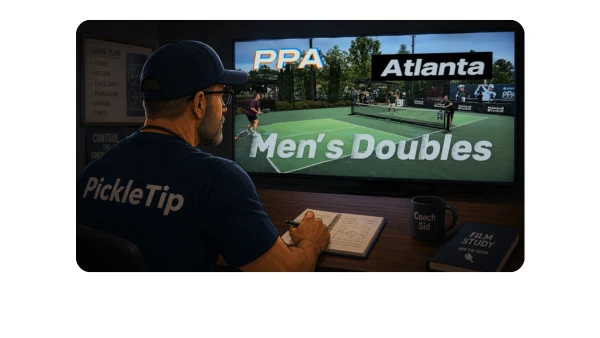
Watch the Match With a Coach’s Eye
Watch the match before you read the full breakdown if you can. The score tells one story. The patterns tell a better one.
Do not watch it like a fan. Watch it like a scout.
The 11-0 game is not the part that made me lean forward. The turn came later, when the losing team stopped feeding comfort balls and started making the better athletes play from uglier places.
The match starts changing right there. It stops being a highlight contest and turns into a decision test.
Coach Sid Film Study Note
The point I kept coming back to was not always the winner or the final error. It was often the ball two shots before the mistake. That is where the leak usually starts. A bad speedup does not always look bad when it leaves the paddle. It looks bad when the counter comes back at your feet.
Film Study Snapshot
Film Study Snapshot
In this best of 3 match, one team won Game 1 by a pickle, 11-0. Then they lost Game 2, 11-5, and lost Game 3, 11-4. The lesson was not that their weapons disappeared. The lesson was that the other team adjusted.
Game 1 rewarded pressure, athleticism, fast hands, and early rhythm. Games 2 and 3 punished the moments when that same pressure turned into early attacks, low percentage speedups, and attempts to create offense before court position was earned.
- Game 1: Pressure landed first. Hands and aggression shaped the rally before the other team settled.
- Game 2: The other team stopped giving the same rhythm. They made the aggressive patterns less comfortable.
- Game 3: The match became less about who had the bigger weapons and more about who could make the better decision after the first plan stopped working.
Why You Lose After Winning Game 1 in Pickleball
Most players assume losing after winning the first game means they got lazy, tight, or overconfident. Sometimes that is true. But at higher levels, the more common reason is simpler:
The opponent adjusted before you did.
Game 1 shows what works when you get your preferred rhythm. Games 2 and 3 show what happens after the other team stops feeding that rhythm.
After Game 1, the other team does not need to become more talented. They only need to make your original winning patterns less comfortable.
- They stop giving the same speedup targets.
- They avoid speeding up into your best counter zone.
- They pull the aggressive left side player wider before attacking middle.
- They make the athletic player hit extra resets before giving pace.
- They extend rallies until impatience starts whispering bad ideas.
- They test whether your overheads actually finish points or merely restart them.
That is why losing after winning the first game can feel so confusing. The weapons are still there. The confidence is still there. The same shots that felt clean early are still available.
They just are not worth as much once the other team knows where they are coming from.
The Film Room Pattern I Kept Seeing
The match that sparked this article had a pattern I have seen many times in advanced doubles.
Early in the match, the aggressive team looked like it was playing downhill. They were first to speed. First to counter. First to take middle. First to make the other team feel rushed.
But after the other team adjusted, the aggressive shots did not vanish. They became less clean. That is the key difference.
The same player who looked dangerous in Game 1 started having to create offense from worse positions in Games 2 and 3. Instead of attacking from full balance at the kitchen line, the attack came from a half step off the line. Instead of speeding up a ball above the tape, the speedup came from near the tape or below it. Instead of taking middle and recovering shape, the movement started opening the next ball.
That is the film room lesson:
The shot that wins Game 1 can become the shot the opponent uses against you in Game 3.
When you watch your own film, do not just ask, “Did I make the shot?” Ask, “Was this shot still a good idea after the opponent adjusted?”
The Visible Mistake vs. The Real Mistake
One of the biggest reasons players do not improve from film study is that they study the wrong mistake.
The visible mistake is the ball everyone notices. The missed counter. The dink into the net. The overhead that comes back. The reset that sits up.
The real mistake usually happened earlier.
| Visible Mistake | Real Mistake | Better Coaching Question |
|---|---|---|
| You lost the hands battle. | You started the hands battle from a low or neutral ball. | Did this speedup actually deserve speed? |
| Your reset floated high. | You attacked from transition first, then had to reset under more pressure. | Could I have neutralized the ball before the court got ugly? |
| Your partner got exposed in the middle. | You hunted too far without recovering shape. | Did my pressure create offense or create a hole? |
| You missed the 14th dink. | You let impatience choose the shot after a long rally. | Did I lose the rally because of skill, or because I got bored? |
| Your overhead did not finish. | You hit hard to a survivable location. | Did I attack the defender’s next step, or just the ball? |
Coach Sid Note
When you review film, rewind two shots before the error. That is usually where the point started leaking.
The Scoreboard Can Lie
A pickleball score tells you who handled that game better. It does not always tell you whether your habits scale.
A player can win 11-0 and still show flaws that better opponents will punish. That sounds strange until you start watching film with the pro standard in mind.
A reset that floats a little high may survive against one team. Against a sharper team, it gets crushed.
A low speedup may win against slower hands. Against a clean counter puncher, it comes back faster than it left.
A safe overhead may be enough against average defenders. Against high level defenders, it just gives them one more chance to reset the point.
An athletic scramble may look like a superpower. But film might show the player only needed to scramble because of a poor decision two shots earlier.
Average players study losses. Serious players study wins. Because wins often hide the habits that lose later.
There is the uncomfortable part. The scoreboard can flatter you. Film does not care about your feelings. Film sits there like a mirror and says, “Let’s see what actually happened.”
Game 1 Showed the Weapons
In the first game of this best of 3, the dominant team had the better early rhythm. Their weapons showed up fast.
The advanced athletic player profile usually looks something like this:
- Fast hands at the kitchen: Comfortable in firefights and willing to counter under pressure.
- Aggressive left side presence: Takes space, hunts middle balls, and looks to create offense.
- Scramble ability: Can dig out tough balls and force opponents to hit one more shot.
- Pressure instincts: Does not wait around for permission to attack.
- Erne awareness: Reads wide dink patterns and looks for chances to punish lazy crosscourt balls.
- Confidence: Plays like they expect to win the exchange.
Those are real weapons. They should not be minimized.
If you are an advanced player with this style, do not let anyone coach the personality out of your game. You need your edge. You need your confidence. You need your ability to make opponents feel rushed.
But here is the pickle juice in the wound:
The same tools that win Game 1 can become the exact targets opponents use against you in Games 2 and 3.
Then the Other Team Started Solving the Puzzle
In Game 1, weapons can overwhelm. In Game 2, the opponent starts asking better questions.
That is why I love best of 3 for film study. One game can lie to you. A full match starts telling on people.
After getting pickled, smart opponents usually stop feeding the same comfortable patterns. They start testing different parts of the court and different parts of the player’s patience.
They may stop speeding up directly into the player’s best counter zone. They may pull the aggressive left side player wider before attacking middle. They may make the athletic player hit extra resets instead of giving rhythm pace. They may extend dink rallies past the point where impatience starts whispering bad ideas.
The match changes when the free rhythm disappears.
Game 1 asks, “Who has the bigger weapons?”
Games 2 and 3 ask, “Whose weapons still work after the other team knows what is coming?”
Advanced players often win the first game with tools. Pros win the later games with adjustments.
The Game 2 Adjustment
After getting pickled, smart opponents usually stop donating rhythm. They change speed, location, and patience. They make the aggressive player prove he can reset, dink, and wait without forcing offense from a bad spot. That is when the first game weapon becomes a third game question.
What Changed After Game 1
The match did not flip because the better shots vanished. It flipped because the other team stopped feeding the same comfortable meal. That is the part advanced players have to study, because the adjustment is usually quieter than the highlight.
| Game 1 Pattern | Opponent Adjustment | Result in Games 2 and 3 | Better Response |
|---|---|---|---|
| Fast hands won early exchanges. | The other team became more selective about when and where they sped the ball up. | The clean counter windows became less automatic. | Use pressure dinks and patient positioning to create better attack windows instead of chasing speed. |
| Left side pressure controlled the middle. | The opponents stretched the aggressive player wider and tested the space created by that movement. | Taking space became riskier when the next ball exposed the open court. | Take middle with purpose, but recover shape before hunting the next ball. |
| Athletic recovery covered mistakes. | The opponents made the athletic player hit extra resets and defend one more ball. | Scramble ability started masking earlier shot selection leaks. | Prevent the emergency sooner with better reset choices and cleaner court position. |
| Early aggression created scoreboard pressure. | The other team extended rallies and waited for a forced attack. | Impatience became more expensive as points got longer. | Treat long rallies as a test of discipline, not as proof that you need to force something. |
| Overheads and pressure balls created panic. | The defenders made the attacking team finish more precisely. | Safe power sometimes restarted the rally instead of ending it. | Finish with geometry: angle, seam, feet, and recovery path, not just noise. |
What to Do Between Game 1 and Game 2
This is where a lot of matches are lost.
Most players win Game 1 and spend the break feeling good. That is normal. But if you won big, the other team is probably using the break to solve you. You should use the same break to protect yourself from the adjustment.
Do not walk into Game 2 assuming the same pattern will keep feeding you points. Assume the opposite.
The 60 Second Between-Game Checklist
- Name what won Game 1. Was it speedups? Left side pressure? Counters? Overheads? Third shot pressure? A weak return target?
- Assume they will take it away. If they are smart, they will stop feeding your favorite pattern.
- Name your second pattern. If they stop speeding up to your hands, how will you create offense? If they stretch you wide, how will you recover middle?
- Watch the first three rallies. Do not wait until 0-5 to admit the match changed.
- If you lose two points the same way, call it a pattern. Do not call it unlucky.
Game 2 Rule
Winning Game 1 proves your first plan worked. It does not prove your first plan will keep working.
What to Say to Your Partner
Keep it simple. Between games is not the time for a TED Talk with paddles.
- “They are going to stop feeding our counters. Let’s build with pressure dinks first.”
- “If they pull me wide, I am recovering middle before hunting again.”
- “No low speedups for the first few rallies. Make them prove they can dink with us.”
- “If we get caught in transition, reset first. Earn the line.”
- “Let’s watch for their first adjustment before we chase highlights.”
That is how you turn a good first game into a better match plan.
The Advanced Player Trap
The advanced player trap is simple:
You become good enough to win with shots that are not quite good enough to survive the next level.
That is a sneaky little swamp.
At 4.0, your speedup from slightly below the tape may work. At 4.5, it may still win because your hands are faster than the other player’s hands. At 5.0, it may work just often enough to keep tempting you.
But against true pro level discipline, that same speedup is not offense. It is a donation.
Same with transition attacks. Same with loose overheads. Same with impatient dinks. Same with relying on athletic recovery instead of preventing the emergency in the first place.
A lot of advanced players stall right here. They do not need more weapons first. They need better shot rules.
Most players think the next jump means hitting harder, moving faster, or winning louder. Usually, it means cutting out the few moments where your best weapons start working for the other team.
The 5.0 Trap Self-Diagnosis Table
Use this after a match, during film review, or between games when something that worked early suddenly stops working.
| If This Happened | Your Likely Leak | Your Next Correction |
|---|---|---|
| You won Game 1 with counters, then the counters disappeared. | The opponent stopped feeding your speed zone. | Create offense with pressure dinks, location, and patience before expecting another hands battle. |
| You started attacking from transition. | You were trying to recreate Game 1 pressure before earning court position. | Reset until established. Earn the kitchen before you start a fight. |
| You lost longer dink rallies. | Your patience broke before your skill did. | Train shot 14 discipline. Do not let boredom choose the shot. |
| Your overheads stopped ending points. | You hit hard but not to bad recovery spots. | Finish with geometry: feet, seam, angle, open court, or recovery path. |
| You kept scrambling and making athletic saves. | Your athleticism was covering earlier decision leaks. | Study the ball before the scramble. Prevent the emergency sooner. |
| Your left side pressure started opening the court. | You hunted the ball without recovering shape. | Take middle with purpose, then reset your court position before hunting again. |
| Your low speedups got countered. | You treated a red or yellow light ball like a green light ball. | Call the color before contact. Red resets, yellow pressures, green attacks. |
Coach Sid Note
The goal is not to blame yourself for every lost point. The goal is to find the repeatable leak. A pattern you can name is a pattern you can train.
Four Questions Before You Pull the Trigger
Before you attack, speed up, counter hard, or try to turn a neutral rally into a barn fire, ask four questions.
1. Am I Actually Established?
Are you established at the non volley zone line, or are you still earning your way there?
If you are more than a step or two off the kitchen line, your offensive menu gets smaller. That does not mean you can never attack from transition, but it does mean the burden of proof gets much higher.
2. Is the Ball Actually High Enough?
Is the ball above the net tape at a usable contact point?
Not just barely floating. Not “I think I can roll this if I do something weird with my wrist.” Actually attackable.
Below the tape is usually a red light. Near the tape is usually yellow. Above the tape with your body in position can be green.
3. Are My Feet Quiet Enough?
Are your feet quiet enough to support the shot? Is contact in front of your body?
A ball can be above the tape and still be a bad attack if you are reaching, leaning, falling, late, or contacting beside your hip.
4. Did the Opponent Invite This, or Am I Just Bored?
Are you attacking because the opponent gave you a reason, or because you are tired of being patient?
This question catches more strong players than they want to admit.
Sometimes the ball is not attackable. You are just bored. Or frustrated. Or annoyed that the rally has gone 12 shots and nobody has done anything dramatic enough for your inner squirrel brain.
That is not a green light. That is impatience wearing sunglasses.
Attack Checklist
A green light attack needs four things working together: court position, ball height, body balance, and opponent vulnerability. If one of those is missing, you may still have pressure, but you probably do not have a clean attack.
Mistake 1: Attacking While Still on Defense
This is the big one.
Advanced players hate giving up the attack. When they get caught in transition or pulled a step off the line, they often try to punch, roll, or drive their way out of trouble.
Sometimes it works. And that is exactly why it becomes dangerous.
When it works often enough, the player starts believing it is a reliable pattern instead of a matchup dependent escape hatch.
The Advanced Thought
“I can do something with this ball.”
The Pro Thought
“I am not established. This ball must be neutralized first.”
That tiny thought change moves mountains.
Pros treat the transition zone like a place to remove danger, not create unnecessary hero shots. When they are off balance, stretched, or late, they do not need to win the rally right now. They need to make the next ball less dangerous.
That is the reset doing its real job.
A good reset does not just land in the kitchen. It lands in the kitchen in a way that prevents the opponent from attacking downward. If your reset bounces high enough for the opponent to pounce, it was not really a reset. It was a polite invitation to be punished.
Coach Sid Note
If your feet are not established, your ego does not get to call the play. Your feet do.
The Two Step Rule
Here is a simple rule for advanced players:
If you are more than roughly two feet behind the kitchen line, your first job is to reset unless the ball is clearly attackable.
Not forever. Just until you earn your way back.
The best players are not allergic to defense. They use defense as a bridge back to offense.
How to Use This in Your Next Game
For one full game, give yourself this rule: if both feet are not clearly established near the kitchen line, you do not get to start a speed battle unless the ball is obviously above the tape and in front of your body.
This will feel restrictive at first. That is the point. You are training your decision filter, not trying to win a highlight contest.
Mistake 2: Speeding Up Balls Below the Net
Fast handed players love speedups. I get it. Speedups are fun. They make noise. They create chaos. They let you feel like the conductor of a tiny plastic orchestra.
But advanced players often speed up balls that are not ready to be sped up.
The most common version is the low roll attack from below the net tape. The player thinks, “I can shape this.” Maybe he can. But the question is not whether he can get it over the net.
The question is:
What happens if the opponent handles it cleanly?
At lower levels, a low speedup may surprise people. At higher levels, it often gives a clean counter target.
Pro players are not shocked by speed. They are waiting for poor speed.
Use Red, Yellow, and Green Lights
Here is the stoplight version:
- Red light: Ball is below the tape, contact is late, feet are moving, or you are stretched. Dink or reset.
- Yellow light: Ball is near net height, you are balanced, but the opponent is not in real trouble. Use a pressure dink, roll with margin, or move the ball to create the next chance.
- Green light: Ball is above the tape, contact is in front, feet are stable, and the opponent is late, leaning, or exposed. Attack with purpose.
The yellow light is the missing category for a lot of advanced players. They treat every ball as either attack or do nothing.
That is too crude.
Yellow light pickleball is where high level pressure is built. You may not attack yet, but you can make the next ball worse.
Pressure is when your shot makes the next ball worse. Panic is when your shot only tries to end the point now.
How to Use This in Your Next Game
Pick one rally cue: “Call the color.”
You do not have to say it out loud during a real match, although doing it in practice helps. Before you speed up, mentally call the ball red, yellow, or green. If you cannot call it green quickly, you probably do not have a clean attack.
Mistake 3: Winning the First 8 Shots, Losing the 14th
This is one of the clearest differences between advanced players and pro level players.
A strong 5.0 player may look elite for the first several shots of a rally. The hands are sharp. The dinks are heavy. The movement is clean. The counters are confident.
Then the rally keeps going.
Shot 9. Shot 10. Shot 11. Shot 12.
Now the paddle face starts opening. The feet get a little louder. The dink floats six inches higher. The player gets tired of the grind and decides to “make something happen.”
Congratulations. The opponent just waited you into a mistake.
Pros are not just better on the first dink. Their fifteenth dink looks like their first.
That is the standard.
Shot 14 Has a Way of Telling the Truth
Long rallies are not proof that you failed to attack. Long rallies are often the price of playing against people who do not hand you cheap points.
Advanced players sometimes feel like a long dink rally means they are being too passive. That is not always true.
Sometimes patience is not passive. Sometimes patience is the pressure.
The player who can make the same disciplined decision on shot 14 that they made on shot 4 is hard to beat.
How to Use This in Your Next Game
When a rally gets long, do not think, “I need to end this.” Think, “This is where they want me to blink.”
That one thought can save you from forcing a low percentage attack just because the rally has lasted longer than your patience wanted.
Mistake 4: Safe Overheads That Restart the Point
Not all overheads are equal.
Some overheads end the point. Some overheads merely make a loud sound and give good defenders another chance.
At lower levels, power alone can finish. At higher levels, defenders reset better, move better, and make you hit one more ball. If your overhead is safe but predictable, it may not be a finish. It may just be a restart with extra noise.
Better Overheads Ask Better Questions
Instead of thinking, “Can I hit this hard?” ask:
- Can I hit the open court?
- Can I attack the feet?
- Can I split the seam?
- Can I move the defender before finishing?
- Can I make the recovery path impossible?
Good overheads are not just strong. They are rude to the defender’s next step.
How to Use This in Your Next Game
Before your next overhead, pick a target that makes the defender move badly. Feet, seam, angle, or open court. Do not just hit the ball hard to the middle of a good defender’s comfort zone and then act shocked when it comes back.
When Your Superpower Becomes Your Leak
Every strong player has something that makes them dangerous. The problem is not the superpower. The problem is when that superpower starts making decisions without permission.
| Superpower | Why It Wins Points | How It Becomes a Leak |
|---|---|---|
| Fast hands | You can win firefights most players lose. | You invite speed battles from poor positions. |
| Athletic scrambling | You recover balls most players miss. | You rely on recovery instead of preventing the scramble. |
| Aggression | You pressure opponents before they settle. | You attack neutral balls that did not deserve violence. |
| Left side presence | You control middle and create offense. | You overreach and open space behind your movement. |
| Erne hunting | You punish predictable wide dinks. | You leave too early and expose the middle or line. |
| Two handed counter | You stabilize against shoulder and body attacks. | You over swing instead of staying compact. |
You do not remove the superpower. You put a governor on it.
Advanced players need weapons. The next level demands weapons with rules.
The Pro Standard Is Boring Until It Is Not
This is one of the strangest things about watching top players.
They may look patient to the point of being boring. Then, in one blink, they are violent.
Advanced players often reverse that pattern. They get violent too early, then patient only after they are already in trouble.
That is backwards.
Pro level pickleball is not passive. It is selective. The best players do not refuse offense. They refuse fake offense.
They know the difference between a ball they can attack and a ball they should use to create the next attack.
The jump is not more chaos. It is better timing.
Pro Level Aggression
Better players are not less dangerous. They are less random. They wait longer, disguise better, attack cleaner balls, and make opponents feel pressure before the ball ever gets sped up.
Court Cues You Can Actually Remember Mid-Rally
Good coaching has to survive the noise of a real rally. If the advice only works while you are sitting on the couch reading it, it is not useful enough.
Use these short cues during games and drills:
- Earn the kitchen before you start a fight.
- Yellow means pressure, not panic.
- Make the next ball worse.
- Do not let boredom choose the shot.
- Win the point two balls before the winner.
- If they stopped feeding your counter, build the point another way.
- Feet first. Hands second.
- If the ball is below the tape, your ego sits down.
- Finish with geometry, not noise.
Pick one cue before a game. Not five. One. Give your brain a job simple enough to remember when the ball starts moving fast.
Coach Sid’s Rules for Escaping the 5.0 Trap
- If your feet are still earning the kitchen line, reset before you attack.
- If the ball is below the net, your hands do not get to vote yet.
- If the opponent is balanced and waiting, speed is probably not surprise.
- If the rally gets long, do not let boredom choose the shot.
- If your overhead does not break the recovery path, it may only restart the point.
- If you won Game 1 easily, expect the other team to stop feeding your favorite pattern.
Drills That Make the Trap Uncomfortable
You do not fix this by reading about it once and nodding like a wise little pickleball owl. You fix it by building a drill for the exact moments where your weapons usually get impatient.
1. The Three Reset Entry Drill
Purpose: Teach your body that earning the kitchen line is not weakness. It is how you rebuild offense.
Setup: One player starts in the transition zone, roughly halfway between the baseline and kitchen. The feeder stands at the kitchen line with a basket or a steady supply of balls.
Feeder job: Attack or press balls toward the player’s feet, hips, and body. Do not feed perfect floaters. Make the player uncomfortable.
Player job: Land three unattackable resets into the kitchen before moving forward. The reset should bounce low enough that the feeder cannot attack downward.
Scoring: Player earns 1 point after three quality resets and a successful move to the kitchen line. Feeder earns 1 point if the player attacks too early, pops the reset up, or rushes forward behind a bad reset. Play to 7.
Progression: Start with cooperative feeds. Then increase pace. Then allow the feeder to attack any reset that sits too high.
Common failure: The player resets once and rushes forward behind a ball that is still attackable.
Coaching cue: “Do not move because the ball crossed the net. Move because the ball made you safe.”
2. The Red, Yellow, Green Speedup Drill
Purpose: Train recognition before reaction.
Setup: Both players start at the kitchen line. One player feeds dinks at different heights and locations. The hitter must classify the ball before choosing the shot.
Feeder job: Mix low dinks, near-net-height balls, and attackable balls. Keep the feed realistic.
Player job: Call “red,” “yellow,” or “green” before contact. Red means dink or reset. Yellow means pressure with margin. Green means attack with purpose.
Scoring: If the player attacks a red ball, automatic loss of point. If the player dinks a green ball with no purpose, replay. If the player makes the correct decision and wins or improves the rally, point for the player. Play to 11.
Progression: First call the color out loud. Then call it silently. Then play live points where either player can attack only after calling green.
Common failure: Treating yellow balls like green balls because the player wants to feel aggressive.
Coaching cue: “Yellow means pressure, not panic.”
3. The Shot 14 Drill
Purpose: Teach patience without becoming passive.
Setup: Two players dink crosscourt. Start cooperative, then gradually increase pressure.
Player job: Neither player may speed up until at least the 14th ball of the rally. If the 14th ball is not attackable, keep dinking until a real green light appears.
Scoring: If a player attacks before ball 14, automatic loss of point. If a player attacks after ball 14 from a red or yellow ball, loss of point. If a player waits for a true green light and wins the rally, 2 points.
Progression: Start crosscourt only. Then play full kitchen. Then allow one player to speed up after 10 balls while the other must wait until 14. That trains both patience and defense.
Common failure: Players count to 14 and then attack the next ball no matter what.
Coaching cue: “Shot 14 gives you permission to attack only if the ball does too.”
4. The Overhead Finish Drill
Purpose: Replace loud overheads with useful overheads.
Setup: One player feeds lobs or pop-ups. The attacking player starts near the kitchen line. A defender starts deep and tries to reset or survive.
Player job: Finish with location: angle, seam, feet, open court, or a ball that makes the recovery path impossible.
Scoring: Raw power does not count unless the point is actually over. Attacker earns 1 point for a true finish. Defender earns 1 point if they reset the overhead or force another neutral ball.
Progression: Start with easy overheads. Then make the feeder vary height and depth. Then add two defenders and require the attacker to choose the better target.
Common failure: Hitting hard to the middle of a defender’s body and calling it a good overhead because it sounded impressive.
Coaching cue: “Finish the defender’s next step, not just the ball.”
5. The Game 2 Adjustment Drill
Purpose: Teach the most important match lesson: winning one game does not mean the matchup is solved.
Setup: Play one normal game to 11. After the game, both teams take 60 seconds to discuss what happened.
Losing team job: Name one pattern they will stop feeding and one pattern they will test.
Winning team job: Name what won Game 1 and what they will do if the opponent takes it away.
Scoring: Play Game 2. After the game, each team must identify whether their adjustment worked. Bonus point for the team that correctly names the other team’s adjustment.
Progression: Play best 2 out of 3. The team that loses Game 1 must make a clear Game 2 adjustment. The team that wins Game 1 must make a counter-adjustment by the first timeout or at 6 points, whichever comes first.
Common failure: The winning team assumes Game 1 solved the match and waits too long to notice the adjustment.
Coaching cue: “If you lose two points the same way, stop calling it unlucky.”
Questions to Ask When the Film Starts Telling on You
When you watch your own match, do not just clip the winners. Study the points that reveal whether your habits hold up.
- Did I attack because the ball was attackable, or because I was tired of dinking?
- Was I established at the kitchen line before I sped up?
- Did my reset actually reset the point, or did it sit up for the next attack?
- When I lost a firefight, was the real mistake the counter, or the poor speedup that started the firefight?
- Did my overhead end the point, or did it give good defenders another chance?
- Did I win Game 1 because my habits were excellent, or because the other team had not adjusted yet?
- By Game 3, was I still choosing shots with discipline, or was I trying to force the match back to how it felt in Game 1?
- If I scrambled three times in one rally, what decision created the first scramble?
- Did my aggression make the opponent uncomfortable, or did it make me predictable?
- What pattern would a smart opponent take away from me in Game 2?
Those questions are not always comfortable. Good. Comfortable film study is usually just a highlight reel with better posture.
How to Turn Advanced Weapons Into Pro Level Habits
The answer is not to become less aggressive.
Please do not read this article and turn yourself into a scared dink statue. That is not the point. If you have fast hands, use them. If you can take over the middle, take it. If you can counter with authority, keep that weapon sharp.
But every weapon needs rules.
To move from advanced to pro level habits, you need to make these upgrades:
- From reaction to recognition: See the attack window before swinging.
- From pace to pressure: Make the next ball worse instead of trying to end every point now.
- From scramble to prevention: Use better shot selection so you do not need miracle defense as often.
- From safe finishing to clinical finishing: End overhead chances with location, not just force.
- From Game 1 confidence to match discipline: Expect opponents to adjust and be ready with a second plan.
The best version of your game is not quieter. It is cleaner.
Related PickleTip Guides
Use this section to link to your related PickleTip articles on advanced shot selection, transition zone resets, speedups, dinking strategy, and how to watch pickleball film.
- Pickleball Transition Zone: How to Move, Stop, and Earn the Kitchen
- When to Speed Up the Ball in Pickleball
- Pickleball Dinking Strategy for Better Players
- Pickleball Shot Selection: When to Attack, Reset, or Wait
The First Game Showed the Tools. The Match Showed the Truth.
Winning Game 1 big does not always mean your game is clean. Sometimes it means your weapons landed before the opponent had time to adjust.
The real test comes after the adjustment.
Can you reset when you are not established?
Can you pass on the low speedup?
Can you let a yellow light ball be a pressure ball instead of forcing it to become a winner?
Can your fifteenth dink look like your first?
Can your overhead end the point instead of restarting it?
Can you keep the weapon while tightening the rules?
That is the 5.0 Trap. You become good enough to win with shots that are almost good enough. Then better opponents make you prove whether those shots are real.
Game 1 showed the weapons.
Games 2 and 3 showed the truth.
And the truth is useful, if you are willing to watch the film without letting the scoreboard flatter you.