How to Choose a Pickleball Coach: What Good Coaching Looks Like
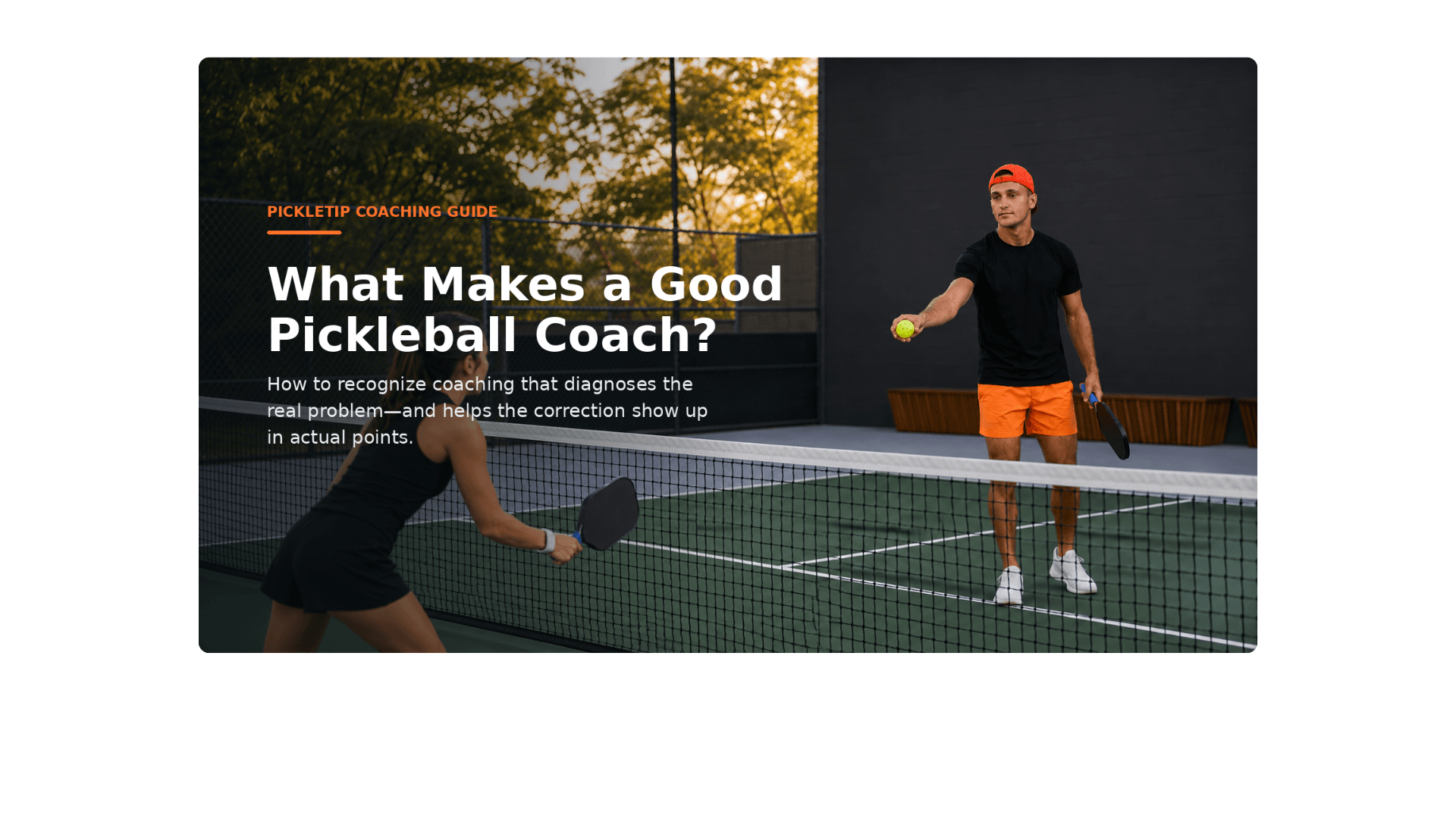
A good pickleball coach should do more than feed balls and tell you where to stand. The coach should watch before correcting, identify the problem costing you points, explain the correction in a way you can use, connect practice to the rally that exposed it, and help you become less dependent on coaching over time.
Choose a coach based on observation, diagnosis, communication, adaptation, progression, and whether the correction eventually shows up in real points, not playing level, social following, or certification alone. The best lesson should change what you notice, not just what you hit.
Coach AJ’s Court-Side Answer
A useful coach sees what you cannot see on your own. The coach should watch before correcting, find the one problem worth fixing first, connect that correction to a real rally, and leave you with something specific to practice. If every lesson feels busy but the same decisions and errors keep returning, the coaching is not transferring.
I’m Sid’s son, so this is not a résumé-based opinion about coaching from a distance. Some of the earliest PickleTip diary entries are literally Sid writing down things I was teaching him while he learned the game. We worked through a different answer for certain backhand balls instead of forcing the same punch at every contact, a “seesaw” idea for a defensive situation, and Red Light Green Light for smash defense. I now coach players around the New Orleans area, but the principle has stayed the same: the correction has to fit the ball and situation in front of the player. What matters here is simple: can the instruction you are paying for help you understand the problem, change it, and recognize it later without the coach standing beside you?
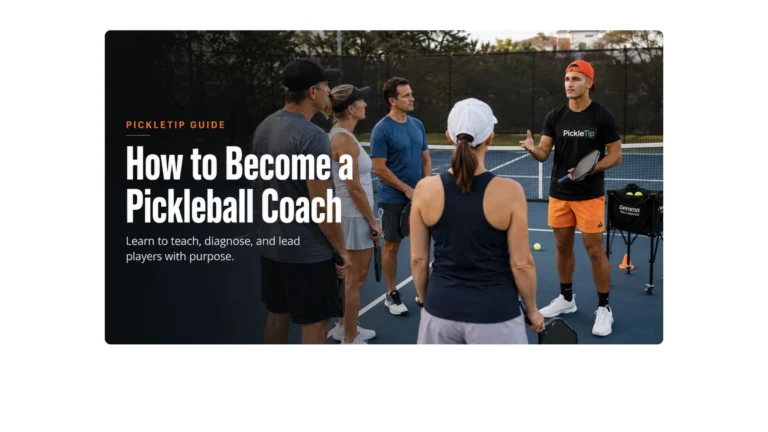
If you are deciding whether to hire, keep, or switch a coach, start with what happens on court. Watch how the coach diagnoses the problem, what happens when the first cue fails, and whether the correction eventually shows up in real points. If you want to teach pickleball yourself, use How to Become a Pickleball Coach.
What Does a Pickleball Coach Actually Do?
A coach has to do more than spot the miss. The real job is to find the cause, choose a correction that fits the player, and see whether that correction survives movement, decisions, and pressure.
- Diagnose the recurring error: Determine whether the problem is contact, movement, positioning, decision-making, partnership, confidence, or a misunderstanding of the rally pattern.
- Explain the cause: Help the player understand why the mistake happens instead of only naming the result.
- Choose the right correction: Match the drill and cue to the actual problem rather than assigning a familiar drill out of habit.
- Adjust the task: Change the feed, distance, pace, movement, or decision load so the player can learn without removing the problem entirely.
- Connect practice to points: Show which ball, position, or rally situation calls for the skill.
- Measure progress: Track a target, error pattern, decision, positioning habit, or live-point behavior.
- Build independence: Give the player a task they can repeat and evaluate without the coach standing beside them.
You do not need to think like a coach to know whether a lesson is helping. From the player’s side, you can watch for the evidence: does the coach find the cause, give you a correction you understand, and eventually make you solve the problem in something that looks more like a real point? For the deeper method behind a recurring failure, use ERROR. When the corrective exercise itself needs to be built or progressed, use DRILL. When the correction needs proof in unpredictable play, use Intentional Play.
One of the clearest patterns I see is that players often arrive describing the shot they miss, while the larger problem is the position, decision, or movement that came before it.
A common example is a player who believes the third-shot drop is the problem. The ball keeps landing short, so the obvious response is to feed more drops. But the real leak may be that the player is contacting the ball while drifting backward, squeezing the handle, or trying to drop a ball that should have been driven. More repetitions of the wrong diagnosis will only make the lesson busier.
A high-level player may understand the game deeply and still struggle to teach it. Playing ability can give a coach useful experience, but observation, communication, lesson design, and adaptability are separate skills.
Coach, Instructor, Trainer, or Mentor: What Actually Matters?
The labels are loose, and one person may fill several roles. What matters is what the person actually does once you step on court.
| Role | Typical emphasis |
|---|---|
| Pickleball instructor | Teaches a specific skill, lesson, or clinic topic |
| Pickleball coach | Diagnoses problems, plans progression, and tracks development |
| Pickleball trainer | Often emphasizes repetition, movement, conditioning, or structured sessions |
| Pickleball mentor | Provides longer-term perspective, accountability, and guidance |
Do not choose based on the title alone. Ask what happens during a normal lesson, how the coach decides what to fix first, and how progress is evaluated afterward.
Do You Need a Pickleball Coach?
A coach is most useful when the same problem keeps returning and you cannot see the cause clearly enough to solve it on your own.
Are Pickleball Lessons Worth It?
A lesson is worth paying for when you need another set of trained eyes. If you already know the problem, understand the correction, and only need repetitions, you may be better off spending that hour practicing. Coaching earns its value when it shortens the guessing: someone sees what you are missing, gives you a useful way to change it, and leaves you with a plan you can continue without paying for another hour of supervised repetitions.
Coaching may help when:
- The same mistake keeps returning.
- You know what went wrong but not why.
- A shot works in drills but disappears in games.
- You receive conflicting advice from videos or other players.
- You cannot see your positioning or movement pattern.
- Your partner communication keeps breaking down.
- You have plateaued despite purposeful practice.
- You are preparing for a tournament or moving into a stronger level of play.
- A physical limitation requires a safer or more realistic adaptation.
You may not need another lesson yet when:
- You already understand the correction and simply need repetitions.
- The real problem is finding a practice partner or court time.
- You have not practiced the assignment from the previous lesson.
- You are collecting new tips faster than you can test them.
- You need match footage before anyone can see the pattern clearly.
Sometimes the missing ingredient is not more instruction. It is repetitions, court time, a practice partner, or video showing whether the same mistake is still happening.
When the problem is already clear, use Pickleball Drills That Fix Your Game. When you need focused solo repetitions, use How to Practice Pickleball Alone.
Before booking a lesson, use this pickleball improvement framework to identify the repeated situation you want help diagnosing.
The PickleTip COACH Check
The title on a business card tells you very little. During the lesson, watch for these five things.
| Step | What good coaching looks like |
|---|---|
| C — Clarifies the real problem | Identifies whether the leak is contact, movement, position, decision, partnership, confidence, or misunderstanding of the point. |
| O — Observes before prescribing | Watches enough normal play or representative repetitions before changing mechanics. |
| A — Adapts the explanation | Changes the language, demonstration, feed, pace, or cue to fit the player. |
| C — Connects practice to the point | Shows when the correction belongs in a rally and gradually adds movement or shot selection. |
| H — Holds progress to a measure | Leaves the player with one priority, one cue, one task, one measure, and one next step. |
Clarify. Observe. Adapt. Connect. Hold to a measure.
A coach does not have to follow this exact order every minute. COACH is not a script for teaching a lesson; it is a way for the player to recognize whether the important pieces are present. It also cannot prove after one hour that every diagnosis was correct. What it can show is whether the coach has a process for observing, adjusting, testing, and measuring instead of simply keeping the basket moving.
A real example: I had a student who was adamant that she needed to dink better and kept asking to work on dinking drills. The problem was not really the dink. She could not reliably drop or reset her way into a dinking rally. More dinking practice was not going to fix the ball that came before it. That is the kind of distinction COACH is meant to reveal: clarify the actual leak before prescribing more repetitions.
How to Find a Good Pickleball Coach
Reputation may get a coach onto your list. What happens during the lesson should decide whether you return.
Where I’d Start Looking
- Local pickleball clubs, court facilities, and parks departments
- Recommendations from players whose games and judgment you respect
- Clinics, tournaments, and local pickleball groups where you can see coaches interact with players
- Regional coaching directories
- Online video-coaching services when in-person instruction is not practical
- Watching an instructor teach before you book
When possible, watch how the coach handles someone who is struggling. A polished demonstration is easy. The more revealing moment is what happens when the first explanation does not work.
Know the Problem You Want Help With
- Your current level and experience
- The problem you most want to solve
- How you learn best
- Physical limitations or injury history
- Private lesson, partner lesson, clinic, or video review
- Location and schedule
- Budget
- Tournament or recreational focus
A coach who is excellent with advanced tournament players may not be the best fit for a beginner who needs simple language, confidence, and dependable fundamentals. The reverse can also be true. A coach who teaches beginners well may not specialize in advanced doubles patterns, partner strategy, or tournament preparation.
How Much Does Certification Matter?
Certification can be a useful signal, but the organization and credential matter. As of August 2026, USA Pickleball identifies Pickleball Coaching International (PCI), Professional Pickleball Registry (PPR), and Racquet Sports Professionals Association (RSPA) as its official coach-education and certification partners. IPTPA operates a separate instructor-certification program. Requirements, assessments, memberships, insurance benefits, and renewal rules vary, so review what the specific credential actually teaches and evaluates.
Certification does not automatically prove that the coach communicates well, diagnoses accurately, adapts to different players, handles physical limitations safely, or helps corrections transfer into games.
Treat certification as one part of the decision. Combine it with observation, player referrals, coaching experience, lesson structure, safety, and evidence that the coach has a process beyond feeding balls and naming shots.
Certification organizations and partner relationships can change. These references were reviewed in August 2026. Verify current status and requirements directly before treating any credential as a hiring requirement.
Questions to Ask Before Booking a Lesson
- Who do you coach most often?
- How do you assess a new player?
- Will you watch normal points or representative patterns before correcting me?
- How do you decide what to work on first?
- How do you measure improvement?
- What should I practice after the lesson?
- Do you coach individuals, doubles partners, or teams?
- Can you adapt for mobility limits, previous injuries, or pain?
- Can I record part of the lesson for personal review?
- What should I bring?
The answers do not need to sound polished. They should reveal whether the coach observes, prioritizes, adapts, and has a plan for what happens after the lesson.
What Should Happen During a First Pickleball Lesson?
Anyone trying to fix your whole game in one lesson is probably giving you too much to carry. A useful first lesson should find the leak costing the most points and give you a clear place to begin.
- Goal discussion: What are you trying to improve, and where does the problem appear?
- Observation: The coach watches normal play or a representative pattern.
- Working diagnosis: The coach identifies the most plausible primary leak rather than correcting every visible flaw, and stays willing to revise that diagnosis if the player’s response does not support it.
- One prioritized correction: The lesson avoids changing several unrelated mechanics.
- Controlled practice: The player gets enough success to understand the correction.
- Movement or choice: The task becomes less predictable and more realistic.
- Lesson test: The correction is tested in a variable feed, scenario, conditioned point, or another task that restores some movement and choice.
- Practice assignment: The player receives a drill or intentional-play task.
- Measure: The player knows what improvement should look like.
- Next step: Repeat, progress, review video, schedule a follow-up, or address the next leak.
What this can look like in a lesson: One of my students kept hitting her third shot and charging forward even after the opponent had already started the fourth. Her eyes were on the kitchen line instead of the opponent’s paddle angle and the contact she was about to receive. We worked on landing a split step just before that contact. The goal was not to stop her from moving forward. It was to get her balanced enough to read whether the next ball had actually earned another step.
A predictable drill can make almost any correction look better for a few minutes. The real test begins when the feed changes, the player has to move, and the correct shot is no longer announced in advance.
Start simple enough to learn the correction. Then make the ball less cooperative. The deeper job of building and progressing that exercise belongs to the PickleTip DRILL framework. From your side of the net, the question is simpler: did the lesson eventually make you solve the problem instead of only repeat the answer?
Sometimes one lesson is enough to identify a useful working problem but not enough to know whether the correction will hold up. Match footage, purposeful practice, a follow-up session, or intentional live testing may be needed before either the coach or player has real evidence. Passing the test during the lesson is encouraging. Doing it later in a messy game is different.
Most bad lessons do not look disastrous. They look busy, encouraging, and organized. The problem becomes obvious when the same mistake returns and the player still does not understand why.
Red Flags When Choosing a Pickleball Coach
- The coach diagnoses the problem before watching enough of your normal play to see the pattern.
- Several unrelated mechanics are changed at once.
- Every player receives essentially the same lesson, feed, and cues.
- The coach cannot explain why the correction matters or adjust when the first explanation does not make sense.
- Success is measured only inside predictable feeds that never recreate the mistake from games.
- Playing level, reputation, or certification is presented as proof that the teaching must be good.
- The coach promises fast rating gains or keeps introducing new fixes before you have tested the last one.
- The lesson creates dependency, or pain, injury history, and movement limitations are ignored instead of adapted around.
One red flag does not always prove that someone is a poor coach. A repeated pattern matters more than one awkward lesson.
Private Lesson, Clinic, Partner Lesson, or Video Review?
| Format | Best for | Main limitation |
|---|---|---|
| Private lesson | Individual diagnosis, detailed feedback, and technical work | Higher cost and less live variety |
| Partner lesson | Doubles movement, communication, middle-ball ownership, and shared patterns | Attention is divided |
| Small clinic | Repetitions, patterns, variety, and social practice | Less personalization |
| Large clinic | Exposure to concepts and general instruction | Limited individual correction |
| Video review | Positioning, decisions, patterns, and match analysis | No immediate physical adjustment |
| Ongoing coaching | Progression, accountability, partner development, and long-term review | Requires commitment and a strong fit |
Choose the format that matches the problem. A private lesson is useful when you need individual observation, feedback, or a closer look at a recurring technical or decision problem. A partner lesson is often better for middle-ball ownership, synchronized movement, partner communication, and deciding which partner should handle a particular ball.
How Many Pickleball Lessons Do You Need?
Some players need one lesson. Others benefit from occasional check-ins or ongoing coaching. One lesson may be enough to identify a clear problem and give you a practice plan. A second lesson may be useful after you have tested the correction and can show what changed, or what did not.
Ongoing coaching makes more sense when you need a progression of skills, tournament preparation, partner work, accountability, repeated video review, or help adjusting the plan as your game changes. Paying for frequent lessons without practicing between them usually produces less value than taking fewer lessons and doing the assigned work.
What Affects the Cost of Pickleball Lessons?
Lesson prices vary by location, coach experience, facility fees, session length, group size, and whether the session includes video review or follow-up support. Compare more than the hourly price. A cheaper lesson that never identifies the problem can cost more in the long run than a focused lesson that leaves you with a clear practice plan.
How to Get More Value From a Pickleball Lesson
Before the lesson
- Bring one or two recurring problems, not a list of every weakness.
- Share relevant match video when possible, especially when the problem disappears during drills.
- State physical limitations, pain, goals, and any upcoming event that changes what you need from the session.
During the lesson
- Ask why the correction matters and which ball or situation calls for it.
- Repeat the cue in your own words and tell the coach when it does not make sense.
- Confirm what success should look like before the drill gets harder.
- Record notes or video when permitted.
After the lesson
- Practice the assigned task before collecting more advice.
- Track the measure you and the coach agreed on and test the skill during intentional play.
- Review video if the behavior disappears in games.
- Return with evidence, what changed, what did not, and where the problem still shows up.
How to Tell Whether Pickleball Coaching Is Working
A good drill can fool you. The correction may look clean while the feed is predictable and disappear as soon as the point becomes messy. The real test is whether the change begins showing up when nobody tells you which ball is coming.
What Should You Measure?
The measure should match the problem. Do not track successful third-shot drops if the real goal is choosing correctly between a drive, drop, and safer defensive ball. Do not count volleys made if the actual problem is standing too close to the kitchen line and getting jammed.
- How often the recurring error appears during live points
- Whether you recognize the situation sooner
- Whether the corrected movement appears without a reminder
- Whether your shot selection improves under variable feeds
- Whether you and your partner communicate before the mistake instead of discussing it afterward
- Whether the skill still works when pace, movement, or pressure increases
Lesson Success vs. Transfer Success
| Lesson success | Transfer success |
|---|---|
| You understand the problem. | You recognize the situation during points. |
| The contact or movement improves. | The corrected behavior appears under variable feeds. |
| The drill measure improves. | The recurring error happens less often. |
| The cue is clear and repeatable. | You need fewer reminders. |
| You can perform the correction predictably. | You make better decisions under pressure. |
Feeling better after a lesson is useful. Playing differently two weeks later is evidence.
When you are unsure whether the change is transferring, use FILM to compare practice with real points. When the skill needs a deliberate live test, use Intentional Play. The coach can help define what to watch for, but the evidence has to come from the game.
Should You Learn From Multiple Pickleball Coaches?
Different coaches may notice different problems or explain the same idea in a way that finally clicks. The danger begins when novelty replaces practice and several people start rebuilding the same shot at once.
| Potential benefit | Potential risk |
|---|---|
| A new explanation finally makes sense. | Conflicting cues create confusion. |
| A specialist sees a problem another coach missed. | You restart before testing the first correction. |
| You gain a different strategic perspective. | Novelty replaces repetition. |
| A fresh diagnosis challenges an assumption. | Several coaches change the same mechanic differently. |
Learn from as many good sources as you like. Just do not let three coaches rebuild the same stroke in three different ways during the same week.
When Should You Consider Switching Coaches?
Do not switch simply because one lesson felt difficult or a correction took time. Consider a change when the coach repeatedly misdiagnoses the problem, cannot explain the purpose of the work, ignores your feedback or physical limitations, gives every player the same lesson, or never tests whether the correction appears in real points.
You may also need a different coach when your goal changes. A beginner instructor who helped build your fundamentals may not be the right specialist for advanced doubles patterns, tournament preparation, partner communication, or match-video analysis.
A Good Coach Should Help You Find Better Practice
A coach cannot be your permanent practice partner. A useful coach can, however, help you find players and practice situations that reinforce the work instead of sending you back into the same habits.
- Introduce players with compatible goals.
- Create practice groups around a shared lesson priority.
- Help partners work on movement, communication, and ball ownership together.
- Match the challenge level to the player.
- Encourage intentional recreational games without turning every point into unsolicited coaching.
Playing stronger opponents can expose weaknesses, but stronger competition does not automatically teach the correction. Challenge is most useful when you know what to watch for and what behavior you are trying to change.
Your Coach Should Be Learning Too
Your feedback is part of the lesson. If a cue does not make sense, a drill feels disconnected from the problem you actually see in games, or a physical limitation changes what you can do safely, the coach should adjust. The coach should be learning during the lesson too.
Pickleball Coach FAQ
Choose a coach who observes before prescribing, explains the problem clearly, adapts cues and tasks to you, connects practice to real rally situations, and gives you a specific way to measure progress. Certification, playing level, reputation, and referrals can help you build a shortlist, but the quality of the coaching process should decide whether you return.
A private lesson is usually better for individual observation, diagnosis, and detailed correction. A clinic may be better for repetitions, variety, lower cost, and learning a general pattern. Partner lessons are especially useful for doubles movement and communication. Choose the format based on the problem you are trying to solve.
Some players need one lesson. Others benefit from occasional check-ins or ongoing coaching. One lesson may identify a clear issue and practice plan, while a follow-up can test what changed after practice. Ongoing coaching is more useful for progression, accountability, partner work, tournament preparation, or repeated match review.
Not every setting has the same requirement. Certification can show that a coach completed a training or assessment process, but it does not guarantee communication skill, accurate diagnosis, player fit, safety judgment, or measurable results. Treat it as one useful signal and verify any facility or program requirements that apply where you play.
No. Strong playing ability can provide useful experience, but coaching also requires observation, communication, adaptable explanations, lesson design, and the ability to help a player connect a correction to real points. A great player may be a great coach, but the rating alone does not prove it.
Look beyond how the drill feels during the lesson. You should understand the problem more clearly, know what to practice, recognize the relevant situation sooner, and begin using the correction with fewer reminders during variable feeds or real points. Feeling better after a lesson is useful; changing how you play later is stronger evidence.
Bring your paddle, court shoes, water, and any equipment requested by the coach. Also bring one or two recurring problems, relevant match video when available, and information about pain, injuries, mobility limits, or other factors that could affect the session.
Consider switching when the coach repeatedly diagnoses before observing, cannot explain the purpose of the work, ignores your feedback or physical limitations, gives every player the same lesson, or never checks whether the correction appears in real points. You may also need a different specialist when your goals change.
Choose a Coach Who Helps You Become Less Dependent
The right coach should make your game easier to understand. You should leave knowing what the real problem is, what to practice, what to measure, and which ball or rally situation calls for the correction.
A good coach does not try to remain the answer to every problem. The goal is to help you see more, make better decisions, and eventually correct more of your own mistakes.
I coach players in the New Orleans area through private and small-group pickleball lessons and instructional clinics. The test I care about most is whether you need me less over time. If you leave seeing the problem sooner, knowing what to practice, and making more of your own corrections in real points, the coaching is doing its job.
Interested in teaching rather than hiring an instructor? Read How to Become a Pickleball Coach.