OWL Paddle USAP Approval: Why the Roughness Test Was Waived
OWL paddles were not secretly illegal. Exact OWL models shown as approved in USA Pickleball’s current database are authorized for USA Pickleball-sanctioned play. The controversy is how that approval was reached and disclosed. Reporting based on an on-record response from USA Pickleball’s chief technical officer says the Acoustene surface could not be conventionally certified through the normal profilometer roughness procedure, the requirement was waived, and approval was provisional while a direct spin test was being developed. That test’s October 1, 2026 implementation date has now passed, making the promised reevaluation an immediate transparency question.
Article and source review: · Last documented exact-model database check: August 6, 2026 · Evidence: Official publications, attributed reporting, independent testing, private industry reporting, commentary from a competing certification organization, and my court experience answer different parts of this case.
What OWL Owners Need to Know
An exact OWL model currently approved in USA Pickleball’s live database is authorized for USA Pickleball-sanctioned play. The new spin-test implementation date does not, by itself, establish that an older model was retested, passed, failed, or lost approval. This October review did not locate a public OWL-specific decision explaining how the previously reported provisional approvals have been resolved. Check the exact model and the event’s current equipment requirements before competing.
The first time you hit against an OWL paddle, the sound gets your attention, or, more accurately, the lack of sound does.
I have played against OWL paddles and hit with OWL demo paddles at the Drew Brees Picklefest in New Orleans during each of the last two years. The carpet-like face feels and sounds wildly different from almost anything else I have tested. The Diadem Hush is the nearest sound-and-feel comparison I can make, although that is not a claim that the two paddles produce the same spin or followed the same approval path.
The ball leaves the face without the normal crack, yet it can still dive, jump, and move with enough spin to make you look twice. Against OWL, the missing crack can make the incoming shot feel almost disconnected from the ball movement that follows. When I hit the demos, the same contradiction was there in my hand: muted contact, then more spin and shape than the sound prepares you for.
My experience was event-demo use and play from the other side of the net, not controlled RPM testing. It helps explain why the paddle immediately feels unusual on court, but it cannot establish a spin measurement, certification result, or regulatory violation.
That contradiction is why players kept asking: How did a surface like that pass USA Pickleball’s roughness test?
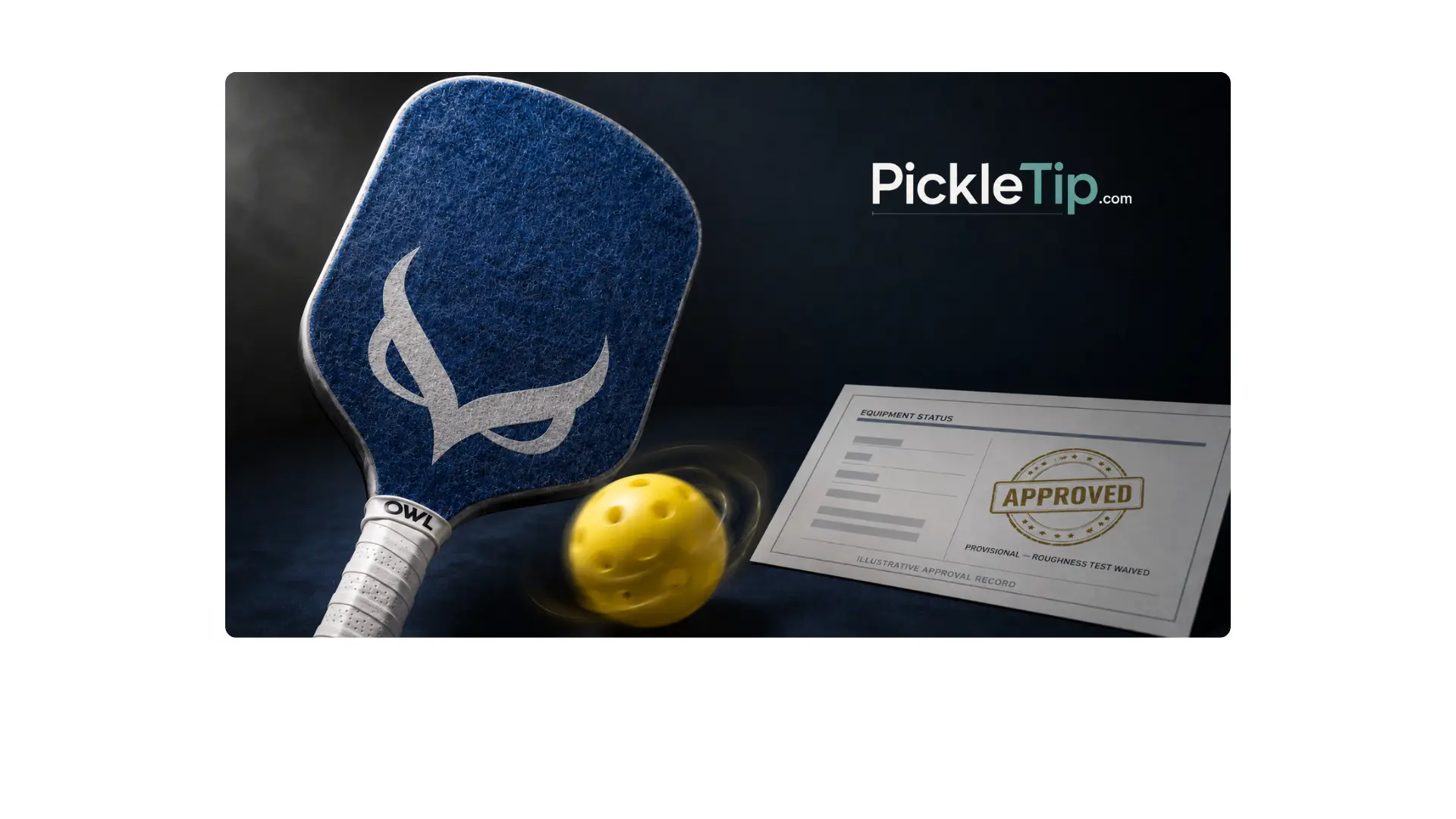
The answer is that OWL was approved, but it did not reach that status through the ordinary pathway players reasonably assumed. In Joseph Sutton’s July 13, 2026 reporting for Pickleball.com, USA Pickleball Chief Technical Officer Carl Schmits said OWL’s Acoustene surface could not be conventionally certified through the profilometer roughness procedure. USA Pickleball waived that requirement and granted provisional tournament approval while it continued developing a direct spin-rate test.
Provisional approval means a paddle may be used conditionally while a test, requirement, or future review remains unresolved. The real issue is not secret illegality. It is what the public approval label left out: the reported waiver, provisional condition, and expected future spin reevaluation.
🎧 Prefer listening? Hear a summary of Coach Sid’s take on the OWL paddle approval. The written article below includes the October 16, 2026 update; the audio may reflect an earlier version.
Are OWL Paddles Legal?
Yes, OWL paddles are legal for USA Pickleball-sanctioned tournament play when the exact model appears with approved status in USA Pickleball’s current database. The controversy over the roughness waiver does not, by itself, make an approved OWL paddle illegal. Approval is model-specific, so match the model, thickness, and version before competing. USA Pickleball approval does not automatically establish eligibility for events requiring UPA-A certification.
You can shop OWL paddles on the official OWL website. Before choosing a paddle for tournament use, check PickleTip’s searchable USA Pickleball Approved Paddle List and confirm the exact model’s current status in the official USA Pickleball equipment database near your event date.
Sutton’s reporting says USA Pickleball confirmed that:
- OWL’s Acoustene surface could not be conventionally certified with the normal profilometer roughness measurement.
- USA Pickleball waived that roughness requirement for the OWL lineup.
- OWL still completed other applicable testing, including coefficient-of-friction and PBCoR power testing.
- Tournament approval was provisional pending development of a direct spin-rate test.
- The provisional status and its conditions remained internal instead of appearing publicly.
| Question | Answer |
|---|---|
| Are currently approved OWL models authorized for USAP-sanctioned play? | Yes, subject to the exact model’s current status and event requirements |
| Did the Acoustene surface complete the conventional profilometer roughness process? | According to USAP’s response reported by Sutton, no |
| Was the roughness requirement waived? | According to USAP’s response reported by Sutton, yes |
| Was approval provisional? | According to USAP’s response reported by Sutton, yes |
| Was provisional status shown publicly at the time? | Sutton reported that it was not |
| Has the October 1 spin-test implementation date passed? | Yes; USAP’s published requirement applies to submissions beginning October 1, 2026 |
| Has this review located a public resolution for every existing OWL model? | No OWL-specific retesting decision or model-by-model resolution was located in the sources reviewed |
Historical status check: August 6, 2026. Multiple OWL models were displayed as “Pass” at that review. That is a dated observation, not a newly verified October database result. The live equipment database could not be retrieved during this update, so verify the exact model again before competition.
What the Evidence Supports, and Where It Stops
| Supported by the available evidence | Not established by the available evidence |
|---|---|
| OWL received different, provisional treatment, according to Sutton’s on-record reporting | That OWL paddles were illegally used in sanctioned tournaments |
| The conventional roughness requirement was waived | That USA Pickleball’s approval was fake or unauthorized |
| The condition was not visible on the public listing at the time of that reporting | That bribery, a payoff, or financial corruption occurred |
| Direct spin testing remained unresolved when provisional approval was granted | That OWL’s APP relationship caused the approval |
| No publicly explained waiver application process was identified in the reporting | That every unconventional paddle deserved identical treatment |
| The October 1 implementation date has passed | That every existing OWL model has since passed or failed the new test |
| UPA-A’s president has publicly criticized the OWL approval process | That a competing regulator’s criticism independently proves every allegation |
Different treatment is documented in Sutton’s reporting. Corruption is not.
OWL Paddle Approval and Testing Timeline
| When | What happened | Why it matters |
|---|---|---|
| November 14, 2023 | USA Pickleball announced OWL as its first certified Quiet Category product. The announcement described specification relief for products designed solely for non-sanctioned events. | Quiet Category recognition and tournament certification were separate questions from the beginning. |
| February 14, 2024 | OWL’s press release announced tournament certification and an APP paddle sponsorship together, describing the paddle as “100% USAP tournament play-approved.” | The public announcement did not identify the provisional condition later described in Sutton’s reporting. |
| Following approval | John Kew Pickleball measured one OWL CXE at 2,729 RPM when new and 2,851 RPM after accelerated wear, a 4.5% increase. | The question was not only how rough the surface felt, but what it produced after repeated impact. |
| Independent testing period | Kew tested one approved paddle from 42 brands with a Starrett profilometer and reported that 40 exceeded at least one published roughness criterion. | The result questioned whether the old physical limits could be reproduced or enforced consistently across the modern market. |
| July 8, 2026 | USA Pickleball published its October 1 implementation date and 2,100-RPM limit for new certification submissions. | The announcement also said certified paddles must meet the standards in effect when they were certified. |
| July 13, 2026 | Sutton reported USAP’s explanation that OWL’s roughness requirement had been waived and approval was provisional pending a direct spin test. | Players learned that “approved” did not necessarily mean the paddle completed the process they thought it had. |
| August 6–7, 2026 | PickleTip documented the approval questions, retained the exact-model eligibility distinction, and identified October implementation as a review trigger. | The article separated current authorization from unresolved future testing. |
| August 28, 2026 | UPA-A announced plans to publish official ADF and surface-roughness reference measurements beginning in 2027. | That is a proposed transparency improvement, separate from disclosing provisional approvals and exceptions. |
| October 1, 2026 | USAP’s published mandatory 2,100-RPM requirement reached its implementation date for new certification submissions. | The original reason for waiting on a direct spin test now requires a public explanation of what happens to OWL’s earlier provisional approvals. |
| October 16, 2026 | UPA-A President Jason Aspes published a critique calling for disclosure, new and broken-in OWL testing, independent review, and a joint certification standard. | The criticism brings renewed attention to the same transparency questions, while coming from the leader of a competing certification organization. |
| Unresolved in this October review | No public OWL-specific retesting decision or model-by-model resolution was located in the sources reviewed. | A general testing announcement is not the same as a published decision closing a provisional approval. |
Why OWL’s Acoustene Surface Raised Approval Questions
The OWL face does not feel like raw carbon fiber, coated grit, or the familiar texture left by peel-ply manufacturing. It feels closer to a thin carpet or dense felt.
Reducing pickleball noise is not a fake problem invented to sell paddles. Court noise has contributed to neighborhood disputes, operating restrictions, and fights over where courts can be built. A paddle that meaningfully reduces impact noise is useful technology.
The question is what happens on the other side of that quiet contact. Independent testing published by John Kew Pickleball gave players a measurable reason to look closer. One OWL CXE produced exceptional spin when new and gained another 4.5% after accelerated wear.
Kew’s independent RPM figures are not an official USA Pickleball result and cannot be dropped directly against USAP’s 2,100-RPM ceiling. Different equipment, impact conditions, balls, conditioning, and calculations can change absolute RPM readings. The clean finding is the controlled before-and-after comparison: the same tested CXE gained spin after accelerated wear.
How can one of the strangest and most spin-producing surfaces in pickleball remain approved while more conventional paddles are investigated or removed for exceeding physical roughness limits?
For more than two years, the visible answer was simple: OWL appeared on the approved list, so players assumed it had cleared the ordinary required process. Sutton’s reporting showed that assumption was incomplete.
Did OWL Pass the Conventional Profilometer Roughness Test?
Not in the ordinary sense. It would also be imprecise to say OWL simply failed the entire certification process.
A profilometer uses a small stylus to travel across the paddle face and measure peaks, valleys, and texture height. USA Pickleball historically used measurements such as Rz and Rt to limit how rough a paddle face could be.
That procedure was designed for surfaces the instrument could read conventionally. According to Schmits’s explanation reported by Sutton, Acoustene presented a different problem.
Rather than rejecting the paddle because the existing tool could not properly evaluate it, USA Pickleball waived the conventional roughness requirement. Sutton reported that OWL still completed applicable coefficient-of-friction and PBCoR power testing.
- OWL did not complete the normal roughness certification pathway.
- OWL did not fail every surface-related or performance test.
- USA Pickleball created an alternative path around a requirement its existing instrument could not apply.
A standards body should not reject useful technology simply because its existing test was built for a different kind of surface. The exception itself is not necessarily the problem.
The Exception May Have Made Sense. Keeping It Quiet Did Not.
USA Pickleball had a legitimate technical problem. OWL developed a surface unlike anything on the existing approved list, and the technology could potentially help pickleball coexist with nearby homes, community boards, and municipalities.
The original November 2023 Quiet Category announcement explicitly provided specification relief for products designed solely for non-sanctioned events. That history matters: the later competition approval was a separate step, not an automatic consequence of being quiet.
USA Pickleball could have rejected the paddle, restricted it to non-sanctioned Quiet Category play, approved it without resolving spin, or created a temporary pathway while building a better performance test.
Temporarily approving OWL until a direct spin test existed could have been a responsible call. It allowed the technology to be evaluated without forcing an unusual surface into a test that could not properly characterize it.
The public record, however, showed ordinary approval. OWL’s FAQ described its paddles as USA Pickleball certified and approved for sanctioned tournament and league play. Its February 14, 2024 competition announcement presented tournament certification alongside an APP sponsorship without explaining a provisional condition.
What players and manufacturers could not see was:
- the conventional roughness requirement had been waived,
- approval was provisional,
- direct spin testing remained unresolved,
- and reevaluation was expected after USA Pickleball completed its new spin test.
According to Schmits’s response quoted by Sutton, that provisional information remained internal until USA Pickleball was ready to disclose it.
A player looking at two identically labeled approved paddles had no reason to know that one completed the ordinary pathway while another received a waiver and future-test condition. A competing manufacturer reading the published standards could not tell whether that same option was available for another unconventional surface.
An older Reddit discussion illustrates the confusion. A player received an OWL marked with the Quiet logo instead of the ordinary approval mark and wondered whether a tournament director would accept it. Reddit is not certification evidence, but the discussion shows that the public-facing information did not answer a basic equipment question cleanly.
Coach Sid’s take: Giving an unusual paddle a temporary path was not necessarily unfair. Giving it that path without showing the waiver, condition, or review date on the public listing was the problem.
You should not need an insider, a two-year investigation, and an on-record exchange with USA Pickleball’s CTO to understand the conditions attached to an approval stamp.
Could Another Manufacturer Have Requested the Same Alternative Path?
An unpublished exception leaves other manufacturers unable to tell whether the same option is available to them.
Manufacturers were working from published surface-roughness requirements. Some designed around those limits. Some changed their surfaces to obtain approval. Others moved performance paddles toward UPA-A because their surfaces could exceed USAP’s former physical roughness thresholds while remaining within a direct spin limit.
The founder of 11SIX24 raised the public version of that issue in USAP Fixed the Spin Test, but the Bigger Certification Problem Remains. His Power 2 paddles use a HexGrit surface reported to read rougher than USA Pickleball’s former physical limits while staying below UPA-A’s direct spin cap.
The concern was not theoretical inside the industry. In PickleTip’s private reporting for Are Paddle Brands Moving From USAP to UPA-A?, one paddle-company founder said the company’s decision to send certain future performance paddles only to UPA-A was intentional. The founder described UPA-A as the better path for those paddles and said USA Pickleball’s approval and compliance system was not providing a workable route for that type of product.
That private source is not identified here, and the statement does not prove every brand shares the same view. It illustrates how unclear approval options can affect a manufacturer’s decisions. It does not establish whether that company knew about OWL’s specific waiver.
Those comments describe the earlier roughness-based environment. Since October 1, USAP’s published direct-spin route changes the options available for new submissions. A paddle that exceeds the former texture limits is not automatically excluded under the new spin framework, but it must still pass the applicable certification requirements. That change does not explain whether the earlier waiver process was equally accessible.
HexGrit and Acoustene are different technologies, so identical treatment would not automatically have been scientifically appropriate. But the fairness question is simpler:
- Could any manufacturer request a roughness waiver?
- What evidence would support the request?
- Who would make the decision?
- Would the public listing show provisional status?
- How long could provisional approval remain in place?
- What would trigger final approval, rejection, or delisting?
A rule does not have to produce the same result for every technology. It should give every applicant a fair opportunity to understand and access the same process.
Roughness Is Not the Same Thing as Spin
OWL was not the only paddle exposing weaknesses in the old physical roughness framework. In his original publication, John Kew reported using a Starrett profilometer to test one USA Pickleball-approved paddle from each of 42 brands against USAP’s published roughness limits. Only two passed every criterion; 40 exceeded at least one.
That does not prove that 95% of all USA Pickleball-approved paddles were officially illegal. The experiment was independent, one paddle could not represent every unit of a model, and production variation, wear, storage, handling, and laboratory procedure all matter.
Still, 40 out of 42 is not background noise.
Was the published roughness limit separating unfair paddles from fair ones, or had the modern paddle market moved beyond a standard that could no longer be consistently reproduced or enforced?
If almost every modern paddle selected from the approved market can exceed at least one physical criterion, enforcement starts to look arbitrary. Why is one paddle investigated while another remains untouched? Is the trigger a complaint, a competitor report, professional exposure, or simply the retail sample that happened to be tested?
A compliance system cannot feel like a raffle where nearly every name in the bowl could lose if someone decides to pull it.
The deeper problem is that the old system was measuring texture when the competitive concern was ball rotation. Surface roughness can contribute to spin, but roughness and spin are not interchangeable. A profilometer measures the geometry of the paddle face; it does not directly measure how many times the ball rotates after impact.
Actual spin can also be affected by friction, whether the ball grips or slides, coatings, embedded particles, contact-patch size, face elasticity, ball condition, paddle speed, angle, wear, and break-in.
Measuring the height of the tread on a tire does not automatically tell you how much traction that tire will produce on every road.
Roughness vs. Spin
Roughness is a surface measurement. Spin is a ball-performance result. A paddle can feel aggressive under your finger without producing spin above a certification limit, and an unusual surface can produce heavy spin without behaving like conventional grit. The ball, rather than your fingertip, shows what the paddle actually does.
Kew’s wear testing showed the same disconnect from another direction. Traditional raw-carbon samples in his testing generally lost spin after wear, while the tested OWL CXE gained spin under the same before-and-after procedure. A texture reading alone cannot reliably predict whether a surface will lose spin, retain it, or become more effective after repeated impacts.
The court does not care how rough the paddle feels. The ball tells us what the paddle actually does.
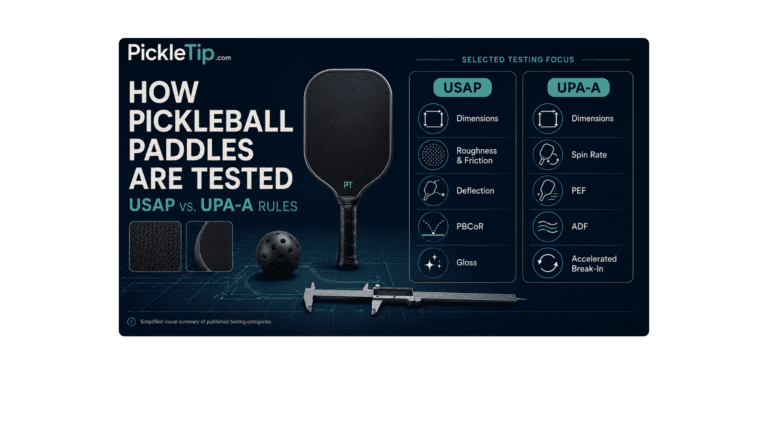
For the full comparison of roughness, coefficient of friction, direct RPM, power testing, and accelerated break-in, see How Pickleball Paddles Are Tested: USA Pickleball vs. UPA-A.
What Changed With USA Pickleball’s October 1 Spin Test?
Direct spin-output testing measures the ball’s response instead of relying on surface measurements as proxies.
USA Pickleball’s published implementation notice requires certification submissions beginning October 1, 2026 to measure no more than 2,100 RPM. Both surface roughness and coefficient of friction become measurements of record rather than upper-threshold certification gates under that change.
USAP describes dual-camera measurement, automated spin calculation, and an instrumented ball. Its notice also says already certified paddles must comply with the standards in effect when they were certified. The new-submission requirement therefore does not establish that every older paddle has undergone the new test.
UPA-A’s 2026 testing page, checked for this update, lists a 2,200-RPM maximum at any tested angle. Jason Aspes’s October commentary refers to 2,100 RPM for UPA-A, but that differs from the published testing page. This article follows the technical page unless UPA-A publishes a superseding requirement.
Even similar RPM limits cannot be compared without accounting for equipment, impact conditions, balls, averaging, and conditioning. A lower number alone does not establish which complete testing system is more restrictive.
That moves the question from How rough is this face? to How much spin does this paddle actually produce?
Will Existing OWL Models Face the New USA Pickleball Spin Test?
This October 16 review did not locate a public OWL-specific answer resolving the earlier provisional approvals. That describes the limits of the sources reviewed; it does not establish that no internal testing or communication has occurred.
The distinction matters because an ordinary older approval and a provisional approval awaiting a particular test are different situations. According to USAP’s explanation reported by Sutton, OWL’s approval was provisional specifically because direct spin testing had not yet been completed, and reevaluation was intended once that test existed.
The July notice establishes general certification policy. It does not identify which existing OWL models have been reevaluated, publish their results, or explain whether their provisional conditions have been discharged.
USA Pickleball should publicly explain:
- whether the existing OWL lineup is still provisional,
- which models have undergone direct spin testing, and when,
- whether testing includes meaningful surface wear or break-in,
- which standard applies if an older provisionally approved model exceeds the new limit,
- and whether the results and final decisions will appear in the public database.
The implementation date has passed. The public explanation of OWL’s provisional approval still needs to catch up.
A Camera Can Measure Spin. It Cannot Fix Disclosure.
| Certification issue | Does direct RPM testing fix it? |
|---|---|
| Roughness being used as an imperfect proxy for spin | Largely yes |
| Measuring actual ball rotation | Yes |
| Public disclosure of provisional approvals | No |
| Publishing alternative certification pathways | No |
| Equal access for manufacturers | No |
| Identifying which standards version a paddle passed | No |
| Automatically retesting legacy paddles | No |
| Testing meaningful break-in | Only if the procedure includes appropriate conditioning and retesting |
| Checking production consistency | Not by itself |
| Showing consumers which tests were waived | No |
The new test is progress. It should not be asked to solve governance problems that a camera cannot measure.
Why Break-In Testing Matters to the OWL Question
John Kew Pickleball published controlled before-and-after testing of the OWL CXE using a high-speed camera, a paddle fixed at a 30-degree angle, and a ball cannon firing at 60 mph. The paddle generated 2,729 RPM in its baseline test, already higher than nearly every paddle Kew’s team had measured.
Kew then subjected the same impact area to 100 accelerated-wear shots at 70 mph and repeated the original spin test. Instead of losing spin, the OWL increased to 2,851 RPM, a gain of 4.5%. His high-speed footage showed the felt grabbing, stretching, and releasing the ball, although he cautioned that the footage did not establish whether elastic snapback added spin beyond friction alone.
What the Kew Test Shows
One OWL CXE gained 4.5% spin after accelerated wear under the same independent setup. That does not prove every OWL paddle behaves the same way or that the CXE would fail USA Pickleball’s different procedure.
A certification test should not ask only what a paddle does before it reaches a player. It should also ask what the paddle is reasonably expected to become through use.
UPA-A says its certification work involves Pickle Pro Labs and the University of Massachusetts Lowell. Its own June 30, 2026 explanation of Accelerated Break-In methodology provides an important qualification: ABI is intentionally broader than a simulation of normal play. It is designed to expose performance increases from conditioning or manipulation while a paddle still appears usable.
That makes ABI relevant to post-conditioning performance, but it should not be described as an exact reproduction of a particular number of games. It also does not establish that every conditioning step targets surface spin. OWL-specific disclosure should explain what was done to the face and whether spin was measured afterward.
In his October article, Aspes criticizes USAP’s spin procedure for evaluating new paddles. That concern strengthens the case for publishing the applicable conditioning protocol and post-wear results. His characterization is not a substitute for an OWL-specific test record or the complete USAP procedure.
A paddle that stays within a limit only while new is not giving players the protection they think an approval stamp provides.
A worn or damaged paddle does not automatically prove the original model was improperly certified. Enforcement still has to distinguish among the submitted design, retail production, expected break-in, and an individual paddle that became defective or altered.
Current eligibility of removed or investigated models can be checked through PickleTip’s Banned and Decertified Pickleball Paddle List.
What Jason Aspes’s October Article Adds
On October 16, 2026, UPA-A President Jason Aspes published How USA Pickleball Quietly Lost Their Credibility. He revisits the OWL roughness waiver, undisclosed provisional approval, commercial relationships, and the need to test performance after break-in.
His proposed response includes publishing provisional approvals and their conditions, testing OWL paddles both new and broken in, and commissioning an independent review. He also advocates a joint certification system combining the organizations’ strengths under an independent technical committee.
Those proposals overlap with the transparency questions this article raised in July and August. They do not establish that OWL has now failed a USAP test, that its approval has been removed, or that a financial relationship caused its certification.
Aspes writes as the president of a competing certification organization. His article is useful as a direct statement of UPA-A’s position, but its account of the original waiver relies on Sutton’s reporting. Repeating that reporting is not a second independent confirmation of the original exchange.
He also says UPA-A has agreed to transition to nonprofit status on November 1, 2026. As of this article’s October 16 review, that is a future transition described by Aspes, not a completed event verified here. Nonprofit status alone would not establish independence; board control, funding, conflict rules, and certification decisions would still deserve scrutiny.
I support the call for clear disclosures and testing that addresses performance changes. A single certification system is a larger proposal. Whether the sport has one approved list or several, each organization should explain what approval means, disclose exceptions, and show how unresolved conditions are closed.
What UPA-A Testing Shows, and What It Cannot Decide
UPA-A does not decide whether an OWL model is eligible for a USA Pickleball-sanctioned event. Its procedures do show why direct spin measurement, conditioning, and fixed certification periods matter.
UPA-A’s published testing page lists a 2,200-RPM ceiling and a 24-month paddle certification period. Its published ABI explanation describes efforts to identify concealed performance changes after conditioning. Those features create a clearer basis for asking whether the equipment used in competition still matches its certified performance.
There is also a newer disclosure commitment. In Publishing Correlative Data, dated August 28, 2026, Aspes says UPA-A will begin publishing official ADF and Starrett surface-roughness measurements for certified paddles in 2027. He describes those values as reference characteristics for checking whether a paddle matches its certified version, rather than direct ratings of power or spin.
Publishing those reference values would be useful. It remains a future commitment as of this review, and it addresses a different disclosure question from provisional approvals, waived requirements, and unresolved retesting conditions.
UPA-A should not escape scrutiny. It operates beside the commercial professional-tour system it regulates, and its launch raised legitimate concerns about fees, industry influence, and a separate equipment system tied to the PPA Tour and Major League Pickleball.
USA Pickleball can be too opaque or too slow to adapt. UPA-A can be too commercially connected. Players do not have to pick a team and pretend the other concern disappears.
For the larger authority question, read Who Governs Pickleball? USA Pickleball, UPA-A, and Event Authority. Exact models can be checked through PickleTip’s USA Pickleball Approved Paddle List and UPA-A Certified Paddle List.
What Did OWL Know, and What Could Buyers Reasonably Infer?
OWL’s competition approval and its APP Tour partnership were announced together on February 14, 2024. That timing creates an appearance issue, but it does not establish that the partnership caused the approval. The available evidence does not prove bribery, financial corruption, or an improper payment.
OWL told buyers that its paddles were certified and approved for USA Pickleball-sanctioned play. That statement described the authorization buyers received: listed models were permitted in those events.
A reasonable buyer could read phrases such as “100% approved,” “tested and certified,” or ordinary USAP approval branding as meaning the paddle completed the ordinary pathway without an unresolved condition.
Before attributing deceptive intent to OWL, we still need to know what USA Pickleball told the company, what its written approval documents said, whether the provisional condition was communicated to OWL, and whether USA Pickleball reviewed the public marketing language.
The PickleTip Five-Part Approval Transparency Standard
A public paddle listing does not need to bury players in laboratory paperwork. It should answer five simple questions:
- What exact paddle was approved?
Manufacturer, model, thickness, and version. - What status does it have?
Full, provisional, conditional, under review, expired, or removed. - What standards did it clear?
Approval date, standards version, and major tests completed. - What was waived or left unresolved?
Any replaced test, exception, limitation, or required future reevaluation. - When must the status be reviewed again?
Expiration, retest date, compliance status, and material changes.
A transparent public listing could have used language like this when provisional approval was granted:
Illustrative historical provisional listing:
USAP Approved — Provisional
Conventional roughness measurement waived because the surface could not be evaluated through the ordinary procedure. Model passed applicable CoF and PBCoR testing. Direct spin reevaluation required after implementation of the Spin Rate Test.
That one public note would have answered the central questions players and competing manufacturers were left to reconstruct later. Once reevaluation occurred, the listing could record the date, applicable procedure, result, and final disposition of the provisional condition.
Questions USA Pickleball and OWL Still Need to Answer
Questions for USA Pickleball
- Is the existing OWL lineup still provisionally approved?
- Which existing models have undergone direct spin testing, under which procedure, and on what dates?
- Does the testing include meaningful surface wear or break-in followed by spin measurement?
- Which standard governs an older provisional model if it exceeds the new-submission limit?
- Have other models received provisional or alternative treatment?
- Was the alternative pathway available to every manufacturer?
- Will conditional approvals receive a public status label, review date, and final resolution?
Questions for OWL
- When did OWL learn that competition approval was provisional?
- What written conditions accompanied the approval?
- Did USA Pickleball review or approve OWL’s public approval language?
- Were later models separately tested or approved by similarity?
- Has OWL submitted existing models for the new direct spin procedure?
- Will OWL publish comparable direct spin results for new and broken-in paddles?
Those answers would tell current OWL owners what happens next, and whether the next unusual paddle gets the same opportunity.
Before Buying or Competing With an OWL Paddle
- Verify the exact model. Match the brand, model, thickness, and version to the current official list.
- Check the event’s equipment system. USA Pickleball approval does not automatically establish professional UPA-A eligibility.
- Do not treat the Quiet Category mark as universal tournament approval. Noise classification and competition eligibility answer different questions.
- Recheck status near the event date. A screenshot, old product page, or historical check in this article cannot replace the current database and event notice.
- Look for an OWL-specific decision. The October 1 spin-test implementation date alone does not prove that an older model was retested or that its provisional condition was resolved.
Coach Sid’s Take: An Approval Stamp Should Not Require an Investigation
I like that someone tried to solve pickleball’s noise problem instead of pretending it would disappear. I have played against OWL paddles and hit with the demos, and the technology is different.
I also do not want a standards organization to punish every unusual idea simply because the current test equipment was built for yesterday’s paddles. Sometimes a temporary pathway is the sensible call.
My line is simple: once you make that exception, own it publicly. Do not make players guess what the stamp means, make tournament directors interpret marketing language, or leave other manufacturers wondering whether the same door was ever open to them.
Now that the direct spin test’s implementation date has passed, the next step should be straightforward: explain which OWL models were reevaluated, what procedure was used, and what happened to the provisional conditions. If that work is unfinished, publish the remaining steps and the timetable.
An approval stamp should work like a line call. We may debate whether the line belongs in that exact spot, but every player and every manufacturer has to see the same line.
I do not care which organization wins the press release. I care whether a player can look up a paddle and get an honest, complete answer.
An approval stamp should not require an investigation to understand it.
How this page is maintained: PickleTip separates official publications, attributed reporting, independent testing, private industry reporting, organizational commentary, and firsthand court experience. Historical observations retain their dates. This October 16, 2026 source review did not produce a fresh live-database check or locate a public OWL-specific retesting resolution. Current official equipment records and event documents control eligibility. Next review triggers: A USAP decision on existing OWL approvals, published new-versus-worn test results, changes to exact-model status, or publication of the governance and certification disclosures discussed above.
Update History
- July 2026: Added Sutton’s reporting on the roughness waiver, provisional approval, and intended future spin reevaluation.
- August 6, 2026: Rechecked current public status, consolidated repeated evidence boundaries, strengthened the firsthand court context, added the five-part transparency standard and buyer checklist, and connected the OWL case to PickleTip’s private reporting on manufacturers intentionally choosing UPA-A for certain future performance paddles.
- August 7, 2026: Clarified the private manufacturer reporting, added a review trigger for USA Pickleball’s October 1 Spin Rate Test, and refined the distinction between current OWL eligibility and unresolved future testing.
- October 16, 2026: Preserved the historical approval account; added precise dates for the Quiet Category and tournament announcements; updated the article after the spin-test implementation date; clarified the replacement of roughness and coefficient-of-friction thresholds; retained UPA-A’s published 2,200-RPM figure; added Jason Aspes’s October commentary, UPA-A’s ABI methodology explanation, and its planned 2027 reference-data publication. Retained August’s model-status observation as historical because no fresh live-database verification was completed. No public OWL-specific retesting resolution was located in the sources reviewed.
OWL Paddle Approval FAQ
Yes, when the exact OWL model appears in USA Pickleball’s current approved database and meets the event’s equipment requirements. Approval applies to specific models, thicknesses, and versions. The historical database check in this article is not a substitute for checking current status.
Provisional approval means a paddle is accepted conditionally while a test, requirement, or future review remains unresolved. In the OWL case, Sutton reported that the condition remained internal rather than appearing on the public approved list.
No. Kew’s result came from an independent procedure, while USA Pickleball’s pass-or-fail result comes from its own equipment and protocol. What Kew’s test establishes is that the tested CXE gained 4.5% spin after accelerated wear under the same independent setup.
Not necessarily. Models may have been approved under different standards versions or through different submission, similarity, compliance-review, provisional, or alternative pathways. The public list tells players whether an exact model is currently eligible, but it may not show every test, waiver, or future-review condition behind that status.
This October 16, 2026 review did not locate a public OWL-specific decision resolving the earlier provisional approvals. USAP’s general notice applies the 2,100-RPM requirement to certification submissions beginning October 1, 2026 and says older certifications must meet the standards in effect when certified. That general policy does not explain how OWL’s reported future-reevaluation condition has been resolved.
The pages reviewed on October 16, 2026 specify 2,100 RPM for USA Pickleball’s new certification submissions and 2,200 RPM at any tested angle on UPA-A’s 2026 testing page. Different procedures mean the numerical limits alone do not establish which complete system is more restrictive.
Use PickleTip’s searchable USA Pickleball Approved Paddle List for USAP-sanctioned play and the separate UPA-A Certified Paddle List for UPA-A eligibility. Confirm current status against the relevant official database and event requirements before competing.
You can purchase from the OWL official website.
Related Paddle Rules and Approval Guides
- Paddle Rules & Approvals: choose the current lookup, testing, governance, watchlist, or case-study page.
- Who Governs Pickleball? USA Pickleball, UPA-A, and Event Authority
- How Pickleball Paddles Are Tested: USA Pickleball vs. UPA-A
- USA Pickleball Approved Paddle List
- UPA-A Certified Paddle List
- Banned and Decertified Pickleball Paddle List
- Are Paddle Brands Moving From USAP to UPA-A?
- New Pickleball Paddle Approvals Worth Watching in 2026
Sources, Attribution, and Further Reading
USA Pickleball and UPA-A publications support their stated standards, procedures, and announcements. Sutton supplies USAP’s reported explanation of OWL’s waiver and provisional path. John Kew supplies independent measurements under his stated protocols. OWL’s announcement and FAQ show what buyers were told. PickleTip’s approval-strategy article contains private industry reporting about intentional movement toward UPA-A. Aspes’s October article supplies UPA-A’s president’s criticism and proposals; it is organizational commentary rather than an independent OWL certification result. None of these sources, alone, proves corruption or establishes how every OWL unit performs.
- USA Pickleball Announces Its First Certified Quiet Product — November 14, 2023
- OWL Tournament Approval and APP Sponsorship Announcement — February 14, 2024
- How the OWL Paddle Got USAP Approved: The Untold Story — Joseph Sutton, Pickleball.com, July 13, 2026
- How USA Pickleball Quietly Lost Their Credibility — Jason Aspes, UPA-A, October 16, 2026
- USAP Fixed the Spin Test, but the Bigger Certification Problem Remains — The Dink
- 95% of These USAP-Approved Paddles Fail Its Own Surface Test — The Dink
- These Two Paddles Gained Spin After Wear — John Kew Pickleball
- John Kew’s 42-Brand Profilometer Experiment
- USA Pickleball Spin Rate Test Update and Implementation Timeline — July 8, 2026
- 2026 UPA-A Paddle Testing Procedures and Certification Information
- UPA-A Paddle Certification Information
- ABI Methodology — UPA-A, June 30, 2026
- Publishing Correlative Data — UPA-A, August 28, 2026
- OWL Sport Frequently Asked Questions
- Official USA Pickleball Equipment Database
- Are Paddle Brands Moving From USAP to UPA-A? — PickleTip