Pickleball IQ: Outsmart Speed, Win Ugly, Rule Every Rally
Pickleball IQ Guide & Self-Assessment
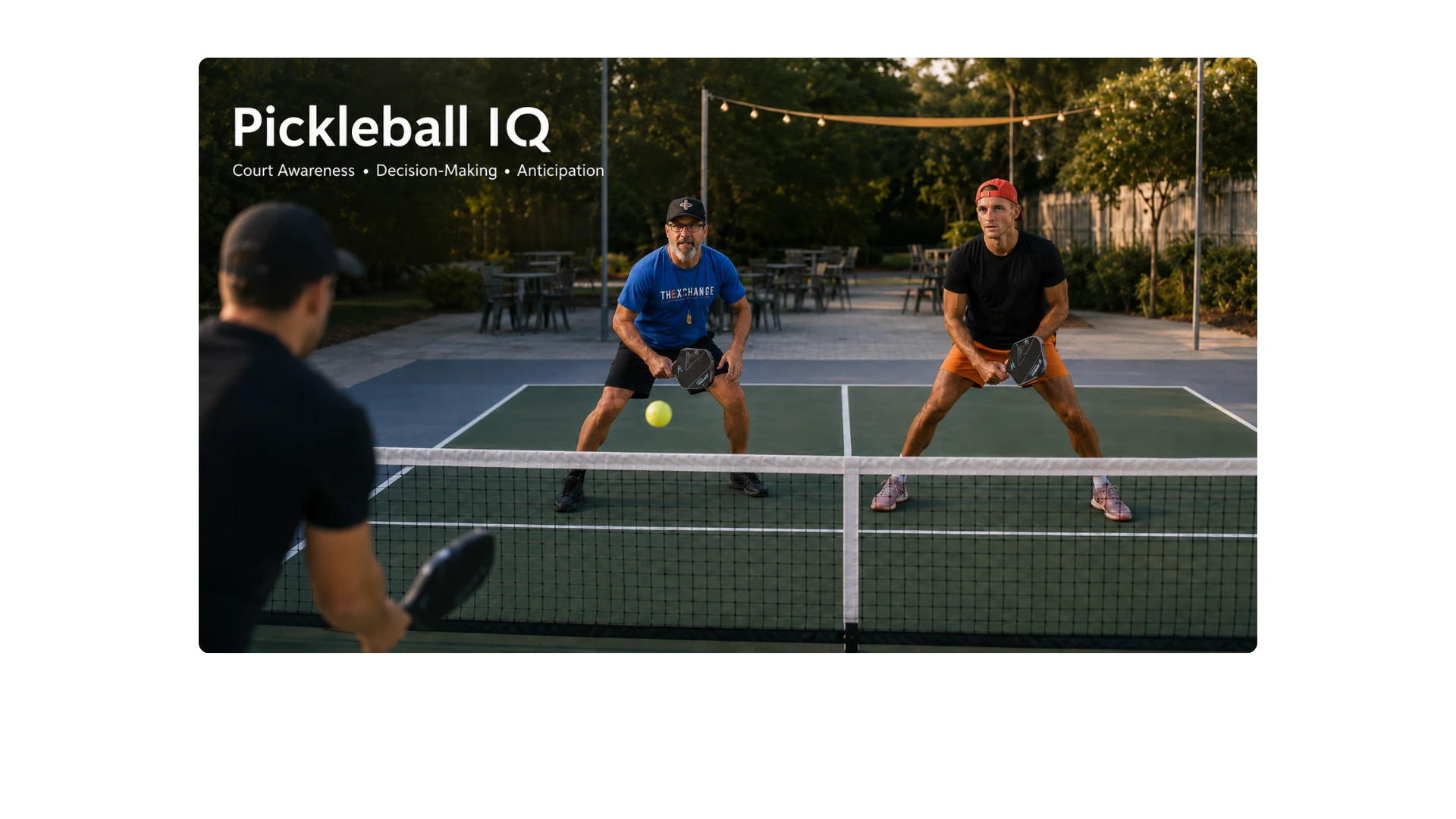
Pickleball IQ is the ability to recognize what is happening, choose a high-value response, anticipate what that response is likely to create, and adjust as the point, score, opponent, or partner changes.
You can own every shot in the game and still make poor decisions with them. You can also lack elite speed or power and consistently win because you read the court earlier, choose the correct level of risk, and prepare for the next ball before it arrives. The useful question is not simply, “Do I have good Pickleball IQ?” It is, “Which part of my decision breaks first when the point speeds up?”
Court Awareness Ball Recognition Pattern Recognition Shot Selection Adaptation Situation Management
What Is Pickleball IQ?
Pickleball IQ is court intelligence: seeing the important information early enough to make a useful decision, understanding what that decision is likely to produce, and adjusting when the rally or match changes.
It is not just patience, strategy, or anticipation wearing a smarter name. A high-IQ player reads ball quality, player position, likely patterns, risk, score, partner readiness, and opponent behavior together. The smartest choice may be an attack, reset, counter, lob, leave, or simple ball through the middle. The ball may look familiar, but the score, positions, partner, and likely next ball are rarely identical.
Who This Helps
This guide is for players who know how to hit the shots but still recognize the right choice a second too late. It is also useful for coaches who need to determine whether a player’s real problem is mechanics, recognition, shot selection, partner awareness, adaptation, or emotional control.
Pickleball IQ Is Not the Same as Shot Skill
Shot skill answers, “Can you execute this ball?” Pickleball IQ answers, “Should you use that shot here, and what will probably happen if you do?”
| Shot Skill | Pickleball IQ |
|---|---|
| Can you hit a third-shot drive? | Does this return, opponent position, and expected fifth ball justify the drive? |
| Can you speed up a dink? | Is the ball attackable, is your partner ready, and which counter lane will the attack expose? |
| Can you reset from transition? | Did you recognize early enough that the rally had turned defensive? |
| Can you hit a sharp angle? | Does the available margin justify opening the opponent’s counterangle? |
| Can you serve hard? | Does the extra pace improve the likely return often enough to justify the missed serves? |
Some players can hit almost anything you ask them to hit. They just choose it one ball too early, or one ball too late. Another player may own fewer shots but keeps using the right one in the right order. The best players continue developing both. Pickleball IQ does not replace execution; it helps you spend your execution on the right problem.
Knowing the correct shot after the rally is analysis. Recognizing it before contact is Pickleball IQ.
The Six Decision Skills Behind Pickleball IQ
Pickleball IQ is easier to improve when you stop treating it as one mysterious talent. For coaching purposes, I use a six-part PickleTip model: court awareness, ball recognition, pattern recognition, shot selection, adaptation, and situation management. “Bad strategy” is often only the final symptom. The real breakdown may have happened before the player ever chose a shot.
During lessons, I ask players to explain what went wrong, and they often label every bad decision a strategy problem. Sometimes they never saw the moving opponent. Sometimes they misread the ball. Sometimes they made the right read and chose the wrong risk. Sometimes the decision was fine, but the execution failed. Once you know where the read failed, “play smarter” finally becomes something you can practice.
1. Court Awareness: See More Than the Ball
Court awareness is knowing where all four players are, who is balanced, who is moving, which space is open, and whether your partner is ready for the ball your choice may create.
A player may see open court behind a moving opponent and fire into it, only to leave the middle completely exposed because their partner is still recovering from the previous ball. The target was open. The team was not ready for the ball that came back. Court awareness means seeing both.
- Do you know which opponent is moving before you choose the target?
- Can you tell when your partner is recovering or exposed?
- Do you recover according to the shot you hit rather than returning automatically to one favorite spot?
- Can you identify the highest-probability lane instead of trying to cover the entire court?
2. Ball Recognition: Read What the Ball Allows
Ball recognition means reading height, pace, depth, spin, bounce, and contact quality quickly enough to choose the correct level of aggression. A waist-high ball may look attackable, but not if you are leaning, late, jammed, or contacting heavy spin below your comfortable strike zone.
In games and drills, I see players attack these balls because the ball crossed the net high. Their eyes read “green,” but their feet, balance, and contact point are all screaming “yellow.”
Use the Traffic-Light approach in the PickleTip strategy guide when your main problem is deciding whether a ball is green for attack, yellow for controlled pressure or neutralization, or red for defense.
3. Pattern Recognition: Prepare Before the Next Ball Arrives
Pattern recognition starts when you stop treating every rally as if you have never seen the sequence before. You do not need to predict the exact ball. You need to recognize which balls have become more likely and prepare for those first. Pickleball IQ is not fortune-telling; it is giving the probable ball more respect than every theoretically possible ball.
- A body drive may produce a short block through the middle.
- A crosscourt speedup may bring the counter toward your partner or the center lane.
- A wide dink may pull the opponent off court and invite a ball back through the middle.
- A deep return may force a softer third and delay the serving team’s advance.
Study those sequences in the Pickleball Pattern Library.
4. Shot Selection: Choose the Risk the Ball Earned
Shot selection is choosing among attack, neutralize, defend, and leave. Risk control is deciding how much danger this particular ball has earned—not defaulting to the amount of risk your favorite shot usually carries.
Smart players are not always safe players. They simply know which risks have earned the right to be taken. A sharp sideline may be correct when you are balanced and staring at a large opening. The middle may be correct when you are stretched, protecting a lead, or trying to reduce counterangles.
Pickleball IQ is not avoiding aggression. It is attaching aggression to evidence.
5. Adapt to the Opponent Without Losing Your Partner
Adaptation begins with testing, not guessing. Notice what the other team prefers, give them a low-cost problem, watch the response, and choose a plan your own partnership can actually execute.
A player with good adaptation does not decide after two points that an opponent “has no backhand.” A useful low-cost test might be a deep return, controlled dink, or firm ball that asks for the backhand without gambling the whole rally. Watch the quality, direction, and predictability of the response. Stay with the pressure only while it continues to produce value.
Partner adaptation matters just as much. A sharp crosscourt angle may win the first ball and still be a poor team decision if the likely counter goes behind a partner who is recovering. A plan is not intelligent if it repeatedly exposes your partner, requires a shot your team cannot repeat, or creates a next ball no one has agreed to cover. Use the PRESS method for opponent profiling and sustained pressure.
6. Situation Management: Make the Decision This Point Needs
The same ball can deserve a different decision at 1–1, 9–9, during a long tournament day, or when your partner has lost confidence. At 9–9, a stretched speedup toward a small sideline target may ask the point to survive too much risk. That does not mean becoming passive. It means choosing pressure you can defend if the ball comes back. Situation management includes score, serving or returning, match format, conditions, fatigue, momentum, and emotional state.
- Do you change a good plan because of one missed shot?
- Do you speed up because the ball is attackable or because you are frustrated?
- Can you protect a lead without becoming passive?
- Can you recognize when your partner needs a simpler pattern?
- Can you separate the previous point from the decision required now?
For competition-specific scouting, communication, and between-match adjustments, use the Pickleball Tournament Gameplan.
What Low Pickleball IQ Looks Like in a Real Game
Low Pickleball IQ does not always look like wild shot selection. Often it looks like a basically sound player arriving one decision late. The player sees the opening after it closes, recognizes defense after the ball is already at their feet, or notices the opponent’s pattern only after it has worked three times.
- You attack because a ball is high without checking balance, spin, or contact point.
- You hit a good shot but recover to a favorite spot instead of covering the next ball that shot invited.
- You expose your partner with an angle or speedup neither of you is prepared to defend.
- You abandon a useful pattern after one miss, then change shots without new evidence.
- You know what you should have done as soon as the rally ends.
A good shot made from a late read is still a late read. Pickleball IQ improves when you recognize the situation early enough to choose and recover before the point makes the decision for you.
How Smarter Decisions Shrink a Speed Advantage
Speed, reach, power, and hand quickness are real advantages. Pickleball IQ does not magically erase them. It helps a player prevent those physical tools from controlling every rally.
- Keep the ball below the opponent’s preferred strike zone.
- Use pace changes so the opponent cannot rely on one timing window.
- Make the athlete move before asking them to accelerate.
- Reset pace when the faster team owns the exchange.
- Recognize impatience and let low-percentage attacks become out balls or counters.
The lesson is not “older beats younger” or “patience beats power.” The hardest opponent is still the fast player who also reads the point early. Pickleball IQ does not replace athletic ability. It gives that ability better places to go.
Pickleball IQ does not ask you to play slowly. It asks you to control when the point becomes fast.
Take the PickleTip Pickleball IQ Test
Score each statement based on what you actually do in competitive games—not what you understand while reading. Use several recent games if possible. One unusually good night, one ugly tournament match, or one emotional loss can distort the picture. Players often score what they know rather than what they do. When in doubt, use the last several competitive games or ask a partner or coach who has actually watched the pattern.
| Score | Meaning |
|---|---|
| 0 | Rarely or only after the point |
| 1 | Sometimes, but not reliably under pressure |
| 2 | Consistently during real points |
This is a coaching self-assessment, not a laboratory measurement. Its value is not proving that you have a certain level of intelligence. Its value is showing which decisions tend to break down first in real games.
Court Awareness — 0 to 6 Points
- Before the opponent contacts the ball, I know which player is moving and which lane I primarily need to protect.
- I consider my partner’s position before speeding up, poaching, changing direction, or using a sharp angle.
- After I hit, I recover for the next ball my shot is most likely to create.
Ball Recognition — 0 to 6 Points
- I distinguish an attackable ball from one that only looks attackable because it is near waist height.
- I adjust my choice for pace, spin, depth, balance, and contact point rather than using one favorite shot.
- I recognize likely out balls early enough to leave them instead of reacting automatically.
Pattern Recognition — 0 to 6 Points
- I can name the likely next ball after one of my team’s common serves, thirds, dinks, or speedups.
- I begin preparing when the sequence becomes probable rather than waiting until the ball has already crossed the net.
- I notice repeated opponent responses and adjust my positioning before changing shots randomly.
Shot Selection and Risk — 0 to 6 Points
- I choose among attack, neutralize, defend, and leave based on the ball and position—not boredom or ego.
- I use large targets when stretched and accept smaller targets only when balance and opportunity justify them.
- I can hold a small advantage without forcing an immediate winner.
Adaptation — 0 to 6 Points
- I test an opponent’s comfort with a low-cost pattern before declaring a weakness.
- I stay with effective pressure long enough to matter and change when the opponent genuinely solves it.
- I choose plans my partner and I can execute and agree on the next ball we expect to cover.
Situation Management — 0 to 6 Points
- My next decision is not controlled by frustration from the previous point.
- I account for score, serving or returning, conditions, fatigue, and partner confidence without abandoning sound principles.
- During timeouts or between games, I can identify one useful adjustment instead of listing every mistake.
What Your Pickleball IQ Score Actually Tells You
Add all 18 responses for a total score out of 36. Your category scores matter more than the overall label, but the total gives you a useful starting point.
| Total Score | Current Decision Profile | Best Next Step |
|---|---|---|
| 0–12 | Mostly reactive. Correct choices are often recognized after contact or after the rally. | Start with ball recognition, court position, and foundational strategy. |
| 13–21 | Developing. You see some situations but lose the read when pace, pressure, or emotion increases. | Train one weak category inside variable, game-like drills. |
| 22–29 | Strong. You usually recognize and choose well but may miss patterns, adaptations, or score-specific decisions. | Improve anticipation and opponent-specific planning. |
| 30–36 | Advanced. You consistently recognize, anticipate, adapt, and manage points. | Refine partner systems, deception, tournament planning, and execution under pressure. |
At higher levels, the question is less whether you recognize the obvious pattern and more whether you can hide your own, change the expected ball without giving away margin, and keep your partner reading the same point.
Do Not Hide Behind the Total
A score of 26 can mean six balanced categories, or it can hide excellent shot selection beside weak court awareness. Circle your lowest category. That is your first training priority.
What Your Weakest Category Means
| Lowest Category | What Usually Shows Up in Games | Read Next |
|---|---|---|
| Court awareness | You hit into open space but expose your partner or recover to the wrong lane. | Pickleball Partner Strategies |
| Ball recognition | You attack yellow or red balls, misread spin, or arrive late to resets and out balls. | Pickleball Strategy |
| Pattern recognition | You know the correct response but prepare after the ball is already on you. | Patterns in Pickleball |
| Shot selection and risk | You force winners, aim too close to lines, or confuse aggression with advantage. | Traffic-Light approach to shot selection |
| Adaptation | You guess at weaknesses, abandon working pressure, or use a plan your team cannot execute. | Winning in Pickleball with PRESS |
| Situation management | Score, frustration, fatigue, or momentum changes your decisions more than the ball does. | Pickleball Tournament Gameplan |
Turn Your Lowest Score Into One Practice Session
Do not respond to a low category by trying to “play smarter” in general. Give the weak decision a job you can observe. If Ball Recognition is your lowest score, have a partner vary height, spin, depth, and pace while you call “attack,” “neutral,” “defend,” or “leave” before contact. Play the ball out, but score the read separately from whether the shot landed.
If Court Awareness is lowest, play points where your only post-rally question is, “Where was my partner when I chose that target, and which lane did my shot ask us to cover?” If Adaptation is lowest, begin each game with one low-cost test and do not change the plan until you can name the evidence that justifies changing it.
One category, one observable decision, one practice block. That is more useful than trying to repair all six parts of your game at once.
How to Improve Pickleball IQ
Twenty identical feeds may improve a stroke. They do not automatically teach you when to use it. Pickleball IQ improves when the drill changes enough that you must read, choose, and prepare instead of repeating the answer you were handed.
1. Call the Read Before Contact
During cooperative drills, call the decision before hitting: “attack,” “neutral,” “defend,” or “leave.” You will get some calls wrong. Good. The goal is to drag the read forward so the decision happens before contact instead of becoming obvious after the ball is gone.
2. Use Variable Feeds
Mix height, depth, spin, pace, and player position. One feed may be high but jam the body. The next may be lower but sit comfortably in front. Require the hitter to choose among multiple valid shots instead of repeating one predetermined response.
3. Predict the Next Ball
After each serve, return, third, speedup, or wide dink, state the most likely next ball and recover for it. Keep score of the prediction, not only whether your shot landed in.
4. Play Constraint Games
- Margin game: Sidelines are out unless the player is balanced and contacting above the waist.
- Neutralization game: A team under pressure must earn one neutral ball before attacking.
- Pattern game: A point counts double when a team correctly predicts and covers the next-ball lane.
- Adaptation game: Each team begins with one plan and may change only after identifying evidence that the opponent adjusted.
5. Review Decisions, Not Just Errors
After playing, find three rallies and ask what information was available, what you chose, and what ball the choice invited. Then separate the decision from the execution. A ball can miss even when the decision was correct. A winner can land even when the decision was poor. Do not abandon a sound choice because you missed once, and do not praise a reckless choice because it happened to work.
6. Retake the Test
Choose one low category, train it for several weeks, and retake the assessment using several recent competitive games. Improvement should show up as earlier recognition and more repeatable decisions—not merely a higher score on paper. If the number rises but the same mistake still appears under pressure, the category is not fixed yet.
For additional game-like practice ideas, use the pickleball drills library. For a broader player-development cycle that identifies what to improve and how to test it, use the PickleTip GROW improvement methodology.
Pickleball IQ FAQs
Pickleball IQ is seeing the useful information early enough to choose well, prepare for the likely next ball, and adjust when the point or match changes.
Yes. Train the read, not just the stroke. Variable feeds, next-ball prediction, constraint games, video review, and game-like drills force you to choose between several valid responses instead of repeating one predetermined shot.
Strategy gives you principles and patterns. Pickleball IQ is your ability to recognize when those ideas apply, choose in time, anticipate what the choice may create, and adjust under pressure.
Yes. A player may read the point early and choose correctly but lack the execution to produce the intended ball. The reverse also happens: a highly skilled player may own more shots but use them at the wrong time.
No. DUPR reflects match results, not the specific reasons behind them. Decision quality can influence results, but a rating does not tell you whether a point was lost through recognition, shot selection, execution, partner coordination, or another factor.
Retake it after several weeks of focused practice and use several recent competitive games. Do not rescore it after one unusually good session or one frustrating loss.
Score the six categories separately, compare the player’s self-score with observed behavior, and choose one category to train. The most useful discussion is often the gap between what the player understood after the rally and what they recognized before contact.
There is no fixed timeline. Look for earlier recognition and fewer repeated decision errors over several weeks of focused practice. A higher self-assessment score matters less than whether the same mistake still appears when pace and pressure increase.
What I Want You to Remember
Pickleball IQ is not knowing more facts about pickleball. It is recognizing the important information early enough to make the correct decision while the point is still alive.
Do not leave this page trying to improve all six categories at once. Score yourself honestly, identify the category that breaks first, and train that decision under changing conditions. Better court intelligence usually feels less dramatic than a new weapon. You arrive earlier, force less, cover the right lane, and stop donating points you once blamed on speed, luck, or the opponent’s paddle.